Folk metal is heavy metal that borrows from traditional folk music: metal guitars, bass and drums, layered with folk melodies and acoustic instruments such as fiddle, tin whistle, bagpipe or accordion. It took shape across Europe in the early 1990s and has since become a worldwide scene with its own festivals, instruments and arguments.
For the short version of where it came from: English and Irish bands arrived first between 1990 and 1995, German and Spanish scenes followed, and Finland turned folk metal into a mass movement around the year 2000. I have always thought the Finnish wave gets too much credit for the sound and too little for the idea, since the concept was a full decade old by then. The beginner listening path sits near the end if you would rather press play than read history.
Table of Contents
- What Is Folk Metal?
- Where Did Folk Metal Come From?
- What Is Folk Metal, Exactly?
- A Short History of Folk Metal’s Development
- What Does Folk Metal Sound Like?
- Which Musical Traditions Shaped Folk Metal?
- What Themes Are Common in Folk Metal?
- Who Started the Folk Metal Movement?
- How Is Folk Metal Different from Traditional Heavy Metal?
- What Are the Main Folk Metal Branches and Subgenres?
- How Can Beginners Explore Folk Metal?
- Frequently Asked Questions
- Is folk metal the same as folk music?
- Which band is considered the first folk metal band?
- Does folk metal always use traditional European instruments?
- What is the difference between folk metal and Viking metal?
- Is folk metal related to Celtic music?
- What are the best folk metal bands for beginners?
- Conclusion
What Is Folk Metal?
Folk metal is a fusion genre. It keeps the permanent backbone of heavy metal — distorted guitars, bass, drums, and vocals raised to a shout or a growl — and wraps folk material around it: dance rhythms, modal melodies, storytelling lyrics, and above all instruments that are not electric.
The folk half matters as much as the metal half. A fiddle line borrowed from a traditional tune, a Finnish drinking song rhythm, a bagpipe drone under a clean sung chorus — those are not decoration. They decide whether a song feels like folk metal or like ordinary metal with a guest musician, and the difference is easy to hear once you know what to look for.
Two further points help. First, folk metal is a European-born style, but it is not owned by one country, and the label gets stretched well past Europe now. Second, the genre is not one sound. Bands that all get tagged folk metal can sit at opposite ends of the metal spectrum, from harsh blackened riffing to bright power metal choruses with a full drum kit and choir.
Where Did Folk Metal Come From?
European musicians had been putting folk touches into heavy metal for years before anyone used the label. What changed around 1990 was that several scenes arrived at the same idea independently, and the idea was simple enough to copy: keep the metal, add the actual traditional music of the place you live in.
The heavy metal underneath had to be sturdy first. The New Wave of British Heavy Metal and the thrash explosion of the mid-1980s gave players fast riffs, strong melodies and the confidence to write songs about something outside their own lives. Finnish melodic death metal bands were already borrowing Finnish folk song in the late 1980s and early 1990s, and second-wave black metal from Norway brought a taste for atmosphere and traditional material that no British band had. Folk metal inherited all of that at once.
On top of the music, the ground was culturally soft. The collapse of the Soviet Union and the end of Yugoslavia set off folk revivals across eastern and central Europe, and a generation of musicians grew up with a strong sense of regional heritage and a lot of local song around them. Celtic and Nordic traditions were being rediscovered at the same time, in festivals, in language revivals, and in the growing popularity of medieval and historical re-enactment.
What Is Folk Metal, Exactly?
Since folk metal sits between two worlds, it gets confused with several things that share its ingredients but not its aim. Being precise here saves a lot of argument, mostly on music forums where the labels get treated like badges.
Folk music is the older, mostly acoustic tradition on its own: reels, polkas, ballads, lullabies, laments, sung with fiddle, flute, accordion or voice. Folk metal is the thing that happens when that tradition is played through a metal amplifier. Neofolk takes a different route again — it is a largely acoustic, often dark, 1980s European movement that borrows medieval and world music textures, and it sits closer to post-punk and goth than to metal.
Folk rock and folk-electronic music can share a violin or a flute with folk metal without being metal at all; if the guitars are not driving the song, it is not folk metal. Folk-punk adds fiddle and accordion to punk rock, which is a fun thing to hear and a completely different lineage.
The workable test is simple. Take the folk element away and ask whether a metal song is left. If yes, the folk material was part of the composition rather than a guest appearance, and you are probably looking at folk metal.
A Short History of Folk Metal’s Development
The genre moves in overlapping waves rather than neat decades. The table below is the version I would give someone who wanted the whole arc in one screen.
| Era | Landmark album or event | Act | Why it matters |
|---|---|---|---|
| Late 1980s–1991 | The Wayward Sons of Mother Earth (1991) | Skyclad, England | The record most writers treat as the genre’s starting gun: a full-length album built around a fiddle, English folk themes and fast British folk metal. |
| 1992 | The Karelian Isthmus (1992) | Amorphis, Finland | Proved folk song material could sit inside Finnish melodic death metal, not sit beside it. |
| 1992 | Cruachan forms in Dublin | Cruachan, Ireland | The band at the centre of the argument over who came first, and the source of most Irish folk metal that followed. |
| 1993–1995 | Tuatha Na Gael (1995) | Cruachan, Ireland | The strongest Irish case, with flute, bodhrán, war drums and a heavy Celtic-metal backbone. |
| 1993–1997 | Bergtatt (1995), German-language folk-inflected metal | Ulver and Falkenbach, Norway and Germany | Showed the folk idea was a European one, not a British-Irish one, and pushed the German-language wing. |
| 1996–2000 | Folkearth (2000) | Mägo de Oz, Spain | Brought Iberian and medieval poetry into chart-adjacent Spanish metal and made the style mainstream in its home market. |
| 1999 | Midnattens widunder | Finntroll, Finland | Trolls, polka and a joke in the voice — the sound that made folk metal fun rather than solemn. |
| 2000–2001 | Suden Uni (2001) | Moonsorrow, Finland | Darker, blacker, cleaner-sung Finnish folk metal; a second texture alongside the polka school. |
| 2001–2004 | Iron (2004), Battle Metal (2004) | Ensiferum and Turisas, Finland | The breakthrough that put Finland at the centre of the genre for two decades. |
| 2003 | Korpiklaani forms | Korpiklaani, Finland | Folk instruments at the front of the mix on a hard rock and metal foundation, and a link back to Sámi duo Shamaani Duo through the musician Jonne Valton. |
| 2002–2012 | Time I (2012) | Wintersun, Finland | Pushed folk metal toward progressive structure, orchestral arrangements and a much bigger sound. |
| 2004 to 2026 | Alestorm, Eluveitie, Týr, Myrath, Tengger Cavalry, Chthonic and others | Scotland, Switzerland, Faroe Islands, Tunisia, Mongolia, Taiwan | The style spread well past Scandinavia, carrying Celtic, Arab, Mongolian and Taiwanese traditions with it. |
Read the table as a sequence of three moves. Britain and Ireland supply the idea in the early 1990s. Germany, Spain and the Nordic countries widen it in the 1990s. Finland then supplies the templates — polka, chant, epic chorus, full line-up of folk players — that the rest of the world copied.
What Does Folk Metal Sound Like?
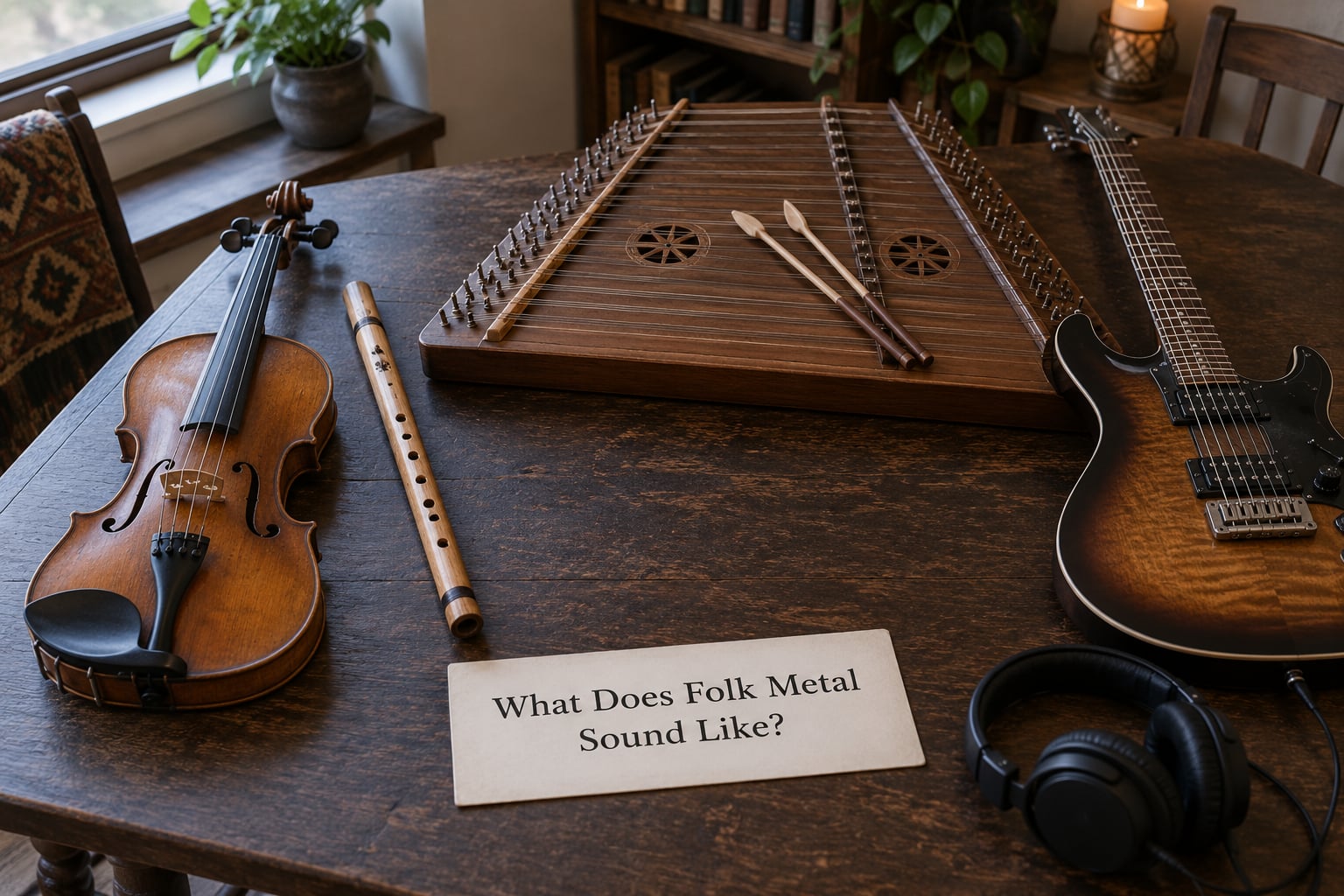
The recognisable sound is mostly about contrast. Folk metal songs swing between a heavy metal core and something acoustic or vocal on top of it, and the shift between the two is deliberate. You get a riff-driven verse with harsh vocals, then a clean sung refrain over fiddle or tin whistle, and often both at once — a metal band playing while a folk tune runs underneath.
Vocals come in three common colours. The first is the harsh metal voice, the second is a clean melody in the tradition of power metal, and the third is a shout, chant or group vocal used like a chorus. A fourth style is genuinely regional: the yoik of northern Norway and northern Finland, a short, pulsed, heavily ornamented vocal form that is far closer to folk singing than to any metal vocal technique.
Rhythm is the part most newcomers underestimate. Finnish folk metal leans on humppa, a fast, lopsided, heavily backbeat polka that makes everything bounce; English and Irish bands lean on jig and reel structures; German-language acts often march. Whatever the local pattern is, it sits under the metal, and it is what makes the genre feel danceable rather than gloomy.
On instruments, the usual suspects and where they come from:
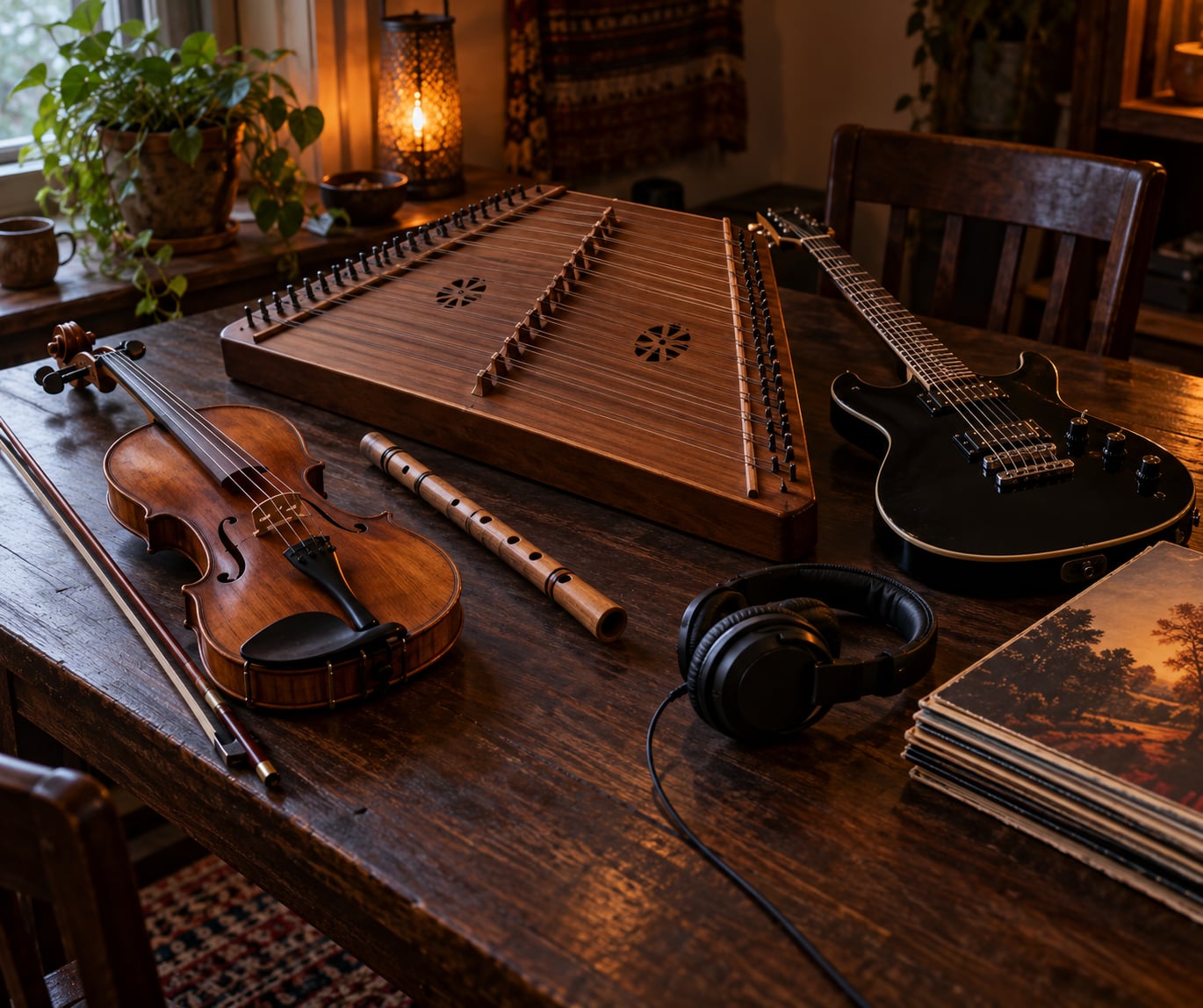
- Fiddle or violin — the signature folk metal instrument, used by bands from England to Switzerland.
- Flute, tin whistle and pipes — whistles and bouzoukis carry the Irish and Scottish scenes; bagpipes show up in the martial and pirate branches.
- Hurdy-gurdy and kantele — the hurdy-gurdy, a cranked bowed instrument, appears in medieval and German-language folk metal; the kantele is the Finnish plucked zither.
- Accordion and concertina — polka fuel, especially in Finland and in folk rock that borrows from the style.
- Torupill and kokles — Estonian bagpipe and a bowed zither, used by acts such as Metsatöll.
- Oud, saz and other strings — the oriental metal branch, usually alongside Middle Eastern rhythmic patterns.
- Keyboards arranged like a folk band — a very common shortcut: one player covering the line a small folk group would play.
Line-ups are large for a reason. Because the folk material is an actual band rather than a texture, folk metal groups often run six members or more, with a dedicated violinist or flautist alongside the metal players. That is why the genre tends to look expensive on stage and unremarkable in a studio.
Which Musical Traditions Shaped Folk Metal?
The honest answer is that several traditions fed it, and the genre kept the parts that survived translation into loud guitars. It would be wrong to hand the whole thing to one country, because even the early bands disagreed about what the music was for.
Melody and mode came first. Nordic, Celtic and Central European folk song all lean on a small set of notes and a repeating pattern, which sits unusually well under a metal riff. Dance rhythm came with it: polka, jig, reel, march, kolo, hora. Storytelling came from folk song’s job of carrying a whole narrative in a few verses, which is why lyric writing matters so much in this genre. Acoustic texture came from the habit of a folk voice or a fiddle sitting right next to the loudest instrument in the room.
Then the regional layers: Kalevala and Finnish folk song in the Nordic bands, Irish and Scottish balladry in the Celtic branches, German Minnesang and Waldlied in the medieval German-language work, Iberian ballad and medieval poetry in the Spanish scene, and Middle Eastern maqam and rhythmic cycles in the oriental branch.
Two traditions deserve a note because they are often left out. Sámi music from northern Scandinavia, with its joik vocal style, feeds directly into some Finnish bands. And the post-1990 folklore revival in eastern and central Europe gave a lot of young metal musicians a living cultural inheritance to write from, rather than a borrowed fantasy setting.
What Themes Are Common in Folk Metal?
Warriors and warriors’ journeys are the most repeated subjects, and they come with a standard set of props: a battle fought or about to be fought, a ruler, a wandering hero, a homeland under threat. Around those sit two other large groups. One is myth and religion — Norse, Celtic, Finnish and Slavic legends, gods, runes, forest rituals. The other is place: forests, mountains, rivers, seasons, weather, and a nostalgia for a countryside that the lyrics imagine as untouched.
Fantasy and the medieval period show up constantly too, sometimes through actual medieval poetry rather than invented fantasy. Several bands sing in their own language, and some sing in reconstructed or older tongues — Gaulish for the Swiss band Eluveitie, Estonian for Metsatöll, Finnish and Swedish, German, Spanish, Portuguese, Persian, Mongolian. On the folk metal forums that gets treated as a feature rather than a barrier, which is roughly the right attitude.
There is a recurring tension underneath all of it, between tradition and modern life. The warrior, the wanderer and the keeper of an old song are stand-ins for people who feel displaced, and that is why the genre lands the way it does on people who would not describe themselves as metal fans.
Fair note on the criticism. A 2015 academic study, summarised at the time in metal press, argued that the genre’s warrior imagery and stage presentation function as a kind of safe leisure space for a narrow demographic, and that several bands on the national-socialist right borrowed its aesthetics. Fans pushed back hard, pointing out that the music is largely apolitical and that its live audience skews far more mixed than the stereotype suggests. Both things are partly true, and the debate is worth knowing about if you are going to read about the genre online.
Who Started the Folk Metal Movement?
Nobody started it alone, and the two names you will meet first are the two people argue about most. Here is roughly the order things happened, with what each act actually added.
Skyclad formed in Newcastle in 1990 and released The Wayward Sons of Mother Earth in 1991, which is the earliest full-length record most writers treat as the genre’s starting gun. The album put an English folk fiddle player in front of a British folk metal band and made the whole idea legible. Amorphis formed in Tampere in 1990, and The Karelian Isthmus in 1992 did the same trick with Finnish material inside melodic death metal, which is why so many later Finnish bands claim that record as a root.
Cruachan formed in Dublin in 1992 and released Tuatha Na Gael in 1995, the record most often cited as the strongest Irish claim. Falkenbach and Ulver in the mid-1990s widened the idea into German-language and Norwegian material. Mägo de Oz put it into Spanish chart territory, and Moonspell from Portugal pushed it towards gothic metal.
The first-wave dispute is worth stating plainly. Skyclad’s case is earlier: formed 1990, debut album 1991, and an English folk metal lineup on record in the first half of that decade. Cruachan’s case is that the Irish scene was a separate root, that their material is genuinely traditional rather than adapted, and that some serious writing credits them with the genre’s beginning. If you meet someone who insists Cruachan came first, you are not being misinformed, you are meeting the other side of a twenty-year argument.
The second wave is bigger and Finnish. Finntroll with Midnattens widunder in 1999, Moonsorrow with Suden Uni in 2001, Ensiferum and Turisas around 2004, Korpiklaani from 2003. That run produced the templates the genre is still built on: the polka bounce, the male chant, the clean chorus stacked over a full folk section, and the promise of a large live show.
Later waves came from everywhere. Eluveitie from Switzerland, Alestorm from Scotland, Týr from the Faroe Islands, In Extremo and Schandmaul from Germany, Agalloch from the United States, and well outside Europe, Myrath from Tunisia, Tengger Cavalry from Mongolia, Chthonic from Taiwan.
How Is Folk Metal Different from Traditional Heavy Metal?
The differences are real but smaller than fans on either side make them sound. Traditional heavy metal is the parent genre and the wider one; folk metal is a regional and thematic branch of it that happens to be very consistent about its folk material.
Instrumentation is the clearest difference. Folk metal adds acoustic and early keyboarded instruments to a metal kit; traditional heavy metal mostly does not. Melody is the second: folk metal leans hard on singable, repeatable folk lines, often more than on lead guitar. Rhythm differs because a polka or jig pattern often governs the song rather than a straight metal groove. Lyrics differ in subject — myth, landscape, history and storytelling instead of the usual metal subjects — and sometimes in language. Performance differs too, with larger line-ups and folk-dressed staging.
Two things folk metal is not. It is not automatically softer, because some of the heaviest bands in the genre are folk metal bands and their acoustic passages do not soften the riffs around them. And it is not automatically more authentic, because a Swedish band playing a written-in-Swedish drinking song is doing the same thing a Finnish band does, and a Spanish band singing medieval poetry is not more legitimate for being closer to the manuscripts.
What Are the Main Folk Metal Branches and Subgenres?
The parent style has split into a dozen labels, and most real bands sit across two or three of them. This table is the version I would give someone who keeps hearing these words and wants them sorted.
| Branch | Core metal style | Defining folk element | Typical themes | Example bands |
|---|---|---|---|---|
| Folk metal | Speed, power and melodic death metal in varying shares | Folk melodies and instruments across the whole catalogue | Warriors, nature, journeys, myth | Ensiferum, Korpiklaani, Finntroll, Moonsorrow |
| Viking metal | Black metal and folk metal, usually fast | Norse instruments and the gallows-song gallop | Norse mythology, warriors, sagas, raids | Enslaved in its later work, Tyr, Skyforger |
| Celtic metal | Heavy metal with Celtic material, often fast | Fiddle, tin whistle, bodhran, Celtic and Scottish modes | Irish and Scottish legend, history, mythic women figures | Cruachan, Eluveitie, Alestorm, Saor Mór |
| Medieval metal | Raw black metal, sometimes industrial and experimental | Hurdy-gurdy, lutes, historical texts and the Middle Ages as subject | Courtly love, plague, inquisition, crusades, war | Falkenbach, In Extremo, Primordial, Corvus Corax |
| Pirate metal | Fast metal with a joke in it | Pipes, accordion and stage spectacle | Buccaneers, ships, drinking songs, comedy | Alestorm, Swashbuckle, Lagerstein |
| Oriental metal | Death, doom and folk metal, often with an electronic edge | Oud, saz, maqam scales, Middle Eastern and North African rhythms | Desert landscapes, myth, struggle, modern politics | Orphaned Land, Myrath, Al-Namrood |
| Neofolk and folk-electronic neighbours | Not metal; acoustic, post-punk, industrial or electronic | Traditional textures in a non-metal framework | Dark folklore, ritual, apocalypse | Sol Invictus, Of the Wand and the Oath |
Two of those rows sit next door rather than inside. Neofolk shares the instruments and the mood but drops the metal. Folk-electronic, where a dance producer works over bagpipe and oud samples, is a club cousin with no lineups at all.
Several of the classic Celtic branches are also crowded enough that a fourth label overlaps them. Bands sing in Irish, Scottish, Welsh and Breton traditions at once, and the arguments about where Celtic metal ends and folk metal begins are mostly arguments about taste.
There is also a newer seam worth watching. Folk metal ideas have been pulled into hardcore and metalcore, with the bagpipes showing up in breakdowns, and into progressive metal, where the folk instrument plays a lead line rather than a melody in the background.
How Can Beginners Explore Folk Metal?
Do not start with the most famous band. Start with the one whose texture sounds like something you already like, and go from there. The five below cover most of the genre’s range, and the reason each one works is the reason to pick it.
Finntroll if you want the genre to sound fun first. Trolls, polka, a rhythm that bounces, and vocals that lean comic. On the r/folkmetal forum the same question comes up over and over — when someone asks what folk metal is, the first band mentioned is usually this one, and the reason is usually that the polka makes the genre feel like fun rather than doom. Ensiferum if you want the epic version: male chant, choir, full folk section, huge choruses, the sound most people picture when they hear the term.
Korpiklaani if you like hard rock more than you like solemnity, since the folk players sit at the front of a plain, heavy rock and metal band. Eluveitie if you want the Celtic and Swiss branch, including the Gaulish-language singing that people find either fascinating or a barrier. Moonsorrow if you want the dark end, because it keeps folk instruments and a folk sensibility but drops the tempo and the cheer.
After that, follow the branch you liked rather than the band. Celtic pull leads to Eluveitie and Alestorm, medieval to Falkenbach and In Extremo, the dark Scandinavian line to Moonsorrow, the epic line to Wintersun. If you like a band’s language, try another band that sings in it — that is a better guide than any genre chart.
Two practical notes. Read the band names and the album art as clues, because a violin on a black album sleeve and a whistle on a pirate ship are not decoration, they are the cheapest way to sort an unfamiliar playlist. And give a band two tracks before you judge it: the first minute of a folk metal song is often the quiet one, and the payoff sits in the second or third.
Frequently Asked Questions
Is folk metal the same as folk music?
No. Folk music is the older acoustic tradition on its own: reels, polka, ballads and laments played on fiddle, flute, accordion or voice. Folk metal is what happens when that tradition is played through metal guitars, bass and drums. The folk material sits inside the song rather than beside it, so removing it leaves a metal song rather than a folk one.
Which band is considered the first folk metal band?
It depends who you ask. Skyclad of England formed in 1990 and released The Wayward Sons of Mother Earth in 1991, which is why most lists name them. Cruachan of Ireland, formed in 1992, press the rival claim from a different angle: genuine traditional Irish material, and serious writing that credits them with the genre’s beginning. Both positions are argued in print.
Does folk metal always use traditional European instruments?
No, and the range has widened. Early folk metal was a European project built on European sources, so violin, tin whistle, hurdy-gurdy and kantele dominate the lists. Later bands have carried the idea outward: Myrath in Tunisia work with oud and maqam scales, Tengger Cavalry in Mongolia with morin khuur and throat singing, and Chthonic in Taiwan with traditional Taiwanese instruments and instruments built like guitars.
What is the difference between folk metal and Viking metal?
Viking metal is a branch of folk metal rather than a rival to it. It takes the same folk metal core and narrows it to Norse subjects and Norse instruments, usually adding black metal harshness and the gallows-song gallop. Folk metal covers Celtic, Finnish, German, Iberian, medieval and other branches that have nothing Viking about them, so a band like Eluveitie or Alestorm is folk metal without being Viking metal.
Is folk metal related to Celtic music?
Yes, and through one of the two oldest roots. Irish and Scottish folk music fed bands from the earliest days, which is how Celtic metal became a distinct branch with its own fiddle-and-whistle sound. But folk metal is not Celtic music: Celtic music stands alone as a tradition, while folk metal uses it as one source among many, alongside Finnish polka, German ballad, Norse myth and medieval poetry.
What are the best folk metal bands for beginners?
Pick by texture rather than by reputation. Finntroll if you want the polka and the trolls to sound fun; Ensiferum for the epic chant and choir; Korpiklaani if you prefer hard rock with folk on top; Eluveitie for the Celtic and Swiss branch; Moonsorrow if you want the dark, slow end of the genre. Start with two tracks each before deciding, since the first minute is often the quiet one.
Conclusion
Folk metal is a meeting point: a heavy metal backbone wrapped in the melodies, rhythms, instruments and storytelling of a region’s folk music. It came from England and Ireland in the early 1990s, widened across Europe, and became an international style through Finland in the 2000s.
If you investigate one thing first, make it Skyclad’s The Wayward Sons of Mother Earth from 1991. It is short, it is fast, it has a fiddle in it, and it explains the genre faster than any history chapter can. Then follow whichever thread of it you liked, because the whole point of the style is that there are several.