Progressive metal and prog rock share the same compositional toolkit: long multi-part suites, odd time signatures, jazz-derived harmony, concept albums and heavy demands on the players. The difference sits in the engine driving all of that. Prog rock runs on tonal colour, synthesizers and open dynamic space; prog metal runs on distorted down-tuned guitars, riff-driven rhythm, palm muting and a wider vocal range that includes growls and screams.
If you have argued about whether a band is “really” prog, the argument is usually not about complexity. Complexity is shared. It is about weight, tone and where the low end sits.
Table of Contents
- How Progressive Metal Differs from Prog Rock at a Glance
- What Are Progressive Metal and Prog Rock?
- Progressive rock is art rock built on extended form and borrowed classical and jazz language
- Progressive metal is that same vocabulary driven by heavy metal
- How Do Their Origins and Histories Differ?
- How Do Musical Structure and Length Differ?
- What Do Sound and Instrumentation Sound Like?
- How Do Vocals and Lyrical Themes Differ?
- What About Production, Artwork, and Performance?
- Where Do Progressive Metal and Prog Rock Overlap?
- How progressive metal differs from prog rock, in practice
- Which Should You Choose?
- Frequently Asked Questions
- Is progressive metal just heavier prog rock?
- Can a band be both progressive metal and prog rock?
- Do progressive metal songs have to be long or technically difficult?
- Is Dream Theater progressive metal or prog rock?
- Can King Crimson be considered progressive metal?
- What should I listen to first to compare the two genres?
How Progressive Metal Differs from Prog Rock at a Glance
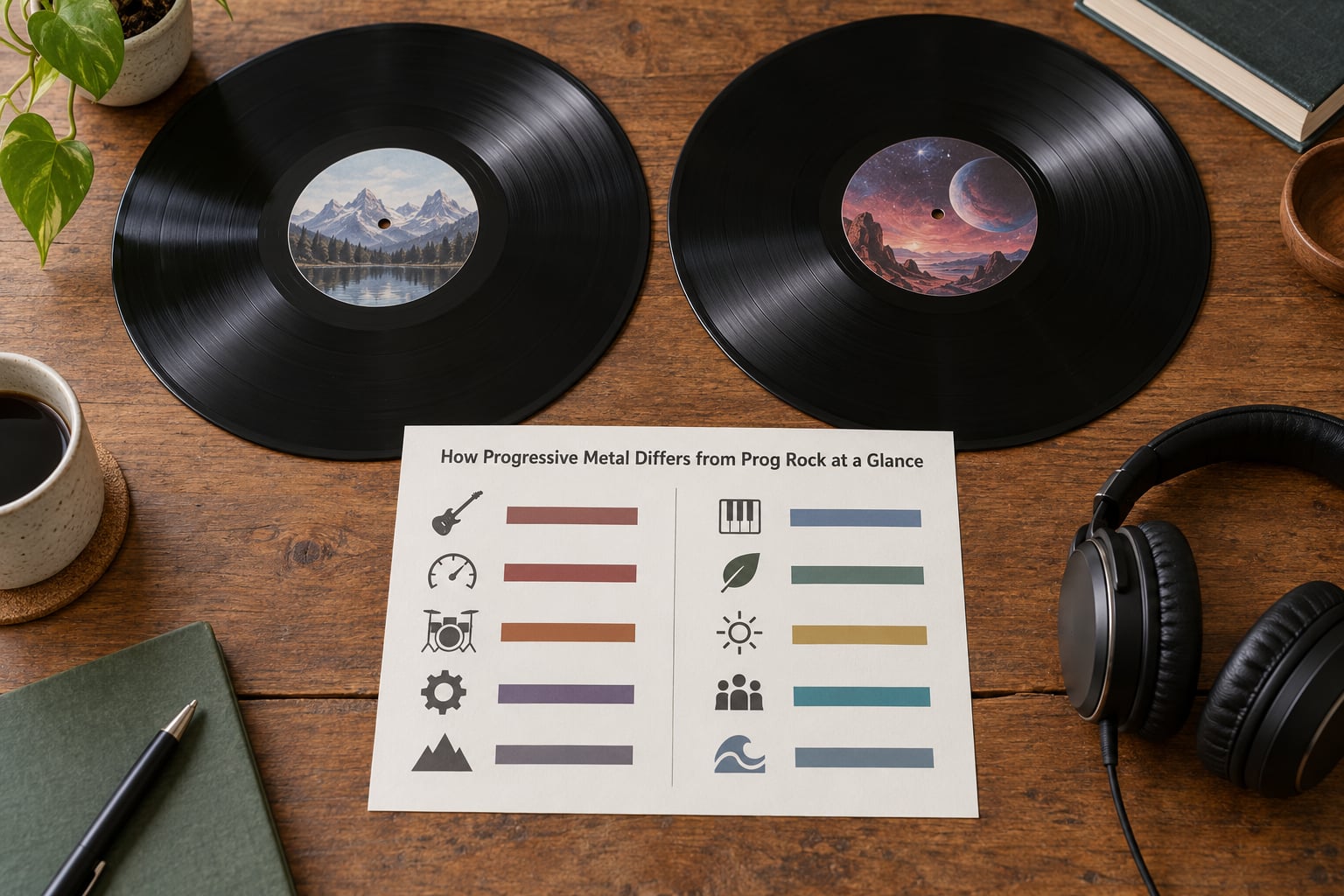
This is the short version. Prog rock is a late-1960s art-rock lineage built around keyboards, harmony and studio craft. Prog metal is the mid-1980s-onward marriage of that compositional language with heavy metal’s guitars, tuning and vocal aggression.
| Attribute | Progressive rock | Progressive metal |
|---|---|---|
| Origin and era | Late 1960s British and American art rock; peak roughly 1970-1976 | Mid-1980s onward, out of the US metal and thrash scenes |
| Core purpose | Composition, arrangement and studio craft; music for listening | Composition built on riffs, weight and extended-range playing |
| Guitar and tuning | Clean to lightly overdriven, standard six-string tuning, melodic and lyrical | Heavily distorted, often down-tuned, six- to eight-string guitars, palm-muted patterns |
| Rhythm section | Drums sit back; bass often melodic and jazz-influenced | Drums are a second lead voice; down-tuned bass carries the groove |
| Keyboards | Structural: Mellotron, Hammond organ, analog synths, piano | Supporting or absent; sometimes an atmospheric layer only |
| Vocals | Mostly sung, wide range from soft to operatic | Clean sung lines plus harsh growls, barks and screams |
| Lyrics and themes | Fantasy, myth, science fiction, inward reflection | Anger, alienation, space, philosophy, and often political or anti-establishment material |
| Song structure | Multi-part suites, side-long compositions, recurring themes | Longer tracks with frequent meter shifts, breakdowns and solo passages |
| Odd time signatures | Often a colour or a mood shift inside a suite | Frequently the main rhythmic hook of the song |
| Production weight | Dynamic range, space, separation between instruments | Compression, saturation, wall-of-sound density |
| Signature bands | King Crimson, Yes, Genesis, Pink Floyd, Rush | Queensryche, Fates Warning, Watchtower, Dream Theater, Opeth |
| Main branches | Canterbury scene, neo-prog, avant-prog and zeuhl, krautrock, post-prog | Technical thrash, progressive death metal, math metal, djent, progressive doom, progressive metalcore |
| Who it suits | Listeners who want harmony, melody and detail | Listeners who want heaviness, aggression and guitar virtuosity |
What Are Progressive Metal and Prog Rock?
Progressive rock is art rock built on extended form and borrowed classical and jazz language
Progressive rock came out of the British and American counterculture of the late 1960s. Bands took ideas from psychedelic rock, jazz, Indian classical music, Baroque composition and avant-garde jazz and used them to build pieces longer and more formally complex than anything on the charts at the time.
Several things travel with the label almost by definition: extended compositions, sometimes running to the length of a full album side; classical-derived harmony; unusual meters; and lyrics that lean on poetry, myth and science fiction rather than everyday life.
Led Zeppelin and Pink Floyd are both usually counted as prog rock, though for very different reasons. That is normal. The category has branches that barely resemble each other.
Progressive metal is that same vocabulary driven by heavy metal
Progressive metal took the progressive toolkit and put a metal rhythm section and metal guitars underneath it. Encyclopaedia Britannica-style definitions call it a fusion genre, and that is the honest framing: prog metal is heavy metal first, with progressive composition applied to it.
That is why the rule of thumb on ProgArchives’ forum is close to the truth even though it is blunt: it has to be a metal band influenced by progressive rock, and it has to use non-standard song structures. Both halves matter.
How Do Their Origins and Histories Differ?
Prog rock starts in 1966 and 1967 with records like the Beatles’ Revolver and Sgt. Pepper, the Mothers of Invention, Soft Machine and Pink Floyd’s psychedelic singles. The word “progressive” was borrowed partly from the political left of the era, and partly from classical music’s forward motion.
King Crimson’s In the Court of the Crimson King (1969) is where the idea of the long suite, complete with a formal section structure and a disciplined time signature change, arrives fully formed. Yes, Genesis and Emerson, Lake & Palmer followed through the early 1970s, and Rush brought a harder, more drummer-centred version of the same values.
Progressive metal does not begin until 1984, when Queensryche released The Warning and Fates Warning released Awaken. Both bands were American, both were working inside a metal scene, and both already had the progressive instincts of their heroes. Voivod’s Nothingface (1989) and Queensryche’s Operation: Mindcrime (1988) are the moment the genre stops being a description and becomes a scene, with Dream Theater’s Images and Words (1992) marking the point where the sound crossed into mainstream metal audiences.
The gap between the two lineages is roughly fifteen years, which is why prog metal bands cite Rush and King Crimson as parents rather than as peers. An r/progrockmusic user put it plainly: they had been listening to 1970s Rush and King Crimson and wanted to know whether those bands were the true precursors to prog metal. A poster on the Ultimate Metal forum, arguing the same point back in the early 2000s, drew the distinction that still gets used today: Rush is a forefather of prog metal and not one of its originators, the same way Iron Maiden and Judas Priest are forefathers of power metal.
That is a useful frame, and it is worth keeping separate from “influenced”. A band can influence prog metal for thirty years without belonging to it.
How Do Musical Structure and Length Differ?
Neither genre has a required song length, and that is the most common myth on both sides. Plenty of prog rock tracks run under four minutes, and plenty of prog metal tracks run under five.
What differs is what the length is for. In prog rock, a long suite exists so the music can develop an idea across distinct movements. A section repeats in altered form, a new mood arrives, and the piece resolves somewhere the listener did not predict. In prog metal, the length usually exists to make room for the technical passage: the solo trading, the polyrhythmic sequence, the breakdown that drops back to a clean guitar figure before the wall returns.
Odd time signatures show the same split in purpose. In King Crimson’s “21st Century Schizoid Man” the 4/4 opening collapse is a dramatic event inside a long narrative. In a math metal song from the 2010s the 7/8 pattern is the song’s identity, carried for minutes at a time.
Rhythmically, prog metal leans harder on polyrhythm and polymeter, and on riffs that lock together before the drums add anything. Prog rock tends to lean on meter changes against a steady pulse, and on bass lines that follow jazz chord movement.
What Do Sound and Instrumentation Sound Like?
The most reliable checkpoint is the guitar. In prog rock, the guitar is often melodic and lyrical: arpeggiated figures, sustained leads, clean tones pushed by a valve amp into overdrive. In prog metal it is rhythmic and weight-bearing: palm-muted patterns, down-tuning, low sustain, and often an extended-range instrument.
That changes the register of everything. A seven-string or eight-string guitar drops the low end far enough that the bass and the kick drum start sharing space with it, which is why the drums on a prog metal record feel so much more physical than the drums on a prog rock record of the same apparent complexity.
The keyboard does the reverse job. In prog rock the Mellotron, the Hammond organ and the analog synthesizer are structural instruments; they carry melody, harmony and mood, and a song can lose something essential without them. Take Genesis, Yes or Emerson, Lake & Palmer away from the keyboards and you lose the arrangement. Take the keyboards away from most extreme progressive metal and you lose a layer, not a band.
Four checkpoints when you are not sure what you are hearing: check the low end first, then listen for palm muting, then note whether the clean vocal sits above or below the riffs, and finally ask whether a piano would be missed if it vanished.
For players, the gear difference is blunt. Prog rock guitarists live with six-strings, volumes and layering. Prog metal guitarists usually need a baritone or extended-range instrument, a heavier amp chain, and more gain than feels reasonable at first. Drummers are on the same page: more toms, more double-bass work, more subdivisions.
How Do Vocals and Lyrical Themes Differ?
The conventional contrast is clean vocals against harsh vocals, and it holds as a tendency rather than a rule. Queensryche’s Geoff Tate singing over “The Enemy Inside” is operatic in range, and King Crimson’s Adrian Belew wrote melodies that could not be mistaken for a metal vocal.
What separates the two is that prog metal typically uses two vocal registers at once. A clean sung line carries the song, and a harsh layer sits underneath or beside it, often on the same word. Opeth’s Mikael Åkerfeldt and Devin Townsend are the standard examples, along with the vocal contrast on Tool’s 10,000 Days.
Lyrical themes overlap more than the sound does. Fantasy, myth and cosmic imagery run through both. The sharper difference is register: prog rock tends toward the introspective, the pastoral or the fantastical, while prog metal tends toward frustration, alienation, political observation and dark subject matter.
That leans political more often than the stereotype suggests. Question-driven themes, anti-authority lines and environmental subjects show up across the modern prog metal catalogue, which is one reason the genre draws a different audience profile than 1970s prog rock ever did.
The complaint you will hear about both genres is the same complaint, which is worth noticing. Prog rock gets called pompous and self-indulgent; prog metal gets called a wall of noise for people who wanted to play faster than their old band. Both complaints are about complexity, not about heaviness.
What About Production, Artwork, and Performance?
Prog rock records are usually built around space. Instruments are given room, dynamics are wide, and silence between passages is treated as a musical event. Prog metal records are usually built around density: more saturation, more compression, more layers fighting for the same band of frequencies.
Stage presentation follows the same logic. A prog rock band can fill a hall with an organ, a Mellotron and lighting states. A prog metal band carries the sound with guitar volume, movement and lighting that pulses with the low end, because that is where the impact lives.
Artwork is the worst classifier, though it is the most fun. Roger Dean covers and Hipgnosis sleeve designs signal the prog rock era strongly, and they signal nothing about how a modern prog metal record was played. Treat cover art as a period marker, not a genre test.
Where Do Progressive Metal and Prog Rock Overlap?
More than either community admits. Both genres use concept albums, odd meters, virtuosity, jazz fusion vocabulary and long instrumental passages, and both have bands that move between them.
How progressive metal differs from prog rock, in practice
In practice, the overlap shows up in four ways. Shared forebears who are prog rock but not prog metal, such as Rush, King Crimson and Jethro Tull. Career changes, where a band crosses the line and sometimes crosses back: Opeth became softer and more melodic over time, and Porcupine Tree has spent periods closer to extreme metal than most of its catalogue. Members who cross over, most famously Steven Wilson and Mikael Åkerfeldt recording as Storm Corrosion. And hybrids where the argument never resolves, such as Tool, Haken, Vola and Sleep Token.
The r/progmetal thread that ranks first for this question shows the confusion in miniature: one poster hears Vola and Haken as mellow next to Ne Obliviscaris and Between the Buried and Me and wonders whether mellowness makes them prog rock. The honest answer is that weight is a bad classifier. What actually decides it is tone, tuning and vocal delivery, not how loud the record is.
Tool is the standing test case. In r/ToolBand, one user describes the band as mostly prog rock that dabbles in prog metal, and another asks outright whether Fear Inoculum (2019) should be called prog metal or prog rock without being sure. Both readings hold, which tells you the category is doing less work than the argument suggests.
Dream Theater sits at the other extreme. Faced with a metal band from Queensryche and Fates Warning that used odd meters and long suites, most listeners call it prog metal, even when a given album is mostly a ballad with a heavy band behind it.
Which Should You Choose?
Start from what you already like, not from which genre is harder to explain at a party.
If keyboards, harmony and long-form mood are what you enjoy, go prog rock. King Crimson’s In the Court of the Crimson King (1969) shows the suite form at its most compact, Genesis’s Selling England by the Pound (1973) shows the band version, and Jethro Tull’s Thick as a Brick (1972) shows what happens when the concept album becomes the joke. Add Soft Machine and the Canterbury scene for the jazzier and looser branch.
If you want metal weight with progressive structure, the direct entry points are Queensryche’s Operation: Mindcrime (1988), Voivod’s Nothingface (1989) and Fates Warning’s Images and Words (1992). Those three records define the sound before the genre started competing with itself.
If you play guitar and want the technical side, Watchtower, Sieges Even and Dream Theater cover the vocabulary, and Meshuggah, Periphery and TesseracT show where the 2010s took it. For the doom-leaning branch, look at progressive doom rather than the melodic mainstream.
If you want the argument settled for you in one record, Tool’s 10,000 Days (2006) and Opeth’s Ghost Reveries (2005) sit on opposite sides of the line most people draw, and both are widely loved by fans of the other genre.
If you want hybrids on purpose, Haken and Porcupine Tree are the cleanest examples of a modern band that keeps its foot in both camps.
Frequently Asked Questions
Is progressive metal just heavier prog rock?
No. Heaviness is a symptom, not the definition. Prog metal differs in tuning, tone, riff idiom and vocal delivery: down-tuned distorted guitars, palm-muted patterns, down-tuned bass, and often a harsh vocal layer under a clean one. A prog metal band can be lighter in volume than a prog rock band and still be plainly prog metal.
Can a band be both progressive metal and prog rock?
Yes, and plenty of them are, usually at different times or on different songs. Tool, Haken, Vola and Porcupine Tree all move between the two. Opeth is a cleaner example because the band has drifted toward more melodic, keyboard-friendly music over its career. Treating a band as permanently filed in one genre is usually a mistake.
Do progressive metal songs have to be long or technically difficult?
Neither is required. Some prog metal tracks run under five minutes and stay inside one tempo and one riff. The difficulty, when it appears, tends to serve a purpose: polyrhythmic guitar parts, extended-range lead work, or a meter change that makes the riff land harder. Length is a habit of the 1980s and 1990s rather than a rule.
Is Dream Theater progressive metal or prog rock?
Progressive metal, by origin and consensus. The band formed in 1984 in the US metal scene, alongside Queensryche and Fates Warning, and combined metal guitars and drums with progressive structures and long suites. Petrucci’s classical and jazz influences come straight from the prog rock side, which is exactly why the band is usually described as prog metal with prog rock influences.
Can King Crimson be considered progressive metal?
Not as a member. King Crimson is prog rock, and it is one of prog metal’s biggest influences, which is a different relationship. An old forum analogy still holds: King Crimson and Rush are forefathers of prog metal, the way Iron Maiden and Judas Priest are forefathers of power metal. They shaped the sound without belonging to the genre that followed.
What should I listen to first to compare the two genres?
Play Yes’s Close to the Edge (1972) against Voivod’s Nothingface (1989). Same length, same appetite for meter changes and long-form development, completely different engine. Add Dream Theater’s Images and Words (1992) if you want the metal side at its most melodic, and Opeth’s Ghost Reveries (2005) for the border case.
Start with one record from each side and let your ears do the sorting. Close to the Edge (1972) on one end, Nothingface (1989) on the other, and you will hear the difference in the low end, the vocal delivery and the space around the drums before anyone has to argue about labels.
Once you can place a band by ear, the label stops mattering. Most of the interesting bands sit somewhere near the line anyway.