A bootleg recording is an audio recording of a live performance, a broadcast, or unreleased studio material that was made and distributed without the authorisation of the artist, band, or record label that owns the rights in it. The word describes permission and provenance, not audio format.
Here is the short version of the whole question. Bootleg recordings are made from four basic sources: a tape in the crowd, a feed tapped off the venue’s mixing console, a capture of a radio or stream broadcast, or copies of studio outtakes and demos. That source then gets transferred, edited, mastered, and pressed or burned onto a physical format. Trading is usually far less serious than the internet implies — buying, keeping, and reselling a lawfully made physical copy sits comfortably inside the first sale doctrine, while manufacturing, advertising, and distributing unauthorized recordings is where the criminal statutes start.
This is general information about how U.S. copyright law tends to apply to records, not legal advice. Rules differ by country, by state, and by the facts of one specific transaction. If you are about to do something commercial, talk to a copyright attorney first.
Table of Contents
- What Is a Bootleg Recording?
- Bootleg, counterfeit, pirate copy and grey market compared
- How Bootleg Recordings Are Made
- The four sources
- From tape to disc in seven steps
- Which Bootleg Sales Can Be Legal?
- How Artists and Labels Can Authorize a Release
- How Bootlegs Are Traditionally Traded
- What Buyers and Sellers Should Check
- Before you buy
- Before you sell
- Can You Trade an Unauthorized Bootleg Legally?
- Frequently Asked Questions
- Are bootlegs illegal to buy?
- Is it illegal to sell bootlegs?
- Is bootleg the same as fake?
- What does the first sale doctrine allow?
- What is the 35 year rule in music?
- What is the best way to record a live concert?
- The Short Version
What Is a Bootleg Recording?
The label gets used loosely, so it helps to pin down what actually counts. A bootleg is unauthorized by the rights holder. It is not, by itself, a description of quality, rarity, or where the audio came from. A scratchy audience tape from 1979 and a pristine soundboard transfer of the same show are both bootlegs if neither was licensed.
It is also not the same as counterfeit. A counterfeit pretends to be something it is not — a fake pressing of an official record, sold as genuine. A bootleg makes no such claim. It advertises itself as an unauthorized document of a show, and collectors buy it for exactly that reason. Sellers who pass a bootleg off as an original pressing are committing fraud, which is a separate and more serious problem than copyright infringement.
Bootleg, counterfeit, pirate copy and grey market compared
| Term | What it actually is | Does it deceive the buyer? | Legal to sell? |
|---|---|---|---|
| Bootleg recording | An unauthorized recording of a live show, broadcast, or studio material | No, usually sold openly as unofficial | Usually no — see the legal section below |
| Counterfeit | A fake physical copy of an official pressing, complete with replicated artwork | Yes, by definition | No, and it also carries trademark and fraud issues |
| Pirate copy | An unauthorized copy, often a rip or a file, of an official commercial release | Usually | No |
| Grey market import | A genuine official record imported into a territory where it was not licensed for sale | No | Often yes — the label licensed it, just elsewhere |
| Authorized live release | An official or officially sanctioned recording, sometimes marketed as a bootleg | No | Yes |
Collectors also use a few words that trip up newcomers. ROIO and VOIO — recording of ill repute, venue of ill repute — mean an unofficial record of a show the band never meant to document. A taper is the person who recorded it. A unique release means no two copies are identical, which is the collector’s word for a one-off or hand-assembled run. A soundboard recording comes off the front-of-house mixing desk rather than from a microphone in the crowd.
How Bootleg Recordings Are Made
Knowledge of this process is not permission. Knowing how a record is made tells you what you are looking at; it does not make copying it lawful, and I want to be plain about that before walking through the steps.
The four sources
Audience recording. Someone sits in the crowd with a tape recorder, cassette deck, DAT, or MiniDisc and captures the show through the air. You hear the band through the PA, so the mix is whatever the venue operator did. Crowd noise, a phone ringing, and a camera shutter in the first three minutes are the price of admission.
Soundboard or FOH recording. A feed is split off the venue’s front-of-house mixing console and recorded directly. This is clean and complete, but it can sound wrong: the board operator is mixing for the room with vocals up and guitars down, so an instrument that dominates your stereo at home was almost inaudible from the tenth row.
Broadcast capture. Radio and TV performances, livestreams, and official webcasts get taped off the air. Quality is broadcast-grade, but edits, fades, and censoring are baked in, and the broadcaster’s own rights complicate the status of the recording.
Studio outtakes and demos. Leftover sessions, rehearsal tapes, and alternate mixes circulate among fans and end up on compilation-style releases. These are governed by both the master owner and the songwriters, which makes the permission question more complicated than for a live show.
From tape to disc in seven steps
- Capture. The show is recorded, usually on a portable deck in the crowd or off a split board feed.
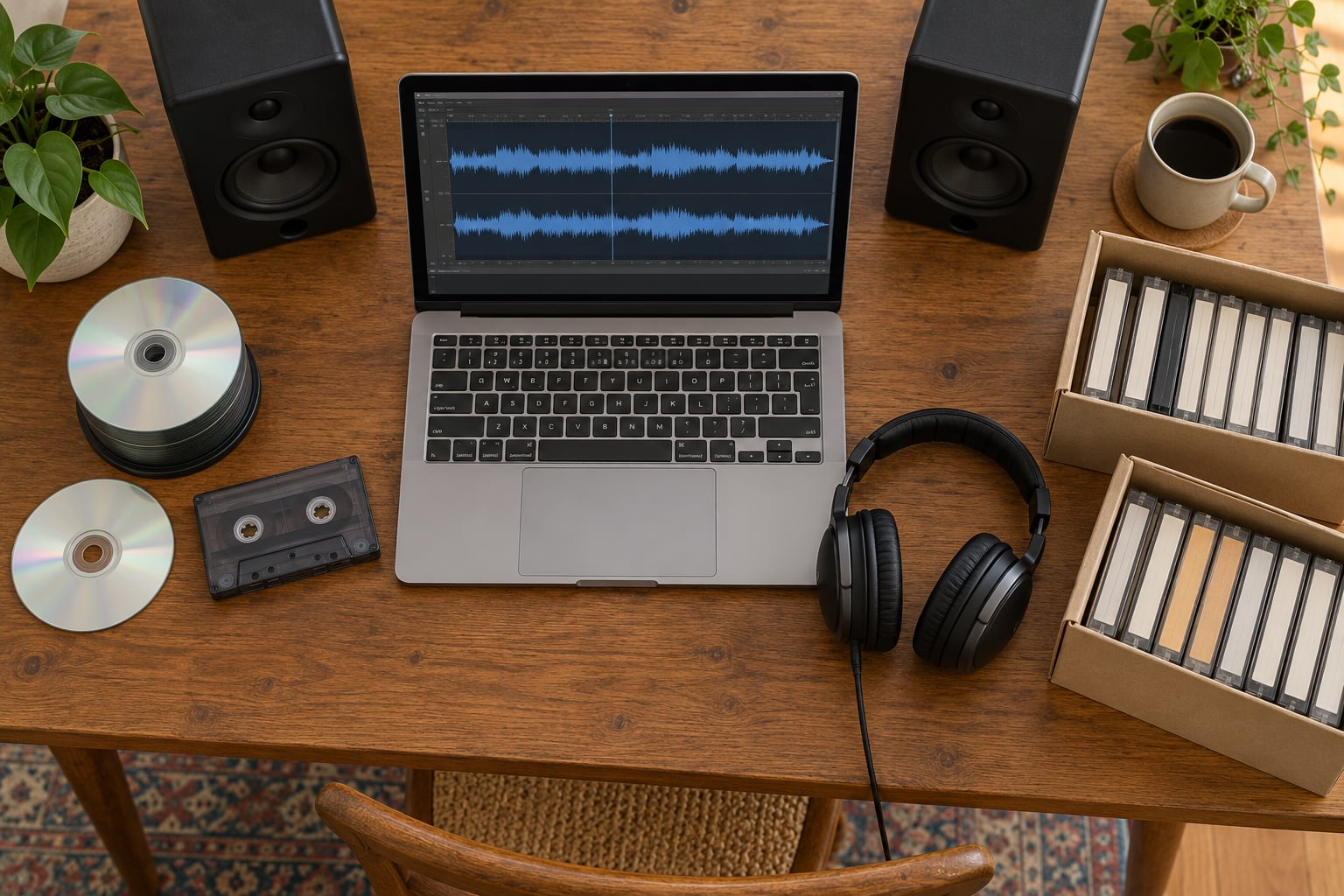
- Transfer. The tape or DAT is dumped into a computer at high bitrate. High-quality tapers record at 7.5 inches per second on DAT, which is where the hiss-floor differences come from.
- Edit. Gaps, banter, tuning breaks, and half a song are cut. One crowd recording can drop twenty minutes in ten minutes of work.
- Restore and master. Rumble, hiss, and hum are filtered out and the show is leveled against other releases in the run so the whole set sounds like one record.
- Lacquer cut. For vinyl, the finished audio is cut to lacquer on a lathe. This is where the digital-to-analog transfer happens, and it is why very loud masters sound compressed on record.
- Plate and press. The lacquer becomes a negative, is electroplated into a metal stamper, and the stamper presses records at a plant. Quality of the stamper, the vinyl, and the press run all affect the finished copy.
- Pack and distribute. Sleeve art, a catalog number, and a mail-order or online listing. Many were assembled by hand in living rooms and shipped from home.
That is also the point where the legal exposure usually begins. A collector who buys one of these is in a very different position from whoever pressed two hundred of them and listed them for sale.
Which Bootleg Sales Can Be Legal?
Plenty of sales in the bootleg world are entirely lawful, and they fall into a small number of categories. The distinguishing question is always the same: did the rights holder authorise it?
- Officially licensed pressings. Released by the label with the artist’s approval, even if they document an unusual or non-festival performance.
- Artist-authorized editions. Bands that embrace the archive often run official series, including digital live bundles and physical editions sold straight from the band’s own shop.
- Contractual and archival editions. Licensing deals that let a partner pressing an out-of-print title, typically with written rights to a specific territory, format, and run size.
- Public domain material. Recordings old enough that the copyright has expired. In the U.S., sound recordings first published before February 15, 1972 entered the public domain when the Uruguay Round Agreements Act took effect, which is why so many early-era tapes and transfers circulate freely.
- Resale of a lawfully made copy. Once a genuine authorized record has been sold by the rights holder or their licensees, the owner can usually resell that physical copy. This is the first sale doctrine, and it is the foundation of the entire secondhand record market.
| Category | Rights basis | Resale considerations |
|---|---|---|
| Official live release | Master owner licence | Free to resell the physical copy; digital files are licensed, not owned |
| Artist-authorized edition | Direct band or management licence | Same as above, plus check that your copy is genuine |
| Public domain recording | Copyright expired | Freely tradeable; note that liner notes and artwork may still be protected separately |
| Grey market import | Licensed in another territory | Generally resellable, but importing into your country may not be |
| Unauthorized recording | None | Sale and distribution sit under the anti-bootleg statute, not the first sale doctrine |
How Artists and Labels Can Authorize a Release
This is the process behind every legitimate authorized edition, and it is more paperwork than most fans assume. If you are a small label or a band’s team putting something together, work through it in this order.
- Identify the master owner. For a band that has recorded for several labels, you may need permission from several companies — and for very old catalogs, from entities that no longer release music.
- Check the compositions separately. The words and music are licensed through publishing, the recording through the master. Clear one and you have still only cleared half.
- Define scope precisely. Territory, language, format, carrier, and run size. “Worldwide, physical and digital, unlimited” and “the United States only, CD, 500 copies” are very different grants.
- Agree the royalty. Per unit, per stream, or a one-time buyout. Retail price matters less here than you would think.
- Approve artwork and packaging. Photo rights, logo rights, and trademark permissions have to be cleared too. Cover art copied from an existing release is its own legal problem.
- Document everything in writing. A signed licence with attached schedules is what you show a platform, a border official, or a buyer who questions the item.
- Mark the release clearly. Catalog number, rights line, and licensing contact. Buyers pay a premium for paperwork they can verify.
How Bootlegs Are Traditionally Traded
The trading culture runs on trust and reputation, and it moves through a handful of channels. Which one you use shapes the legal risk far more than the act of trading itself does.
Record shops and conventions. Physical tables at weekend markets and in-store racks. Prices are cash, faces are visible, and the risk of unknowingly handling a counterfeit is the biggest practical problem.
Established dealers. Specialists who have published sources, grading, and provenance for years. Dealers in the bootleg trade are careful about describing an item honestly, because their whole business depends on it.
Online marketplaces and databases. Sites like Discogs carry an “Unofficial Release” tag, which describes authorization status and nothing else — it is not a legal verdict, and plenty of catalogued releases are entirely licensed. More importantly, counterfeit listings and unauthorized recordings are two different problems on these platforms and get handled differently.
Tape trading networks. The classic exchange: you dub a show for someone, they dub one back. Non-commercial, honor-system, and built entirely on reputation.
Digital channels. Downloads, streaming uploads, and file sharing. This is where the law is least forgiving, because distribution is exactly what the anti-bootleg statute targets, and digital platforms respond to takedown notices quickly.
What Buyers and Sellers Should Check
Most collectors who get burned are not hurt by the law; they are hurt by a fake pressing sold as a rare one. Here is what to look at before money changes hands.
Before you buy
- Is the source stated? Soundboard, audience, broadcast, or vinyl transfer. A distant audience recording and a board feed are worth very different amounts, and plenty of listings simply do not say.
- Is the taper credited? Real sellers credit the person who recorded it. An anonymous listing is either very new or trying to hide something.
- Matrix and runout data. Etched or stamped numbers on a vinyl record tell you the pressing plant and the run. Vague catalog numbers and a clean sleeve with no trace of a stamper etch are worth pausing over.
- Edition size. A “limited edition of 100” should be documented. Hand-numbered copies and hand-assembled runs are normal for unofficial vinyl.
- Artwork and print quality. Fuzzy print, wrong fonts, or a misprinted track list usually means a counterfeit rather than a rough bootleg.
- Seller history. Feedback scores and years on the account. A new account selling a scarce item at a bargain is the classic setup.
- Where it is shipping from and to. Cross-border shipping raises import questions that the seller may not be able to answer for your country.
Before you sell
Describe the item accurately, including whether it is authorized. State the return policy plainly. Strip out anything you cannot document, and if you are shipping internationally, be honest with yourself about whether you can answer the import question.
Can You Trade an Unauthorized Bootleg Legally?
Short answer: buying and keeping one is very rarely the problem, and selling or distributing one is where the exposure sits. The federal anti-bootleg statute, 18 U.S.C. § 2319A, makes it unlawful to knowingly transport or import in commerce an unauthorized fixation of a sound recording, when the person knows it was made without authorization and is acting for commercial purposes or financial gain. Under the No Electronic Theft Act, knowledge of that kind can be treated as willful infringement. A private sale of a single disc, repeated at scale through a marketplace, is exactly the pattern that provision describes.
The first sale doctrine, 17 U.S.C. § 109, is the reason collectors are not all in prison. It provides that the owner of a particular lawfully made copy may dispose of that copy. That is what makes every used record shop possible. Its limits matter just as much, though, and courts have made several: it does not authorize making new copies, it does not excuse material that was itself unlawfully made if you had reason to know, and it does not cover rental lending. Importing copies you lawfully bought in another country is also a separate question, because making copies abroad is not always treated as exhausted by a domestic sale.
| Law or provision | Year | What it governs here |
|---|---|---|
| First sale doctrine, 17 U.S.C. § 109 | 1909, amended repeatedly | Resale of a particular lawfully made copy; no protection for making new copies |
| Unauthorized fixations, 17 U.S.C. § 1101 | 1994 | Possession and distribution of bootleg fixations made after January 1, 1972 |
| Anti-bootleg statute, 18 U.S.C. § 2319A | 1994 | Transporting or importing unauthorized fixations in commerce for commercial purposes or financial gain |
| No Electronic Theft Act, 18 U.S.C. § 2319 | 1997 | Willful infringement, including large-scale unauthorized distribution |
| Digital Millennium Copyright Act | 1998 | Online service provider liability, notice-and-takedown, and safe harbours |
| Uruguay Round Agreements Act | 1994 | Restored U.S. protection to foreign works, including many sound recordings |
| Berne Convention, Article 9 | 1886, revised 1971 | Recording rights are separate from the underlying work and protected as such |
Where you are standing changes the answer. The U.K., EU member states, and Australia each have their own exceptions for private copying, and those exceptions were generally written for copies of lawfully made recordings rather than for bootlegs, so the position differs in practice. Enforcement also differs in tone: in the U.S. the visible pressure tends to arrive as a DMCA notice from a rights holder or a platform, aimed at whoever uploaded or listed something, rather than at the person who owns a box of CDs.
Which is why the community view splits cleanly. Collectors on r/beatles generally take the line that buying from a private party carries virtually no chance of enforcement. Rights-side participants in the Discogs marketplace debate make the opposite case, pointing out that small artists have the least ability to police unauthorized copies and lose the most when they circulate. Both are describing the same fact: enforcement in this area is uneven, and uneven enforcement is not permission.
So for a specific transaction — a sale, an import, a business arrangement — talk to a qualified copyright professional in your jurisdiction before you commit. That is the one piece of advice here that is worth more than everything above it.
Frequently Asked Questions
Are bootlegs illegal to buy?
Generally no. In the U.S., buying and keeping an unauthorized recording is not itself the conduct that criminal and civil copyright law targets. The anti-bootleg statute at 18 U.S.C. 2319A focuses on transporting or importing unauthorized fixations in commerce for commercial purposes or financial gain. Buying from a private seller at a fair market price sits well outside that description, though rules vary by country and a counterfeit is a different problem entirely.
Is it illegal to sell bootlegs?
This is where the exposure sits. Selling unauthorized recordings commercially is what 18 U.S.C. 2319A prohibits, and doing it knowingly and at scale can be treated as willful infringement under the No Electronic Theft Act, which allows statutory damages. Trading one disc for another at a record fair with no profit is a very different fact pattern from running a storefront. Counsel before you do either.
Is bootleg the same as fake?
No. A bootleg is an unauthorized recording that makes no attempt to imitate an official product. A counterfeit is a fake copy of an official pressing, complete with replicated artwork, sold to buyers who believe it is genuine. Counterfeits carry trademark and fraud problems on top of copyright, which is why marketplaces remove them first and most aggressively.
What does the first sale doctrine allow?
It lets the owner of a particular lawfully made copy dispose of that copy, however many times it changes hands. That is the legal foundation of the entire secondhand record market. It does not let anyone make new copies, and its protection is weaker where the copy was itself unlawfully made and you had reason to know that. Resale abroad is treated separately too.
What is the 35 year rule in music?
There is no general 35-year rule for sound recordings. In the U.S., the Uruguay Round Agreements Act of 1994 restored protection to many foreign sound recordings and set the boundary for domestic ones: recordings first published before February 15, 1972 entered the public domain. Longer terms apply to newer recordings and to unpublished works, where the rule is life of the author plus 70 years.
What is the best way to record a live concert?
It depends on what you want. A split feed off the front-of-house board gives you a complete, clean mix of whatever the engineer chose. A single shotgun mic in the crowd gives you a more honest representation of what the room sounded like but captures more crowd noise. For personal archiving, either is defensible; recording the show and then distributing copies of it is where the law becomes relevant.
The Short Version
Start with one question: did the rights holder authorise this recording? If yes, you are buying and selling a normal record, and the first sale doctrine covers the resale. If no, you can still buy and keep one with little practical risk in the U.S., but commercial sale and digital distribution are the lines worth staying well behind.
Second question: is it real? Most collectors who regret a purchase regret it because they paid collector money for a counterfeit, not because they broke a law.
And before anything crosses a border or gets listed for money, get advice from someone who handles copyright in your jurisdiction. This guide is general information, and the difference between a hobby and a problem is usually one specific fact about one specific item.