Metal subgenres branch off each other when a band takes one defining feature of its parent style — vocals, guitar tuning, rhythm, tempo, attitude — and pushes it far enough that the result no longer sounds like the thing it came from. Most splits trace to a handful of concrete moments: punk arriving in the early 1980s, Venom and Slayer pushing thrash darker, hardcore structure reshaping metalcore. Understanding how metal subgenres branch off each other tells you why a record sounds the way it does, and what to queue up next.
I have spent a lot of years going down this rabbit hole myself, and the thing that finally made it click was writing the lineage out as plain text instead of staring at a poster. Every family tree chart you find online gets shared as an image. Images don’t explain. Text does.
So here is the whole thing laid out parent to child, fork by fork, with the band that caused each split named and the one sonic change that made the split audible.
Table of Contents
- How Many Subgenres of Metal Are There?
- How Metal Subgenres Branch Off Each Other: The Branching Map
- The Trunk: Where Heavy Metal First Forked
- Fork 1: New Wave of British Heavy Metal and Speed Metal
- Fork 2: Thrash Metal and the Two Children That Split It Open
- Death metal branched off thrash metal, roughly 1986 to 1991
- Black metal branched off thrash metal too, roughly 1984 to 1993
- Fork 3: Glam Metal, the Mainstream Branch Off the Same Trunk
- Fork 4: Doom, Stoner, Power and Progressive Metal
- Fork 5: Crossover, Hardcore and the Metalcore Family
- Fork 6: Groove, Nu Metal, Rap Crossover and Industrial Metal
- Why the Same Sound Forked Differently in Different Cities
- How to Tell Metal Genres Apart: The Five Variables
- Where Branch Lines Blur: The Disputed Subgenres
- Why Subgenre Labels Exist at All
- Where to Start Listening on Each Major Branch
- Frequently Asked Questions
- How do metal subgenres branch off each other?
- How many subgenres of metal are there?
- Did death metal come from thrash metal?
- How can I tell two metal subgenres apart by ear?
- Is metalcore a subgenre of metal?
- Who are the four fathers of metal?
- Why do metalheads hate metalcore?
- Conclusion
How Many Subgenres of Metal Are There?
Nobody can give you a reliable number, and that is the honest answer rather than a dodge. Counters have argued for anywhere from a dozen to several hundred subgenres, depending on whether you count every regional style, every fusion, and every label a band has ever worn. A 2022 study of metal taxonomy built clusters from quantitative musical and thematic features rather than from scene consensus, and it did not land on a single canonical list either. The practical count of distinct branches most listeners use sits somewhere around thirty.
Two things drive the inflation. First, fusion genres multiply at the edges — symphonic death metal, blackgaze, folk metal, djent — and each one can be described as its own thing. Second, local scenes keep naming things locally: Tampa death, Gothenburg melodic death, Bay Area thrash. Fans of those scenes do not think of themselves as naming variants. They think of those as the correct names.
How Metal Subgenres Branch Off Each Other: The Branching Map
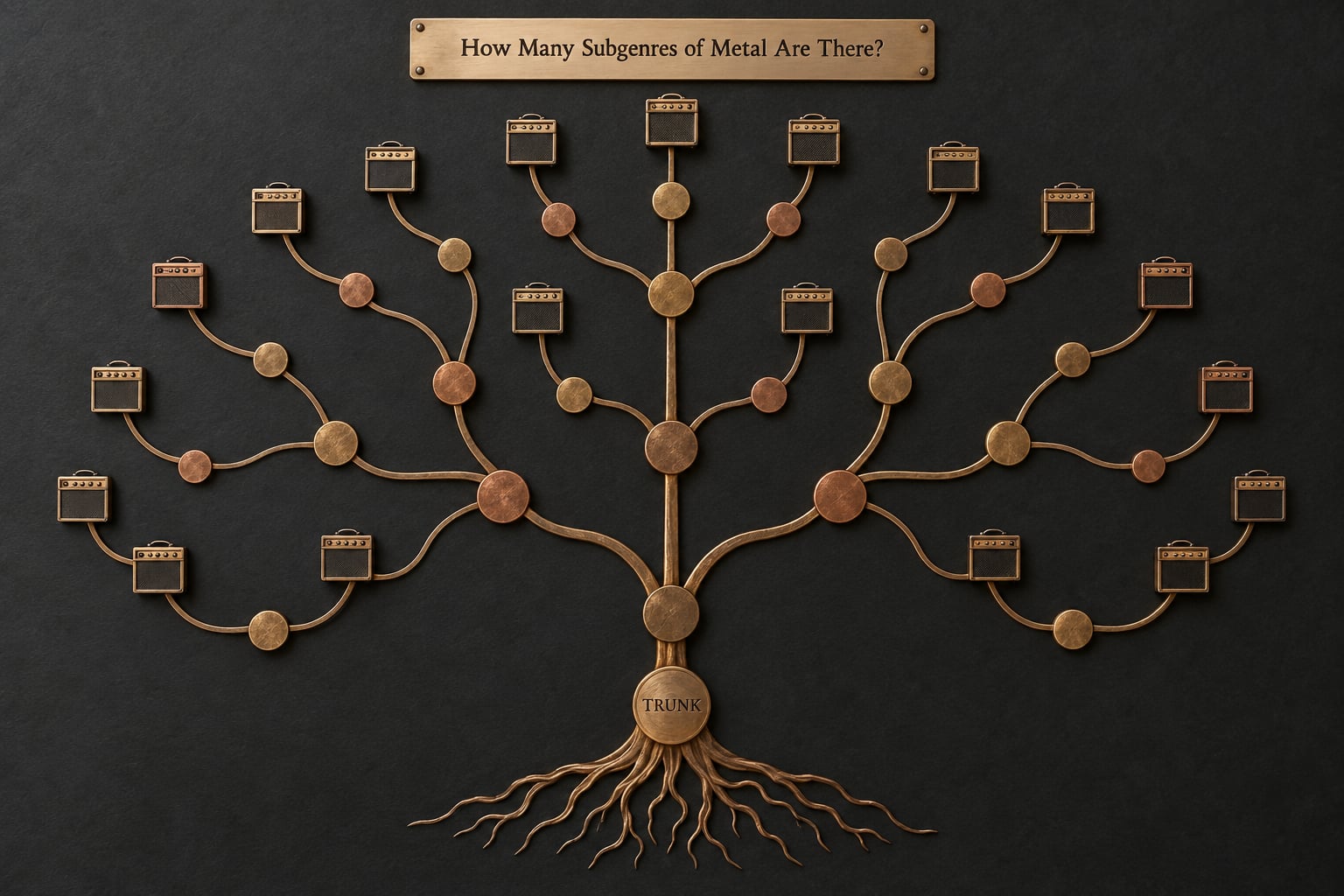
Here is the family tree in table form. Read each row as a sentence: this subgenre split off this parent, around this era, because of this sonic change, led by these bands. It is the single most useful thing on this page if you just want the map.
| Subgenre | Branched from | Fork era | Defining sonic change | Progenitor bands |
|---|---|---|---|---|
| Heavy metal | Hard rock, blues rock, psychedelic rock | 1968-1974 | Heavy distortion, power chords, amplified volume, no longer blues-based | Black Sabbath, Led Zeppelin, Deep Purple, Judas Priest |
| Doom metal | Heavy metal | 1971 onward | Slowness taken as the point; riffs stretched until they weigh something | Candlemass, Pagan Altar, Saint Vitus |
| NWOBHM | Heavy metal, punk rock | 1978-1982 | Blues dropped out; double kick, twin lead attack, short sharp songs | Iron Maiden, Venom, Saxon, Motörhead |
| Speed metal | NWOBHM, German metal | 1980-1986 | Very fast tempos, long instrumental soloing, no blues at all | Accept, Helloween, Running Wild, Blind Guardian |
| Thrash metal | Heavy metal plus NWOBHM plus hardcore punk | 1982-1986 | Tighter riffs, palm muting, constant double kick, harder vocals | Metallica, Slayer, Megadeth, Anthrax |
| Death metal | Thrash metal, plus Venom and punk | 1986-1991 | Growled vocals, low tunings, blast beats, six-string bass, dissonance | Possessed, Death, Morbid Angel, Entombed |
| Black metal | Thrash metal, plus Venom and punk | 1984-1993 | Raw production, shrieks instead of growls, speed pushed past thrash | Venom, Bathory, Mayhem, Burzum |
| Melodic death metal | Death metal plus NWOBHM | 1991-1998 | Death metal rhythm kept, melody put back on top; growls traded for clean and scream | At the Gates, In Flames, Dark Tranquillity, Children of Bodom |
| Second-wave black metal | First-wave black metal | 1992-1996 | Anti-Romantic and Satanic imagery, lo-fi and atmospheric production | Mayhem, Burzum, Darkthrone, Dissection |
| Glam metal | Heavy metal, NWOBHM | 1978-1988 | Same riff, hooks aimed at the radio; makeup, melody, image over extremity | Kiss, Mötley Crüe, Def Leppard, Ratt |
| Groove metal | Thrash metal, plus hardcore | 1990-1994 | Thrash dropped for a groove built on pan-continental groove, vocals turned mean | Pantera, Prong, Machine Head |
| Crossover thrash | Thrash metal plus hardcore punk | 1984-1991 | Thrash riffs with hardcore tempo and shouty vocals | Suicidal Tendencies, Corrosion of Conformity, D.R.I. |
| Metalcore | Hardcore punk plus thrash and death metal | 1995-2004 | Breakdowns and breakdowns-only choruses, clean vocals traded for screams | Hatebreed, Shadows Fall, Killswitch Engage |
| Deathcore | Metalcore plus death metal | 2001-2006 | Breakdowns kept, blast beats and growls added back, very short songs | The Acacia Strain, Misery Signals, Job for a Cowboy |
| Blackgaze | Black metal plus shoegaze and post-rock | After 2008 | Black metal instrumentation buried under walls of reverb and tremolo | Deafheaven, Nothing, Misasery |
| Progressive metal | Heavy metal plus progressive rock | 1972 onward | Songs stop following verse-chorus rules; time signatures shift mid-track | Mastodon, Tool, King Crimson, Dream Theater |
| Power metal | Speed metal plus NWOBHM | 1988-2000 | Speed kept, heaviness traded for melody, keyboards and heroic vocals | Helloween, Blind Guardian, Rhapsody, Sonata Arctica |
| Stoner and funeral doom | Doom metal plus stoner rock | 1989-2005 | Fuzz pushed further, volume kept very low, groove added to the doom | Electric Wizard, Sleep, Sunn O))), Pallbearer |
| Nu metal | Thrash groove plus hip hop, funk and industrial | 1995-2004 | Scratching and programmed backing replacing most guitar solos; one riff per song | Korn, Linkin Park, Limp Bizkit, Deftones |
| Industrial metal | EBM, industrial rock, thrash | 1988-1996 | Machine percussion, samples and treated vocals over metal guitar | Ministry, Fear Factory, Static-X |
| Djent | Progressive metal and technical death metal | 2008-2013 | Polyrhythms, detuned and muted guitar, groove as the lead voice | Meshuggah, Periphery, Animals as Leaders |
The same tree as text, so it survives without an image. Indentation shows descent.
Heavy metal
– Doom metal
– Funeral doom
– Stoner metal
– NWOBHM
– Speed metal
– Power metal
– Symphonic power metal
– Heavy metal
– Traditional heavy metal
– Glam metal
– Speed metal
– Thrash metal
– Groove metal
– Crossover thrash
– Death metal
– Technical death metal
– Brutal death metal
– Melodic death metal
– Gothenburg melodic death
– Deathcore
– Black metal
– Second-wave black metal
– Blackened death metal
– Symphonic black metal
– Blackgaze
– Progressive metal
– Djent
– Industrial metal
– Nu metal
– Metalcore
– Beatdown hardcore
– Deathcore
– Metalcore with clean vocals
Sam Dunn’s Heavy Metal Family Tree is the version most people have actually seen — an arborescent poster, first published in the early 2000s, with genres as branch points and example bands as leaves. It is genuinely useful and it is also simplified in ways that cause arguments. Wikipedia and several academic sources cite it as the reference lineage model, which is why it keeps resurfacing.
The Trunk: Where Heavy Metal First Forked
The trunk forms between 1968 and 1974, when blues rock and psychedelic rock shed their blues and got loud. Four bands are almost always named together: Black Sabbath, Led Zeppelin, Deep Purple and Judas Priest. Most people asking who the four fathers of metal are are expecting those four names.
There is a naming footnote worth knowing. The phrase heavy metal was used well before any of these bands. William Burroughs used it in Naked Lunch in 1962, Steppenwolf had a song called “Born to Be Wild” with the lyric in 1968, and Mike Saunders’ November 1970 Rolling Stone review of Black Sabbath is usually credited with putting the phrase in circulation as a genre name.
Two things happened inside that trunk that set up every later fork. The first is that Judas Priest, mid-1970s, threw away most of the blues phrasing that its predecessors carried and played almost nothing but metal. That is the moment the genre stops being hard rock and starts being heavy metal as its own thing.
The second is that the four fathers disagreed about what the music was for. Sabbath and Zeppelin leaned into weight and weirdness; Purple leaned into virtuosity and blues scale; Priest leaned into rhythm and speed. Glam metal takes the hooks end of that, thrash takes the aggression end, doom takes the slowness end. The fork lines were drawn in the trunk before a single subgenre existed.
Fork 1: New Wave of British Heavy Metal and Speed Metal
NWOBHM branched off heavy metal in Britain around 1978 to 1982, and the cause was punk. Bands were hearing the Sex Pistols and the Damned and asking why metal songs needed twelve bars and a shuffle feel. Strip the blues out, shorten the songs, double the kick drum, and you get Iron Maiden, Venom and Saxon.
This is the first major branch point, and it is a clean one. The parent genre loses blues harmony, gains punk attitude. The songs become about the songs, not about feeling.
Speed metal branched off that trunk in Germany, Scandinavia and Britain at roughly the same time, from the early 1980s into the mid 1980s. Accept, Running Wild, Helloween and Blind Guardian pushed tempo up and lengthened instrumental passages until the vocal was almost an afterthought. Venom’s Welcome to Hell in 1981 is the artifact people point at, because it did the important bit: it kept the satanic imagery and the speed but made the production deliberately cheap, which set up both black metal and a chunk of death metal later.
Fork 2: Thrash Metal and the Two Children That Split It Open
Thrash metal branched off heavy metal and NWOBHM in the early 1980s, and the third ingredient was hardcore punk. This is the single largest branching event in metal history and everything in the underground descends from it.
The recipe was specific. Take the twin-guitar attack of NWOBHM, add American hardcore’s tempo and its refusal to slow down, add palm muting and a snarl instead of a clean belted vocal. The Big Four of Thrash are Metallica, Slayer, Megadeth and Anthrax, and the scene had two centres: the San Francisco Bay Area and West Germany, with Brazil running its own version a few years later.
The album that defines the fork is Metallica’s Master of Puppets in 1986. Until then, most metal records in the mainstream were a mishmash. After it, riff-driven music with no blues left was the underground default.
Death metal branched off thrash metal, roughly 1986 to 1991
Death metal branched from thrash metal, c. 1986, driven by Possessed, Death and Morbid Angel. Venom had already shown that the fast, dark, minimal version of thrash worked; the Florida and Bay Area bands took that further with growled vocals, tunings down to the bottom of the guitar, blast beats, six-string bass and deliberate dissonance.
The argument people ask about most is death metal versus thrash metal, and it comes down to one thing: speed versus heaviness. Thrash plays fast at mid-weight with riffs you can nod along to. Death metal plays at mid-tempo at maximum weight with riffs that sit wrong in your ear until the second listen.
Black metal branched off thrash metal too, roughly 1984 to 1993
Black metal branched from thrash metal and from Venom specifically, c. 1984, driven by Venom, Bathory, Mayhem and Burzum. It is a sibling of death metal, not a child of it. Both parents got the same Venom input, and they diverged on production and vocal attack rather than on weight.
What you lose going up the black branch: recorded cleanliness. What you gain: shrieks instead of growls, and production that is raw on purpose. The second wave in Norway between 1992 and 1996 is where the branch got its imagery — Satanism, anti-Christian posturing, black and white photography — and where it got the attention, largely for reasons the bands did not plan.
Melodic death metal is the branch that surprises people. It forked off death metal in Sweden from 1991 to 1998, driven by At the Gates, In Flames, Dark Tranquillity and Children of Bodom, and it owes as much to NWOBHM as to death metal. The Gothenburg sound keeps the blast beats and growls but puts melody on top, and it grew fast enough to shape the entire 2000s underground.
Technical death metal takes the opposite route. Same parent, same era, but the priority is precision and polyrhythm rather than riffs. Rivers of Nihil and later bands in that circle are the reference points.
Fork 3: Glam Metal, the Mainstream Branch Off the Same Trunk
Glam metal branched off heavy metal and NWOBHM in the late 1970s and ran parallel to thrash through the whole 1980s. The music is more closely related to Mötley Crüe and Def Leppard than to Metallica, and it forked for a reason that has nothing to do with sound: image.
Glam kept the metal riff and added the pop hook, then built a visual language that could be recognised from a stadium seat. That made it enormous commercially while thrash was selling albums to mail-order customers and rehearsing in garages. The Sunset Strip branch is therefore a mainstream branch of the trunk, not an underground descendant of it.
It is also the branch with the most second-generation descendants nobody expected: hair metal’s melodic instinct runs straight into the late 2000s glam-and-EMO crossover, which is one reason people who loudly hated metalcore in 2004 quietly enjoyed parts of it in 2008.
Fork 4: Doom, Stoner, Power and Progressive Metal
Doom metal branched off heavy metal almost immediately, c. 1971, driven by Candlemass, Pagan Altar and Saint Vitus. This is the oldest fork in the tree and the one that sounds least like metal to people who only know metal from the eighties. Slow, minor-keyed, and built from a handful of riffs repeated for four minutes.
Stoner and funeral doom came out of doom decades later, in 1989 to 2005. Stoner added fuzz and a groove borrowed from stoner rock; funeral doom slowed it past the point where anyone in the audience could stay still. Electric Wizard, Sleep and Sunn O))) are the names that split it. The Pelican and Candlemass revival of the 2010s gave the whole slow branch a second audience.
Power metal is the deliberate anti-thrash branch. It forked from speed metal and NWOBHM between 1988 and 2000, driven by Helloween, Blind Guardian, Rhapsody and Sonata Arctica, and its founding move was to take thrash’s seriousness and reject thrash’s darkness. Faster, major-keyed, melodically structured, with a vocal range that is closer to opera than to rock.
Progressive metal is a branch that kept arriving instead of forking once. King Crimson and Pink Floyd supplied the method in the early 1970s; heavy metal supplied the weight. Mastodon and Tool arrived in the 2000s and fused it with the modern metal scene so thoroughly that the parentage is now hard to trace in either direction.
Fork 5: Crossover, Hardcore and the Metalcore Family
Crossover thrash branched off thrash metal in the mid 1980s, driven by Suicidal Tendencies, D.R.I. and Corrosion of Conformity. Thrash riffs, hardcore tempo, a shouty vocal. It is the first genuinely two-parent branch in the tree and the bridge that made metalcore possible.
Metalcore itself is a three-parent fork. It branched off hardcore punk and thrash metal in the late 1990s, c. 1995 to 2004, with death metal influence layered in through 2002. Hatebreed and Shadows Fall are the origin points; Killswitch Engage is where the branch found its commercial shape.
What metalcore changed was structure. Clean vocals got replaced by screamed choruses, breakdowns became the loudest thing in the song instead of a change of pace, and riffs got shorter so there was room for the breakdown. That is a structural change, not a tonal one, and it is why metalcore sounds unfamiliar to people who came in through 1980s metal.
Deathcore branched off metalcore around 2001, driven by The Acacia Strain, Misery Signals and Job for a Cowboy. It kept the breakdown and put death metal’s blast beats and growls back on top, producing something short, heavy and, for a while, everywhere. It is routinely described in community discussion as the first subgenre built by the internet rather than by record shops, with Myspace as the mechanism that launched several of those bands.
Blackgaze branched off black metal after 2008, driven by Deafheaven, Nothing and Misasery. The gimmick sounds like a joke and works better than it has any right to: take black metal’s tempo and instrumentation, bury all of it under enough tremolo and reverb to sound like shoegaze, and add clean vocals you would not expect in the genre.
Fork 6: Groove, Nu Metal, Rap Crossover and Industrial Metal
Groove metal branched off thrash metal around 1990, driven by Pantera, Prong and Machine Head. Pantera’s Vulgar Display of Power in 1992 is the record that defines it. Thrash dropped out, a heavy groove built mostly on the low end came in, and the vocal went from belted to a percussive shout.
Nu metal branched off in the mid-to-late 1990s from groove metal plus hip hop plus funk plus industrial, with Korn, Limp Bizkit, Linkin Park and Deftones as the names. What replaced guitar solos was scratching and programmed backing, and what replaced riffs was one heavy groove per song with the same drum pattern behind it.
This is where the biggest genre argument in metal lives, so it is worth being precise about both sides. The case against nu metal being metal is that it drops the riff, the solo and the harmony — the structural things metal is made of — and borrows from genres metal never had kinship with. The case for it is that nu metal descends directly from thrash and groove, its members come from metal scenes, and every element people point at as disqualifying was already present in 1990s metal.
On forums the disagreement usually lands the same way. Mainstream-adjacent branches get admitted reluctantly, if at all, while the person making the argument insists they are not metal at all. Neither position has a fact in it that settles the question, which is probably why it does not stop.
Industrial metal branched from electronic body music and industrial rock rather than from a metal parent at all, c. 1988 to 1996, with Ministry, Fear Factory and Static-X. Machine percussion, sampled textures and treated vocals over metal guitar. It is a true outsider branch, and it shows that the family tree has more than one trunk once you look closely.
Djent is the newest branch here, off progressive metal and technical death metal between 2008 and 2013, driven by Meshuggah, Periphery and Animals as Leaders. The defining move is that the guitar stops carrying melody and becomes a rhythmic instrument — muted, detuned, playing polyrhythms — so the groove leads the song.
Why the Same Sound Forked Differently in Different Cities
Genres did not fork because some band had an idea. They forked because a scene in a city had shared constraints — a venue, a fanzine, a record label, a climate, a handful of bands rehearsing within a mile of each other. Location is the mechanism behind most of the branching.
| Scene | Signature branches | What forced the fork |
|---|---|---|
| San Francisco Bay Area | Thrash, technical death, later progressive | College-town counterculture and a dense scene of clubs and studios in a very small area |
| West Germany | Speed, thrash, later power | Strong state music funding, festival circuit, technical musicianship rewarded first |
| Florida | Death, later brutal death | Hot, humid, cars and cheap rehearsal space, plus tape-trading instead of touring money |
| Tampa | Death, noise, industrial-leaning industrial death | One rehearsal building that dozens of bands shared; proximity, not touring, made the sound |
| Sweden, Gothenburg | Melodic death, later metalcore adjacent | Death metal already established locally, then NWOBHM influence applied on top of it |
| Norway, Oslo | Second-wave black metal | Poor weather, high unemployment, and youth with very little to do but rehearse |
| Brazil | Thrash, Brazilian death | English-language barrier fell early; covers were the fastest way to import and mutate a style |
| New Orleans | NOLA sludge | A shared swampy local style fused into riffs; no interest in being fast |
| Quebec | Quebec death metal | French-language scene with its own press and vocabulary, mostly sealed from US touring |
The Bay Area and Florida case is the clearest illustration. Both had thrash in the mid 1980s and both produced death metal, but Florida’s bands slowed down, tuned lower and traded in gore imagery, while the Bay Area bands stayed faster, stranger and more concerned with structures and time signatures. Same parent, same decade, two different children.
Gothenburg is the reverse case. Melodic death metal is death metal in almost every technical detail, and then suddenly there are major-key guitar lines on top. What happened is that Swedish players had been listening to British heavy metal the whole time, so the melody had never left the room. It just moved above the growls.
How to Tell Metal Genres Apart: The Five Variables
Two tracks are different subgenres when at least one of five variables has changed enough that you would not file them in the same folder. Those five variables are vocal delivery, guitar tuning and tone, rhythmic backbone, bass and groove, and production and aesthetic. Check them in that order and you can place almost anything.
1. Vocal delivery. This is the fastest test and the one beginners should learn first. A belted clean vocal with vibrato points to traditional heavy metal, NWOBHM or power. A mid-range snarl points to thrash or groove. A low growl points to death or black. A high shriek points to black or deathcore. A shouted vocal over a breakdown points to metalcore or beatdown hardcore. The vocal changes before anything else does in almost every branch on the map.
2. Guitar tuning and tone. Note where the lowest string sits and how the distortion sounds. Bright, crunchy, tuned high and clean-ish is NWOBHM or speed. Tight, palm-muted, mid-tunings is thrash. Detuned to the bottom and thick is death, groove or sludge. Dropped to the floor with a fuzz layer is stoner or drone.
3. Rhythmic backbone. What is the drum kit doing? A steady backbeat with accents means thrash or groove. A blast beat means death, black or deathcore. A very fast but straight groove with lots of notes in the solo sections means speed metal. Half-time and slow with space between notes means doom or stoner. Power metal usually sits at a fast tempo with almost no double kick.
4. Bass and groove. Is the bass guitar or is it a six-string doing it? Death metal, black metal and most modern extreme metal use a six-string bass tuned to the bottom. Thrash and speed almost never do. Funk-influenced nu metal sits one bar and repeats. Doom and stoner put the bass at the front of the mix and let the guitar sit behind it.
5. Production and aesthetic. Where are the guitars in the mix? Death metal usually has razor and close mics with a lot of room on the drums. Black metal may be lo-fi or thin by accident. Groove metal has a very wide, very fat sound. Symphonic branches add orchestration. Also look at the artwork and lyrics: those are weaker signals than sound, but they are how most listeners first sort out what they are about to hear.
| Variable | Thrash metal | Death metal | Black metal |
|---|---|---|---|
| Vocal | Snarl or aggressive belted clean | Low growl | High shriek or raw shout |
| Guitar tuning | Standard, occasionally dropped a step | Dropped to the bottom of the neck | Dropped, often with an open string left ringing |
| Rhythm | Fast, constant, accented backbeat | Mid-tempo blast beats, snare-forward | Fast, often a two-step feel |
| Bass | Four-string, following the riff | Six-string, often tuned to the guitar | Six-string or very distorted four-string |
| Production | Clean and tight, drums forward | Spacious, razor guitars | Raw or lo-fi, drums recessed |
| Reference album | Master of Puppets | Scream Bloody Gore | Mayhem’s debut |
Where Branch Lines Blur: The Disputed Subgenres
Some branches have two parents who both show up in the family photo, and those are the ones that cause arguments. Here is the factual basis on each side, without taking a position.
Metalcore. The case against: its structural DNA is hardcore punk, and the band-classical breakdowns, the vocal delivery and the rhythm came straight from that scene. The case for: it uses metal riffs and metal tunings, its bands came out of metal and adjacent scenes, and metalcore acts routinely tour and split audiences with metalcore bands on the same bill. The confusion is honest — this is genuinely a branch with two parents.
Nu metal. The case against: it abandoned riff-based song structure and imported hip hop and funk production. The case for: it descends directly from groove metal and thrash, the musicians came from those scenes, and treating genre descent as disqualifying would disqualify half the tree, since nothing stays still long enough to keep its original features.
Blackgaze. The case against: bury the drums and the vocals under reverb and you have removed the things that made black metal black metal. The case for: tempo, tuning, instrumentation and the underlying song structure all come from black metal, which is the same criterion people use to keep deathcore inside metal. It is judged by a different standard than its siblings, which is the actual complaint.
Groove metal. The case against: it simplified thrash into a single riff per song and dropped the solos. The case for: it forked from thrash, it kept thrash’s weight and the aggressive vocal stance, and it is the direct parent of nu metal and of a large part of modern metal. Whether the simplification counts as a branch or a dilution depends entirely on what you think a branch is for.
Folk and Christian metal. Both get treated as separate species when both are better understood as overlays. Folk metal puts a tin whistle or a nylon-string melody over a metal arrangement, and the arrangement underneath is usually power or folk metal proper. Christian metal uses the same structures with different lyrical content. Neither changed the underlying branch.
There is also a definitional dispute that runs underneath all of these: whether heavy metal is a subgenre of rock, whether rock is a container of metal, or whether they are siblings under a hard rock heading. Community threads have gone back and forth on this for years without resolving, which is arguably proof that the argument is about identity rather than taxonomy.
Why Subgenre Labels Exist at All
Labels exist for navigation first. Record shops, streaming playlists and recommendation algorithms all need a way to say “if you liked this, try that,” and a subgenre name is the cheapest available unit. Most people describe how they discovered metal as a series of hand-offs — someone played them something, they followed it into a neighbouring branch — rather than as a deliberate tour of a taxonomy.
Second, labels are how scenes build identity. Nobody plays a festival because they like “groove metal.” They play it because they belong to a scene, and the scene name is the label. In community discussion this shows up constantly as listeners describing their own path as moving from NWOBHM into thrash and then into death and black, guided by people rather than charts.
Third, labels are a sorting mechanism for status, and that is where the trouble starts. A scene with a strong identity protects itself, and the way it does that is by deciding who counts. Metal culture gets described as a patchwork of scenes that fight each other constantly and defend the family against outsiders. That framing is not entirely unfair.
If you are newer to this and finding it exhausting: the labels are a navigation tool, not a test. Nobody has ever lost an argument or made a friend by correctly identifying a subgenre.
Where to Start Listening on Each Major Branch
If you want to hear a branch at its clearest, start with the record that defined it. These are not rankings; they are the artifacts most cited by the bands that came after.
Heavy metal trunk. Black Sabbath’s Master of Reality, then Judas Priest’s Sin After Sin. The second one is the album where the blues runs out.
NWOBHM. Iron Maiden’s Piece of Mind, then Venom’s Welcome to Hell. Those two records between them produce speed, thrash and black.
Thrash. Metallica’s Master of Puppets, then Slayer’s Reign in Blood for the Bay Area vs Teutonic split you can hear directly.
Death. Possessed’s Seven Churches, then Death’s Human and Morbid Angel’s Scream Bloody Gore. After those three, go somewhere else in the family.
Black. Venom’s Welcome to Hell again, then Mayhem’s De Mysteriis Dom Sathanas for the second wave.
Melodic death. At the Gates’ Slaughter of the Soul, which is where the Gothenburg sound is at its most legible.
Doom and stoner. Candlemass’ Epicus Doomicus Metallicus, then Electric Wizard’s Dopethrone for the fuzz branch.
Power. Helloween’s Pink Bubbles Go Ape, then Blind Guardian’s Imaginations from the Other Side.
Glam. Mötley Crüe’s Shout at the Devil, which is the mainstream branch at maximum velocity.
Metalcore. Shadows Fall’s Warzone for the early shape, then Killswitch Engage’s self-titled debut for the version that went everywhere.
Deathcore. The Acacia Strain’s Stepped in a Second for the breakdowns-as-chorus approach in full.
Groove and nu. Pantera’s Vulgar Display of Power, then Korn’s self-titled debut for the branch that split.
Progressive and djent. Mastodon’s Blood Mountain, then Meshuggah’s Catch Thirtythree for what happens when the guitar becomes percussion.
Two video series are worth knowing about if you would rather watch than read. Sam Dunn’s Metal: A Headbanger’s Journey covers the origins and the scenes, and his later documentary work follows how the branches spread. Banger’s Metal Evolution series walks the mainstream 1980s and 1990s in order, which is roughly the path along the trunk and glam branch in this article.
Frequently Asked Questions
How do metal subgenres branch off each other?
A subgenre splits off when a band takes one defining feature of its parent style and pushes it far enough that the sound no longer belongs to the parent. In practice that means a change to vocals, guitar tuning, tempo, rhythm, or production, usually within one scene and one city. Punk pushing metal toward thrash in the early 1980s is the clearest example.
How many subgenres of metal are there?
There is no agreed count. Depending on how you treat fusion genres and local scene styles, published counts run from roughly a dozen to several hundred. Most listeners work with around thirty named branches. A 2022 quantitative taxonomy study built clusters from measurable musical and thematic features rather than scene consensus, and it also stopped short of a single canonical number.
Did death metal come from thrash metal?
Yes, directly. Death metal forked from thrash metal between roughly 1986 and 1991, driven by Possessed, Death and Morbid Angel, with Venom as a key outside influence. What changed was speed traded for weight: lower tunings, blast beats, six-string bass, growled vocals and dissonance. Black metal forked from the same parent at about the same time, making death and black siblings rather than parent and child.
How can I tell two metal subgenres apart by ear?
Check five variables in order: vocal delivery, guitar tuning and tone, rhythmic backbone, bass approach, and production style. Vocal delivery is the fastest signal, since it changes earliest in almost every branch. A growl points to death, a shriek to black, a breakdown and a shout to metalcore. Bass is the giveaway for the extreme branches, where a six-string tuned to the guitar replaces the four-string.
Is metalcore a subgenre of metal?
It has three parents: hardcore punk, thrash metal and, from 2002, death metal. The argument against is that its breakdowns and vocal delivery came from hardcore. The argument for is that the riffs, tunings and players came from metal, and deathcore added extreme metal elements back on top. Both cases rest on real facts, which is why the debate has never really settled.
Who are the four fathers of metal?
The four usually named are Black Sabbath, Led Zeppelin, Deep Purple and Judas Priest, active between 1968 and 1974. They are not founders so much as the four bands whose disagreement set up every later fork. Judas Priest is usually credited with the single most important move, dropping most of the blues phrasing in the mid 1970s so the music became metal rather than hard rock.
Why do metalheads hate metalcore?
It usually comes down to parentage and structure rather than sound alone. Listeners who came up through thrash, death or black hear breakdowns and shouty vocals as punk language inside a metal frame, and they feel the label was claimed rather than earned. Listeners who came up in the 2000s hear a distinct and coherent thing. Both readings come from the same three-parent lineage.
Conclusion
Start anywhere on the tree. Pick one branch that catches your ear, find the album listed above that defined it, and then follow the children from there — that is how the map turns into a listening path instead of a diagram.
If you want the shortest possible version of how metal subgenres branch off each other: punk pushed the trunk into thrash in the early 1980s, thrash split into death and black in the late 1980s, and everything after that has been either a regional variation on one of those two or a fusion with something outside metal. Get those three moves and the rest of the tree is detail.