Live mixing is the real-time balancing of every sound source from a console at the front of house position, adjusting levels, EQ and dynamics while the band plays, with no chance to rewind or re-render the result. A metal show is the hardest version of that job, because double bass, double kick and twin rhythm guitars all pile into the same narrow frequency slots. Learning how live sound engineers mix a metal show is mostly a matter of learning to subtract until the lyric is intelligible.
The engineer’s day runs in a fixed order: tune the PA to an empty room, set gain structure, patch and EQ each source in the same sequence every time, build the monitor world, then balance the front of house mix around the vocal. Follow that order consistently and the show becomes a series of small corrections instead of a fire drill.
Table of Contents
- What You Need
- Step-by-Step: How Live Sound Engineers Mix a Metal Show
- 1. Prepare the show file and reference material
- 2. Align the PA and establish headroom
- 3. Build drums from attack, body, and space
- 4. Separate guitars with movement and space
- 5. Make vocals clear without losing intensity
- 6. Set bass for definition and weight
- 7. Tune, time, and arrange for dynamics
- 8. Automate, rehearse, and protect the show
- Common Mistakes
- Frequently Asked Questions
- How do you mix metal guitars so they sound wide but not harsh?
- Should metal engineers use DI for guitars and bass, or rely on amp microphones?
- How can I stop a metal show from sounding muddy in the low end?
- What is the best way to monitor a loud metal band without destroying the mix?
- How do you mix harsh vocals, growls, and clean singing in the same show?
- How do engineers keep a metal show consistent across different venues?
- Conclusion
What You Need
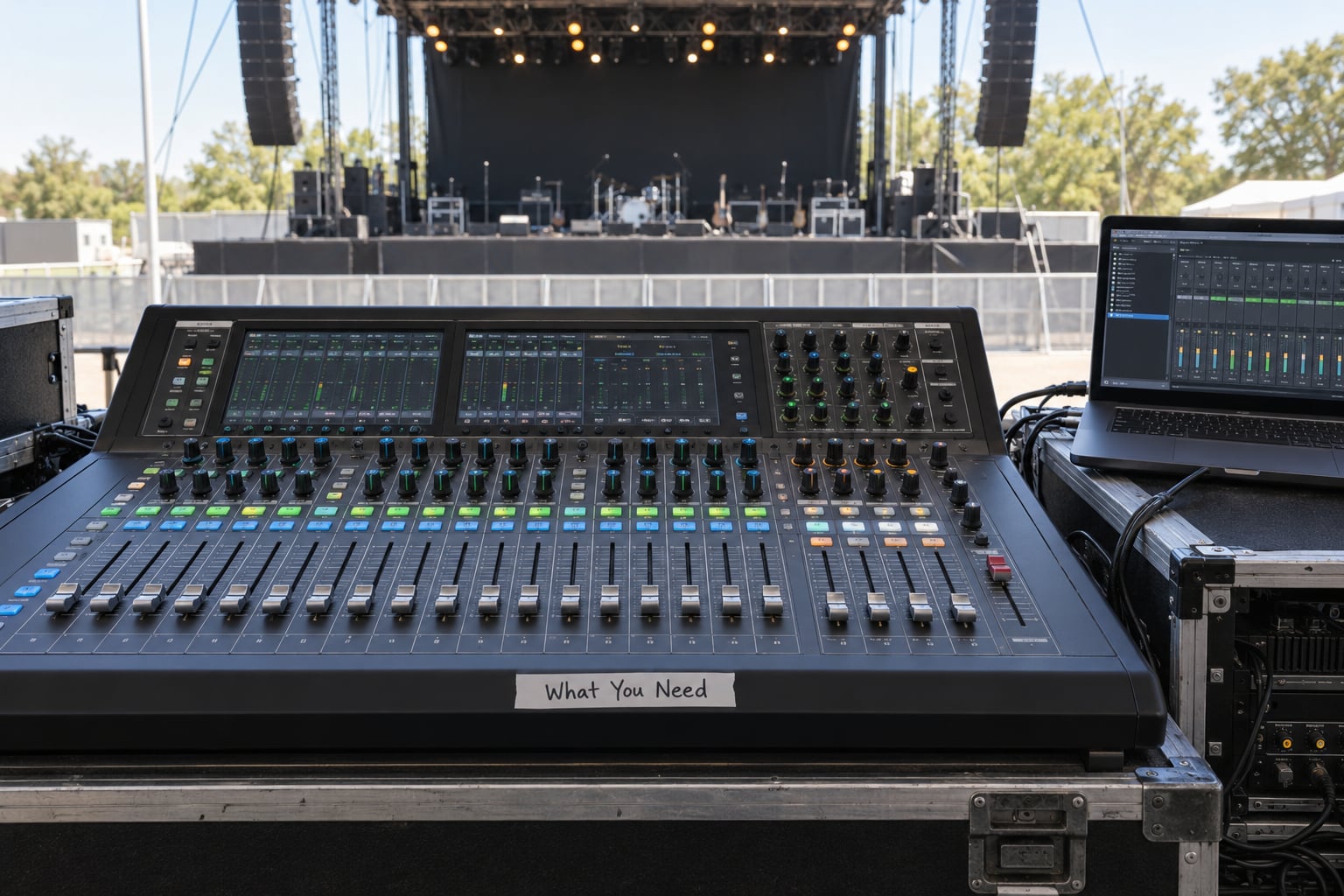
Most engineers running a metal show carry the same core kit regardless of the venue size. None of it is exotic, and none of it is optional.
- A digital console with scene recall. Yamaha, Midas, DiGiCo, Behringer X32 and Allen & Heath desks all do this. The recall is what lets you set the drum mix once at soundcheck and get it back identically for the encore.
- A proper input list. For a four-piece: kick, snare, hat, two toms, two overheads, room, bass DI, bass amp, two guitars, two vocal mics. Five-piece adds a third guitar and a second vocal.
- Microphones that suit the source. Shure SM58 or Beta 58A for vocals, SM57 on snare and guitar cabs, a large-diaphragm condenser on overheads and room, a dynamic like the Sennheiser e906 on bass cabs, an AKG D112 inside the kick if the drummer allows it.
- DI boxes and a way to blend. Bass players on modern metal usually want the amp mic and the DI together, which needs both fed into the desk and a channel or aux to blend them.
- Processing. Parametric and graphic EQ, a decent compressor per vocal chain, noise gates for overheads, a delay and a reverb for vocals, and sidechain routing if your desk offers it.
- A reference track or two. Pull the exact songs the band plays into the console player, loaded and cued, so you are matching to a record rather than to a memory.
- Earplugs. This is not optional advice. A club at full tilt will damage your hearing over a career if you work unprotected.
Keep a printed or on-screen copy of the patch list on the desk, and label your console strips with masking tape. When the guitarist says the vocal is too low in his wedge at the third song of soundcheck, you want to solve it in seconds.
Step-by-Step: How Live Sound Engineers Mix a Metal Show
1. Prepare the show file and reference material
Build the show file before the band arrives, not during line check. Setlist in the right order, scene per song, channels labelled and colour-coded, effects pre-loaded, and the two or three most demanding songs cued in a player.
Study those hard songs before anyone sets foot on stage. A breakdown with no guitars, a blast beat passage, and the tune the band plays at double time are the three places mixes fall apart, and knowing where they are tells you what to watch during soundcheck.
2. Align the PA and establish headroom
With pink noise through the mains, walk to the back of the room and walk back up. If the highs disappear by row ten or the bass turns into mush at the bar, that is a system problem, not a band problem. Ring the resonances with a parametric filter and set delay between the flown tops and any outfills before the band loads in.
Next, set output gain so the console is not on its last 6 dB. Bands play harder at the show than they did five minutes ago at soundcheck, and engineers who set their gains hot at line check find themselves riding a wall they cannot push through. Headroom is the difference between mixing a show and surviving it.
Check phase too. Overhead mics reversed against the room mic, or a kick sub channel arriving with the wrong polarity, will hollow out the low end in ways no amount of EQ fixes.
3. Build drums from attack, body, and space
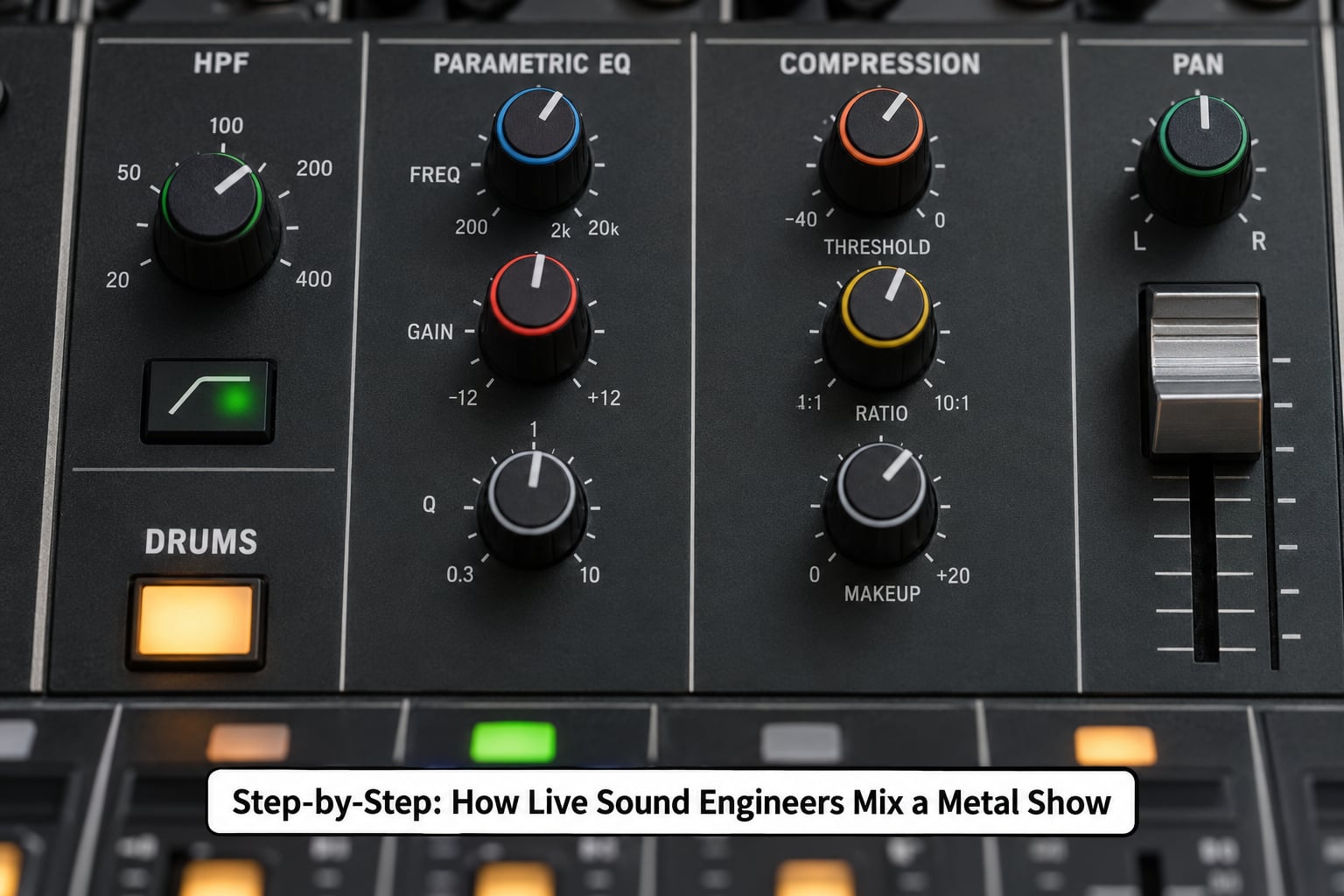
Metal drums are fast and busy, so clarity comes from the top of the transient, not from raw level. Start with the kick: high-pass around 30 Hz, take a small notch near 250 Hz where the shell and the guitar bass both pile up, and keep the click under control so it does not smear at speed.
Snare next. A tight cut or a notch around 4.5 to 5 kHz tames the wire rattle that smears under fast double-kick passages. Overheads are the usual culprit in a metal mix, so gate them harder than feels reasonable and accept losing some natural decay; cymbal bleed is what makes a blast beat unreadable.
Toms and floor tom get space and fewer cuts, since they carry the fills between sections. High-pass everything except the kick and the floor tom. If the hats disappear in the mix, that is a panning and level problem, not an EQ one, and crimped hats are far easier to hear once they sit clear of the overhead pair.
4. Separate guitars with movement and space
Twin rhythm guitars in a V-style or down-tuned setup are the wall the whole mix has to survive. Pan the rhythm pair wide left and right, keep the lead guitar centre, and cut a band of midrange around 2 to 4 kHz on the guitars so the vocal region stays open.
The advice that circulates on metal forums is blunt and correct: cut the guitars to make room for the singer. They will sound less aggressive in isolation, and the mix will sound considerably better, because aggression comes from the combined balance rather than from any single channel.
Use amp mics and DI together when the player wants clarity, and keep a modest amount of amp wobble in the mix so it does not sound like a studio patch. Delay on the guitars should be a short slap at most, tuned to the song, and a compression ratio low enough that the palm-muted chugs keep their edge instead of pumping.
5. Make vocals clear without losing intensity
Two different jobs sit on one stage, so build two chains. A clean vocal chain handles melody and needs presence, tuning and controlled compression. A scream chain handles shouting, death growls and low shrieks, and it needs a different high-pass, a different compressor behaviour and much less tuning.
Set the vocal gain so peaks land around -12 dBFS and leave the fader at roughly 75% of full travel. That leaves real headroom above the fader for the moments when the singer leans into a line. On the clean chain, use a soft-knee compressor with a 3:1 ratio, set the threshold to catch the peaks without flattening the quiet bars, and consider splitting the band so the upper range gets its own lighter compression.
For the scream chain, high-pass higher than you would on a clean vocal, use a faster compressor, and treat tuning as optional. Auto-tuning audible on a growl sounds like a mistake, and the audience notices that long before they notice a pitch drift.
Then walk out of the booth. One of the most repeated pieces of advice in the forums is to listen from where the audience actually stands, because the difference between the desk and row ten is often night and day.
6. Set bass for definition and weight
Modern metal bass is usually an eight-string tuned low, and it is competing with a kick in the same octave. Put the bass and kick into a group and consider sidechain ducking so the bass steps back under each kick hit; on a desk without that routing, a slower bass compression with the kick triggering it does the same job.
Blend the amp mic for tone with the DI for note definition. If the notes vanish when the guitarist and bass both chug, that is a low-mid problem, and a small cut in the 200 to 300 Hz region on one of the two instruments solves it faster than boosting anything else.
Keep the bass audible rather than huge. The audience should follow the riff because the whole mix leaves space for it, not because it is the loudest thing in the room.
7. Tune, time, and arrange for dynamics
Live tuning is a set of choices. Tune the clean vocal lightly, and add a short delay slung after the reverb so the vocal sits behind the guitars instead of in front of them. In a dense genre, restraint with sends is what separates a mix that breathes from one that smears.
Dynamics matter more in metal than the genre’s loudness suggests. Bring the guitars and bass down under a breakdown, open the room up during an instrumental, and let the full-band sections arrive with actual weight. Most weak metal mixes are flat, not harsh.
A master bus compressor pulling 2 to 6 dB of gain reduction is a common move in small clubs, where drum transients hit a small PA hard enough to clip. It is a blunt tool, so use it for glue and not as a substitute for riding the mix properly.
8. Automate, rehearse, and protect the show
Store the finished balance as a scene per song, then listen back to the recalls. Rehearsing the recalls is what makes a touring show repeatable, and it is the step most skipped by engineers who are certain they will remember.
During the set, ride faders rather than reaching for EQ. Sit at around 75% most of the time, expect a harder room on the last song than the first, and record the board feed so the band has something to judge the show by.
Watch the room change across a run. Humidity, temperature and how full the room is shift the low end from night to night, which is why the mix that worked on Thursday can feel thick on Friday. Keep a small set of corrective moves ready, and check the back of the room at soundcheck rather than only the booth.
Common Mistakes
Over-compressing the vocal. Crushing the singer to the point where the words stop moving is the most common fault in a beginner metal mix. Pull the ratio back, raise the threshold, and let the quiet lines stay quiet.
Letting low end accumulate. Kick, bass, floor tom and guitar low mids all competing around 120 to 150 Hz is the definition of mud. Subtract from one source rather than reaching for the master fader.
Guitars that disappear. The fix is midrange carving and correct panning, not more guitar level. If the guitars are wide left and right and the vocal is centre, you have room to work.
Monitor mixes that feed back. Aim wedges upward at ear height, keep microphones off the null points, and remember that a monitor level is a performance decision, not just an engineering one. If a guitarist insists on more, the band gets what they asked for and so does the audience.
Over-tuned or gated drums. Heavy tuning removes the attack that makes a double kick readable, and an over-gated overhead sounds like a hole. Tune for speed, gate for bleed, and do neither past the point where the kit stops sounding like a kit.
Mixing at one volume in the booth. If you never move, you never check. Walk the room, stand in the middle, and check the mix on a phone recording afterwards, because phone speakers and subwoofers fail in the same places the audience’s do.
Frequently Asked Questions
How do you mix metal guitars so they sound wide but not harsh?
Pan the rhythm pair hard left and right, keep the lead guitar centre, and cut a band around 2 to 4 kHz so the vocal region stays open. Use a short slap delay tuned to the song rather than a long one, and keep compression ratio low so palm-muted chugs keep their edge. Amp mics blended with DI give the width some movement instead of a static studio sound.
Should metal engineers use DI for guitars and bass, or rely on amp microphones?
Both, in most cases. The amp mic carries the character and movement, and the DI carries definition and consistency night to night. Bass players on modern metal almost always want the two blended, which is why a live rig for a five-piece usually carries both a bass amp mic and a bass DI on separate channels. For guitars, mic the cab as the main source and use DI only when the player wants a cleaner, more modern tone.
How can I stop a metal show from sounding muddy in the low end?
Work by subtraction, starting in the 120 to 150 Hz region where kick, bass and guitar low mids collide. Put kick and bass into a group and use sidechain ducking so the bass steps back under each kick hit, or trigger a slower compressor on bass from the kick. Then high-pass everything except the kick, floor tom and bass, and check the result at the back of the room.
What is the best way to monitor a loud metal band without destroying the mix?
Give each player a monitor mix that carries what they need to perform and little else, and keep the level somewhere the band can hear themselves without straining. Aim wedges upward at ear height, keep mics out of their null points, and use gain-before-feedback so you can add level before adding feedback. In-ear monitors remove most of that problem at the cost of losing the room around the band.
How do you mix harsh vocals, growls, and clean singing in the same show?
Build two separate vocal chains. The clean chain gets a higher input level, light tuning, a soft-knee compressor around 3:1 and a short delay behind the reverb. The scream chain gets a higher high-pass filter, a faster compressor, and almost no tuning, because auto-tuning on a growl is audible and wrong. The scream fader usually sits lower, since it carries more midrange weight.
How do engineers keep a metal show consistent across different venues?
Scenes and a disciplined patch list do most of the work: the same input, the same EQ, the same effects every night, recalled rather than rebuilt. Expect the room to move underneath you, because humidity, temperature and how full the room is all shift the low end. Keep a small set of corrective moves ready, re-check the back of the room at soundcheck, and record the board feed each night to catch drift you stopped noticing.
Conclusion
Start clean. Patch the show, tune the PA to an empty room, set gain structure, then build a drum mix and a vocal that sits clearly on top of it. Everything after that is adjustment. Once drums and vocals are right, the guitars fall into place, the bass finds its space beside the kick, and the automation and effects become choices rather than repairs. Master the order, and how live sound engineers mix a metal show becomes a repeatable process instead of a night of guesswork.