Live albums get overdubs because the show cannot be repeated. Once the crowd has gone home, the only way to correct a flubbed solo or replace a thin vocal is to record it afterwards in a studio and lay it over the concert tape. Producers treat that repair as part of finishing the record, and most bands sign off on it.
The interesting part is where the line sits. Repairing one wrong note feels like editing. Replacing an entire guitar part starts to feel like a construction. Fans have argued about that line for forty years, mostly without agreeing on what counts.
Here is how the process actually works, why it happens, and how you can work out what was changed on the record you are listening to.
Table of Contents
- What Does It Mean for a Live Album to Be Overdubbed?
- The scale runs from a single spliced note to a re-recorded song
- Why Live Albums Sometimes Get Overdubs
- 1. The show already happened
- 2. The song fell apart in the middle
- 3. A performance was weak rather than wrong
- 4. The record was assembled from a whole tour
- 5. The soundboard feed was poor
- 6. Consistency across the record
- 7. What the label expected
- 8. Vocals carry the most risk
- What Is the Difference Between an Overdub, an Edit, and a Studio Retake?
- Do Overdubs Make a Live Album Fake?
- How Can Listeners Tell Whether a Track Was Overdubbed?
- Frequently Asked Questions
- Are all live albums recorded in front of an audience?
- Does overdubbing mean a live album was recorded in a studio?
- Why do bands replace a guitar or vocal part after a concert?
- Are crowd noises ever added or removed on live albums?
- Should live albums disclose all edits and overdubs?
- Conclusion
What Does It Mean for a Live Album to Be Overdubbed?
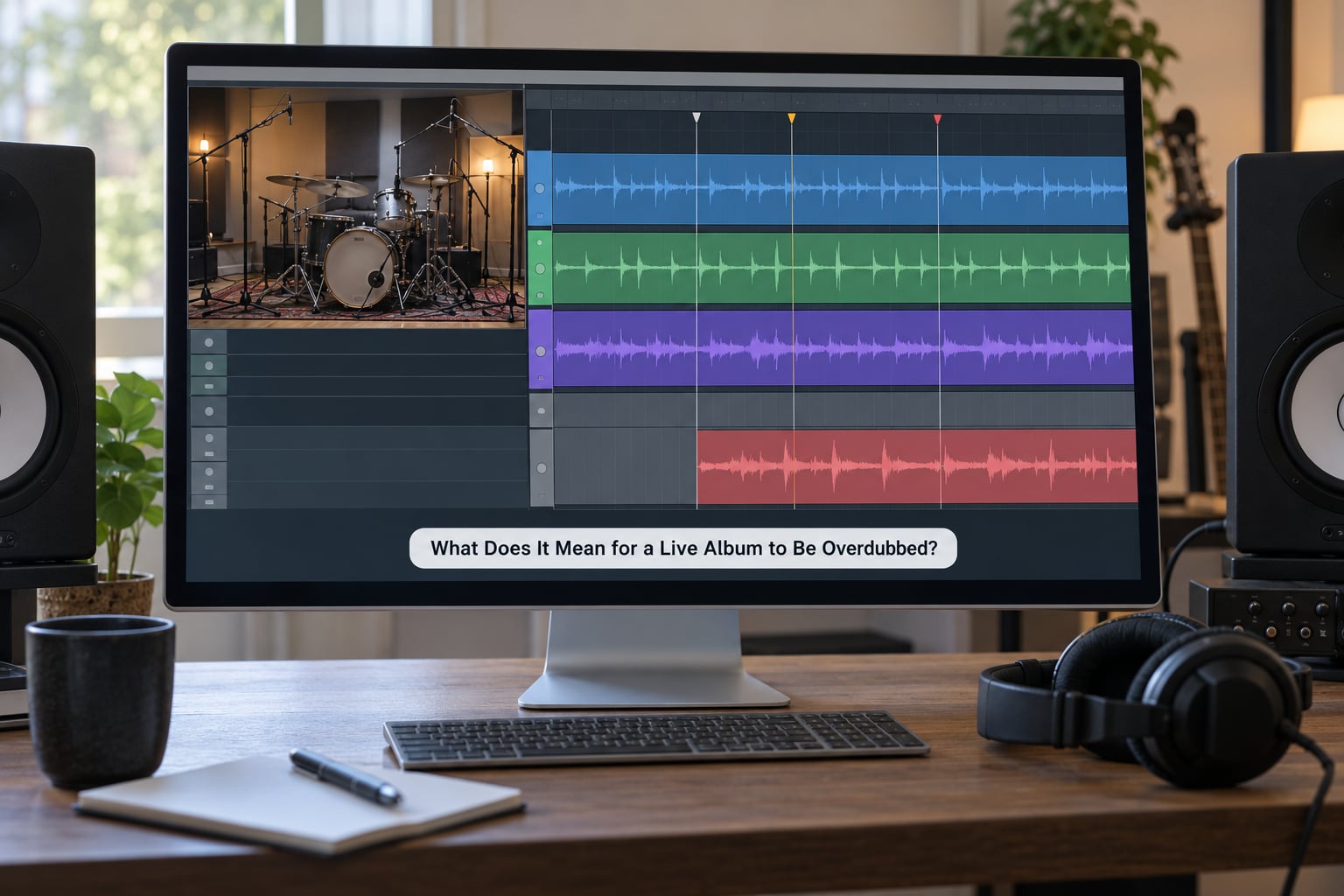
An overdub is a performance recorded after the concert and layered onto the live recording to replace, correct or supplement what happened in the room. Editing, by contrast, only removes or joins material that was already captured. Mixing sets the balance, and mastering prepares the finished stereo mix for release. None of those three add anything new.
Overdubbing is the only one of those stages that puts a new performance inside a record billed as live. That is why the word carries so much weight in metal circles, where the live document is treated as a piece of history rather than a product.
Engineers describe the normal baseline bluntly. On Gearspace, engineer Jay Kahrs put it at roughly 90 percent cut live with punch-ins to fix mistakes, with guitars occasionally replaced entirely and vocals almost always overdubbed. A Nashville engineer in the same thread described a different house style: 80 percent kept as the band, drums in one pass, bass maybe punching out a wrong note here and there.
The scale runs from a single spliced note to a re-recorded song
| Level of intervention | What happens | Commonly called |
|---|---|---|
| Splice edit | A wrong note or cough is cut out and the surrounding audio joined | Editing, tightening |
| Punch-in repair | A single note or phrase is re-recorded to replace a flub | Punch-in |
| Layered replacement | A whole guitar line or vocal is re-performed and swapped in | Overdub |
| Multi-show comp | The best version of a song is assembled from several dates | Compilation, tour document |
| Studio retake | The song is essentially re-recorded, with only drums or some backing left live | Studio-plus-live |
Why Live Albums Sometimes Get Overdubs
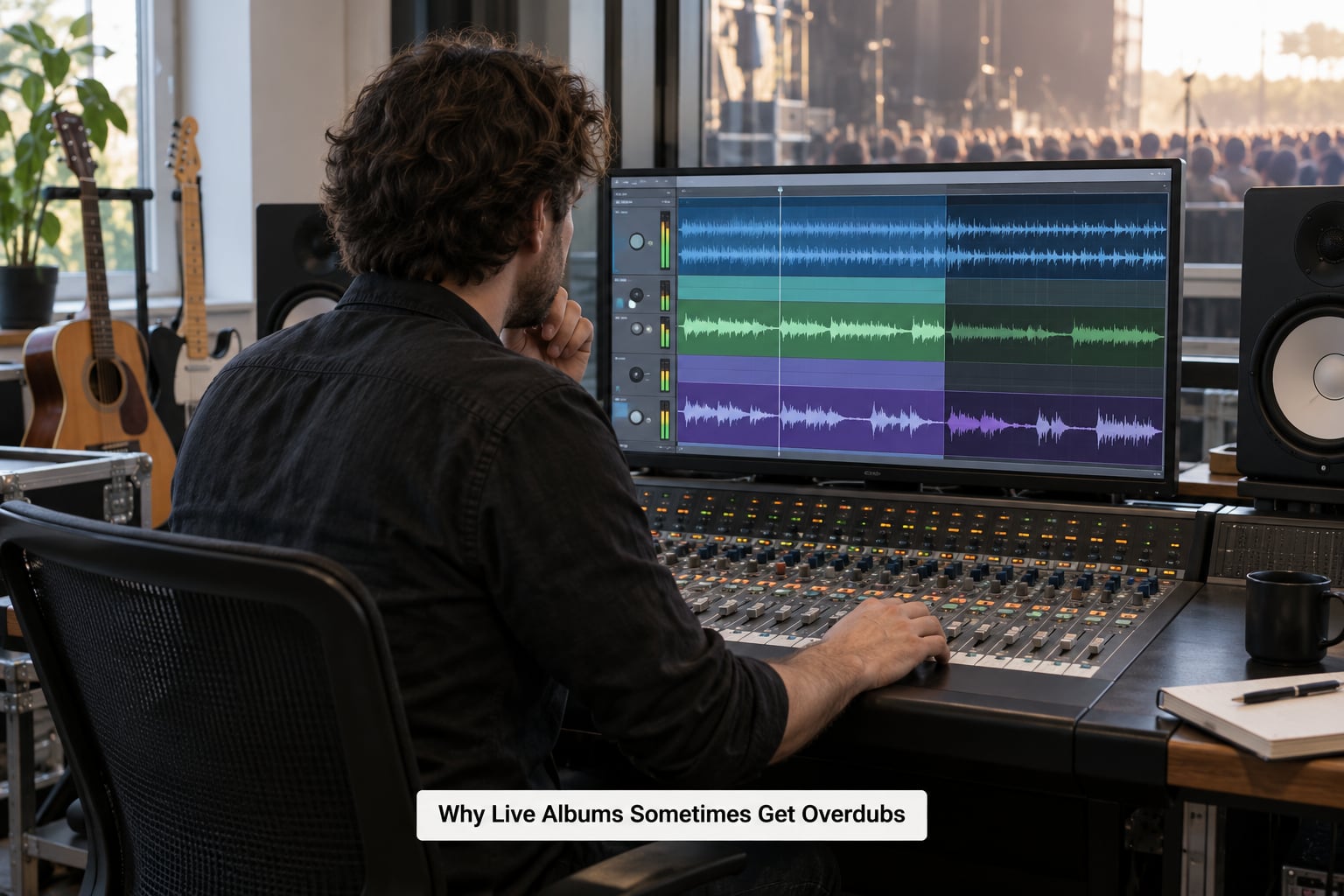
There are eight reasons that come up again and again, and only one of them is about deceit. The rest are scheduling, physics and money.
1. The show already happened
This is the reason nobody in the forums mentions first, and it is the one that decides everything else. A band can rehearse a song until it is reliable. It cannot un-play a bad Tuesday night in Cleveland. Every fix is therefore applied afterwards, on a machine, to an event that is closed.
2. The song fell apart in the middle
A bridge that changed tempo, a breakdown where the band lost the thread, a stop that stretched too long. These are not small flubs. When a track has a hole in its centre, splicing becomes obvious and ugly, which pushes the engineer toward replacing a whole section instead.
3. A performance was weak rather than wrong
Nothing went wrong technically. The guitar solo just had no lift, or the singer lost the melody on the second verse. A correct but boring take is hard to defend keeping, and hard to explain in the liner notes.
4. The record was assembled from a whole tour
When a label asks for a live album after forty dates, the temptation is to collect the best version of each song. The result may be assembled from four cities and five months. It documents the tour well and the individual night barely at all.
5. The soundboard feed was poor
A front-of-house desk run by a visiting engineer with unfamiliar levels can clip a vocal or bury the guitars. If the tape exists, the answer is to mix from the multi-track stems instead. If it does not, the answer is to lay down replacements.
6. Consistency across the record
Eighteen tracks recorded over five weeks, in halls with different acoustics and weather, will not sit together by accident. Engineers describe timing and volume corrections as routine even when no new performance is involved.
7. What the label expected
Loudersound reported Philthy Animal Body’s account of a live release in which the drummer went back into the studio to touch up parts, with the band member describing pressure to deliver something closer to a pop record. When the brief is a single that competes with the studio album, fixing flaws stops being optional.
8. Vocals carry the most risk
Singing while moving, sweating and projecting for two thousand people is hard. Vocalists are the most exposed part of a live record and the most often replaced, which is also why so many singers sound worse on stage than on their albums.
What Is the Difference Between an Overdub, an Edit, and a Studio Retake?
An edit changes nothing you hear except the joins. A punch-in replaces a small unit of performance with a re-recorded one. An overdub replaces a whole part. A studio retake goes further and rebuilds most of the track, leaving only some elements of the concert behind.
The distinction that gets lost is between comping and double tracking. Comping means choosing pieces from several recorded attempts at the same concert take and assembling the best version. Double tracking means recording a second, separate performance of the same part and layering it to thicken the sound. Both are ordinary studio techniques. Both can appear on a live record without anyone having played the part twice in front of a crowd.
Two other terms cause confusion. Live to tape means the show was recorded straight to tape or disk with no further tracking, which makes fixes impossible rather than merely discouraged. Au natural in liner notes is a claim of exactly that: the performance as it happened, including the mistakes. Gentle Giant’s Playing the Fool is cited on the Steve Hoffman forum as an example precisely because the notes make the claim and the recording sounds like it keeps it.
Do Overdubs Make a Live Album Fake?
Most of the people who work on these records do not think so. An engineer correcting one note sees a defect removed, not a performance rewritten. The producer who replaces a weak vocal sees a song made usable. From inside the process, every fix is a small professional judgement with a defensible reason.
Listeners tend to disagree, and the disagreement is about what the record promised. A live album sold as a document makes a claim about a specific night. If that night is quietly re-recorded, the document is no longer doing its job, whatever the technical quality of the result.
The Kiss argument is the cleanest example of that split. On KissForum, fans describe Alive! as a complete fraud, citing Derek Sherinian’s claim that only Eric Singer’s drums were live. The record still sells and still gets played, which tells you how many listeners treat the accusation as a detail rather than a verdict.
Judas Priest’s Unleashed in the East sits at the other end of how people talk about these things. Fans describe loving it while openly acknowledging the known studio parts. A record can be disputed and beloved at once, which is the honest outcome for most live releases.
Disclosure is what turns a rumour into a decision. When a record does not say what was replaced, listeners assume the worst case and argue about it for decades. When the notes are specific, the argument narrows to something a reasonable person can weigh.
How Can Listeners Tell Whether a Track Was Overdubbed?
Most of the time you will not get proof from listening alone. You can, however, narrow it down with a few habits.
- Read the credits before the reviews. Terms like recorded live, some parts overdubbed, or mixed from multi-track tracks tell you the shape of the record before you hear a note.
- Compare versions. Bootlegs of the same tour exist for most well-documented bands. Listening to the same song from two dates often shows whether the record is one night or a compilation.
- Listen to the room. Genuine audience noise and room tone stay consistent around a performance. A replacement take made weeks later can sit slightly cleaner or flatter than the crowd around it.
- Watch for changes in performance character. A guitar part that suddenly sounds tighter and heavier, or a vocal that suddenly turns up, is often where the switch happened.
- Check reissue material. Deluxe editions sometimes ship stems or alternate mixes. The Thin Lizzy Live and Dangerous super deluxe campaign in 2022 existed largely to put to bed the decades-old claim that the record was heavily overdubbed, which shows how much a release can change once documentation appears.
- Accept the limits. Absent documentation, you are estimating. Treat it as an estimate rather than a verdict.
Frequently Asked Questions
Are all live albums recorded in front of an audience?
No. Most are, and those are the ones people mean when they argue about overdubs. A smaller group are recorded in a studio with a live band playing along, sometimes with audience noise added later to create the impression of a show. A third category is assembled from rehearsal, soundcheck or archival tapes. The liner notes usually hint at which category you are in, and the phrase recorded live in front of an audience is the one worth looking for.
Does overdubbing mean a live album was recorded in a studio?
Not necessarily. An overdub means some part of the performance was re-recorded after the fact, which could be one note or one guitar line while the rest of the show stays untouched. The concert itself was still captured live, with the crowd present and the band playing together. A live record only becomes a studio recording in the broader sense when most of the instruments have been replaced and very little original concert audio remains.
Why do bands replace a guitar or vocal part after a concert?
Usually because the part was weak rather than wrong. A solo that had no lift, a vocal that lost the melody on a verse, or a bridge where the band lost the tempo can be unlistenable on a record. Vocalists get the most attention because singing while moving and projecting for a large crowd is genuinely difficult. Some replacements are also simple commercial pressure to deliver a track that holds up next to the studio version.
Are crowd noises ever added or removed on live albums?
Both happen. Engineers frequently reduce audience noise that swamps a quiet passage or sits on top of a vocal, and some records add crowd sound recorded at another show to make a studio-with-band session feel like a concert. Neither is usually a fraud, but both change the document. Forum listeners tend to treat added crowd noise far more harshly than a corrected guitar note, because it goes to whether the performance itself was real.
Should live albums disclose all edits and overdubs?
Most listeners say yes, and the argument is practical rather than moral. Without disclosure, every suspicious moment turns into an argument, and a single bad rumour can poison enjoyment of an entire record for decades. Specific credits, such as saying some parts were overdubbed or that the album was compiled from several shows, let a listener decide what level of authenticity matters to them. Records that disclose clearly are judged on their terms rather than on guesses.
Conclusion
Overdubs on live albums run from a single spliced note to a song rebuilt in a studio, and the difference is usually stated somewhere in the credits if you look. Start there, before any argument begins.
Then judge the record against what it was trying to be. A tour document built from several dates answers a different question than a single-night capture, and fans are rarely disappointed by a record that told them which one it was. When nothing is documented, suspicion fills the gap, and it rarely fills it kindly.