Bands drop hits from setlists because the number of minutes is fixed and the competition for those minutes is real. When a new album arrives, a festival slot shrinks to 40 minutes, or the singer changes the key the whole band has to learn, something familiar gets pushed out.
Sometimes the song no longer suits the lineup, sometimes a rights block makes it impossible to play, and sometimes the band is just sick of it. It is very rarely a statement about the fans.
I have read a lot of setlist threads over the years, and the same handful of explanations keep coming up while fans insist on a seventh: that the band secretly hates the song. That one is almost never true. Below is what actually goes on, in the order it matters on a tour.
Table of Contents
- What Does It Mean When a Band Drops a Song?
- Why Do Bands Change Their Setlists So Often?
- The 8 Main Reasons Bands Drop Hits from Setlists
- 1. The set got shorter and something had to go
- 2. New album material takes the minutes the old singles had
- 3. The band got tired of playing it
- 4. The song no longer fits the voice or the rig
- 5. Timing and pacing conflicts push it out
- 6. Festival slots and one-off dates change the shape of the show
- 7. Rights, label and licensing blocks
- 8. New members, new arrangements, old songs
- How Bands Choose Which Songs to Play Live
- Is a Missing Song a Sign of a Problem With the Band?
- Frequently Asked Questions
- Why does a band not play one of its biggest songs?
- Do bands drop songs because fans do not like them?
- Why do bands change their setlist for different shows?
- Can a band play a hit that it normally avoids?
- How long does a band usually play the same setlist?
- Should I be worried if my favorite song is missing from a concert?
- Conclusion
What Does It Mean When a Band Drops a Song?
A dropped hit is a song with real streaming or radio success that a band has either stopped playing live or reduced to occasional appearances. Fans usually talk about it as a single event, but there are three very different things hiding behind the phrase.
The first is a one-night omission, which means nothing. Vocalists tire, a guitar string goes, somebody has a sore throat, and the crew prints a short set for that date. The song is usually back the next night.
The second is a rotation-out, where the song sits in the band’s wider pool of 40 or 60 playable tracks and simply stops coming up. The Who and Phish style long rotation works this way, and it is the reason a song can vanish for a whole tour and return without anyone making an announcement.
The third is a retirement. The band has taken it out of the pool entirely, which is a much firmer decision and often permanent for the rest of that band’s touring life.
Setlists are working documents, not promises. Almost nobody announces a change, so the person who tells you a song is definitely gone is usually guessing from two data points.
Why Do Bands Change Their Setlists So Often?
Because a touring band is fitting a fixed number of minutes into a different room every night, and the room sets the terms. A 500-seat club with a strict curfew, a 20,000-seat arena and a 35-minute festival slot are three entirely different problems.
That produces the fixed versus rotating divide. A fixed set means the band plays the same run of songs in the same order every night of a leg. Pearl Jam fans have long argued in favour of that approach, since a show played nightly gets tighter and the stage and lighting design can be built around one fixed shape.
A rotating set means the band holds a much larger pool and mixes it per show. The argument against it, raised constantly on the Queen Concerts board, is that with a big enough pool your song may simply never come up in a short run of dates.
Long rotations also let a band match material to the room. Bands tend to play to a general crowd rather than to one fan’s deepest cuts, which is why the rarest tracks are usually reserved for residency runs rather than a single date.
Encore blocks are usually scripted rather than spontaneous these days, which surprises people who still treat an encore as a reward. And the overall trend is compression. Festival sets, support slots and residencies have all trimmed minutes year on year, so the pool of songs competing for stage time keeps shrinking too.
One more piece of mechanics worth knowing: bands rarely play every song at the same tempo as the record. Most live arrangements are faster because of the time pressure and because the extra tempo keeps a big crowd moving through the verse.
The 8 Main Reasons Bands Drop Hits from Setlists
1. The set got shorter and something had to go
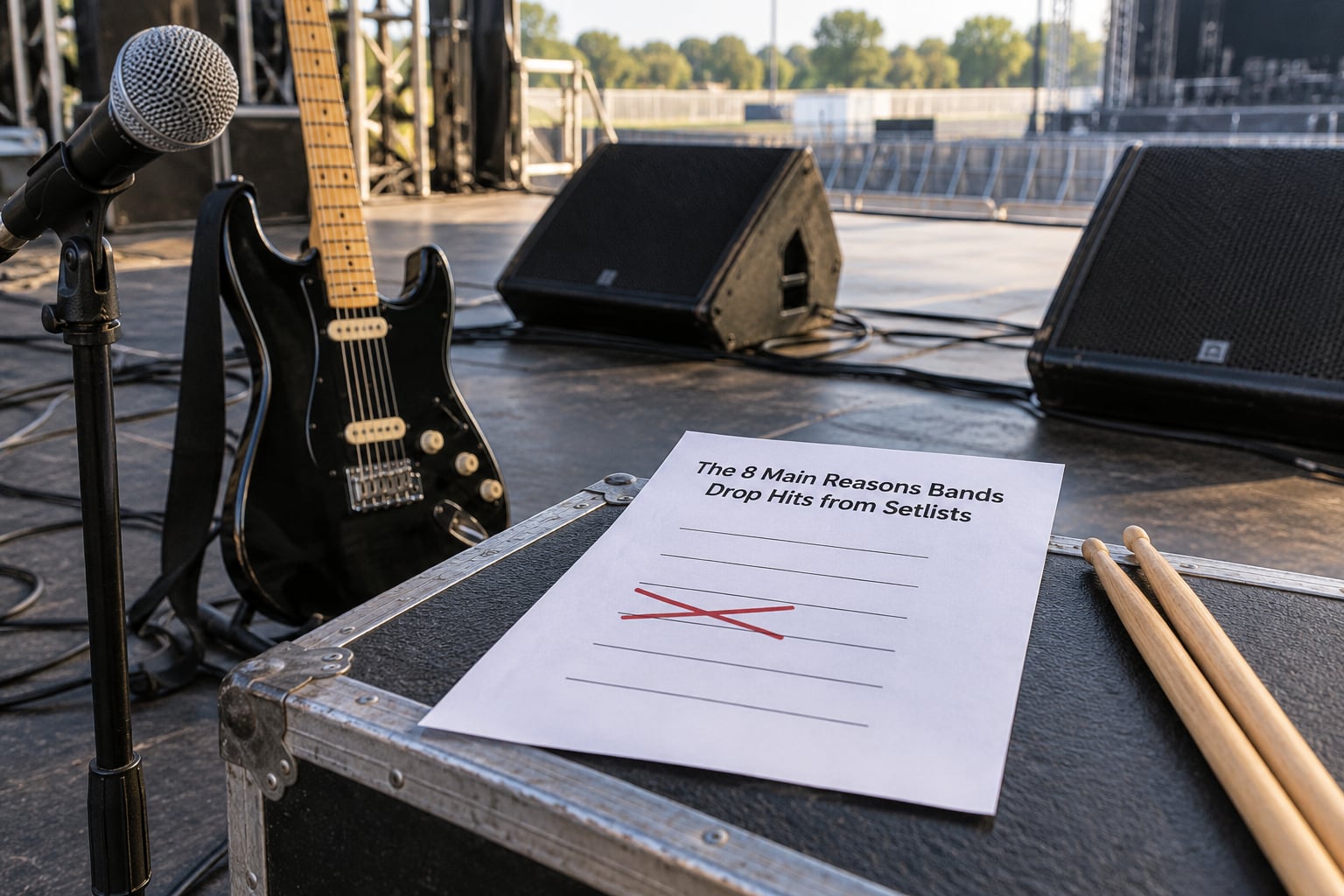
This is the boring answer and it is the most common one. Every song competes for the same fixed number of minutes, so each addition forces a cut somewhere else in the running order.
The arithmetic is straightforward when you average a rock song at roughly three and a half to four minutes and add the half-minute of crowd noise and stage banter between songs.
| Set length | Approximate songs | Typical context |
|---|---|---|
| 40 to 45 minutes | 11 to 13 | Festival day slot, support act |
| 60 minutes | 15 to 17 | Club or small headline night |
| 75 minutes | 18 to 20 | Mid-size headline show |
| 90 minutes | 22 to 24 | Arena night, reunion tour |
That table is the whole argument in miniature. When a fan on r/GreenDayOfficial asked why The Static Age had been cut, the top answer was not about art or fatigue at all. Fitting it into a 20-song set meant bumping something bigger.
2. New album material takes the minutes the old singles had
On an album tour, the newest songs are non-negotiable. Label support, press interest and the reason people are buying tickets all point at the record that just came out, so the tour support singles and, eventually, deeper album tracks crowd out older fan favourites.
This is the reason a fifteen-year-old anthem can vanish in the year its follow-up is released and reappear three tours later. Nothing changed about the song. Everything changed about what the band is selling.
3. The band got tired of playing it
Playing the same 90 songs for 20 years wears a track down. There are documented cases of performers stepping away from a signature song because it stopped being fun or because the arrangement had become a job rather than a moment.
Marilyn Manson is a case fans still argue about. A long-running thread in a Manson fan group asks why Raise the Red Flag disappeared from the set with no stated reason, and the honest answer in that thread is that newer material took its place and nobody publicly explained it further.
Boredom is a legitimate reason and it is the one bands defend least often, because there is no polite way to say it out loud.
4. The song no longer fits the voice or the rig
Hits get written in one key, one tempo and one arrangement, and bands outlive all three. A singer whose range has shifted, a guitarist who stopped using a capo, a dropped tuning, a new drummer, a stripped-down rig for a lean tour: any of those can quietly retire a number.
This is the reason almost nobody explains to fans, because the band would have to announce that a song is hard to sing. It is often just quietly put in a different key and, when that does not work, quietly removed.
5. Timing and pacing conflicts push it out
Setlists are shaped like an arc, not a playlist. Ballads do not sit next to ballads, an uptempo number rarely follows another uptempo number, and a song that needs a long intro or a crowd singalong section needs neighbours that set it up properly.
Drop one song and the ordering problem can ripple through six others, which is why a single omission sometimes reshuffles a whole block.
6. Festival slots and one-off dates change the shape of the show
A festival set is a different show with the same band in it. Daytime slots are short, the crowd is half-drunk and spread out, and the band often plays a short core set to a sparse field rather than the arena version.
The same applies to support slots and guest appearances. If you saw a band at a festival and your song was missing, that tells you very little about what will happen at their headline show six weeks later.
7. Rights, label and licensing blocks
Some songs are owned by other people. A legacy band playing a songwriter’s catalogue can hit approvals, publishing splits or label negotiations that make a track unavailable or uneconomic to perform, and those constraints do not appear in any fan forum post.
Cover songs carry the same problem. A tour highlight can disappear because clearance for a new arrangement is more expensive than the fee the venue can justify.
8. New members, new arrangements, old songs
Reunions and line-up changes reset the repertoire. A returning guitarist plays the parts they remember, a drummer rebuilds the groove, and songs that only worked with the old rhythm section fall away in the rehearsal room rather than on stage.
Oasis reunion shows generated exactly this kind of argument, with fans building lists of songs they assumed had no chance of being played and others upset that a familiar track was absent from the first run of dates.
How Bands Choose Which Songs to Play Live
Setlist construction is a craft with real rules, and knowing them explains most omissions without any conspiracy. The useful number is simple: a song takes roughly three and a half to four minutes including the pause after it, so the count falls straight out of the slot length.
Order matters as much as selection. Bands generally open with something fast and familiar to win the room, avoid placing two slow songs near each other, save the loudest material for the last third, and place a predictable crowd-pleaser at the very end so the room leaves satisfied.
The encore is a slot in the running order, not an improvisation. Whether it is three songs or one depends on how the night is going, and the choice is usually made somewhere between soundcheck and the top of the show.
It is also a conversation. The guitarist who wants a deep cut pushed for it, the drummer who needs a certain groove before a leg of shows, the crew who know which songs cannot have light cues cut short, and the singer whose voice is not what it was in March. Fans flatter themselves into thinking the crowd decides, and occasionally a request really does land, but the mechanics run the other way.
One last reality from the touring economy. Guarantees, merch tables and festival slots all reward a show that lands, which pushes bands toward songs they can deliver reliably to a room of strangers rather than songs that reward the dedicated fan.
For fans doing their own homework, the useful tools are setlist.fm for rotation history and the band’s own tour page for anything official. Compare several shows from the same leg rather than one. Check whether a song showed up in a soundcheck but not the show, which usually means it is close to coming back.
Is a Missing Song a Sign of a Problem With the Band?
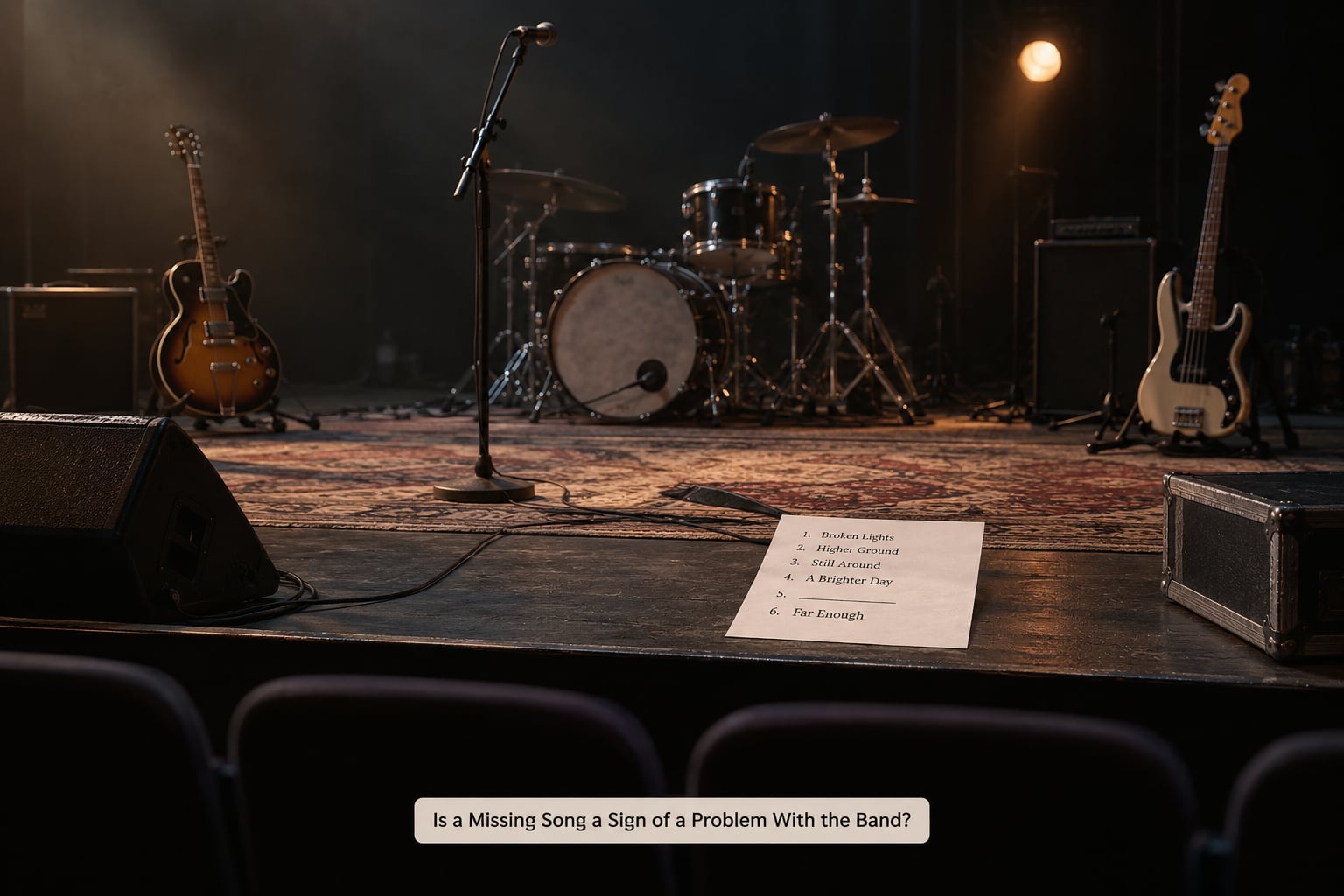
Usually it is arithmetic, not drama. Fans read an omission as a statement because a setlist is the one place a song exists outside the studio recording, so cutting a hit feels like being told the song does not matter to them anymore.
There are a few real warning signs worth caring about: a song missing across every leg of a long tour with no rotation back, an encore slot that never changes, a touring guitarist who no longer appears on that song’s material, or a run of shows with the same songs in the same order and no variation at all.
Those can point to a band playing on autopilot rather than to a band in trouble. Bands going through a change of scenery, a new lineup or a stretch of small difficult rooms will tighten the set and lose the room to experiment.
Everything else is usually rotation. Before you conclude anything, look for the tour and the leg, not just the band, and see how many shows you can actually count.
Frequently Asked Questions
Why does a band not play one of its biggest songs?
Usually because the minutes ran out or the set changed shape. A 60-minute slot holds roughly 15 to 17 songs and a 90-minute slot about 22 to 24, so every new track pushes something else out. New album material is the usual priority on an album tour, with key changes, a new lineup or a licensing block also common causes.
Do bands drop songs because fans do not like them?
That is almost never the reason. A song that never gets played is far more often competing for stage time, inaudible in a loud room, or no longer fitting the current arrangement and lineup. Bands have retired plenty of tracks that fans still rank among their favourites, which is why an omission tells you more about the running order than about demand.
Why do bands change their setlist for different shows?
Because every room imposes a different limit. A venue curfew, a festival day slot and an arena night all allow a different number of songs, and the crew also tailors material to the crowd, the room acoustics and how the voice is holding up. Bands with a large song pool rotate to keep shows varied, while others play an identical run of songs every night of a leg.
Can a band play a hit that it normally avoids?
It happens, and usually it is a deliberate one-off. Bands play retired or rarely played songs for anniversaries, reunion shows, residencies, cover sets or a festival slot built around a specific era. Seeing a deep cut live is often more reliable than hearing an old single, since the older material gets rehearsed properly for those occasions.
How long does a band usually play the same setlist?
A band playing a fixed set often keeps it for a whole leg or a whole tour, sometimes for years. Bands with a rotating pool change the order nightly and may work through 40 to 75 songs over a run of dates, so a song can stay dormant for the length of a tour and come back without warning. Comparing several shows from the same leg tells you which camp you are dealing with.
Should I be worried if my favorite song is missing from a concert?
No, not from one show. A missing song usually means rotation, a shorter slot, a one-night vocal issue or a different arrangement. Check other dates from the same leg, look for the song on setlist.fm, and see whether the band has new material to promote. If it never appears across a whole tour, that is when it reads as a retirement rather than a scheduling decision.
Conclusion
Why bands drop hits from setlists comes down to competition. The slot length is fixed, the song count follows from it, and every new song, key change, lineup swap or festival cut takes minutes away from something else.
Before you read anything into a missing track, count the songs in that show, look at other dates from the same leg, and check whether the band is promoting something new. That will usually explain the gap in about a minute.