A good tribute band show reproduces an artist’s music faithfully enough that every song is instantly recognisable, then rebuilds the parts that made the originals feel special: the vocal phrasing, the movement, the era-correct look, the pacing. Costume similarity on its own has never carried a night. What decides it is whether the illusion holds for forty-five minutes.
The rest of this guide breaks that illusion into seven testable parts, then explains how to build a setlist, handle a bad night, and judge a tribute act before you commit to a ticket. The examples lean toward rock and metal, since that is where the standards tend to be harshest, but the criteria hold anywhere.
Table of Contents
- What Makes a Good Tribute Band Show?
- How Do Tribute Bands Recreate the Original Band’s Sound?
- Study the details listeners actually notice
- Get dynamics right, not just notes
- Know when a keyboard is a shortcut
- Watch the monitor mix and the PA
- How Do You Build a Tribute Band Setlist That Keeps the Crowd Engaged?
- How Important Are Costumes, Visuals, and Stage Presence?
- Match the era, not just the artist
- Stage presence beats a static show
- Know where resemblance stops being homage
- How Do You Handle Mistakes, Requests, and Audience Interaction?
- Recover like a professional
- Have a requests policy and stick to it
- Read the room, do not perform at it
- How Do Bands Create a Respectful and Memorable Tribute Experience?
- Frequently Asked Questions
- What should a tribute band learn before choosing songs?
- Do tribute bands need to look exactly like the original band?
- How long should a tribute band setlist be?
- Should tribute bands perform songs they cannot reproduce accurately?
- How can a tribute band connect with the audience?
- How can fans tell if a tribute show is well performed?
- Conclusion: Start With the Song, Then Build the Show
What Makes a Good Tribute Band Show?
Short version: musical accuracy, vocal character, stage presence, era-correct visuals, a setlist with an arc, showmanship, and clean sound. Any one of those on its own produces a decent night. All seven together produce the shows people still talk about years later.
- Musical accuracy. Notes, timing, tempo and the signature riffs that make a song recognisable. Miss the riff and the audience stops hearing the song they know.
- Vocal character. Not just hitting the notes. Phrasing, breath placement, the little pushed syllables, the way a harmony sits slightly behind the lead.
- Stage presence. Movement, eye contact, stillness at the right moments. Bands that stand in a row and read the music destroy the effect faster than a wrong note.
- Era authenticity. Costume, hair, instruments and gear that belong to a specific period of the artist’s career, not to whatever decade the wardrobe came from.
- Setlist construction. Hits and deep cuts in an order that builds. A show that plays all its best songs in the first fifteen minutes has nowhere to go.
- Showmanship and audience connection. Banter, gestures, the willingness to play off the room instead of running the same show regardless of who shows up.
- Sound and band chemistry. A balanced PA, audible rhythm section, players who listen to each other. Chemistry is visible even to people who could not name it.
Here is how those same criteria look when a show goes wrong.
| Criterion | Weak show | Strong show |
|---|---|---|
| Musical accuracy | Riffs simplified or dropped, tempo drifts by the second verse | Signature parts reproduced, tempo holds from first count to last chord |
| Vocals | Strained high notes, backing harmonies missing or landing late | Phrasing matches the record, harmonies land with the beat |
| Stage presence | Members reading music stands, backs turned during vocals | Movement that traces the original performance, eyes on the room |
| Visuals | Presentable but from no particular era | Gear and wardrobe pinned to a specific year |
| Setlist | Twelve singles in a row, encore dropped | Deliberate arc with pacing breaks and a planned finish |
| Sound | Vocal buried, thin low end, karaoke track doing the work | Band audible, monitor mix clean, real players playing |
How Do Tribute Bands Recreate the Original Band’s Sound?
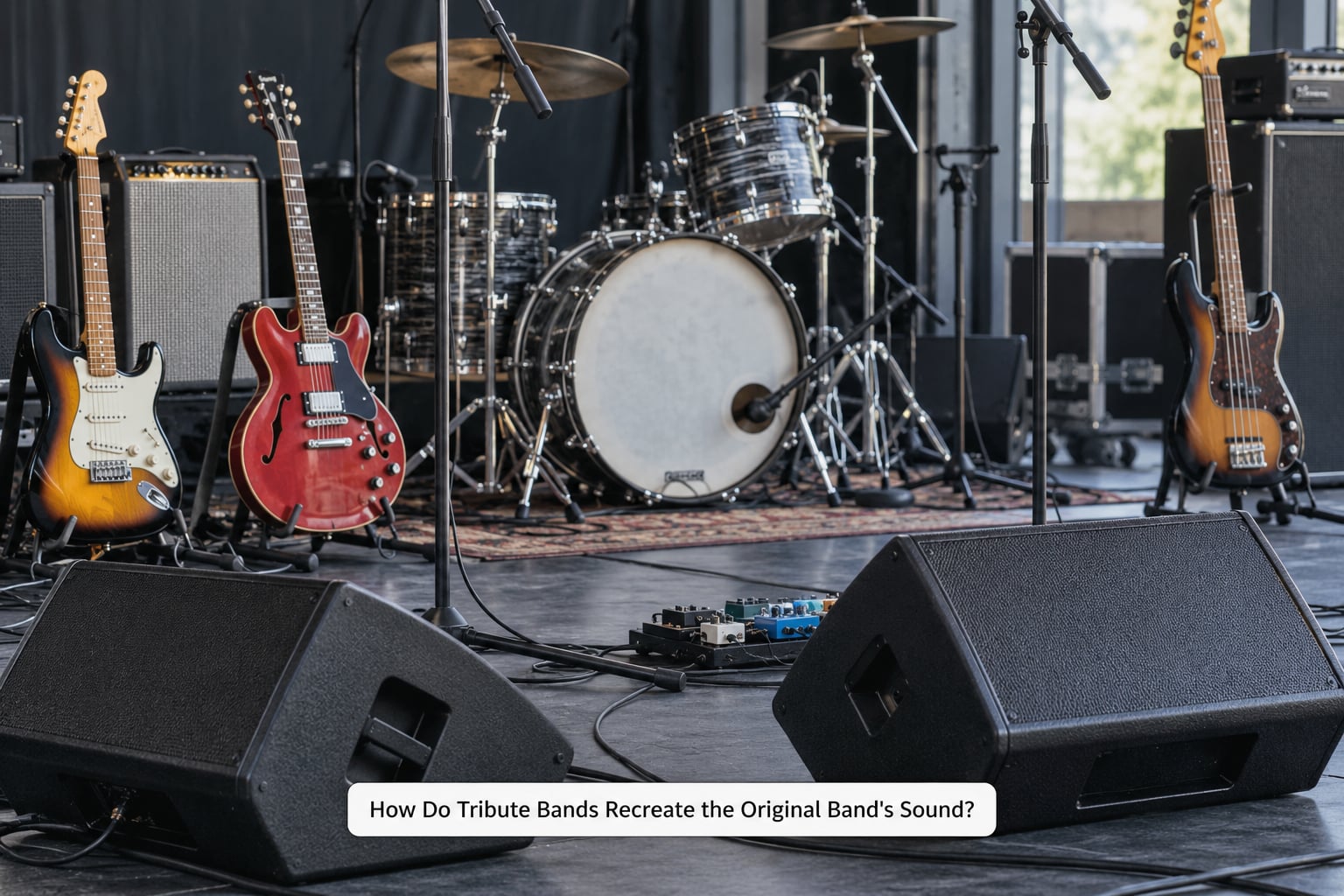
Start with the record, then go find the live version. The studio cut tells you what the song is; the live cut tells you what the show is. A band that only rehearses from a record will sound correct and flat at the same time.
Study the details listeners actually notice
Audiences are not musicians, but they are extremely good at detecting a song that has lost its fingerprint. On TalkBass, players keep returning to the same minimum bar: one artist, songs nailed as recorded, the known attire, similar gear. Notice that nobody in that conversation said a note had to be perfect. They said nailed.
The practical version is a short checklist you can rehearse against. Does the intro riff match the original shape or just the key? Does the band take the bridge at the tempo it was recorded, or does it drift four beats behind by the third chorus? Are the vocal placements the same, or has the singer moved every long note to the beat?
Get dynamics right, not just notes
A flat cover of a song that should feel warm and full is one of the most common complaints in public reviews of tribute shows. Note-perfect playing with no dynamic range sounds like a practice-room demo. The songs that lasted on stage were often built around contrast: quiet verses, sudden loud choruses, a breakdown that drops to almost nothing.
Reproduce that shape. Pull the band down before the chorus instead of just playing louder through it.
Know when a keyboard is a shortcut
Using a keyboard to fake string sections or horn lines comes up constantly as a sore point. It is not cheating in principle, because bands reconfigure lineups all the time. It becomes obvious when the parts are wrong or when the players on stage are not actually making the noise the audience hears.
The same goes for backing tracks. Most successful tribute shows run a backing track of some kind for backing vocals or for songs with parts the lineup cannot cover. It stops working the moment it becomes the show. Watch for the tell: a band that looks busy while the track carries the arrangement.
Watch the monitor mix and the PA
Most of what audiences describe as a bad vocal actually happens in the monitors. When a singer turns away from the mic, the mix can drop, and the whole room notices without knowing why. It is the single most common technical complaint in show reviews, and it is one of the easiest things for a band to fix in rehearsal with the venue’s engineer.
How Do You Build a Tribute Band Setlist That Keeps the Crowd Engaged?
A setlist is an argument about order. Two bands playing the same twelve songs in a different order produce two completely different shows.
- Open with something that proves you can play. A strong, familiar opener with a recognised opening gesture. Not the single everyone shouts requests for.
- Build an arc, not a playlist. Alternate energy levels. Two fast songs in a row flatten the impact of the second.
- Reserve two songs for late in the set. Deep cuts reward a paying audience and give the show a shape that a singles-only setlist cannot.
- Pick one era and own it, or cover several deliberately. Fans on r/Genesis consistently reward acts that represent a coherent mix of periods rather than leaning on one. That works for costume and wardrobe too: choose a stretch and commit, or be visibly about more than one decade.
- Plan the ending. The last song should feel like an ending, not like the set ran out. If you are playing an encore, pick it before the set, not after.
On length, most club and theatre tribute shows land somewhere between sixty and ninety minutes of music, with a changeover or an interval in longer productions. Two 45-minute sets with a break tends to beat one long block, because attention drops somewhere around the fifty-minute mark no matter how good the band is.
One more practical habit: post the setlist in advance when you can. Fans who know what they are getting for their money complain far less, and they arrive ready to listen instead of ready to be surprised.
How Important Are Costumes, Visuals, and Stage Presence?
Important, but they are the second half of the job rather than the first. Nobody in the audience cares about a period-correct jacket if the harmony vocals never arrive.
Match the era, not just the artist
A band can look exactly like the artist and still evoke nothing in particular, because they have mixed 1974 and 1991 in the same set. The stronger choice is to pick a window and stay inside it: the wardrobe, the hair, the guitars, the amps, and the setlist all pointing at the same year.
Instrument matching is where most tribute bands notice the biggest lift. Copying the guitars and amps the artist actually used changes how the band plays, not just how it looks. Players who switch to a different instrument to match the original often find the riffs fall out of their hands more easily.
Stage presence beats a static show
Good stage presence is not constant motion. It is knowing which parts of the song demand movement, which want stillness, and where the frontman should stop walking and let a riff land. Rehearse the gestures along with the songs, because unplanned movement looks like fidgeting.
Know where resemblance stops being homage
There is a line between playing the part and impersonating the person, and it is thinner than most bands expect. What tips it over is usually parody: comedy accents, winks at the crowd about how old the artist is, material chosen because it is easy to mock. Fans forgive wrong notes far more readily than they forgive a joke at the expense of the music.
A useful test: would the show still work if the costumes were identical to the original but nobody in the band ever said a word about who they are playing? If yes, the musical spine is solid.
How Do You Handle Mistakes, Requests, and Audience Interaction?
Something goes wrong in nearly every show. A note is dropped, a cue is missed, someone in the crowd asks for a song the band has never played. What happens next is the clearest signal of whether the act is any good.
Recover like a professional
Keep playing. Most mistakes are audible for a few seconds and invisible in context, and the recovery that works almost every time is carrying on as though nothing happened. A band that grimaces at each other, stops, and restarts the verse has turned a small error into the thing the audience talks about later.
The one exception is a technical failure. If the vocal drops or the sound cuts, an audience will forgive a short pause and a quick word from the front of the stage. Silence with no explanation is what people remember.
Have a requests policy and stick to it
Say at the start of the night what you will and will not play. Bands that promise anything and deliver nothing lose the room; bands that hold a line and explain it warmly keep it. A short spoken intro is enough: what the show covers, how long it runs, and that requests are welcome at the end.
Read the room, do not perform at it
Audience interaction works when it is real and works badly when it is scripted. Singers who watch the crowd and adjust phrasing, tempo of the banter, or whether they hold a note longer will feel connected to almost anyone. Shouting a joke into a silent room will not.
How Do Bands Create a Respectful and Memorable Tribute Experience?
There is a reasonable complaint that tribute acts have turned live music into paint by numbers, and the people making the best shows are the ones answering it rather than ignoring it. Respect here means the material is served seriously, the band’s own identity stays in the background, and nobody is used as a punchline.
Before the show, three checks do most of the work. Can every member play the set cold, not just the songs they know? Is the wardrobe genuinely era-matched? Has anyone listened to the setlist end to end recently and marked the places where energy dips?
During the show, the standard is simpler: does the audience leave able to sing or hum something they could not hum when they walked in. If the answer is yes, the show did its job.
After the show, ask people who were there two questions. Which song worked, and which one did not. The second answer is worth more than the first.
One more idea worth borrowing from fans: score a show song by song out of ten when you get home. A detailed public review of a Beatles tribute set gave a track with flawless vocals and harmonies a full 10, a fraction less to one that leaned on simulated crowd vocals, and a middling score to a single that should have been the safest thing in the set, then still rated the whole evening highly. That pattern is the honest version of how most people experience these shows: individual songs are imperfect, the evening as a whole still lands.
That is also the closest thing to a useful scoring framework for anyone weighing up a tribute act. Score the songs, note where the score dips, and look for a pattern. One weak song is a bad night in the making. Weak songs spread across the set is a band that has not done the work.
Frequently Asked Questions
What should a tribute band learn before choosing songs?
Learn the artist before you pick anything. Go back to the earliest records and listen in order, then find live footage from the era you want to represent. Notice phrasing, tempo, key changes, which instruments carry which part, and where the band drops or adds energy. Choose a window first and let the songs fall out of it.
Do tribute bands need to look exactly like the original band?
No. Matching the era matters more than matching any individual detail, and nothing beats the music. A band in the right clothes playing the songs better than a band in a costume and a wig will win the night every time. Set the wardrobe to a specific year, get the instruments close, and spend the saved effort on rehearsal.
How long should a tribute band setlist be?
For a club or theatre show, aim for sixty to ninety minutes of music. That usually means two sets of about forty-five minutes with a break, which works better than one long block because attention dips somewhere around the fifty-minute mark. Longer productions run longer, but the pacing rule holds: alternate energy levels and save your strongest material for late in the set.
Should tribute bands perform songs they cannot reproduce accurately?
Not unless the inaccuracy is the joke. Songs whose entire identity is a signature riff or a set vocal phrase fall apart when those details are missing, and audiences notice even when they cannot name what is wrong. You can cover the easy part and be honest about it. What kills credibility is playing a song the band plainly has not learned.
How can a tribute band connect with the audience?
Watch the room and respond to it instead of delivering the same show to whoever shows up. A short spoken intro explaining the show and the length works better than silence. Banter helps when it is warm and reading the crowd helps more. Play a deep cut well and the connection usually follows, because fans remember being shown something they did not expect.
How can fans tell if a tribute show is well performed?
Listen for three things in the first two songs: whether the vocal level stays steady, whether the signature parts of each song are there, and whether the backing harmonies land on time. Watch whether the musicians are playing or miming along to a track. If the band recovers smoothly from a mistake instead of stopping, that is usually a good sign about everything else.
Conclusion: Start With the Song, Then Build the Show
What makes a good tribute band show good comes down to whether the illusion survives contact with the audience. Get the songs right first: the riffs, the phrasing, the dynamics, the tempo that holds all the way through the third chorus. Everything after that, the wardrobe, the movement, the banter, adds to a show that already works instead of rescuing one that does not.
The first thing to do, whether you are in the band or in the audience, is pick one signature song and judge everything else against it. If the essential parts of that one song are there, you are probably looking at a good show. If they are not, no amount of costume will fix it.