Vinyl records warp because heat softens the PVC, uneven pressure bends it while it is soft, and time locks the bend in. Cool it back down and the new curve stays. That is the whole mechanism, and every prevention habit worth having comes straight out of it.
If you have ever pulled an album out of a crate in summer and felt the disc flex under your thumb, you already know the shape of this problem. Warped records skip, mistrack, wander in pitch, and put extra load on the stylus. Once a warp is set it is essentially permanent, so prevention is a far better deal than repair.
Updated for 2026. Here are the causes, in the order they usually do damage:
- Direct sunlight on the shelf, warming one edge of the disc
- A parked car, attic, garage or shed with no temperature control
- Long flat stacks where the weight of albums presses the ones beneath
- Records stored for years in tight shrink wrap or inners
- Fast temperature swings, such as a cold car to a warm room
- Radiators, appliances and fireplaces on the same wall as the shelf
- Poor cooling after pressing, which is why new records arrive bowed
The collector community has compressed all of that into a phrase you will hear again and again on r/vinyl: heat, pressure and time. Take away any one of the three and the disc usually survives.
Table of Contents
- What You Need to Prevent Vinyl Records From Warping
- Why Vinyl Records Warp and How to Prevent It: Step by Step
- 1. Keep Records Away From Heat and Direct Sunlight
- 2. Store Records Upright With Even Support
- 3. Control Temperature and Humidity to Stop Vinyl Records Warping
- 4. Protect Records During Handling and Playback
- 5. Inspect and Store New or Used Records Correctly
- Common Mistakes
- Frequently Asked Questions
- Can a warped vinyl record be fixed?
- What temperature should vinyl records be stored at?
- Does humidity warp vinyl records?
- Can you flatten a warped record with heat?
- Why does a record warp when it is only slightly curved?
- How should records be stored in a small apartment?
- Conclusion
What You Need to Prevent Vinyl Records From Warping
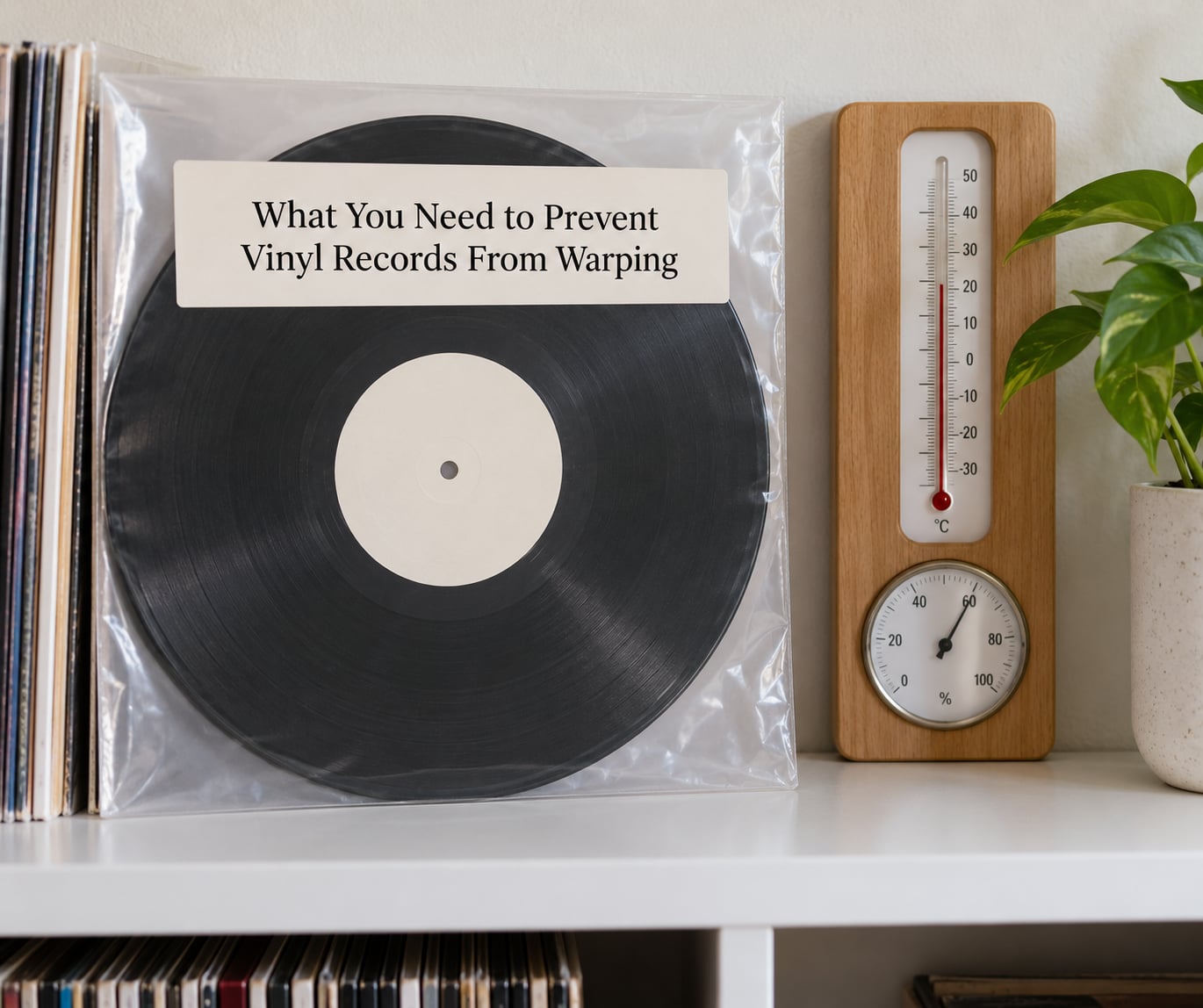
None of this is expensive gear. A working thermometer, a cheap hygrometer and a solid shelf solve most of the problem.
- A cool, stable indoor spot. An interior wall, ideally in a room you use regularly so the temperature does not swing overnight. Avoid exterior walls, radiators, airing cupboards, loft hatches and anything above a radiator.
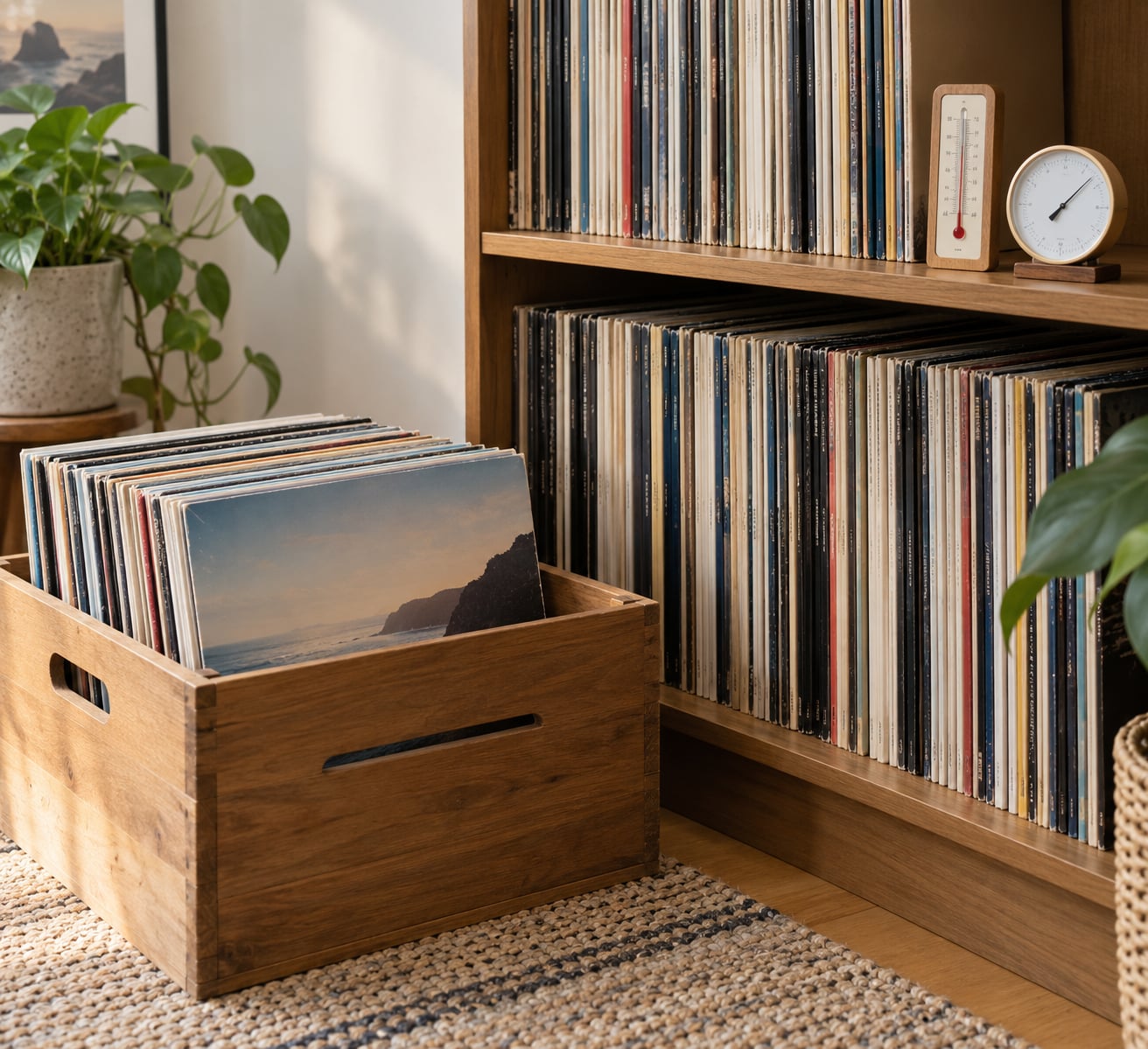
- A thermometer and a hygrometer. Cheap combined units are fine. You want to read numbers rather than guess, because a room that feels fine to you can be doing 75°F and climbing at midnight.
- A proper record shelf. Solid, level, and stiff enough not to bow in the middle. Particle board furniture that sags under a full crate is a warp factory. Check it with a level after loading.
- Dividers or shelf lips. Upright albums lean into each other unless something stops them. Vinyl dividers, bookends or a lip on the shelf edge keep spines straight and pressure even.
- Inner sleeves and, where useful, outer sleeves. Polypropylene or polyethylene inners keep jackets from scuffing and reduce the friction that can twist a disc in its sleeve. Outer sleeves protect artwork from shelf wear on records you play often.
- A dry cleaning routine. A soft brush, a carbon-fibre brush and a damp cloth for the shelf. Mould and mildew on jackets are permanent, and damp jackets invite both.
Why Vinyl Records Warp and How to Prevent It: Step by Step
1. Keep Records Away From Heat and Direct Sunlight
Vinyl is a rigid plastic with a narrow working window. It does not need to melt for it to move. When a record warms up, the outer edge and the label area expand at different rates, and if anything is leaning on it or pressing it flat, the softened disc bends to fit.
Black vinyl is the worst case because the pigment absorbs sunlight and converts it straight into heat inside the disc. A west-facing window in the afternoon is one of the most reliable ways to ruin a shelf without ever touching it.
| What happens to the record | Temperature | What you will notice |
|---|---|---|
| Softening begins | About 120-140°F (49-60°C) | Flexible edge, slight give when you press the rim |
| Warps under lean or weight | About 170°F (77°C) | Visible curve, sticking to the surface below |
| Melting range | 212°F (100°C) and above | Deformed, stuck, ridged or fused discs |
None of those numbers require a fire. A closed car on a summer afternoon passes 120°F easily, and collectors on r/vinyl and the Stereonet boards report records coming out of a parked car visibly bent after well under an hour. The useful rule of thumb from the forums: if a pet could not safely sit in the car, vinyl cannot either.
The usual culprits in a home are the radiator wall, a boiler or appliance cupboard, a games console or amplifier stack, a skylight, and a bay window facing west. Walk to your shelf and work out what is radiating or shining within a metre or two. Then move the shelf, not the records, if you can.
2. Store Records Upright With Even Support
Flat stacking is the habit most collectors are proudest of and most likely to regret. Every album in a tall stack presses the ones under it. The bottom twenty in a stack of two hundred sit under thousands of grams, and over years the PVC creeps.
Store records vertically, spine out, like books. Fill a shelf to roughly three-quarters, which stops albums sliding sideways into a lean, but do not pack it solid. A record leaning at an angle for months is a record leaning at an angle for months.
Two more things matter here. Never rest a shelf on a sagging wardrobe rail or a bed base, because the whole shelf curves and the whole collection curves with it. And when you pull an album out, hold it by the edges with both hands rather than gripping the label area, which puts your thumb pressure in one spot on the disc.
3. Control Temperature and Humidity to Stop Vinyl Records Warping
Aim for a steady 65-70°F (18-21°C) and roughly 45-50% relative humidity. The steadiness matters more than the exact number. A room held at 68°F day and night is better for vinyl than a room that touches 66°F in the morning and 76°F in the afternoon.
Most storage guides skip the part that matters most here, and it is not only the peak temperature that bends a disc. It is the change. A record that has been in a cold car for an hour and then comes straight into a heated room can pick up stress the same way a cold glass dish cracks under hot water. Collectors on r/vinyl consistently describe this as a bigger factor than steady heat.
The practical habit: when you bring records in from a car, a garage or a cold attic, keep them in their sleeve and let them sit until they reach room temperature before you handle them or put them on the shelf. An hour or two is plenty.
Humidity swings cause their own damage. Paper jackets and cardboard gatefolds absorb moisture and release it, so a sleeve that swells during a humid spell and shrinks again in winter can end up with a split seam and a crooked-looking record inside it. A hygrometer on the shelf tells you when the room needs a dehumidifier or a closed window.
4. Protect Records During Handling and Playback
Wash and dry your hands before you touch a record. Skin oil and moisture on the groove surface attract dust, and dust is what gets dragged under the stylus. It also grips the disc, which is how a record ends up half out of its sleeve at an angle.
Slide the record out of the sleeve rather than pulling it straight up, support it with a hand on each edge, and never hold a record by the rim with one hand while reaching for the turntable. When you take a pile to a friend, carry it flat with both hands or in a crate, not pressed against your chest.
For moving house, upright is still the answer. Pack records in sturdy record mailers or cardboard boxes, fill every gap with packing paper so nothing shifts, and keep the boxes out of the sun during the move. Whatever you do, do not park a box of vinyl in a van that is standing in the sun on moving day. That is the single most common way a collection is lost to warping.
On the turntable, a correctly aligned deck with a firm tracking force setting handles a mild warp without drama. Entry-level players with a light floating tonearm are less forgiving, and a badly aligned one will make a modest warp sound far worse than it is. If a warped record warbles and skips, drop the cue weight a fraction or try a firmer arm before you decide the record is ruined.
5. Inspect and Store New or Used Records Correctly
New pressings arrive warped more often than they used to, and the reason is in the factory. Vinyl is pressed hot, cooled quickly, then packed while demand is high. Fast cooling and tight shrink wrap together leave a disc with tension still in it, and containers sitting in summer heat do the rest.
So check on arrival. Look at the disc edge-on against a light source and look for a curve, look at it reflected in a window or a phone screen, and drop it onto a flat table to see if it rocks. Check the label edges too, since a good warp can hide under the label. Then play it and listen for pitch wobble, skipping on the first track or a repeated chirp.
Give new records a day or two out of the packaging before you judge them, then store them upright with breathing room. If one is badly warped out of the box, photograph it before and after your attempt at a fix, because that is your evidence if you decide to ask the seller for a replacement. That advice comes straight from the forum consensus: a mildly warped record you can play, you keep, and one that skips from the first second is a return.
| Severity | What it looks and sounds like | What to do |
|---|---|---|
| Mild | Very slight curve, no audible pitch drift, plays through without a single skip | Keep it. Store upright and stop worrying about it |
| Moderate | Visible edge bend, tone wavers in quiet passages, occasional skip on the inner tracks | Try the book-weight method for two weeks, then reassess |
| Severe | Rocks on the table, sticks to the sleeve or the album below it, skips constantly | Use a pressing machine or a record shop service, or replace it |
Common Mistakes
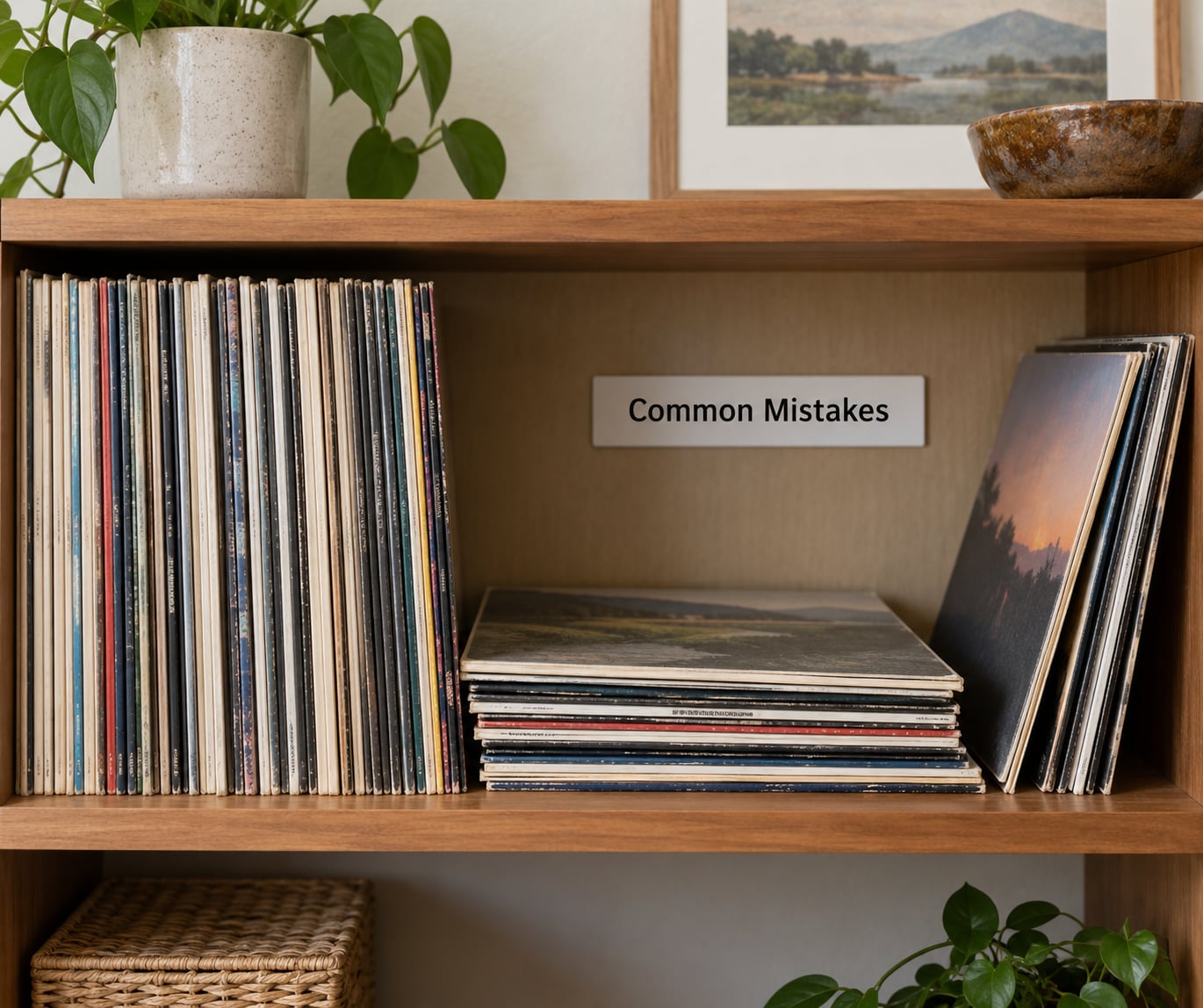
Almost every warped record I have come across had one of these six problems behind it, and almost every one of them is fixable in an afternoon.
- Leaning albums against a wall or on a shelf. Fix: dividers or a shelf lip so nothing leans. A permanent lean becomes a permanent curve.
- Leaving records in a car, attic, garage or shed. Fix: treat any vehicle and any unheated space as temporary storage only, and never overnight.
- Gripping the label or the middle of the disc. Fix: hold both edges. Thumb pressure in the middle of a soft disc is a thumbprint-shaped warp.
- Stacking records flat and heavy. Fix: upright storage only. If you must stack for transport, keep the stack short and never leave it that way for more than a few days.
- Pulling records out with damp or freshly washed hands. Fix: dry hands every time. A wet fingerprint holds the disc against the sleeve and twists it as you slide it out.
- Ignoring what the hygrometer says. Fix: check it monthly, especially in summer. If it reads above 60% for days, run a dehumidifier or move the collection to a drier room.
And a warning list, because the DIY advice online is genuinely mixed. Do not put a record in an uncontrolled oven, because that is how grooves, dynamics and labels get permanently damaged rather than fixed. Do not use a hair dryer or heat gun, for the same reason with less control. Do not lean heavy books on a warped record for a day and call it repaired; the pressure needs weeks, not hours. Do not park a shelf of records in direct sun hoping to dry damp jackets.
Frequently Asked Questions
Can a warped vinyl record be fixed?
Sometimes, and the milder the warp the better your odds. A record with a slight dish often relaxes on its own after a few weeks of upright storage. Moderate warps usually respond to two weeks under heavy books between flat glass sheets. Severe warps that rock on a table or stick to the sleeve rarely come back, and heat-based methods risk damaging the grooves permanently. The community rule of thumb is simple: if it plays, it stays.
What temperature should vinyl records be stored at?
Between 65°F and 70°F (18-21°C) is the target, and stability matters more than precision. Vinyl starts to soften around 120-140°F (49-60°C) and warps under weight near 170°F (77°C), but records can also pick up stress from a fast jump between cold and warm. Avoid radiators, exterior walls, west-facing windows and unheated attics, and read a thermometer rather than trusting how the room feels.
Does humidity warp vinyl records?
Humidity is more of an indirect problem than a direct one. Vinyl itself barely responds to normal indoor humidity, but the paper jacket and cardboard gatefold around it absorb and release moisture, and those repeated cycles swell and shrink the sleeve, split seams and leave the disc sitting crooked. Keeping relative humidity near 45-50% protects the packaging and makes the whole shelf more stable.
Can you flatten a warped record with heat?
You can, but it is the riskiest option and results are not guaranteed. Controlled heat relaxes the PVC so gentle pressure can reshape it, yet excess heat also permanently alters the groove surface, softens labels and reduces the dynamic range you paid for. Heat plus books is the only fix that survives first-hand accounts, and serious warps are better handled with a dedicated record flattening machine or a pressing plant.
Why does a record warp when it is only slightly curved?
A gentle curve is usually a sign of uneven stress rather than visible damage. The outer edge and the label area cool and shrink at different rates, so the disc carries a built-in tension that shows up as a slight bow even when nothing obvious happened to it. Collectors also report the sudden-curve case, where a record from a cold car warms in a heated room and flexes within the hour. Check for it and correct the cause, but a mild curve alone is not a reason to discard a record.
How should records be stored in a small apartment?
Upright, spine out, in the coolest stable spot you have, with nothing heavy resting on the collection. A metre-wide shelving tower tucked against an interior wall works better than a low shelf under a window, and rotating between two towers beats overfilling one. Use dividers so albums stand square, keep the shelves about three-quarters full, add a thermometer and hygrometer, and keep records off the floor if you are in a ground-floor flat with any damp at all.
Conclusion
Start today by walking to your shelf and moving it off any heat source. Then check that every record is standing upright with dividers, and put a thermometer and hygrometer on the shelf so you stop guessing at the conditions.
From there, handle discs by the edges with dry hands, keep them out of parked cars and unheated rooms, and let cold records acclimate in their sleeve before you shelve them. If a record has already gone, judge it against the severity table above: mild warps are normal and not worth fixing, moderate ones deserve two weeks under books between flat glass, and anything severe belongs with a pressing service or on the replacement list.