
How band royalties are split comes down to two separate copyrights in every song. The composition copyright pays the writers, and the sound recording copyright pays the performers, producer and label. Each side is divided by its own agreement, so a member can earn from one and nothing from the other.
That is the short version. The longer version involves three different split models, a stack of deductions, a recoupment clause that can swallow a record’s entire earnings, and a payment chain with six or seven companies in it. Bands that understand the chain get paid. Bands that skip the paperwork spend years arguing about money that went somewhere nobody can name.
Here is how it actually works, from the songwriters’ table outward.
Table of Contents
- What Are Band Royalties and Who Gets Paid?
- How Band Royalties Are Split Across Different Income Sources
- Who Sits Between the Song and the Bank Account
- What Income Does a Band Usually Split?
- How Band Royalties Are Split in Practice: The Three Common Models
- What Deductions Can Reduce a Band’s Royalty Income?
- How Do Contracts and Recoupment Change the Final Split?
- When Do Royalties Actually End?
- Frequently Asked Questions
- Should every band member receive the same percentage of royalties?
- Are royalties paid directly to each band member?
- How are royalties split for an independent band?
- Can a band member take a larger share to cover extra expenses?
- What happens to royalties when a musician leaves a band?
- Conclusion: Start With a Written Split
What Are Band Royalties and Who Gets Paid?
A royalty is payment for letting someone use your work, rather than a fee for a service. A producer who records your album for a flat payment is doing work for hire; a producer who takes a percentage of the master is holding a piece of the copyright and collecting rent on it.
That distinction matters because royalties keep arriving long after the invoice is paid. A one-off studio fee ends the day the session ends. A master royalty arrives every quarter for as long as somebody streams, sells, licenses or broadcasts the recording.
How Band Royalties Are Split Across Different Income Sources
Every recording carries two copyrights, and each copyright generates several kinds of income. How band royalties are split across those sources depends on which right the income belongs to.
| Income source | Copyright it belongs to | Who collects | How the band divides it |
|---|---|---|---|
| Streaming | Composition and master, both | Distributor, then PRO for the publishing side | Publishing split by writer shares; master split by master shares |
| Digital downloads | Master, with a mechanical on the composition | Distributor | Master split only, after distributor commission |
| Physical sales | Master | Distributor, then retailer | Wholesale and retail cuts come out first |
| Radio and TV airplay | Composition | PRO or CMO via the publisher | By writer share, regardless of who plays it |
| Sync licensing | Composition and master | Publisher and master owner separately | Two separate negotiations, two separate splits |
| Live shows | Neither. It is a performance fee | The promoter pays the band | After expenses, usually a fixed number of cuts plus a band fund |
| Merchandise | Neither. It is goods income | The band’s company or a seller | After production cost, by whatever split the band agreed |
The last two rows are where most confusion starts. Touring income and merch income are not royalties and are not governed by copyright law. Bands can call them whatever they like internally, but they are negotiated per show and per order.
Who Sits Between the Song and the Bank Account
A dollar earned in a bar in Berlin might pass through six parties before it reaches a band account. The promoter pays the guarantee, the venue takes a cut of the door, the tour manager holds the cash, the accountant reconciles expenses, the distributor takes a commission on recorded income, and the publisher or administrator pays out the writing side.
On the publishing side specifically, four names usually appear. The publisher is the company that registered the song and collects on it. The administrator does the paperwork for the publisher and takes a fee, typically 10 to 20 percent of receipts. The subpublisher is a regional company handling certain territories. The performing rights organization, or PRO, is the society that collects performance royalties from radio, TV, live venues and streaming services, then pays them out to members.
In the United States that PRO is usually ASCAP, BMI or SESAC. Outside the US you are more likely to deal with a collecting society such as PRS, APRA AMCOS, GEMA or SOCAN, which handles both the publishing and the recording side for its members. PROs pay out on a lag. Six to twelve months is normal, and it can run longer for unmatched or incorrectly registered works.
What Income Does a Band Usually Split?
Royalties are only one line in a band’s income picture, and usually not the biggest one. Most working bands run two parallel systems that look identical on paper and behave completely differently.
The first system is income splitting. This covers gig guarantees, merch, session work and one-off payments. It is money for services rendered, so it is negotiated, taxed as earned income, and usually divided after expenses. A common pattern on a small tour is six ways: one cut per member plus one cut into a band fund for rehearsal-room costs, strings, cymbals and van repairs.
The second system is royalty splitting. This covers the composition and master rights, and it is governed by the ownership percentages recorded on a split sheet. It runs for years and follows the song rather than the show.
Keep them apart in your bookkeeping. A band that splits gig money six ways and then applies a percentage royalty split on top is double-counting, and the argument about why the bank balance is wrong usually starts there.
Gross revenue rarely survives contact with the bank. A show that grosses $1,600 may hand the band $400 after the guarantee is calculated, door costs, support act and crew payments come out, and the promoter’s commission is taken. That remainder is the only figure worth splitting.
How Band Royalties Are Split in Practice: The Three Common Models
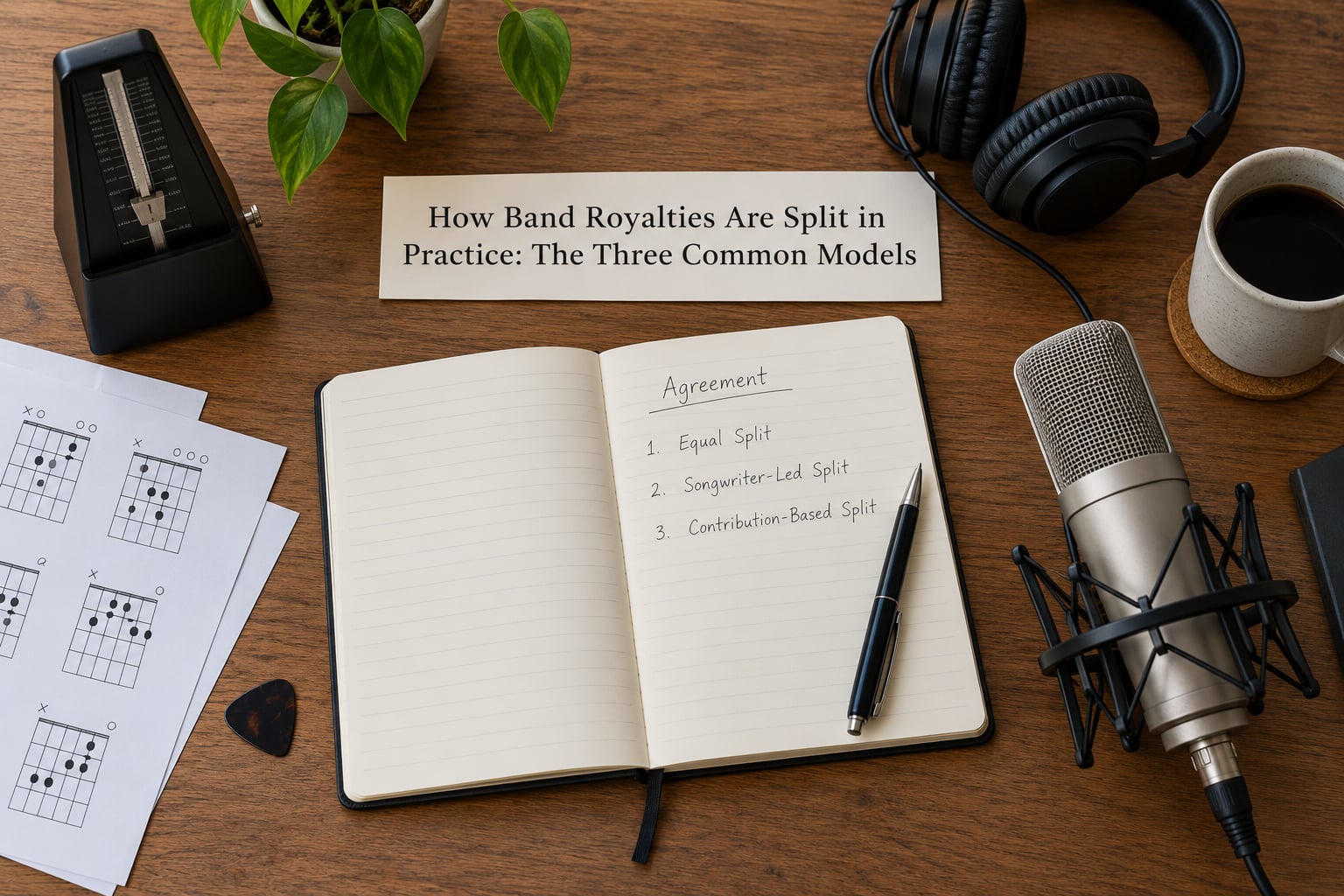
Three split models cover almost every band. The rest are variations, and the differences between them are mostly about whose name goes on the top line of a split sheet.
| Model | How it works | Who it favours | Where it goes wrong |
|---|---|---|---|
| Even split | Every member takes an identical percentage of both copyrights | Band harmony, simple administration | Resentment builds quietly when one member writes everything |
| Contribution-weighted split | Shares track actual writing input, song by song | The main writer, accuracy in law | Arguments over a single line, and nobody can agree to the paperwork |
| Role-based split | Fixed shares by job title, with a pool for the band | Stable line-ups, producer and session player clarity | Underpays the person who actually does the writing |
| Label-deal split | The label owns part or all of the master; the band takes the rest | Certainty of funding and promotion | Recoupment, cross-collateralization and long terms |
U2 agreed from the early days to divide everything equally among the four members, a widely reported arrangement that is often credited with the band’s longevity. Coldplay have long said publicly that the four of them share composition income equally, which is the same idea reached from a different starting point. These are deliberate choices, and the reasoning is straightforward: money disputes are the single most reliable way to end a band.
The opposite case is The Police. Sting wrote most of the material and took the majority of the songwriting royalties, while Andy Summers and Stewart Copeland collected performance royalties on the master side. The gap between those two income streams sat unresolved for roughly four decades and ended in litigation. It is the canonical warning in every songwriting course I have read, and it is still the answer when a band asks whether a lead songwriter deserves more than the rest.
The Beatles operated a version of the role-based model: Lennon and McCartney held the publishing, and the four of them were listed as performers and authors with the labels and publishers handling administration. That is why their catalogue administration is still a maze of estates, whereas a current band with clean registration can usually trace a stream to a person in an afternoon.
Nashville contributes its own convention. The “one word, one third” rule divides a song three ways among writers regardless of who contributed more, and it has spread well outside Nashville. Bands elsewhere often borrow it as a neutral starting point, which tells you something about how uncomfortable pure contribution weighting can be in a rehearsal room.
What Deductions Can Reduce a Band’s Royalty Income?
A royalty statement shows a gross figure and a net figure, and the difference is where most of the disappointment lives. Common deductions fall into four groups.
Recording and development costs. Studio time, engineering, mixing, mastering, session players, instruments, tuning, artwork, photography and the music video. These are usually recouped from the master share rather than deducted at payment time, which is the same result with extra steps.
Promotion and marketing. Radio plugging, press, advertising, publicists and touring support. Bands often sign these without reading the recoupment section closely, then discover the marketing spend is being recovered from album royalties for years.
Operating deductions. Distributor commission, administration fees, publishing administration, collection society fees, and management commissions of 15 to 20 percent. Some of these are ordinary business costs. Others are vague enough to be worth challenging, particularly a management fee charged against income that has already had a commission taken.
Taxes and withholding. Royalties arriving from overseas are often subject to withholding tax that can be reclaimed with a treaty form. Bands that never file the paperwork simply lose that portion permanently.
Ask any booking agent or tour manager and you will hear the same answer: the paperwork gap is the real enemy. Bands that skip split sheets find royalties credited to “unidentified writer” and uncollectable, not because anyone is withholding them but because nobody claimed them in time.
How Do Contracts and Recoupment Change the Final Split?
A split sheet tells you how to divide income. A recording contract tells you how much of it survives to be divided. The second document changes the first one completely.
Advances are a payment against future royalties, not a gift. A band signs for a $300,000 advance, and the label recoups it from master and artist royalties before the band receives anything. Recoupment means the label recovers its costs first. Cross-collateralization means the label can recover the costs of your second record from the earnings of your first, and often the reverse.
Here is the arithmetic. A label spends $8,200 on a record, covering recording, instrumentals, artwork and a modest marketing push. The band receives an advance that the label counts toward that figure. Until cumulative royalties exceed $8,200, the band’s royalty statements show deductions with no income beside them. That is not an accounting error, it is the deal working as written.
Reversion matters more than bands expect. If the label has not recouped by the end of the contract term, the master usually comes back to the band. A term measured in the twenties means the reversion is worth little in practice.
Other clauses to read closely: who owns the master and the publishing, how long the term runs, whether there is an option on further albums, and how the deal ends if a member departs. Audit rights are worth checking too, because a band with no right to see the label’s statements cannot verify what was deducted.
When Do Royalties Actually End?
Royalties do not run forever, but the answer is more generous than most people expect. For musical compositions, the copyright runs for the life of the last surviving author plus 70 years in most countries. Once that period closes, the song enters the public domain and the royalty stream stops.
Sound recordings were treated differently and received a longer term. Under the current US rules for modern recordings, protection runs 95 years from publication or 120 years from creation, whichever is shorter. Older recordings sit under the rules that applied when they were made, and pre-1972 American recordings are still governed by a patchwork of state law and separate federal legislation.
For a band, this rarely matters. The practical point is that a catalogue assembled with clean registration keeps paying for decades, while a catalogue with incomplete metadata stops paying quietly, because unmatched royalties cannot be traced to a writer.
Frequently Asked Questions
Should every band member receive the same percentage of royalties?
An even split is the most common choice in working bands because it removes the argument before it starts. It works best when contributions are broadly similar. When one member writes most of the material, an even split on the composition side often causes quiet resentment that surfaces years later. A practical middle route is an even split on the master and a weighted split on songwriting, agreed song by song in writing before release.
Are royalties paid directly to each band member?
Rarely. On the composition side the money goes to the publisher or administrator, which pays writers according to the shares on record with the performing rights organization. On the master side it goes from the distributor or label to the account holders listed on that split sheet. If the metadata is wrong or a share is unclaimed, the payment is held or credited to an unidentified party rather than reaching the person who earned it.
How are royalties split for an independent band?
An independent band splits each copyright among its own members and pays a distributor commission, usually 5 to 10 percent of receipts, before splitting the rest. Some distributors also take a small fee for rights administration on the publishing side. The band registers its compositions directly with its performing rights organization as a publisher and splits writer shares there. Bands that release their own music keep the majority of master income.
Can a band member take a larger share to cover extra expenses?
Extra expenses are usually handled outside the royalty split. Paying a member more to cover their own costs blurs ownership with reimbursement and creates tax and legal messiness. Cleaner methods include paying a fixed monthly retainer charged to the band’s expenses, or splitting gig and merch income after expenses so everyone absorbs a proportion. Royalty ownership should reflect contribution and agreement, not reimbursement needs.
What happens to royalties when a musician leaves a band?
Without a written agreement, ownership usually follows the split sheet, which means a departing member keeps the share registered in their name on songs they helped write. Many bands instead buy those shares out, or agree that compositions stay with the band while the departing member keeps performance income. The master side depends entirely on the label contract. Unrecouped advances complicate everything further, because the departing member’s songs may still be paying off a debt they no longer share.
Conclusion: Start With a Written Split
The first thing to do is small and unglamorous. List every source of band income, write down which copyright each one belongs to, and name every person entitled to a share of it. Then agree the percentages, the deductions you will accept, the payment schedule, your audit rights and what happens to the split if someone leaves.
That single page, signed by everyone before the song is released, prevents nearly every problem described in this guide. Splitting music well is not about finding a clever percentage. It is about deciding who owns what, in writing, before the money creates its own opinions.