A live album adds a documented performance of existing songs to a discography: the same material, captured at one moment, in one room, by one line-up. What a live album adds to a discography is rarely new songwriting. It is interpretation, proof of how a band developed, and a record of who stood on stage that night.
That sounds modest next to a studio record, which is built from scratch over weeks. But a good live album answers questions no studio record can. It shows you a guitar solo that only existed in front of a crowd. It captures a singer finding a song for the first time. It keeps a line-up alive on disc after that line-up is gone.
Metal fans tend to notice this more than most genres, probably because metal shows are loud, physical and heavily dependent on chemistry. A breakdown that works on a record can fall flat at 8pm in an arena, and a simple riff can turn into something physical in a room where everyone can hear the drummer. The record of that is a second layer on the catalogue, not a duplicate of it.
Table of Contents
- What a Live Album Adds to a Discography
- How a Live Album Differs from a Studio Recording
- Why Performance Can Reveal a Band’s Evolution
- The Different Ways a Live Album Expands the Music
- Which Live Recordings Are Most Valuable to Collectors?
- What a Live Album Adds to a Collector Beyond the Recording
- How to Listen to a Live Album Without Expecting a Studio Clone
- When a Live Album Is Essential, and When It Is Optional
- Frequently Asked Questions
- What is a live album, and how is it different from a studio recording?
- Why do bands release live albums?
- Are live albums better than studio albums?
- What is considered the greatest live album of all time?
- How do I know which live album to collect for a band with dozens of them?
- Conclusion: Start with the Performance That Changes Your View
What a Live Album Adds to a Discography
A live album is an officially released recording of a band or artist performing in front of an audience, usually captured on a multitrack rig at a concert, then edited, mixed and mastered afterwards. It sits in the discography as a documented performance rather than a new set of compositions.
What it contributes falls into a few recurring buckets. Performance interpretation, where a familiar song is rearranged, extended or slowed down. Concert atmosphere, the crowd, the room, the specific night. Historical context, pinning a tour and a line-up to a date. Rare material, songs that never appeared on a studio record. And evidence of development, the clearest record of how a band’s playing and writing changed over time.
Not every release delivers all five. That is exactly why collectors argue about them.
How a Live Album Differs from a Studio Recording
Studio and live versions share the skeleton, not the skin. The song is usually the same song, written by the same people, and any differences come from the room, the moment and the people in it.
| Element | What usually stays consistent | What usually changes | What to listen for |
|---|---|---|---|
| Songwriting | The riff, the chorus, the lyrics | Structure and length | Extended intros, breakdowns, outros |
| Arrangement | Verse and chorus order | Tempo, instrumentation, dynamics | Songs stretched into segues or medleys |
| Vocals | Melody and words | Pitch, phrasing, ad-libs | Crowd backing vocals, banter between songs |
| Production | The band’s core sound | Everything around it | Room bleed, crowd noise, uneven levels |
| Editing | Nothing, usually | Cuts between songs | False starts, tuning, applause left in |
| Audience | Nothing | Everything about the performance | Whether the room is actually part of the record |
The last row is where the live album vs studio album argument usually stalls. A record cut in a studio with an audience present but no playing along is not the same thing as a live album, and most collectors treat it as a studio record with a strange recording method. Japan used that middle ground deliberately on Oil on Canvas, recorded live in a studio, and a QuadraphonicQuad thread holds it up as the example of a live record that reworks a band’s own material into something darker and more ambient.
Anything that captures a real performance also carries artefacts: a wrong note left in, a dropped cover, a monitor feeding back, a set that ran long. Those are deal-breakers for some listeners and the entire reason the record exists for others.
Why Performance Can Reveal a Band’s Evolution
A song in a rehearsal room is a decision a band made in private. A song on stage is a decision a band made in front of an audience that could leave. Playing it out changes it, and the changes accumulate until the live version and the studio version are only relatives.
Live at Budokan is the clearest case. Cheap Trick recorded the album on a multi-camera shoot in a Japanese arena in 1978, and the resulting single of “I Want You to Want Me” from that performance changed how the band was heard for the next four decades. Nothing about the arrangement changed. Everything about the stakes did.
Line-up changes do the same thing. Slipknot’s Disasterpieces documents a nine-piece band at full stretch, and Soundsphere’s guide credits the mix as the reason the extra players matter rather than clutter the songs. Black Sabbath, Judas Priest and Kiss all built parts of their identity on stage rather than in the studio, and their live records preserve that better than any interview could.
The Different Ways a Live Album Expands the Music
Every band adds something different, and it helps to know which category a release belongs to before deciding whether it belongs in your collection.
- Fresh interpretations. The song stays recognisable but the arrangement changes: dropped tuning, longer solo sections, a stripped acoustic version played before the full band joins.
- Songs with no studio home. B-sides, tour-only tracks, covers and early versions played before they were rewritten. Cream’s Royal Albert Hall reunions put 1966-era numbers back in rotation decades after the studio versions.
- Changed lyrics. Verse swaps, localised rewrites, spoken sections added for the stage.
- Medleys and segues. Full-album runs or two songs fused into one piece. Grateful Dead built whole careers on this; Phish still do.
- Improvisation. Jams that could never be written down in advance. The Allman Brothers Band’s At Fillmore East is the reference point most collectors reach for, and it introduced a generation of listeners to the idea that a live album could be more adventurous than anything in the studio catalogue.
- A different setlist order. The same songs sequenced as a concert rather than as an album, which changes how the record reads even when no note differs.
Dream Theater’s Score and its Ytsejam series fall into a related category: live records used as deliberate archives. Nightwish’s Showtime, Storytime does the same thing with a new singer in the band, and on r/ToddintheShadow it gets named alongside Live at Budokan and At Fillmore East as a live record that matters as much as the studio work.
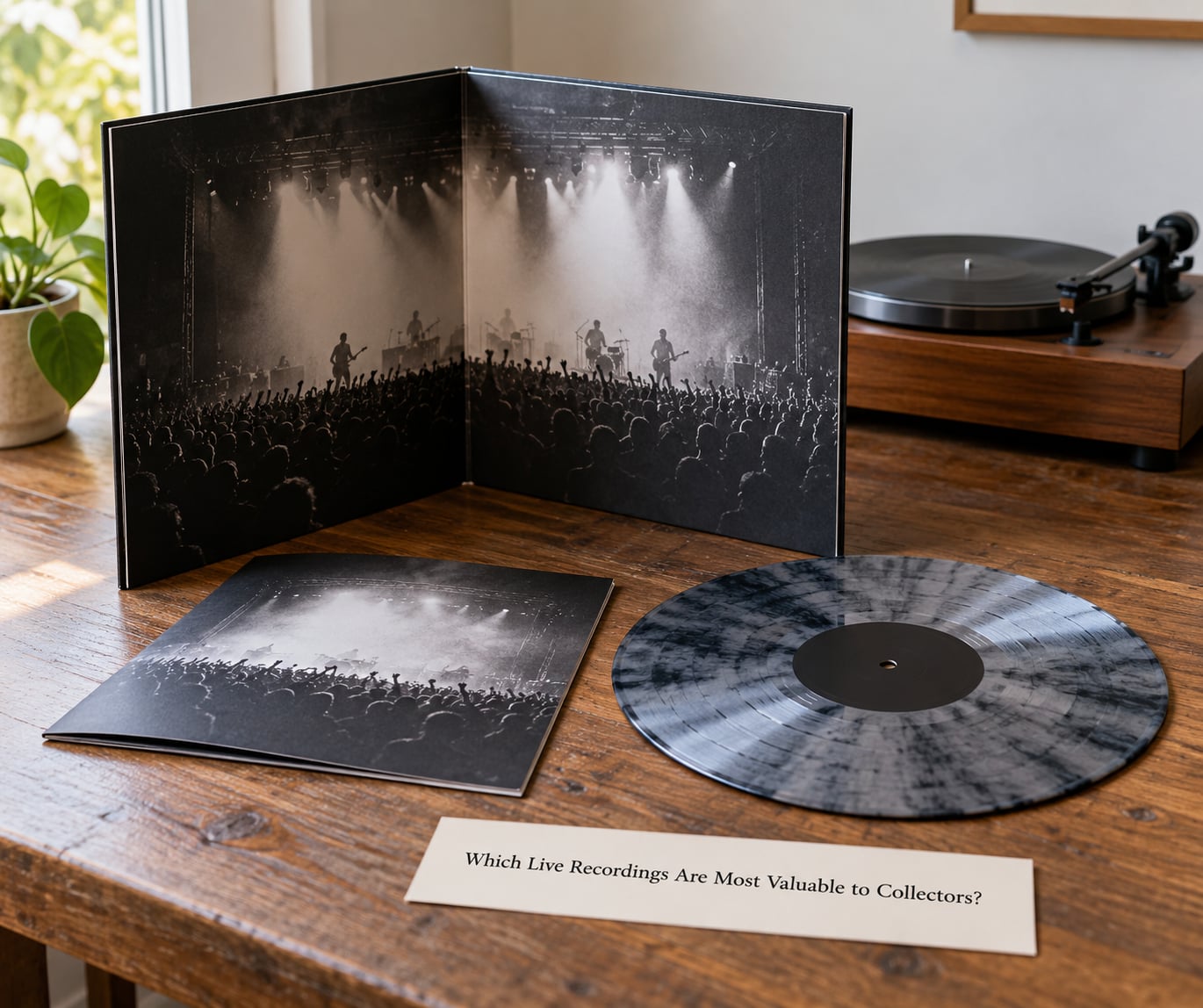
Which Live Recordings Are Most Valuable to Collectors?
The most valuable live albums are the ones that record something specific. A generic arena show from a quiet year in the middle of a tour rarely holds up next to a farewell show or a line-up that existed for six weeks.
- A clear era. The release pins a specific period, usually the one where the sound was still forming.
- A clear line-up. Whoever played that night is named, and often that version of the band exists nowhere else.
- A venue with character. Small rooms and unusual stages end up in the mix and shape the record.
- Something rare. A song never cut elsewhere, or a set from a tour that never got a full release.
- An engineering credit you can trust. On r/audiophile, people vouch for live records by naming the recorded-by, mixed-by and mastered-by chain, and cite Fat Freddy’s Drop’s Wairunga as a benchmark.
- Something physical to hold. Booklets, inserts, art and provenance still matter in a format that costs nothing to stream.
What a Live Album Adds to a Collector Beyond the Recording
It adds the parts a stream cannot carry: the sleeve art, the tour dates in the liner notes, the credits for the crew, the numbered edition, the poster. That is why vinyl and box-set issues of the same show keep circulating for decades. Collectors on r/vinyl and r/Cd_collectors describe the same problem from both ends: a band with fifty official live releases makes a complete discography a budgeting exercise rather than a hobby.
The counter-case deserves a hearing too. On r/1001AlbumsGenerator, users complain that points get deducted on album-ranking lists simply because a record is live, without anyone arguing the merits. The bias is real, and so is the opposite habit of treating every live release as a masterpiece. Both mistakes come from ignoring whether the record captured something.
How to Listen to a Live Album Without Expecting a Studio Clone
The fastest way to enjoy a live record is to stop treating it as a photocopy of the album. It is a different document about the same song, and it needs a different listening posture.
Start by knowing the source material. Put the studio version on first if you have not heard it in years, then play the live one without skipping anything. Follow the arrangement rather than the melody: where the band added a section, where they cut one, where the tempo moved.
Listen to the room, not just the band. Crowd noise is usually treated as a flaw on modern releases, but on records from the 1970s it is the whole texture. An r/audiophile thread treats live reference records as a genre in their own right, listing Bill Withers at Carnegie Hall, Donny Hathaway Live, Sam Cooke at Harlem Square and Aretha at Fillmore West as the kind of release where the room is half the performance.
Then compare across decades when you can. Hearing how a band plays a song five years apart, or before and after a member leaves, tells you more about their development than any interview. When two live versions of the same song exist, pick the one from the more interesting period, not the more expensive edition.
One last thing: read the credits. A record that names its recording crew, venue and line-up is usually a record that was treated as an event rather than a cash-in. That is what a live album adds to a discography at its best, and it is visible in the paperwork.
When a Live Album Is Essential, and When It Is Optional
A live record earns a place in a collection when it captures something a studio record could not. Farewell shows are the clearest case: once the tour ends and the line-up is gone, the recording is the only proof of how that particular group played together.
Other strong cases include the first live appearance of a new singer, the record of a line-up change that the band never documented in the studio, a rare track that exists nowhere else, and any release a band treats as an archive rather than a product. Nirvana’s MTV Unplugged in New York and Queen’s Live at Wembley ’86 both changed how bands were recorded and presented, which is another kind of value entirely.
Optional ones are easier to spot. If a band issued three releases from the same tour with the same songs, pick one. If a live record is the studio version with applause in front of it, it adds nothing. If the performance is technically worse in every measurable way, the only argument left is that it happened, and that is usually thin.
None of this means your discography is incomplete without them. A catalogue of studio records plus one or two well-chosen live albums is a perfectly coherent collection. Completeness is a matter of taste, not of correctness, and the endless official live catalogues of long-running acts exist for people who enjoy the searching.
Frequently Asked Questions
What is a live album, and how is it different from a studio recording?
A live album is an officially released recording of a band performing in front of an audience, captured on a multitrack rig at a concert and mixed and mastered afterwards. A studio recording is built in a controlled room over several days or weeks. The live version keeps the song and changes the arrangement, the production and everything the room contributes.
Why do bands release live albums?
Bands release live records to document a tour, a line-up or a farewell show, to introduce material that never reaches a studio album, and to show how a song has changed under pressure. For fans, a live album adds a performance layer to the discography that no studio record can supply, including rare tracks and evidence of how the band grew.
Are live albums better than studio albums?
Neither is better, because they do different jobs. A studio album is the finished composition. A live album is the evidence of a performance, sometimes more interesting, sometimes rougher. The weakest live records are the studio version with crowd noise added. The strongest ones rearrange familiar songs into something the studio version never attempted.
What is considered the greatest live album of all time?
Lists usually converge on a small group: Cheap Trick’s Live at Budokan, the Allman Brothers Band’s At Fillmore East, Nirvana’s MTV Unplugged in New York and Cream’s Royal Albert Hall. Jazz and soul collectors add Bill Withers at Carnegie Hall, Donny Hathaway Live and Aretha at Fillmore West. Metal listeners tend to point at Slipknot’s Disasterpieces and Dream Theater’s Score.
How do I know which live album to collect for a band with dozens of them?
Pick the release that documents the most interesting period, line-up or venue, then check whether it includes songs that appear nowhere else. Avoid buying three releases of the same tour. Read the recording and mixing credits, look at the packaging if you collect physical media, and treat an official release from a farewell show as more collectible than a routine arena stop.
Conclusion: Start with the Performance That Changes Your View
A live album adds a second reading of songs you already know: the arrangement, the era, the line-up, the room. Some are minor. The ones worth chasing capture something specific, usually a moment the studio format could not hold, and they sit in a discography without replacing any part of it.
Start with one release tied to an interesting period, a line-up change, an unusual venue or a rare track, then listen to it against the studio version. What a live album adds to a discography is easiest to see in that comparison, and once you make it a few times, you will start picking out the shows worth hearing before anyone tells you which ones matter.