Before the internet, metal fans discovered bands the hard way: through record shop counters, dubbed cassette tapes passed between friends, photocopied fanzines, college radio DJ interviews, MTV rotation, and printed magazines like Metal Edge. There was no search box and no recommendation feed, so a new band usually reached you through another person who had already decided you should hear it.
That is the short answer to how metal fans discovered bands before the internet. The mechanics were slow, physical and local, and the underground often moved faster than retail. Understanding them explains a lot about how metal scenes still form today.
Table of Contents
- How Metal Fans Discovered Bands Before the Internet
- Which Discovery Methods Mattered Most?
- How Did Record Shops Shape Metal Taste?
- How Did Radio, MTV, and Metal TV Introduce New Bands?
- What Role Did Concerts and Club Scenes Play?
- How Did Magazines, Fanzines, and Mail-Order Catalogs Help?
- How Did Tape Trading and Word of Mouth Build Communities?
- Why Did Pre-Internet Discovery Feel More Personal?
- How Can You Discover Bands Without the Internet Today?
- Frequently Asked Questions
- How did people discover underground metal bands before the internet?
- Were fanzines important for metal?
- How did tape trading actually work?
- Was radio or concerts more important for finding new metal bands?
- How can I find obscure metal bands today?
- How did MySpace change the way metal fans found bands?
- Conclusion
How Metal Fans Discovered Bands Before the Internet
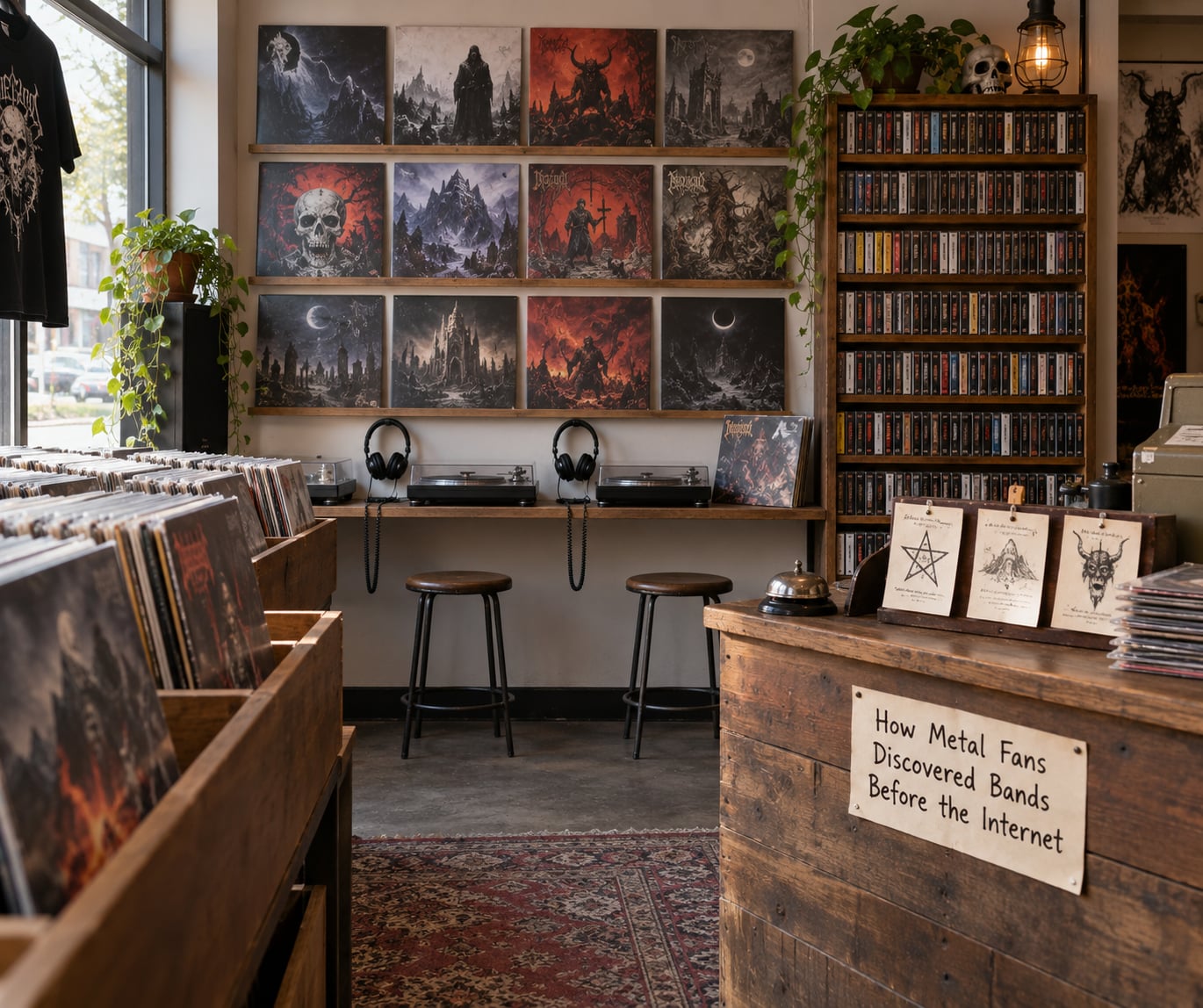
Nine channels did most of the work, and almost every one of them ran through a person. A brief answer to how metal fans discovered bands before the internet is a list of those channels, because the mechanics mattered more than any single release.
- The local record shop. You browsed the metal section, asked at the counter, and trusted whoever worked there with your taste.
- Friends, siblings and older fans. The most common answer on music forums: one person handed you one record, and it changed everything.
- Tape trading and dubbing. Two decks, a patch cord, an hour, and a hand-written label on the shell.
- Magazines and fanzines. Print reviews, interviews, tour reports and classified ads were the only editorial filter you had.
- Radio. College and public stations, plus nationally syndicated metal shows, where a DJ might play a demo no label had released.
- MTV and local television. Video rotation put a band in living rooms, even if only one song ever aired.
- Concerts and club scenes. Opening slots and merch tables exposed you to a dozen bands in one night.
- Mail order and import records. Backlists and overseas catalogs reached scenes that no shop in your town stocked.
- Flyers, stickers and shop counter cards. Paper told you a show existed before anything else did.
Notice what all nine have in common. Each one required a gatekeeper, a physical object, or a place to go. A tape had to be copied by hand, a zine had to be photocopied and stapled, a show had to be announced on paper, and a record had to be shipped across an ocean. The friction was the feature, and it shaped what people actually listened to all the way into the 1990s.
Which Discovery Methods Mattered Most?
Ranked by how much music they introduced to the average fan, shops and personal recommendation came first, then radio and video, then print, then tape trading, which affected fewer people but ran much deeper. No two channels gave the same result.
| Channel | What it surfaced | What it could not give you | Peak era |
|---|---|---|---|
| Record shop counter | New releases, staff favourites, imports in the bin | Anything the distributor had not restocked | 1970s to 1990s |
| Friends and family | One band at a time, usually from a record they already owned | Context, history, or anything you were not ready for | Always |
| Tape trading | Demos, split releases, and bands with no record deal | Clean sound; quality dropped with every dub | 1980s to mid 1990s |
| Magazines and fanzines | Interviews, reviews, tour reports, release dates | Audio. You still had to find the record somewhere | 1980s to 1990s |
| Radio | One song, repeated, from a DJ with taste | The rest of the album, unless you bought it | 1970s onward |
| MTV and local TV | Performance, image, the visual identity of a band | Range. One video did not equal a whole catalogue | 1980s to 1990s |
| Concerts | Live volume, support acts, local scene contacts | Nothing about a band you never saw live | Always |
| Mail order and imports | Japanese, Brazilian, German and Scandinavian releases | Speed. Postage, customs and backlogs added weeks | 1980s to 1990s |
What you could not get is the more interesting column. A shop could not play you a band that had not been pressed. Radio could not tell you what happened on track four. That ceiling is why fans layered channels instead of relying on one.
How Did Record Shops Shape Metal Taste?
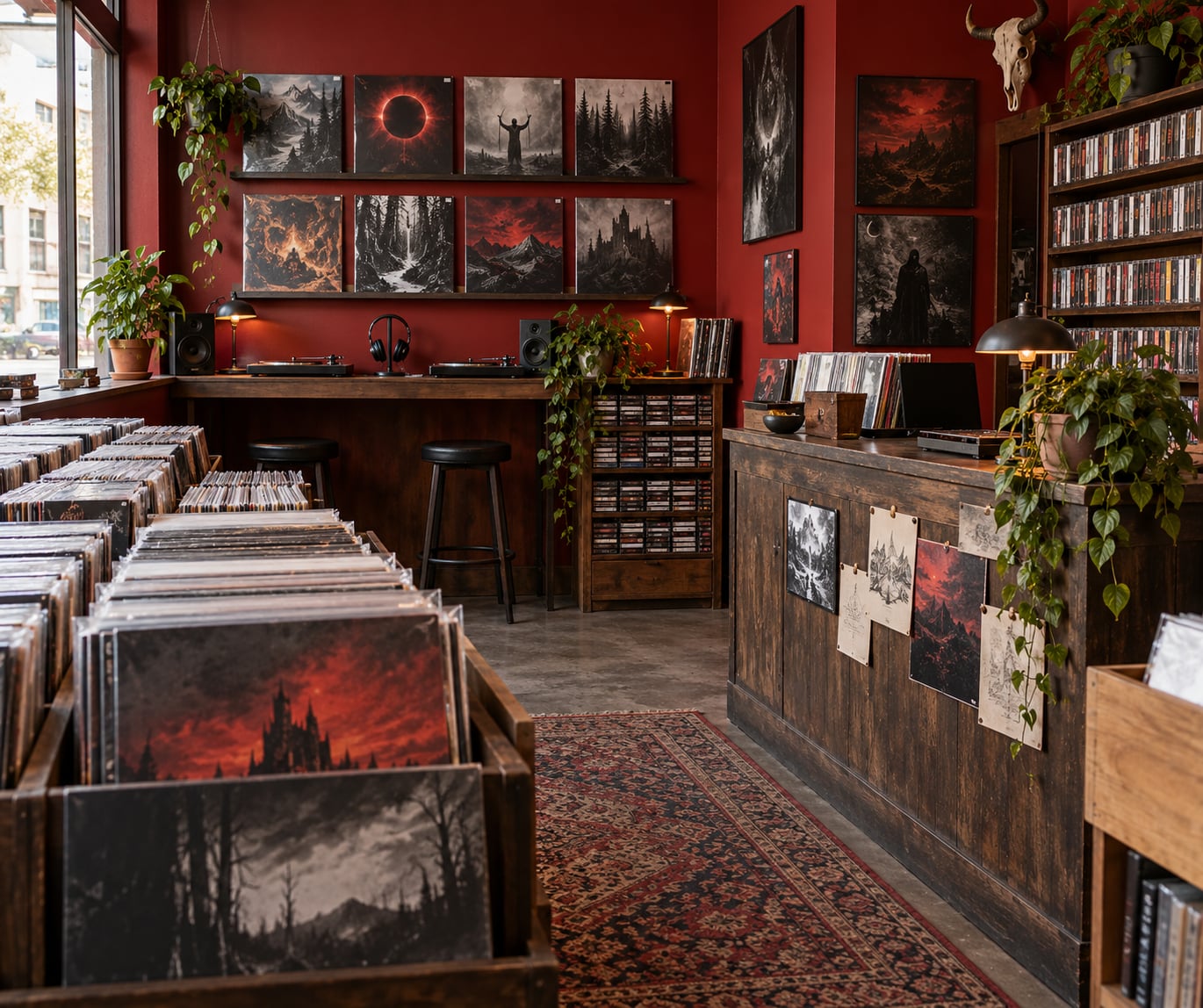
Record shops shaped metal taste by turning a purchase into a consultation. The counter was the local anchor: a person with opinions, a memory for who liked what, and the ability to put a record in your hand that you had not asked for by name.
Four things happened in those stores. Wall browsing exposed you to covers you would never have searched for, because the artwork was the only advertisement a record had. New release bins put this month’s output in one place, so you could hear the shape of the scene at a glance. The imports section reached scenes that no domestic distributor carried, and those sleeves often looked stranger than anything on the chart. And staff recommendations filtered all of it down to what one person thought was worth your money.
Metal Music Archives forum users still name specific print titles as their discovery gateways, and shop staff carried the same weight quietly. Forum consensus is that the trusted counter was worth more than any chart, because a chart told you what was already popular and a counter told you what your taste was about to become.
The catch was that this only worked in towns that had a shop. Fans in small towns often relied on mail order or a travelling friend instead, which is one reason scene geography looked so uneven before the internet flattened it.
How Did Radio, MTV, and Metal TV Introduce New Bands?
Radio, MTV and local television introduced new bands at three different levels, and confusing them is a common mistake. Hearing a song, seeing a performance and committing to a full release were three separate decisions in 1986.
Radio was the slowest and often the deepest. College stations and public radio took chances that commercial play would not, and a DJ with a following could break a demo or an import track to a small audience over and over for months. Some of the best-known underground stations built their whole reputation on metal programming. Nationally syndicated shows widened that further, carrying one host’s taste to listeners across several markets.
MTV was faster and shallower. Video rotation put a band in front of people who had not asked for it, which is exactly why it created so many first-time metal fans. It also flattened everything into one image. Local television and public-access shows mattered more than their reach suggests, because a single regional airing in a band’s home market could be the first serious attention a local act received.
The pattern fans describe is that radio made you curious and video made you buy. Neither one told you what to listen to next, which is why print and word of mouth stayed essential.
What Role Did Concerts and Club Scenes Play?
Concerts were a discovery system, not just entertainment. A single bill could put eight unfamiliar bands in front of you, and the two or three on the middle of the night were often the ones you still listened to years later.
Small clubs did the real work. Regulars learned who was good before the crowd did, and being recognised at the door by a promoter or a touring band was how many people got demo tapes, a spot on a bill, or a job as sound engineer. Merch tables functioned like record shops for one night, with shirts, cassettes and hand-numbered splits sold cash only.
Meeting other fans at a show created the local network that tapes moved through later. The person who stood near you in the pit was often the person with the dubbing deck. Shows also let you judge a band before buying anything, which is a luxury a search result cannot offer.
How Did Magazines, Fanzines, and Mail-Order Catalogs Help?
Print was the part of pre-internet discovery that had editorial judgment. A magazine writer decided what mattered, a zine editor decided what mattered more fiercely, and their choices were visible, repeatable and worth arguing about.
Full-length print magazines offered interviews, reviews with scores, tour reports, release announcements and classified ads. Titles like Metal Edge ran for decades, while Metal Forces ceased print publication in 1993 and was later rebooted as a webzine. That single fact captures the transition well: the audience survived, the delivery method did not.
Fanzines were the other half. They were photocopied, stapled, and sold or traded at shows, with distribution running through mail order and backlists that meant a new reader had to hear about the zine from another reader. Old-school metal magazines shaped both taste and careers, since bands sent in demos and photos because a printed mention was the strongest promotion available to them.
Album cover art carried more of the marketing load than it does now. Artwork was how a record communicated its scene before you read a word of copy, which is why metal sleeves from the 1980s still function as reference material for collectors.
How Did Tape Trading and Word of Mouth Build Communities?
Tape trading is the clearest answer to how discovery worked as a chain of physical handoffs rather than a feed. One fan discovered a band, copied the record, wrote the band name on the shell, and handed it to a friend. That friend then did the same thing.
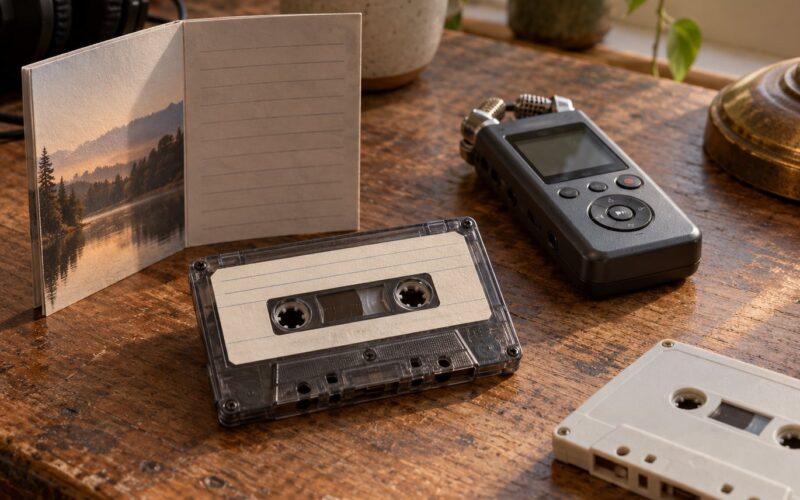
The mechanics were simple. Two cassette decks, an auxiliary or patch cord, one blank tape and about an hour. Songs were often split across both sides, so you learned to flip the tape at the halfway point instead of skipping tracks. Metalforum posters describe tape changing with friends as the dominant discovery method for years, and describe the quality loss as an accepted trade-off rather than a complaint.
Etiquette mattered more than it does with a streaming link. You returned the copy, you did not keep the only dub, you wrote legibly, and you traded up as well as down. Common trade goods were demo tapes, split releases, and records that had been out of print long enough to be impossible to buy new.
Word of mouth supplied the last piece. Fans recall discovering music before it reached their local underground shop, which tells you the underground network was running ahead of retail by weeks or months. A band could build a following in a dozen cities without any of them being on a map.
Why Did Pre-Internet Discovery Feel More Personal?
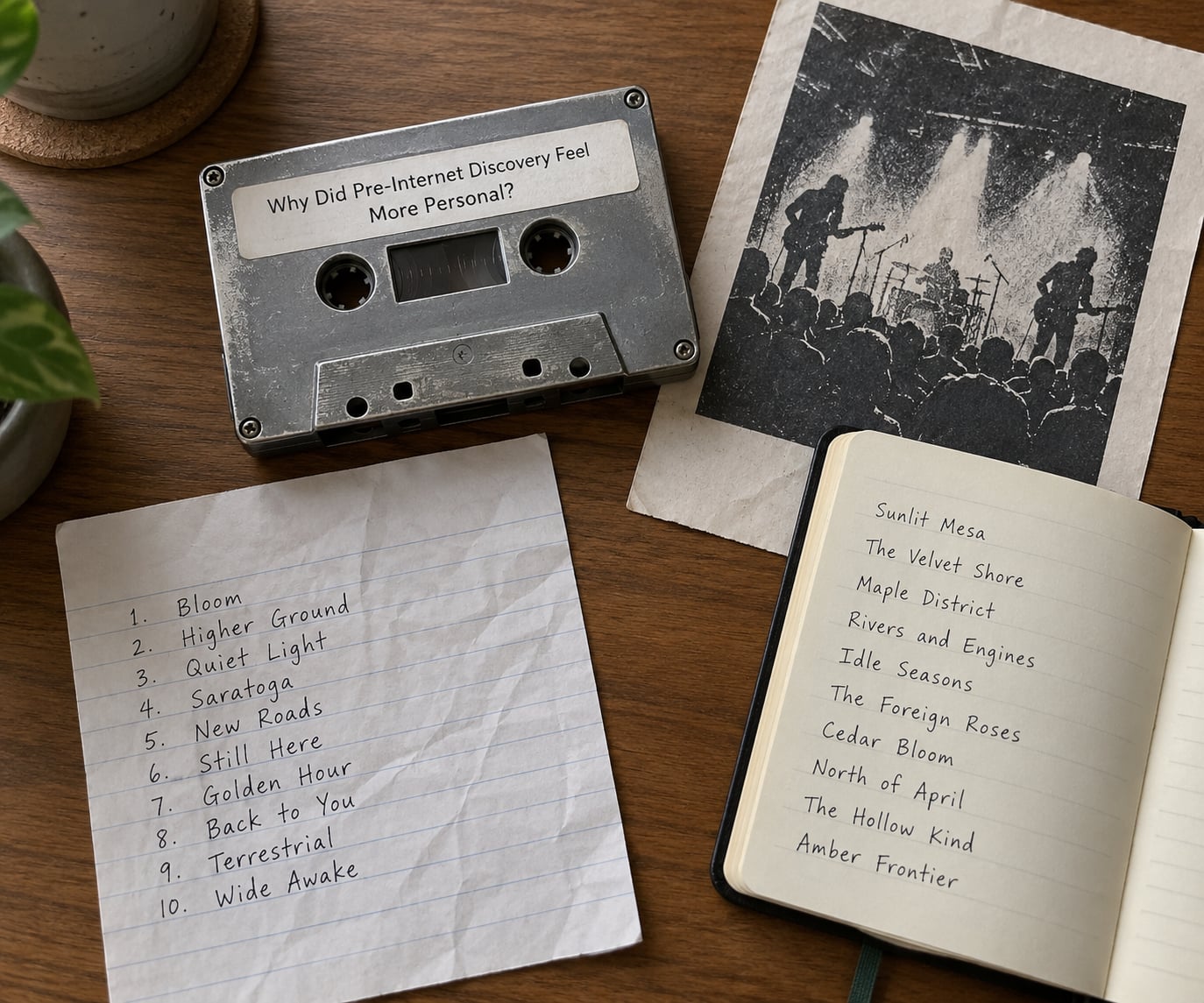
Pre-internet discovery felt more personal because a recommendation always carried a person and a reason with it. Someone had spent money, tape and time on that record, and they handed it over with an opinion attached.
That context is what streaming and algorithm-driven discovery removed. A generated playlist gives you twenty options and no argument. A friend gives you one album and a fifteen-minute story about why the guitarist joined the band. The context-rich version makes the recommendation stick, which is exactly what makes it feel personal.
Scarcity did the rest. When a release was limited, pressed once, and only available through a backlist, the few people who had it formed a visible club. Buying in made you part of something. Limited access also raised the value of any single new release, so a new record felt like an event rather than one more item in a feed.
The honest drawback is that gatekeeping was real. Some shop staff and zine editors were snobs, some scenes were hostile to newcomers, and nobody who was not already inside the network had an easy way in. Forum posters are candid that the old way felt like work. The counter-argument is that finishing an entire album, rather than sampling thirty seconds of it, was a normal outcome of the effort involved.
How Can You Discover Bands Without the Internet Today?
You can still reconstruct most of this process, and the mechanics have not changed as much as people assume. What has changed is availability and pricing: records that once vanished for years now often reappear, and imports that once cost a small fortune are far less exotic. Import postage and customs, though, still add time.
- Go to a shop that still has a used bin. Staff recommendation works exactly as it used to, and asking for a recommendation is the fastest way to get one.
- Learn the staff names. The most valuable thing in any metal section is a person who tells you when something arrives.
- Read specialist print and archives. Back issues of Metal Edge and surviving fanzine collections document releases and scene histories that never made it online.
- Use your library. Music libraries and local archive collections hold periodicals and recordings that no shop will ever stock.
- Go to small shows. Opening slots are still the cheapest discovery system available, and the merch table is still a one-night record shop.
- Read liner notes. Thank-you lists, production credits and label names are a documented map of who was talking to whom.
- Ask a fan, not an algorithm. One conversation with a knowledgeable person beats a hundred generated recommendations.
- Trade properly. Dubbing etiquette still works: copy what you can, label it clearly, and give something back.
Pick two of these and follow them for a month. The habit matters more than the specific source, because the point of the old system was that attention came from somewhere you chose rather than from somewhere that chose for you.
Frequently Asked Questions
How did people discover underground metal bands before the internet?
Mostly through people rather than platforms. Fans traded dubbed cassette tapes with friends, read photocopied fanzines and print magazines, browsed record shop metal sections, and ordered imports by mail. The chain almost always started with one person recommending one record to another person, who then copied or photocopied it and passed it along.
Were fanzines important for metal?
Very. Fanzines carried interviews, reviews, tour reports and classified ads for bands that had no label and no shop presence. They were photocopied, stapled and sold or traded at shows, then distributed through mail order backlists, which meant a new reader had to hear about a zine from another reader. Several bands credit printed mentions with early career exposure.
How did tape trading actually work?
You needed two cassette decks, an auxiliary or patch cord, a blank tape and about an hour. Records were often split across both sides, so you flipped the tape halfway rather than skipping tracks. Etiquette was strict: return the copy, label the shell legibly with the band and album, and trade something back rather than only taking.
Was radio or concerts more important for finding new metal bands?
Radio built the appetite and concerts converted it. College and underground stations played records repeatedly to a small, loyal audience, often including demos and imports. Concerts then let you judge a band live and exposed you to several unfamiliar acts on one bill. The most common combination was hearing a song on radio, seeing the band, then buying the record.
How can I find obscure metal bands today?
Use the channels that still work: shop counters, used bins, small shows, library music collections, surviving print archives and liner notes. A named recommendation from a knowledgeable fan is still the single most effective method. Streaming is excellent for breadth, but narrow it with one trusted source and stay with it for weeks rather than hours.
How did MySpace change the way metal fans found bands?
MySpace compressed months of tape trading, fanzine copying and mail order into a single profile page, and it let a band build a following without a label or a distributor. Pages were built by fans, not generated by a platform, so discovery still depended on a person linking you to something. When that era ended, a lot of scenes lost their front door at once.
Conclusion
Pre-internet metal discovery ran on physical objects and human judgment: shop counters, dubbed tapes, photocopied zines, print magazines, radio rotation, club bills, mail order catalogs and paper flyers. Each one put a named person between you and a record, and each one had a limit that forced fans to use several channels at once.
Streaming removed the friction and, with it, a lot of the context. What survives from the old system is the part that worked: ask one trusted source, take one recommendation seriously, and follow a band all the way to a complete album. Start with a single record shop, a specialist magazine back issue, or the opening bands at your next show, and trace what you find there to one album you would not have picked on your own.