Most independent albums take somewhere between three and nine months from the first demo to release day, and they absorb roughly 50 to 100 booked studio hours along the way. So how long an album takes to record depends on whether you are counting studio hours or calendar months, and the second number is the one that catches bands out. Ten songs at about 40 hours of work each is 400 hours of focused effort, and almost none of that happens inside a paid studio room.
That gap is the whole topic. Studio hours are what you book and pay for. Calendar time is what actually passes while the band waits for a weekend, the engineer works through a queue, and the vocalist is on a plane. Most confusion about recording timelines comes from mixing those two numbers up, so this guide keeps them in separate columns the entire way through.
Table of Contents
- How Long Does It Usually Take to Record an Album?
- What Counts as the Album Recording Process?
- How long an album takes to record: writing and demoing
- Pre-production
- Tracking and overdubs
- Mixing, mastering and release
- How Long Do Each Recording Stages Take?
- How Long Does an Album Take for Different Metal Genres?
- What Factors Can Make Recording Take Longer?
- Songs that arrive late
- Band availability
- Editing load
- Unbounded revisions
- Guest musicians, producers and technical problems
- How Can Bands Finish an Album on a Tight Deadline?
- How Long Does a Professional Studio Album Take?
- How Do Musicians Know When an Album Is Really Finished?
- Frequently Asked Questions
- How long do most albums take to record?
- Why does it take so long to record an album?
- How long does it take to release an album after recording?
- How long does it take to record an EP?
- What is the average cost to record a song at a studio?
- How long should I book the studio for?
- Conclusion
How Long Does It Usually Take to Record an Album?
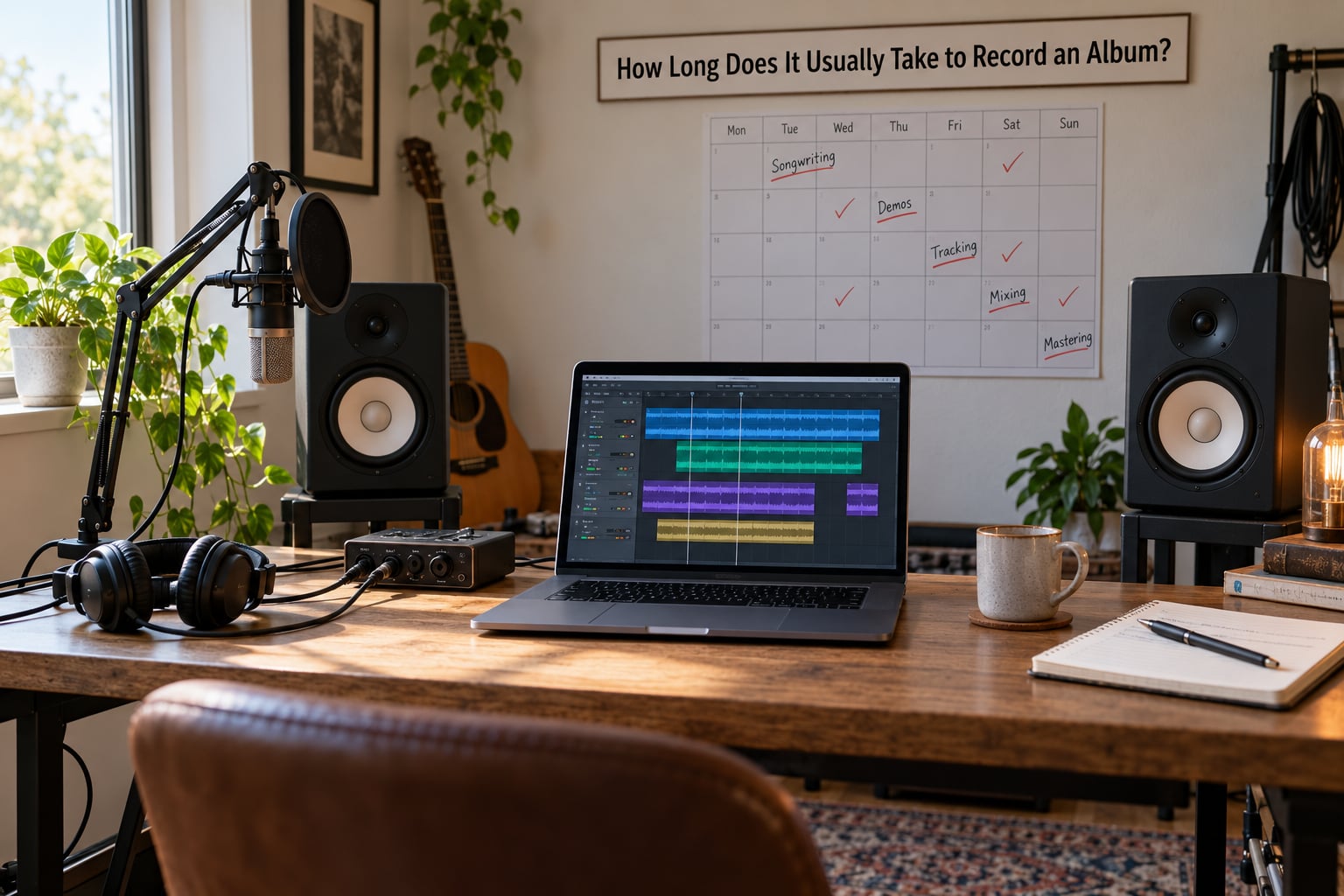
The honest range is three to nine months for an independent record, and up to a year or more when a band has day jobs, a label involved, or songs that are not finished being written. A funded label debut can run two to three years without anything going wrong.
Break the same project into hours and the picture changes completely. A tight, well-rehearsed band tracking one instrument at a time can lay down a song in four to six hours, which is the figure that keeps coming up on r/WeAreTheMusicMakers. Bands that track drums, bass and rhythm guitar together, then layer leads and do their own arrangements, tell a different story: one musician on that forum booked ten days for a 45-minute record and burned three of them on drums alone, with two more on bass.
So how long an album takes to record depends less on the number of songs than on how many separate passes each song needs. A ten-track record tracked in one pass is a different job from a ten-track record with click tracks, edited drums, doubled rhythm guitars and comped vocals.
What Counts as the Album Recording Process?
An album is not one activity. It is a chain, and the phases have very different shapes of time in them. Some are counted in hours with a clock on the wall, others in weeks that pass regardless of what anyone does.
How long an album takes to record: writing and demoing
The songs exist first, in some form, usually as voice notes, phone recordings and rehearsal-room recordings. This phase is the one nobody budgets for properly, and it is the one that decides whether the next six months are calm. A band that walks into preproduction with ten finished songs is doing something close to preproduction. A band with three finished songs and seven ideas is starting a writing project that happens to contain a recording project.
Pre-production
Arrangements get locked, key signatures get written down for the click track, tempo maps get made, gear and microphone lists get built, and every musician gets a chart. This is desk work that can be spread across weeks or crammed into a single week. It is the highest-leverage phase in the project because every hour spent here removes roughly an hour of confusion later.
Tracking and overdubs
Tracking is the part people picture when they imagine a studio: the band in the room, the engineer behind the glass. Overdubs are the quieter phase that comes after, where the missing harmony guitars go, the bass gets replaced, the backing vocals get stacked. For metal and hard rock especially, the overdub count is usually where the schedule quietly doubles.
Mixing, mastering and release
Mixing is where the record actually becomes the record. Mastering is the final stage that sets loudness and makes the album sound right next to everything else in a playlist. Then there is the release runway, which is invisible until someone forgets it exists: delivery, artwork, metadata, and the several weeks distributors and editorial teams need before a release date. One producer put it at 104 to 150 hours from tracking to finished final mixes for a full album when there is no beat detective doing the heavy editing, which is more than the tracking itself.
The single most useful habit is writing the finish line down before the project starts, because the difference between recording an album and releasing one is often two months of nobody assigning anybody a job.
How Long Do Each Recording Stages Take?
Here is the schedule most metal and hard rock records actually follow. The middle column is paid studio time; the right column is wall-clock time, and the two only look similar if the band never leaves home.
| Stage | Focused hours | Calendar time |
|---|---|---|
| Writing and demoing | 100 to 250 | 4 to 16 weeks |
| Pre-production and rehearsal | 30 to 60 | 2 to 6 weeks |
| Drum tracking | 10 to 25 | 1 to 4 days booked |
| Bass, rhythm and lead guitar | 15 to 30 | 2 to 5 days booked |
| Vocals and overdubs | 15 to 35 | 2 to 6 days booked |
| Editing and comping | 20 to 40 | 1 to 3 weeks |
| Mixing, two to three revisions | 60 to 150 | 2 to 6 weeks |
| Mastering | 8 to 20 | 3 to 10 days |
| Release runway | 10 to 20 admin hours | 4 to 8 weeks |
| Total for a 10-song record | 270 to 640 | 4 to 9 months |
A few things stand out in that table. Mixing is the single largest block and the one most bands underestimate, which is why so many first records get finished three months late and never get released. Mastering is short, typically around half an hour of attention per track, but it depends on someone else’s queue. And the release runway is dead calendar time that happens after the record is already finished.
How Long Does an Album Take for Different Metal Genres?
Genre changes the schedule more than most people expect, and it has almost nothing to do with tempo. Fast songs are often quick. Arrangements are the problem.
| Style | Tracking days for 10 songs | Why |
|---|---|---|
| Traditional heavy metal | 5 to 8 | Simple arrangements, few layers, songs that are basically riffs and a solo |
| Thrash metal | 6 to 10 | Tight playing, but precise timing means more passes and more edits |
| Hard rock | 7 to 12 | Key changes, harmony stacks and piano parts multiply the overdub count |
| Death metal | 8 to 14 | Tuned-down guitars, dense picking, blast sections and long rehearsal-to-track gaps |
| Progressive metal | 12 to 20 | Time signature changes, odd meters and dozens of layers per song |
| Doom and sludge | 5 to 9 | Few parts, but sustained and slow, so takes run long and edits are slow |
| Djent and polyrhythmic | 10 to 18 | Everything is quantised and grid-locked, so the work moves to editing |
The historical record is useful here. Black Sabbath recorded their fourth album in roughly 36 hours of studio time, which remains the low-water mark for how fast a heavy record can be made when the band already knows what it is doing. Metallica tracked Master of Puppets at Sweet Silence Studios in Copenhagen over about four months in early 1986 and then spent the spring and summer mixing the thing with Flemming Rasmussen, so a “four-month session” became a six-month story. Tool took roughly two years on Lateralus, and much of that was not playing but sorting. Radiohead recorded OK Computer in about four months at a rented house, with the writing and the recording essentially fused.
The pattern worth remembering is that the fastest records are made by bands with nothing left to decide. Every open question during tracking costs a day.
What Factors Can Make Recording Take Longer?
Almost every delay traces back to one of a handful of causes, and they are worth naming in advance because most of them are preventable.
Songs that arrive late
A record with four unfinished songs does not finish four songs early. It finishes four songs late, because tracking is sequenced around what is ready and the finished songs sit in a folder waiting for a slot. Bands that insist on writing in the studio lose weeks to that alone.
Band availability
Schedules, day jobs, illness, a bassist’s holiday. One musician being unavailable for three weeks can force an entire guitar or vocal phase to be rebuilt around a different window, and rebuilt work rarely goes straight into the session.
Editing load
Live drums with no editing are fast to record and slow to mix. Programmed or electronic drums with rigid timing invert that: quick in the room, then hours of grid work per song. The third common case is comped, layered, quantised and edited, which is the slowest of all.
Unbounded revisions
This is the month-four killer. A mix engineer and a band with no fixed number of rounds will discover a new problem in every round, because nobody wrote down what “done” means. Agree on two revisions plus one bonus before the first mix starts, and hold the line.
Guest musicians, producers and technical problems
A session drummer who wants to comp the whole kit, a producer in another time zone, a preamp that develops hum on day three. Each of these is small and each one costs a week, and they tend to arrive together.
One myth deserves clearing out. The usual story is that studios are booked forever and you are waiting on the room. In practice the room is usually available and your band is not. The GearSpace template people keep returning to is about six weeks of recording with 12-hour days and Sundays off, roughly 360 hours for 12 songs, which sounds brutal because the compressed version is brutal, not because the studio refused to open.
How Can Bands Finish an Album on a Tight Deadline?
When the deadline is real, you cut decisions, not sleep. Here is a twelve-week version of an album that has already-written songs, which is the only version that works.
Weeks 1 and 2: finish arrangements and charts. Every key change, every tempo, every odd-meter figure written down. No tracking before this is done.
Week 3: three days drums, two days bass and rhythm, two days lead guitar. Book a room large enough to hold the band and leave the amp choices alone.
Week 4: two days vocals, one day for any harmony layers, one day of pickups. Metal records usually need that fourth day more than they expect.
Weeks 5 and 6: editing and comping, done by the same person who tracked, so nothing gets reinterpreted.
Weeks 7 and 9: mixing and revisions on alternate weeks, with a written list of what each revision must fix.
Week 10: mastering and sequencing.
Weeks 11 and 12: delivery, metadata, artwork and the release runway, which cannot be compressed below about four weeks without pushing the date.
The version of this that fits in a notebook is simple. Give every song a status of finished, arranged, tracked or mixed, and count the songs not yet finished. That number is your real deadline, and it is almost always the number the album is actually held up by.
How Long Does a Professional Studio Album Take?
The clock changes with who is paying and who is deciding. The three scenarios below use the same ten-song record as the reference point.
| Scenario | Studio hours | Calendar time |
|---|---|---|
| Solo artist, home production | 0 booked, 400 to 600 hours at home | 9 to 18 months |
| Rehearsed independent band, professional room | 50 to 100 | 3 to 6 months |
| Funded label debut with a producer attached | 200 to 600 | 18 to 36 months |
The solo home producer has the longest calendar time and the shortest studio time, because every phase runs through the same pair of ears. One musician on r/WeAreTheMusicMakers reported about a month to write and fully produce one track, roughly two months for a four-song EP, and projected a full year for a 15-song record. That is the shape most first albums take.
A funded record is long for different reasons: songs get written and rewritten under A and R notes, producers rotate, and the label wants a single out of the finished material before the album is even sequenced. Some bands also release singles from the sessions as a waterfall release, which funds the record and keeps listeners warm while the mixing drags.
How Do Musicians Know When an Album Is Really Finished?
Finished is a decision, not a feeling, and the distinction matters because “it will feel right when we hear it” is how records die on the mixing desk.
Write the criteria down while you are still in preproduction, when nobody is emotionally invested in any single mix. A workable list looks like this: every song is tracked, with no placeholder parts left; the song count matches what the release format requires; the sequence is final, not provisional; mixes are approved against a written brief; mastering is delivered in the format the distributor asked for; metadata, splits, artwork and publishing are settled; and the release date is four weeks out with delivery already done.
Then set a hard limit on revision rounds and respect it. Two rounds usually finds the problems worth fixing. A third round finds new problems that were always tolerable. Bands who ship a slightly imperfect mix in the window they planned sound better on record than bands who chase perfection into a release date that no longer exists, because finished music gets played and unreleased music does not.
Frequently Asked Questions
How long do most albums take to record?
Most independent albums take three to nine months from first demo to release day and use roughly 50 to 100 booked studio hours. Ten songs at about 40 hours of work each means 400 hours of focused effort, most of which happens outside the studio. A funded label debut commonly runs two to three years, mostly because of writing rounds and revisions rather than tracking.
Why does it take so long to record an album?
Four things dominate. Songs that are not finished when tracking starts, band members with conflicting availability, mixing revisions with no agreed limit, and the release runway after mastering. Each track also needs more passes than people expect: drum take, then bass, then guitars, then vocals, then edits. Fast records are made by bands with nothing left to decide.
How long does it take to release an album after recording?
Plan on four to eight weeks after the masters are approved. Delivery, metadata, artwork, splits and publishing all have to be finished, and distributors and editorial teams need time before a date is confirmed. Release lead times vary by distributor and territory, so check the requirements early rather than assuming four weeks is universal.
How long does it take to record an EP?
An EP is roughly a third to a half of the work of a full album. Four to six songs usually means around 15 to 25 studio hours and a calendar window of two to four months for an independent act. Because the cost of the release runway stays fixed, EP timelines compress less than their tracking time does, so the administrative phase often dominates the schedule.
What is the average cost to record a song at a studio?
Rates vary by city, room quality and engineer, and the engineer fee is often booked separately from the room. The more useful number is the hours: a rehearsed band recording in bulk needs about five to eight hours per song, while a layered, heavily edited record can run twenty or more. Estimate from your arrangement, not from a per-song average.
How long should I book the studio for?
Book per phase rather than as one block. Ten songs of traditional heavy metal need about five to eight tracking days; hard rock usually needs seven to twelve; progressive metal can need twelve to twenty. Add two to three days for pickups and add nothing for mixing, because that happens after you leave. Add roughly 25 percent more for anything with live, unedited drums and comped vocals.
Conclusion
How long an album takes to record comes down to two numbers people keep confusing: about 50 to 100 studio hours of booked time, and three to nine months of calendar time for most independent records. The hours are the easy part to estimate. The months are decided by songwriting, member availability, revision limits and the release runway, none of which appear on a studio rate card.
Start by counting the songs that are not finished being written, not the songs you plan to record. That count is the real schedule, and it is usually bigger than the one on your calendar. Then pick a recording window, add a realistic block for mixing, and keep four weeks of empty space at the end for delivery before you commit to a release date.
Everything else, the overdubs and the comps and the third revision, fits inside a plan that was built honestly. Most albums that take two years do not fail on talent or budget. They fail on a start date nobody agreed to.