Quick answer: a metal band here means a music group, not a steel strap or an exercise band. How to support a small metal band comes down to four things you can do this month — buy something directly from them, turn up at a show, share their work with a real comment attached, and help them get in front of listeners who would actually show up.
That is it. No secret handshake, no big money required. A small band cannot hire a publicist, buy radio ads, or land a festival slot, so the few things fans do add up faster than people expect. I have watched bands cancel tours because a room did not sell, and I have watched the same bands keep going because twenty people showed up, bought a shirt, and brought a friend.
This guide walks through nine practical steps, in roughly the order you would do them. It also covers the money side, because understanding where the money goes changes how you spend yours.
Table of Contents
- What You Need
- Step-by-Step: How to Support a Small Metal Band
- 1. Discover the Band’s Official Channels
- 2. Buy the Music and Merchandise Directly
- 3. Stream the Band Consistently
- 4. Show Up: How to Support a Small Metal Band Live
- 5. Share Their Work Authentically
- 6. Help Them Reach the Right Listeners
- 7. Support Rehearsals, Recording, and Travel
- 8. Engage Constructively at Gigs and Online
- 9. Support the Band’s Local Scene
- Common Mistakes and Better Alternatives
- Frequently Asked Questions
- What is the cheapest way to support a small metal band?
- Does streaming actually help a small band?
- How do I tell whether a band’s page or shop is legitimate?
- What are support bands?
- How can I support a band in another city or country?
- How do I help a band get booked?
- Conclusion
What You Need
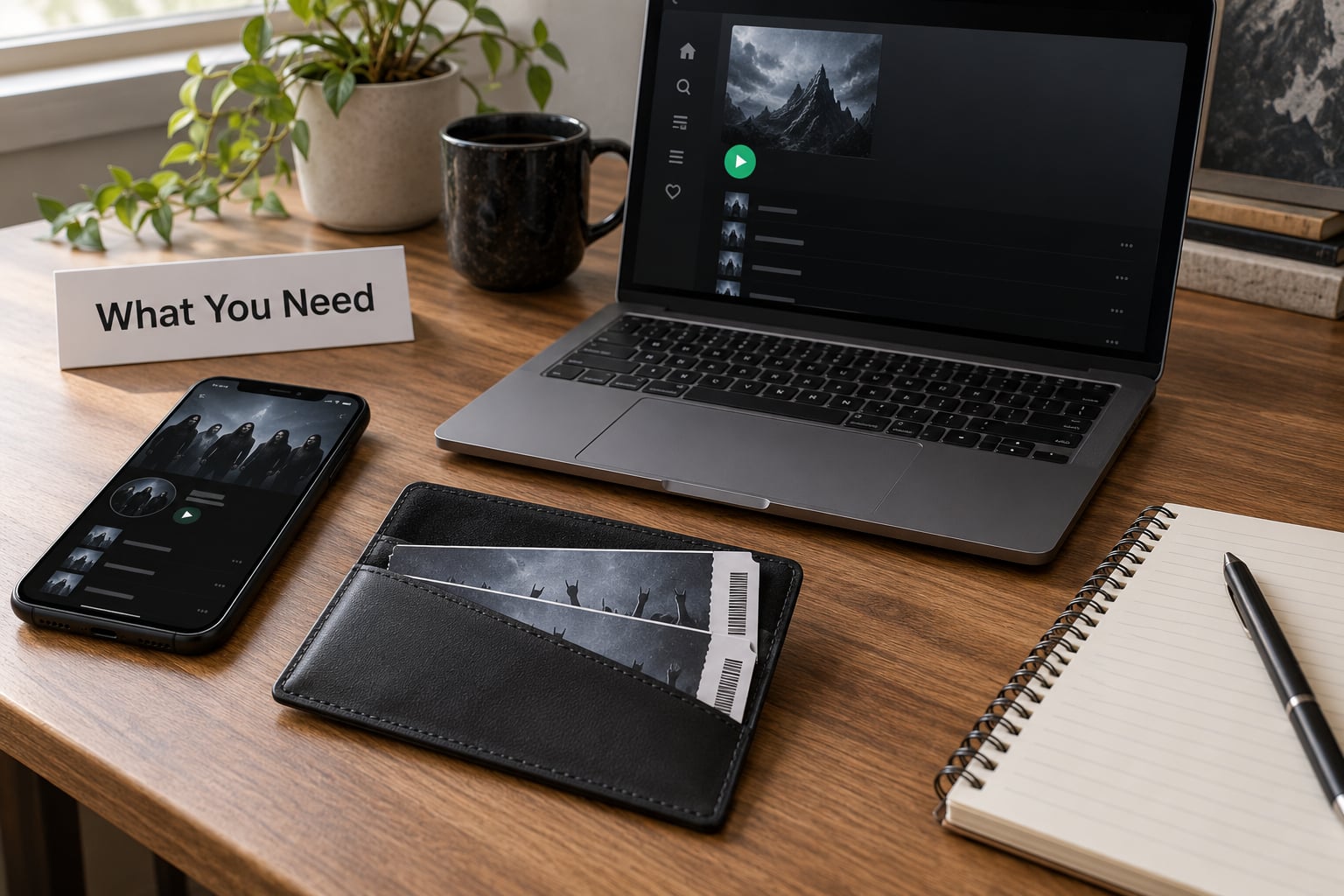
You do not need a wallet full of cash or a contact inside the industry. You need three things, and it helps to sort them before you spend a minute.
Confirmed channels. A band website or a verified social account, a streaming profile you can find by searching their name, and a mail-order store if they have one. Every reputable small band links these from one hub page, so finding one confirms the rest.
A number that is honest about your budget. Decide what a show costs you before you commit. Small venues run on whatever they can, and support slots are frequently free to enter. Being able to say no quickly matters more than being generous once.
One habit you can keep. The most useful supporter is not the one who buys everything. It is the one who buys a shirt, then comes back for the next release.
One more thing worth doing first: find out where the band actually plays. If they are local, there is a scene calendar somewhere. If they are not, you are working from the outside, and steps 2, 3 and 5 carry more weight for you.
Step-by-Step: How to Support a Small Metal Band
1. Discover the Band’s Official Channels
Start from the source, not from an algorithm. Search the band’s name and look for the profile other links point to — the one with a website, a mailing list sign-up, and a store. Cross-check that the accounts link back to each other.
Unofficial fan pages and repost accounts are common in metal, and they are usually harmless. They become a problem when they sell records, take payments, or post “official” tour dates that were never confirmed. If a page asks you for money and does not link back to anything the band controls, close it.
Joining the mailing list takes about a minute and it is genuinely useful. Small bands email their own list far more often than they get covered anywhere else.
2. Buy the Music and Merchandise Directly
This is the highest-value thing on the list. At this level the merch table is usually the largest single income line for a touring band, ahead of guarantees and often ahead of the door split. A tour that sells a few hundred in shirts can out-earn the show it was playing.
Why a shirt costs what it does: blanks, printing in small runs, postage, and payment fees all stack up, and runs get more expensive the smaller they are. When someone on a music forum argued that paying to play a big venue is close to self-sabotage, the logic applies to merch too — money that goes straight to the act beats money that goes to a middle layer.
What to buy, roughly in order of usefulness:
- Vinyl or cassette if the band presses them. These usually carry the best margin of anything on the table.
- A shirt if you will actually wear it. A shirt you love is worth more to a band than one you hide in a drawer, because it advertises on its own.
- Digital through the band’s own store page, which usually pays more than a streaming service and takes a smaller cut.
- Whatever the band is actually short on. Some bands post this directly.
Check legitimacy the same way you checked the channels: does the store sit on the band’s own domain or a known platform storefront, and does the band link to it?
3. Stream the Band Consistently
Be straight about this one. Streaming a small band pays close to nothing per play, so treating it as charity support is a myth. What it does do is register in the numbers the band sees, and those numbers affect playlist placement and how promoters read a profile.
So stream deliberately. Save the album rather than letting it shuffle through once. Follow the artist so new releases surface in your recommendations. Listen to the full record — a complete listen in one sitting is a signal that casual skipping is not.
Skip the folklore about pressing a track forty times or buying your own single to boost charts. Those tactics do not pay the band and they make you look odd. Intentional listening does not need a workaround.
4. Show Up: How to Support a Small Metal Band Live
Attendance is the currency of the underground. Bands routinely report that a packed room changes what a promoter will book next time, and an empty one changes it in the other direction. Showing up is the single most direct answer to how to support a small metal band.
How the money usually works, roughly, for a mid-size room on a mid-sized bill:
| Income line | Typical share of a small band’s live money | What it depends on |
|---|---|---|
| Merch sales | Often the largest single line | How many people came, and whether they got to the table |
| Door split | Large when there is no guarantee | Total door take after the venue’s cut, divided among the bands |
| Guarantee | Fixed and unpredictable, sometimes zero | Negotiated per show; support slots often carry none |
| Physical media | Modest but steady | Whether the band pressed anything and brought it along |
| Streaming | Effectively negligible | Platform rates for independent artists |
Treat those as rough ranges, not a settlement sheet. Every promoter negotiates differently.
What that means in practice, before and during the night:
| Stage | What you can do | Why it matters |
|---|---|---|
| Before the show | Buy the ticket early, not at the door | Advance sales are the number venues and promoters look at when deciding who gets rebooked |
| Before the show | Bring two people | A friend who converts into a regular is the cheapest growth a small band gets |
| Doors | Get there early | Merch tables usually sit at the entrance, and a room that fills early reads as a room that worked |
| Doors | Ask whether the shirt is on the table | They carry what sold last time, so a request sometimes gets it made |
| During the set | Watch the whole thing | Audience attention is the footage, the review, and the reason a band feels worth rebooking |
| After the set | Say something specific to the band | A specific note lands better than a generic compliment, and the merch table conversation follows |
Turning up early also does something for you. You get the sound check, you see the room before it fills, and you stand closer to the stage than the person who arrives at the last song.
5. Share Their Work Authentically
Sharing is cheap and it compounds, but only if it is honest. A post with a sentence about why the song works reaches people. A bare link with no comment gets scrolled past by everyone, including the band’s existing fans.
Say what you actually liked. “The rhythm section on the second track is what got me” is more useful to a band than a wall of fire emojis, and it is the kind of post that makes someone click through.
Credit the source. Link the band’s own channel or their store rather than a repost account, so the play count and the sale land where they were meant to. If you film anything, ask first.
One warning, and it is a firm one. Metal communities are good at spotting someone who only appears to post their own band. Participate in the subreddit, answer questions about other people, recommend other people. That is not marketing niceness; it is how you avoid getting removed and ignored.
6. Help Them Reach the Right Listeners
You do not need a contact. You need an introduction to the right twenty people. A scene is small enough that one enthusiastic fan who knows a promoter can do more than a year of posting.
Ways to open a door:
- Put them on bills with compatible acts. If you book shows or run a night, a four-band bill of local metal is easy to fill and easy to promote. That scene thread about getting shows when nobody books you keeps circling back to the same advice: make friends with local and smaller touring bands, show them what you have, and start small.
- Send them to small radio shows, podcasts and genre zines. Genre-specific outlets read mail. A one-paragraph email with a link beats a generic blast.
- Post them into communities that fit. Check the rules first. Most subs have a day or thread for recommendations, and using it is fine; dumping a link into a discussion is how accounts get shadowbanned.
- Connect them to promoters and bookers properly. Mention the band in a message where a human reads it, with the EPK link attached and one line on why the room suits them.
The pattern that works is never “get on a big stage.” It is small rooms, honest bills, and a band that fills the one it has.
7. Support Rehearsals, Recording, and Travel
Some costs are visible and some are not. Studio time, rehearsal room hire, strings, drum heads, a broken cab, fuel for a van — these are where money leaks out between releases.
When a band runs a transparent campaign, read it properly. Look for a specific cost, a stated goal, and an honest note about what happens if they miss it. That format is not a formality; it is the difference between a fundraiser and a vanity page.
If there is no campaign, the closest equivalent is buying the specific thing they are raising money for — a reissue of the demo, a tape run, a repair. Direct money tied to a stated purpose is easier for a small band to accept than an open gift, because they know what it is for.
Cash in an envelope or a bank transfer for a rehearsal nobody asked for is the kind of help that becomes awkward. Skip it.
8. Engage Constructively at Gigs and Online
Repeat attendance is what builds a fanbase. A band that plays the same room six times has six chances to convert a passer-by into someone who buys a record.
Online, specific feedback is worth more than applause. Saying a particular song drags and the closing one lands tells a band something real. Criticism only helps when it is about the work rather than about whether the band is worthy of your attention.
Two things to avoid entirely: demanding access you have not earned, and treating members as characters in your personal story. Nobody wants a stranger explaining their own band to them.
9. Support the Band’s Local Scene
The band that survives is the one whose scene survives with it. When you go, you support every act on the bill. You buy a record from the opener you have never heard of. You tell the venue staff you liked the room.
Going to an unfamiliar band’s show and telling the promoter afterwards that they were good is genuinely valuable work. Promoters book rooms based on the last five conversations they had about them, and very few fans bother having those.
Some scenes also run benefits, compilations, or small-label projects where a dozen acts split the proceeds. Those help more than most listeners realise, and they need people who show up and buy, not just people who repost.
Common Mistakes and Better Alternatives
Mistaking empty engagement for support. A stream with no attention behind it and a link posted into a subreddit where it dies are both close to worth nothing. The fix is the same: one genuine comment, one real listen, one person brought along.
Paying through unofficial links. Payment requests that do not sit on the band’s own domain or a known storefront can be anything. If the band’s official page does not link to it, do not use it.
Buying counterfeit or print-on-demand lookalikes. A design lifted from the band’s store, printed somewhere cheaper, sends your money to a stranger. If the listing does not come from the band, you are supporting a copyist.
Demanding free content. Asking for unreleased tracks, studio time, or a private stream tells a band you want their resources more than you want to see them succeed. Buy what exists instead.
Paying to play a show. If a band asks for a fee or sells you a spot with no guarantee, they are handing their problem to you. The usual community view is blunt about this: a slot in a room you will never fill is worse than no slot.
Expecting one purchase to fund a career. A shirt does not pay for a van. It funds an afternoon of rehearsal and a better cable for the bass. Understanding that is what keeps support steady instead of occasional and disappointed.
Three rules that keep this simple: spend where the band keeps the money, spend repeatedly rather than dramatically, and never spend money you resent. That is the whole of how to support a small metal band without overthinking it.
Frequently Asked Questions
What is the cheapest way to support a small metal band?
Turning up and buying a ticket is usually the cheapest meaningful thing you can do, because advance ticket sales are the number promoters and venues read when deciding who gets booked again. Add one item from the merch table and your whole visit funds part of the night. Streaming on its own pays a small band very little, so treat it as listening rather than as giving.
Does streaming actually help a small band?
Marginally, and not in the way people claim. A full listen registers in the numbers the band sees, and those numbers influence playlist placement and how promoters read a profile. Saving the album, following the artist and listening start to finish are worth doing. Repeated plays and self-purchases do nothing for the band’s balance and are better skipped.
How do I tell whether a band’s page or shop is legitimate?
Start from the band’s own hub page, usually on their website, and follow links from there to the store, socials and streaming profiles. Legitimate accounts cross-link each other. If a payment page or merch listing does not appear anywhere on the official hub, treat it as unverified. When in doubt, ask the band directly and wait for a reply on a channel they control.
What are support bands?
In metal, a support band is the act that plays before the headliner on the same bill, not a strap or an exercise band. Support slots are usually unpaid or paid only through the door split, so the money for them comes from merch and from how many people the room brings. If you want to help a small act, see who is opening and go early enough to see them.
How can I support a band in another city or country?
Physical media and direct purchases travel best. Buy vinyl, a shirt or a tape through the band’s own store, stream properly, and share release dates so people in their own city know when it is happening. If the band tours near you at any point, that is when a supporter presence matters most, because touring is where the costs land.
How do I help a band get booked?
Introductions beat cold submissions. Put them on a bill with an act their audience already follows, send them to small genre radio shows and podcasts that read mail, and mention them to promoters you actually know, with their EPK link and one line on why your room suits them. Most venues and bars book bands, so simply asking a room what it would take to play is a normal question.
Conclusion
If you do nothing else today, do these three things. First, find the band’s official hub page and confirm the store and social accounts from there rather than from a search result. Second, make one legitimate purchase or one deliberate full listen, using the band’s own channels. Third, look for a date they play and put it in your calendar, and take someone with you.
None of that fixes a broken music industry. It keeps one band writing records, rehearsing, and turning up at the next room, which is the only part of the problem any single fan can actually reach.