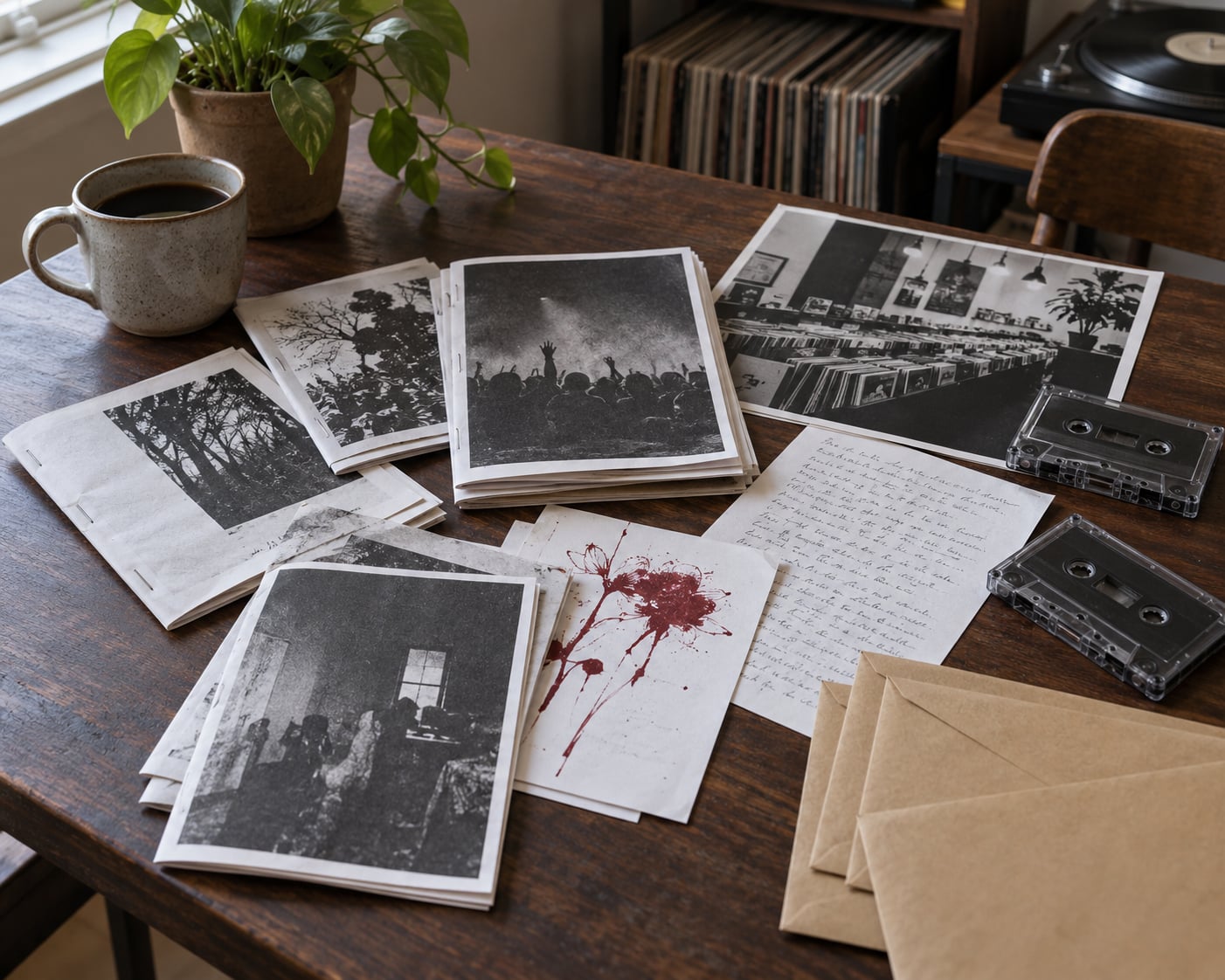
A metal fanzine is a magazine made by a metal fan, for other metal fans, outside any label, distributor or mainstream press. Zine is the short form of fanzine, and a webzine is the same idea published online. Most metal fanzines were photocopied or mimeographed, stapled, and mailed. That is how metal fanzines spread the scene: by passing an object from hand to hand, country to country, for years before anyone had heard of a social feed.
Six things to know before you read on:
- A fanzine needed no permission, no ad budget and no office. A typewriter and a duplicator were the whole barrier to entry.
- Distribution was the real work. Copying a zine is cheap; getting it into three countries is the job.
- Bands mailed demos to editors, and editors mailed copies back. That reply loop was the underground’s search engine.
- Back-page ads from small labels turned fanzines into unpaid marketing for labels that could not afford metal magazines.
- Fanzines printed what the mainstream refused to: local bands, regional scenes and subgenres with no national coverage.
- The form did not die. Print-on-demand shops, bandcamp zine sales and festival tables replaced the photocopier, not the habit.
Table of Contents
- Why Metal Fanzines Mattered
- How Metal Fanzines Spread the Scene
- How Fanzines Built Underground Networks
- The Channels That Made Fanzines Work
- From Photocopies to Mail-Order Networks
- Why Some Metal Fanzines Became Essential
- How the Shift to Digital Changed the Network
- The Limits, Conflicts and Exclusions
- How New Zines Can Spread Metal Today
- Frequently Asked Questions
- What is a metal fanzine?
- Who were the earliest heavy metal fanzine makers?
- How did fanzines help underground bands get noticed?
- Are printed metal fanzines still relevant today?
- What is the difference between a fanzine and a music magazine?
- Conclusion
Why Metal Fanzines Mattered
Before fanzines, an underground metal band existed in a room. A photocopied sheet handed to a friend after a show was the entire promotional budget of most bands in the 1980s and early 1990s.
What a fanzine added was repetition and a return address. One copy in one town is gossip. Fifty copies mailed to fifty strangers is a network, and once it exists it starts returning information: who is replying, who is trading, who has a venue, who has a label.
That is also why the ones that mattered were selective. Thousands of stapled objects were produced and most vanished. The ones still read today had something the others lacked: coverage nobody else would print, or a working distribution habit.
The word itself is older than metal. The term zine was coined in 1940s science-fiction fandom by Russ Chauvenet, a shortening of fan magazine, and it entered general use through punk’s photocopied press in the late 1970s and 1980s. Metal inherited the word and the method, with one addition punk rarely had: a global mail-order trade for demo tapes.
The earliest underground metal fanzine generally cited by collectors is Metal Rendezvous, appearing around 1983 and 1984 and frequently named as the gateway title for readers who came out of punk into metal. By the mid-1980s, US zines like Headfucker and Metal Rendezvous, and European titles in the UK and Scandinavia, were running review sections, classifieds and interview features as standard features.
How Metal Fanzines Spread the Scene
The mechanics matter more than the myth. These are the channels fanzine editors actually used, in roughly the order they mattered.
- Snail-mail correspondence networks. Editors wrote to each other first, then to bands, then to labels. Letters carried addresses, which is the raw material of the whole system. Once two editors trust each other, they swap subscriber lists.
- Mailbox review piles. Promo records and demos arrived addressed to the editor, not the band. The editor reviewed it and mailed a copy to the sender. That physical reply was how a band in a country with no metal press found out that anybody had listened.
- Zine trades. A trade means one zine for one zine, usually with a note, sticker or review. Trade culture is why a Finnish old-school title and a US one could both reach readers who lived on different continents and shared no language.
- Demo and cassette trading. Zines were the noticeboard for tape trading. Ron Nieto, who edited Brain Damage, described taping live shows on a boom box and trading the tapes with contacts on the East Coast. Bands mailed demos abroad because a fanzine editor abroad had told them to.
- Distro chains. A distro is a paid wholesaler: you post them a bundle of your zine, they sell it to shops and other outlets and send back what sold. One copy entering a distro could leave as forty.
- Record shops and flyers. Copies were left in shops and hand-passed at shows. Kat Gillham recalled early-90s discovery working through flyers, print zines and tape trading together rather than any one of them.
- Festival circulation. Conventions were logistics hubs. The three editors of Metal Mafia met as pen pals, then met in person at Milwaukee Metalfest in 1997, and distributed at festival tables and passed copies around the floor.
- Back-page ads. Small labels bought space because it was the only readership they could buy. Jill Girardi’s Mortal Coil Records did it deliberately: the label published a zine as, in her words, one big advertisement for the label, cheap enough to mail out free.
How Fanzines Built Underground Networks
Each of those channels connected an editor to a different kind of resource. Demo post connected them to bands and unreleased music. Trades connected them to other editors, which is how they learned what was happening in scenes they had never visited.
Distros connected them to shops. Festival tables connected them to bookers, promoters, tape labels and photographers. Back-page ads connected them to labels with money, which in turn connected bands to those labels.
Put together, the editor was a switchboard. A small review of a local band in one town could turn into a label interview two issues later, or into a classified ad that produced a first show. Nothing about that chain was official, and that is the point: no gatekeeper existed except the editor’s taste.
The Channels That Made Fanzines Work
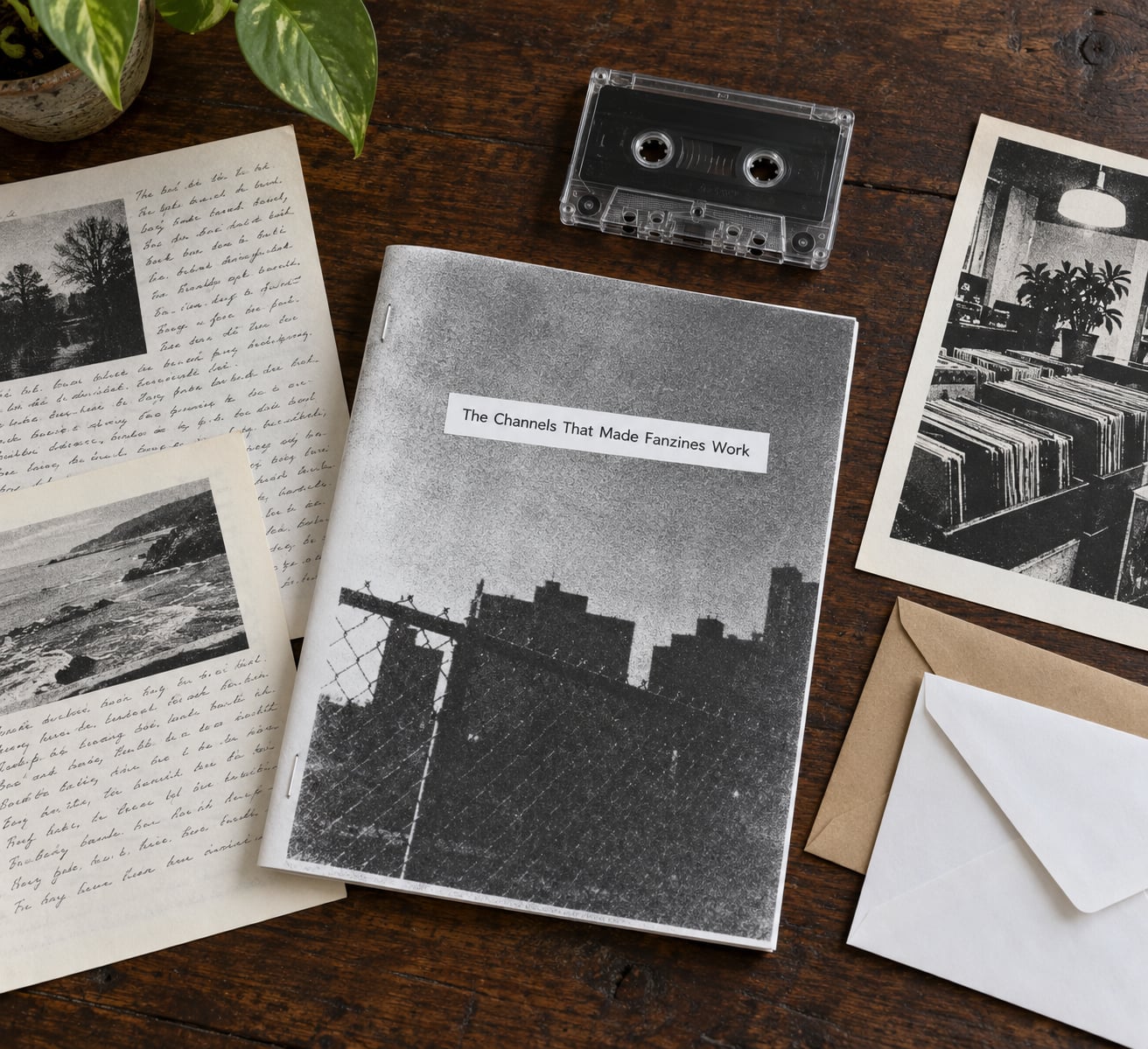
Reviews were the highest-volume channel and the least glamorous. Their job was not to praise. Their job was to tell a reader that a band existed, in a town they might visit or a country they might write to.
Interviews did the opposite work. An interview gave a band something no reviewer could: a page that outlasted the review cycle. Bands kept fanzine interviews for years because they were the only published document of what the band said at that moment.
News and scene reports covered record releases, lineup changes, label signings and local shows. These were the sections readers trusted most for accuracy, and they were the sections that required the most legwork, since nobody sent a press release.
Opinion columns were where a zine took a side. Scene arguments that a magazine would never print ran here in full, sometimes badly, which was part of the appeal.
Classified ads were the practical engine. Bands and labels advertised for members, for shows, for distro inquiries, for mail-order availability. Small classified rates were often paid in records or in ad space rather than money, and every one of them was a line of contact between a band and somebody who could actually help.
Event listings were the least glamorous and the most locally useful. A zine that printed where the good show was next month changed how people spent a Saturday.
From Photocopies to Mail-Order Networks
Early fanzine production ran on a typewriter and a mimeograph duplicator, or later a shop photocopier. Pages were laid out by hand, cut with scissors and glued or pasted down, then collated and stapled. The mess was a by-product, not a statement.
Print runs grew in steps, and the Metal Mafia editors documented the ladder precisely: an early issue around twenty pages and fifty copies, then roughly fifty pages and two hundred copies, then a later issue of thirty-two pages and one thousand copies. Costs were split between the editors minus whatever came in from ads, and one issue was printed free because a co-editor had photocopier access at her job.
Distribution followed print. Copies went to distros, to personal contacts who passed them at shows worldwide, and onto record shop counters. Reading that list is instructive: there is no central distributor, no warehouse, no invoice. The editor’s address book is the logistics system.
Festival distribution is the part that gets skipped in most retellings, and it is the part that made the international metal underground function. Milwaukee Metalfest, Ohio Death Fest and regional metal weekends in Cleveland worked as physical exchange points where editors, label owners and bands met face to face once a year.
The economics were rough, and readers are often surprised by how rough. Printing ate the money, postage ate the rest, and the real currency was free labour plus ads. Metal Forces magazine ran a dedicated fanzine section and asked, in a 2008 interview, how those fanzines were distributed and spread. The answer in most cases was hand to hand.
Why Some Metal Fanzines Became Essential
Six qualities kept a fanzine alive long enough to matter.
Specialized coverage. Titles that covered one subgenre or one country could go deeper than any national magazine. Old-school titles printed liner notes, tape reviews and reissue news that larger outlets had no space for.
Trust among readers. A zine that got facts wrong lost its authority permanently and fast. That reputation was the whole asset, and it is why fanzine archives still get treated as primary sources rather than retellings.
Consistent production. A predictable schedule let readers know when the mail was coming and let editors plan review cycles. Intermittent zines usually died after one or two issues, usually because of burnout.
Exclusive access. First interviews, first reviews of an unreleased demo, first reports on a regional scene. Regulars like Metal Forces gave the form a place in the infrastructure by running a fanzine section at all.
Useful contacts. A zine that could tell a band who its booker was, or who released demos, was doing work no magazine would do.
A recognizable voice. Editors named in interviews often say the same thing: they did not know what they were doing, but they had drive and motivation. The voice is what readers remember, not the print quality.
On print quality, the Metal Mafia position is worth repeating because it settles the argument. Dea Evenbeck’s response was blunt: hell no, she did not care what the zine was printed on, and a professionally printed zine was not better than a photocopied one.
How the Shift to Digital Changed the Network
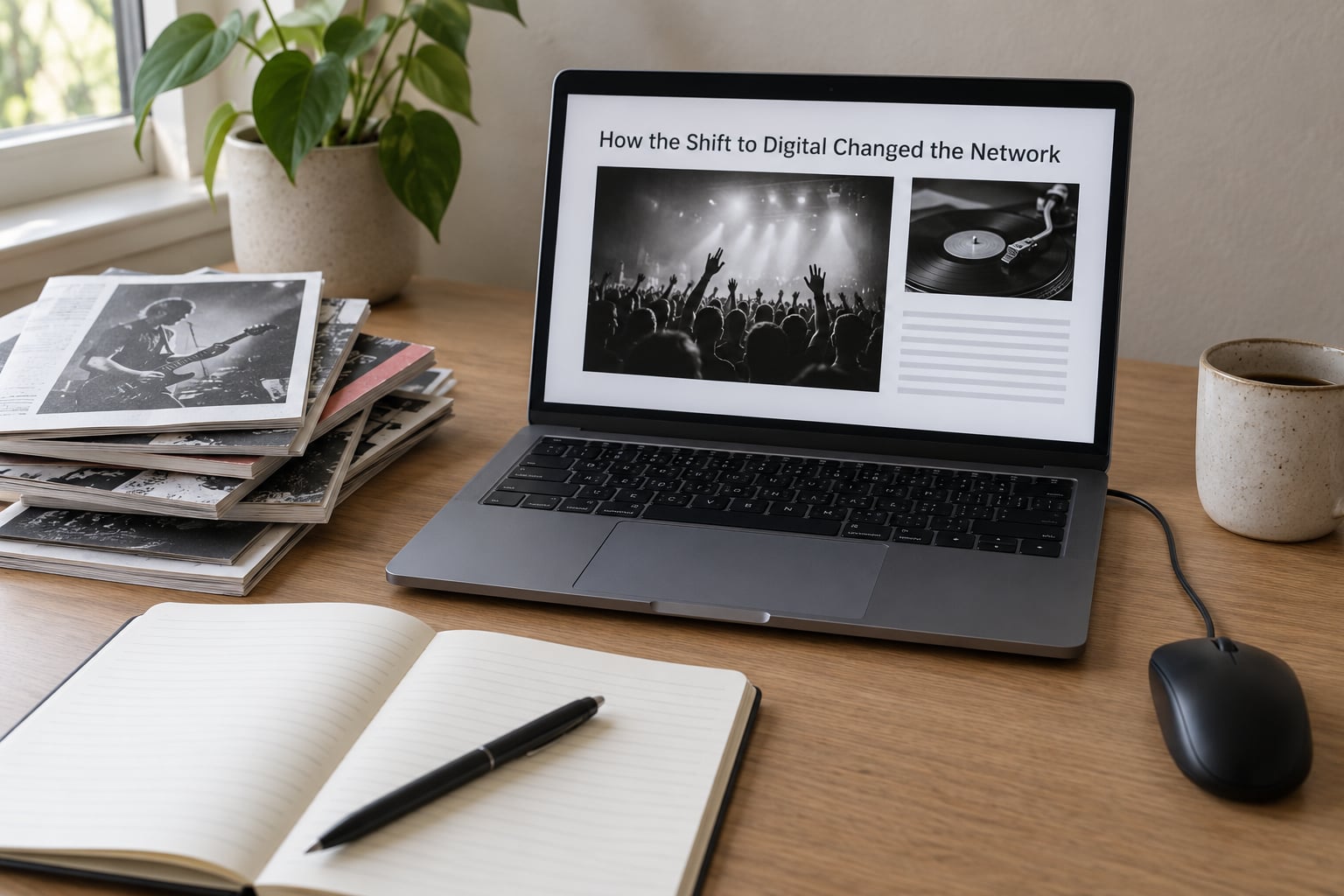
The internet arrived and changed the network in two opposite directions at once. Speed went up, and reach went up with it. Credibility and curation went the other way.
What got faster: a demo from a band in Manila could reach a reviewer in seconds. Bandcamp pages, streaming, social posts and email lists replaced snail mail for discovery. Festival announcements no longer depended on a printed listing.
Vic of Embalsamo described the shift from the Philippine side. In the early 1990s there were tons of bands there but barely a handful of releases, and reaching anyone outside the country depended on fanzines and the demo trade. Internet access later made DIY releases ordinary. Willie Desamero of Pathogen and Omenfilth said he formed his band in 2001 to record a demo and spread it worldwide because of his involvement in the global underground snail mail demo trading network and because he was running a fanzine.
What got worse: the editorial function. A photocopied page carried one person’s judgement. A feed carries a thousand undifferentiated posts, and the reader has to do the filtering that the editor used to do. That is the whole argument, and it is why zine revival keeps showing up alongside social media rather than being replaced by it.
Some editors chose obscurity on purpose. The editor of the Finnish old-school zine Abhorrent Visions kept minizines so underground that no information about them could be pulled off the internet, treating the un-indexed object as the point rather than a failure. He also ran a tape label alongside, duplicating on a Telex machine, and kept writing reviews for Metal Archives to bridge the print and digital eras.
Why it declined is unglamorous. Postage rates went up, editors burned out, and a lot of zines printed one issue and stopped. Webzines filled the gap and then went quiet themselves, which is the version of the story the people still publishing point at when they say a website that never updates is worse than a zine that comes out four times a year.
The Limits, Conflicts and Exclusions
The romantic version leaves out the hard parts, and the hard parts are worth stating plainly.
Money decided who got covered. Editors with printing budgets and access to shops reviewed more, and bands already on a label mailed promos with better artwork. A photocopied zine covering a local scene competed on attention against a professional magazine, which is not a fair fight.
Geography decided who got answers. International postage was slow and expensive, so the well-connected scenes in the US and UK were faster at getting responses than scenes in countries with weak postal infrastructure. That gap is visible in the record and it shaped which scenes got documented.
Gatekeepers existed anyway. Nobody had the authority of a label or a magazine, but an editor’s review pile was a real filter, and rivalries between editors were as sharp as rivalries between magazines. Metal Mafia’s editors described splitting coverage to avoid duplicating each other’s reviews, which is a form of editorial policy at that scale.
Scene politics were not neutral. Anarcho-punk and anti-war zines carried ideology as infrastructure, and titles in that tradition linked bands to causes as a matter of course. That is a strength when you want politics in your metal and a problem when you want a neutral directory.
Prejudice ran through it too. Regional scenes, women musicians, and bands outside the usual circuits were often underrepresented, because the network only reached as far as people’s address books. Networks that widen opportunity still reproduce bias, and pretending otherwise would be dishonest.
How New Zines Can Spread Metal Today
The model translates. What you need is a content pipeline, a duplication method, a distribution list and a reason for a band to write back. The tools changed; the loop did not.
Start with a defined angle, because a generic metal zine has nothing to trade for. Regional coverage, one subgenre, old-school tape reviews, live reports, or interviews with bands nobody else calls. Forums keep asking the same two questions: where do you print now that photocopiers have left the shops, and should a first issue be photocopied or professionally printed. The consensus answer on r/zines is that a zine is inherently DIY, so cheap print quality is part of the charm rather than a failure.
Pick a duplication method that matches your aim. Print-on-demand services replaced the photocopier as the default entry point, which is good for colour and consistent quality and worse for the deliberate roughness of a hand-made object. Shop photocopiers and university print rooms still exist and cost less per copy at small volumes.
Set a realistic print run. Fifty copies is a legitimate first issue and is exactly where the Metal Mafia editors started. Print more only when the previous issue actually sold or when you have a distribution commitment lined up.
Build the list before you print. Distros, shops that will take a few copies on consignment, bands you have written to, festivals you will travel to, and other editors willing to trade. A short printed piece with forty names on it beats a large run that goes nowhere.
Sell at shows without begging. A table with a sign, a stack and a price works, and one founder of a well-known zine admitted she was too shy to walk up to people and ask them to buy one, which is a problem thousands of zine makers share and nobody has solved by wishing.
Then layer digital on top rather than instead. Email a newsletter, post samples, sell physical copies through bandcamp or a personal site, keep the archive online. Metal Mafia’s three editors already ran a radio show and knew the print and broadcast worlds overlapped.
Report shows and local news, and keep doing it. Bands treat a zine feature as a milestone, and consistent local reporting is the one thing no algorithm rewards you for.
Frequently Asked Questions
What is a metal fanzine?
A metal fanzine is a magazine published by a metal fan for other metal fans, outside any commercial press, label or distributor. Most were photocopied or mimeographed, stapled, and mailed to readers. Typical contents are reviews, interviews, scene news, artwork and classified ads. The term zine is simply the short form of fanzine.
Who were the earliest heavy metal fanzine makers?
The word zine was coined in 1940s science-fiction fandom by Russ Chauvenet as a shortening of fan magazine. Metal inherited the method through punk’s photocopied press. Metal Rendezvous, appearing around 1983 and 1984, is widely cited as the first underground metal fanzine, with US and European titles following throughout the 1980s.
How did fanzines help underground bands get noticed?
Bands mailed demos to editors rather than to labels, and the editor mailed a copy of the zine back with the review in it. That physical reply was often the first evidence a band had that anyone outside its own town had listened. Editors also ran classified ads, wrote first interviews and passed copies at shows and festivals, which turned one local review into an international contact chain.
Are printed metal fanzines still relevant today?
Yes, though the mechanics changed. Print-on-demand services replaced the photocopier as the usual entry point, and bandcamp, email lists and social media handle discovery. Zine makers still value the form for what digital cannot easily copy: one editor’s consistent judgement, an object readers keep, and coverage of local scenes no algorithm will surface.
What is the difference between a fanzine and a music magazine?
A fanzine is non-professional, self-published and usually unowned by any company. A music magazine is sold commercially, has staff, advertising budgets, an editorial board and a distribution deal. The fanzine depended on trades, ads in kind and free labour; the magazine depends on cover price and ad revenue. Neither format is inherently better, but they reach different readers.
Conclusion
Fanzines spread the scene by connecting three things digital replaced separately: trusted curation, direct reporting and personal exchange. One editor decided what mattered, went to the show, and handed a physical object to someone who then handed it on.
If you want to do this now, start by mapping your network. List the local bands, the venues, the independent labels, the photographers and the cultural events you actually go to, then decide what your editorial identity is. Everything else, printing method, print run, distro, follows from that one decision.
And read the archives. The ones worth reading are the ones where you can see a scene being built in real time, in someone’s handwriting, before anybody thought it needed documenting.