Most bands answer the question of how independent bands fund their albums the same way: by stacking several small sources instead of chasing one big one. Day-job savings and gig money, crowdfunding, direct-to-fan pre-orders and merch, arts grants, small loans, and sometimes recoupable advances. The order matters more than the sources. Work out a real itemized budget first, find the cheapest money you can get, and only run a public campaign for whatever gap remains.
This guide walks through that order in eight steps, from setting a minimum viable budget to closing the books after delivery. It assumes an unsigned band releasing a self-released album without a label attached. Costs below are typical US ranges; they move with your city, your bargaining, and the year you are reading this in.
Table of Contents
- What You Need
- Step-by-Step Funding Plan
- Step 1: Set the album goal and minimum viable budget
- Step 2: Estimate every recording and release cost
- Step 3: Audit the band’s cash flow and ownership terms
- Step 4: Build a funding target and funding ladder
- Step 5: Combine several funding sources
- Step 6: Design a credible campaign and reward ladder
- Step 7: Lock contracts and protect the band’s rights
- Step 8: Release, track returns, and finish the accounting
- Common Mistakes
- Funding an inflated budget
- Relying on one unpredictable source
- Using personal emergency money
- Making promises you cannot keep
- Forgetting taxes, fees and contingency
- Mixing band money with personal spending
- Frequently Asked Questions
- Can an independent band fund an album entirely through crowdfunding?
- Should band members contribute money toward recording an album?
- Are grants or loans realistic for a new independent heavy metal band?
- How should a band divide ownership when different members pay different amounts?
- What should a band do if it raises only part of the album budget?
- Do crowdfunding and pre-orders mean the label owns part of the album?
- Conclusion
What You Need
Six things have to exist on paper before a band starts raising money. Bands that skip this step end up funding a budget nobody wrote down, then arguing about it after the record is mixed.
- An itemized total budget. Every line item with a real number attached, not a lump sum called “record costs”.
- A personal cash reserve. Money you will not touch for the project, kept in a separate account from the band fund.
- Written ownership terms. Who owns the masters, who owns the publishing, who paid what, and what gets recouped.
- Audience data. Email list size, open rates, show attendance, and how many people actually bought something from you before.
- A funding target. A specific number tied to a specific scope, with the amount you must earn stated separately.
- A defined release goal. Format, release date, and what success looks like when it exists in the world.
Six documents and numbers beat enthusiasm every time. If a band cannot produce these six, the money conversation is really a creative conversation wearing a disguise.
Step-by-Step Funding Plan
Run these steps in sequence. Bands that jump to step 6 with nothing from steps 1 to 5 usually end up with a campaign that underfunds badly and a refund headache on delivery day.
Step 1: Set the album goal and minimum viable budget
Define the deliverable before the money: how many songs, what length, which format, what release date. Then build the minimum viable budget, the smallest spend that produces an album you would defend in five years.
Split every line item into essential and optional. Essential items are the ones that make the record exist and reach people. Optional items are the ones that make it prettier. A debut funded by gig income can almost always drop the video, keep the artwork, and finish.
Then calculate the break-even figure: the number of units you must sell, at your average per-copy price net of fees and postage, to recover the budget. Write that number down and keep it visible. It converts an abstract record into a sales target, which is easier to plan a release around.
This is the core of how independent bands fund their albums: define a viable core, then go find money for it. You can always fund a second half later.
Step 2: Estimate every recording and release cost
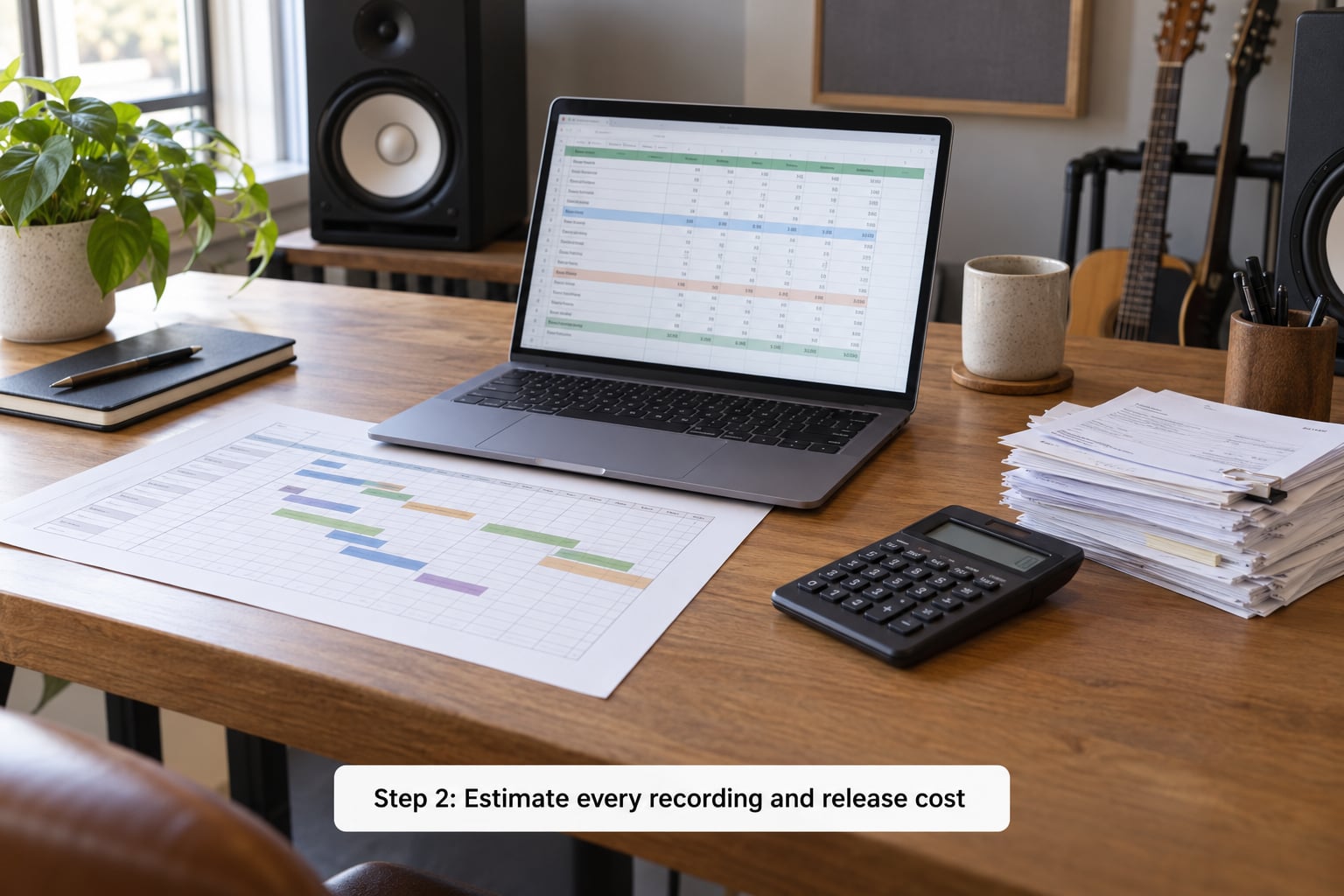
Break the project into line items and price each one separately. Studio time, engineering, mixing, mastering, artwork, band photography, video, pressing, distribution, promotion, rehearsal and travel, taxes, and a contingency. Quote from three suppliers for anything expensive.
The figures below are typical US ranges in dollars for a full-length, and they exist to make your own quotes legible rather than to be quoted back at you.
| Cost line | DIY home route | Semi-professional | Professional |
|---|---|---|---|
| Studio time and tracking | 0 to 300 | 800 to 2,500 | 3,000 to 8,000 |
| Engineering | 0 to 600 | 600 to 1,500 | 2,000 to 5,000 |
| Mixing | 0 to 600 | 800 to 2,000 | 2,500 to 6,000 |
| Mastering | 150 to 400 | 300 to 700 | 800 to 2,000 |
| Artwork and layout | 0 to 300 | 500 to 1,500 | 2,000 to 6,000 |
| Band photography | 0 to 200 | 400 to 900 | 1,500 to 4,000 |
| Video | 0 | 500 to 2,000 | 3,000 to 12,000 |
| Pressing or manufacturing | 0 | 1,500 to 4,000 | 4,000 to 15,000 |
| Distribution | 0 to 40 | 30 to 60 | 30 to 60 |
| Promotion | 0 to 200 | 500 to 2,000 | 2,000 to 10,000 |
| Contingency (10 to 15 percent) | 100 to 300 | 600 to 2,000 | 3,000 to 7,000 |
| Typical total | 250 to 2,900 | 6,500 to 21,000 | 21,000 to 75,000 |
Success check: every line has a figure, a supplier quote or a stated reason why you skipped it, and the total matches the number on your funding target. If the DIY column looks achievable to you, that is a real answer, not a compromise.
Step 3: Audit the band’s cash flow and ownership terms
Separate the band’s project money from members’ personal money before anything else. Personal emergency savings are not album funding; taking them destroys the cushion that lets a member walk away from a bad situation instead of trapping everyone in it.
Work out what the band can actually apply: personal contributions everyone genuinely can afford, gig and touring income after van, fuel and gear, session work, teaching, and royalties from earlier releases. Keep a simple monthly record of gig income going back a year. Bands routinely underestimate show income because they never wrote it down.
Then document ownership in writing: contribution amounts, splits, recoupment of rehearsal space and van costs, pre-existing gear, publishing, and who holds the master. Forum threads full of arguments about pooled gig money that never reached players are the same problem this document prevents. The cost of an hour with a lawyer later is far higher than the cost of an hour now.
Step 4: Build a funding target and funding ladder
Convert the budget into a fundraising goal, then split that goal into an amount that must be earned and an amount that would be welcome. Bands that set one aspirational figure fail publicly. Bands that set a modest target and exceed it celebrate publicly.
Build the ladder in ascending order of cost to the band. Start with internal sources, then direct sales, then grants, then borrowed money, then public campaigns. Every rung added later carries more risk and more paperwork, so the ladder exists to make sure the expensive rungs are only climbed when the cheap ones are exhausted.
Set the goal at the break-even figure plus a modest margin, not at your dream number. Success check: you can name the exact sum needed to deliver the album you described in step 1, and the date you need it in hand.
Step 5: Combine several funding sources
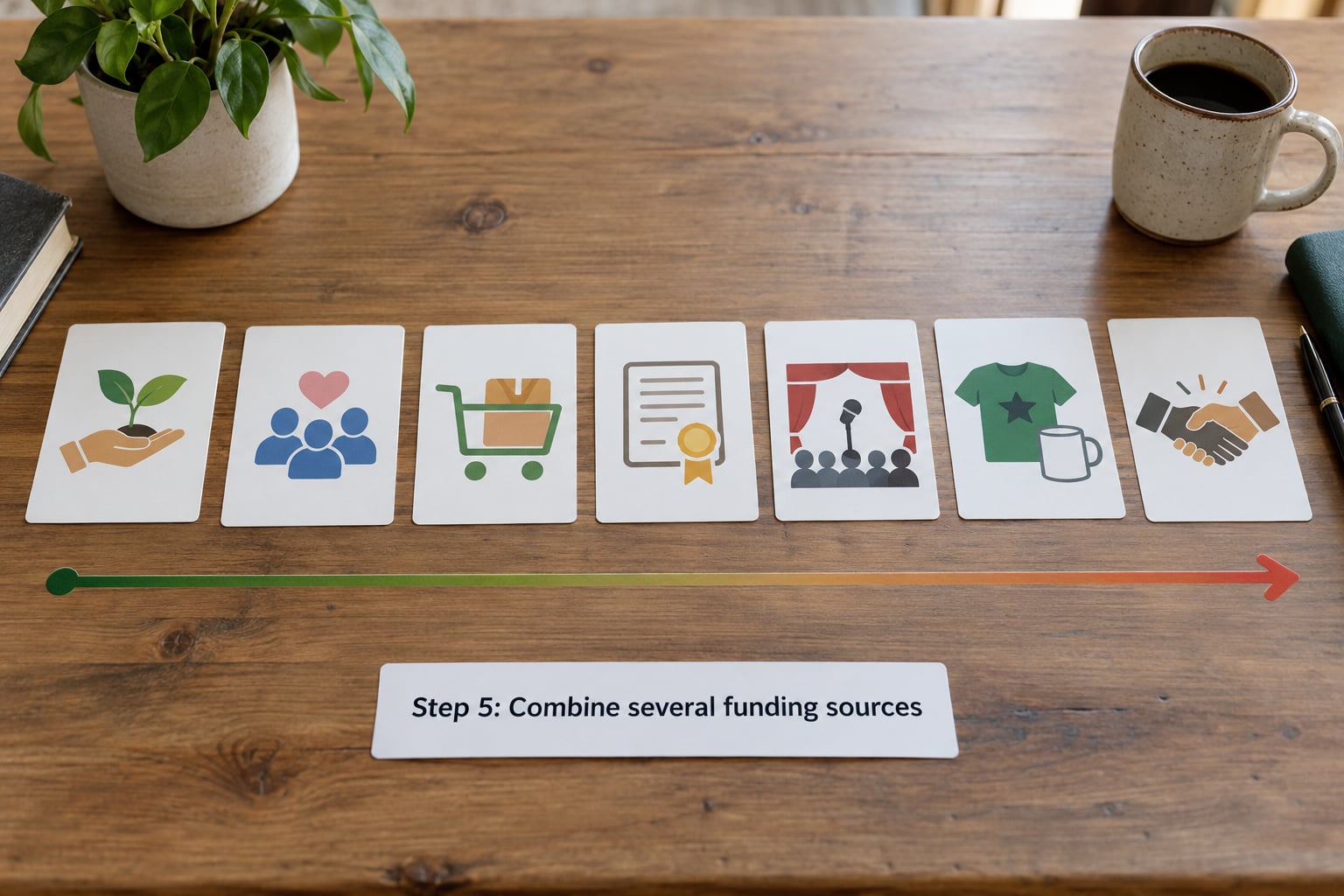
Stacking is the normal case, not the compromise case. Here is how the main routes compare for a typical unsigned band.
| Funding route | Cost to the band | Creative control | Time to cash | Main risk |
|---|---|---|---|---|
| Savings and day-job income | Personal risk, no fees | Total | Immediate | Depleting personal reserves |
| Gig and merch income | Time and travel | Total | Weeks to months | Van and gear costs cancel out profit |
| Direct-to-fan pre-orders | Manufacturing deposit | Total | At delivery | Under-ordering or late delivery |
| Crowdfunding | Platform fee, commonly 5 to 10 percent plus payment processing | Total | End of campaign | Missing the target in all-or-nothing models |
| Grants and residencies | Time, unpaid applications | Total | Months, often months later | Rejection, thin budgets, dead ends |
| Loans and private investors | Interest or a share of revenue | Varies | Days if approved | Owed regardless of how the record performs |
| Recoupable advances | Deduction from future revenue, no interest | Total, since sales are not surrendered | Days after qualifying | Repayment drags on for years |
Three quick definitions so the table is readable. A grant costs you nothing and gives nothing back. A loan must be repaid whether or not the record sells. An advance purchases a share of your future revenue, gets recouped from what you earn, and does not count against credit because no debt is created.
On platforms, Kickstarter takes 5 percent plus payment processing and uses an all-or-nothing model by default. Indiegogo charges 5 percent and offers flexible funding. Bandzoogle charges no commission on its subscription tier. PledgeMusic, which once dominated music crowdfunding, wound up in 2019, and that is why most campaigns now sit on general-purpose platforms. What is worth comparing across platforms is the fee, the funding model, and who handles delivery when you cannot.
Streaming income is not a funding source. On an average independent release, a stream pays a fraction of a cent to the master owner after the platform and the label take their share. It helps with rehearsal money, not with a record.
Step 6: Design a credible campaign and reward ladder
A campaign is a pitch to people who already like you, so lead with the record and the reason it exists, not with a countdown timer. Show the itemized budget. Bands on Reddit and in local musician groups who publish their real cost breakdown get taken more seriously than those quoting a round number with no explanation.
Design rewards you can physically deliver. A signed copy, a name in the liner notes, an unreleased demo, early access, or a limited edition pressing all work. House concerts, large merchandise bundles, and short-run signed variants are where bands get caught: manufacturing and postage are the most underestimated costs in the entire campaign.
Run the campaign only after the money is needed. Build the list first, use a realistic goal, and post honest updates even when they say the campaign is slow. Success check: a stranger who has never heard the band could read the page and understand what money buys and when it arrives.
Step 7: Lock contracts and protect the band’s rights
Written agreements matter most when money is changing hands between people the band already likes. Get contribution records in writing, even for a thousand dollars from a member. State whether member loans are repaid before splits or shared as revenue. Decide what happens if the band breaks up mid-project and who owns the finished masters.
Check the fine print on anything that touches ownership. A label services agreement can quietly take a percentage of publishing. A publisher advance is normally an unrecouped balance against future royalties, not a gift. Some crowdfunding reward levels hand over rights rather than goods. Ask a qualified music lawyer about any deal involving master ownership, publishing, or a term longer than a few years.
Success check: every contributor has a document, every platform fee is written down, and nobody in the band has signed anything they have not discussed out loud first.
Step 8: Release, track returns, and finish the accounting
Set the success bar before launch, because disappointment afterwards is usually a goal-setting failure. For a small independent release, one that covers costs, gets the band back in a room with people, and grows the email list is a success. Chart position is not the bar.
Watch cash after delivery, especially if you sold physical rewards. If you are underfunded or a supplier delays, contact backers before they contact you, offer a firm new date, and offer a refund to anyone who wants one. A band that communicates honestly about a delay usually keeps its audience. A band that goes quiet does not.
Then reconcile everything: every invoice, every fee, every person paid, and the split sheet to the dollar. Pay everyone who worked on the record before paying yourselves. Then write a short note on whether the model worked, because that note is the starting point for the next record.
Common Mistakes
These six errors account for most failed self-released albums. Each one has a simple fix.
Funding an inflated budget
Fix: take your itemized budget and cut every optional line. If the essential version cannot be funded, change the scope instead of chasing a bigger goal.
Relying on one unpredictable source
Fix: aim for the full target from at least three sources. Campaigns that hit a modest goal tend to be the ones backed by an engaged list, which is why audience size and goal size decide most outcomes rather than luck.
Using personal emergency money
Fix: keep a fixed personal reserve that the band cannot access, and never count money you need for rent, medical bills, or the next three months.
Making promises you cannot keep
Fix: read every reward as a job you have to finish. If fulfilling it requires a manufacturing run you cannot afford, cut the tier.
Forgetting taxes, fees and contingency
Fix: reserve 10 to 15 percent for contingency and budget for platform fees and payment processing up front. Reserve part of the takings for tax as income arrives rather than in a panic at year end.
Mixing band money with personal spending
Fix: one shared band account, a written split sheet, and monthly statements everyone sees. Informal pooling is where arguments come from, not the amount of money involved.
Frequently Asked Questions
Can an independent band fund an album entirely through crowdfunding?
It happens, but it is rarer than the campaigns suggest. Most successful music campaigns raise between part and a few times their target, and the ones that fund an entire record usually started with an existing email list and a track record of delivering. Pre-orders and merch often raise more money with no platform fee, so many bands combine a modest campaign for extras with direct sales for the core album.
Should band members contribute money toward recording an album?
Yes, if it is genuinely affordable and documented. Members typically cover a share of costs the band fund cannot cover, in exchange for a loan to be repaid or a reduced split. Write down the amount, whether it is repaid or treated as a gift, and what happens to the masters if the band breaks up. Informal contributions without records are a common source of later disputes.
Are grants or loans realistic for a new independent heavy metal band?
Grants are realistic but slow, and most fund rehearsal, residencies and development rather than a full recording. Bodies such as Help Musicians UK, the PRS Foundation, Arts Council England, the National Endowment for the Arts and local arts councils all publish fixed annual deadlines with lead times of several months. Loans are easier to get and far harder to carry, because repayment is due whether or not anyone buys a copy.
How should a band divide ownership when different members pay different amounts?
Separate contribution from ownership. Decide the split first, on a written split sheet signed by every member, then decide how personal contributions get handled, either as loans repaid from revenue or as advances against royalties. Mixing the two is what causes disputes. If someone paid for most of the recording, a temporary weighted split with a defined end date is fairer than a permanent change in ownership.
What should a band do if it raises only part of the album budget?
Cut scope before cutting quality. Drop the video, reduce the pressing run, release digitally first and fund the physical edition later with pre-orders. Then tell supporters plainly what changed and when the record arrives. Bands that underfund quietly lose trust; bands that communicate a smaller plan usually keep the audience and often get a second wave of support at release.
Do crowdfunding and pre-orders mean the label owns part of the album?
No. Crowdfunding pledges are purchases, so the money belongs to you subject to platform fees and the rewards you promised. Pre-orders are also sales. Ownership only changes when you sign a contract that assigns masters or publishing, such as a label services deal or a publishing administration agreement. Read those before signing, and get qualified legal advice on anything long-term.
Conclusion
Do three things this week. Write the itemized budget and mark every line essential or optional. Work out the real number the band can apply from savings, gigs and merch without touching anyone’s emergency fund. Then pick two small sources, one internal and one external, and aim for a modest target you can beat.
That is how independent bands fund their albums without handing over the record to someone else. Build the list before you ask for money, keep the scope honest, and the financing takes care of itself.