A demo tape is a rough, often self-recorded version of a song made to capture an idea and show it to someone else, such as bandmates, a producer or a record label, before the finished studio recording exists. It is not a bad album. It is a working document, and for heavy metal fans it is often the only surviving proof of what a band sounded like before the polish, the money and the machinery arrived.
I have spent a lot of time with old metal cassettes, and the thing that gets me every time is not the sound quality. It is hearing a band that already had an identity three years before anyone else knew they existed.
That gap between the demo and the album is where most of metal’s history actually happened. Labels signed on finished product and never heard the argument behind it, so the demo is where you see the arguing.
Table of Contents
- What a Demo Tape Is and Why It Matters
- How Heavy Metal Bands Used Demo Tapes
- Demo Tape Formats: Cassette, DAT, CD-R, and Digital Files
- What a Demo Tape Is and Why It Matters in Practice
- Why Demo Tapes Matter to Metal Fans and Collectors
- How to Tell Whether a Demo Tape Is Rare or Valuable
- Demos, Rehearsal Tapes, and Album Demos: What’s the Difference?
- Frequently Asked Questions
- Should a demo be live or recorded?
- What is tape in music?
- What makes a demo different from a rehearsal recording?
- Are metal demo tapes worth collecting?
- What does demo mean on a deluxe edition track listing?
- Conclusion
What a Demo Tape Is and Why It Matters
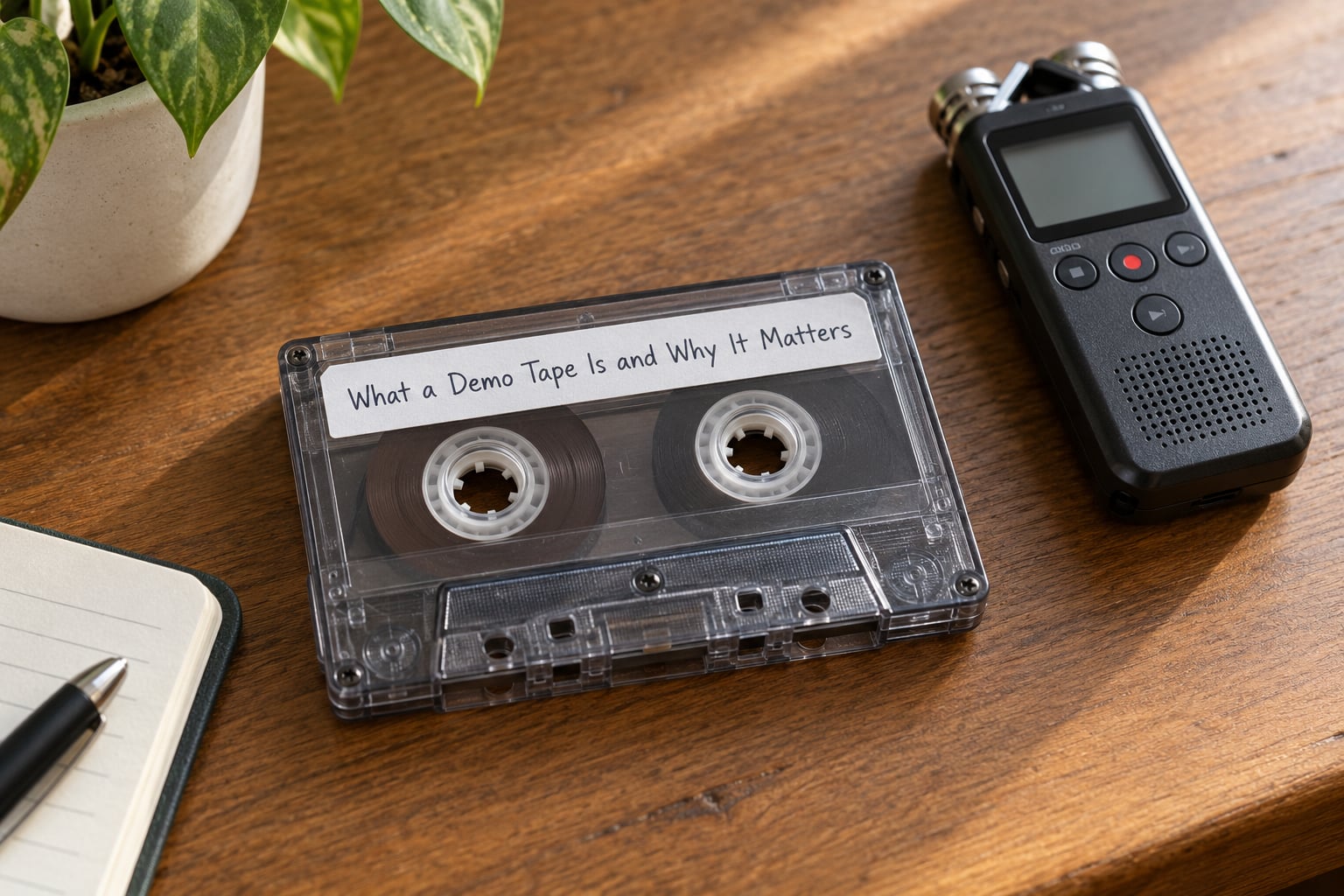
The word “demo” is short for demonstration. A demo tape demonstrates what a band can do, either to itself or to an outside party, without pretending the recording is finished.
Traditionally it was a physical cassette, which is why we still say tape even when the file is a WAV on a laptop. Bands that never had a label deal recorded onto whatever was in the rehearsal room: a four-track recorder, a Portastudio, a cassette deck with a mic plugged into the input, sometimes a reel-to-reel if the band had day jobs that paid for it.
Four things separate a demo from everything else it gets confused with:
- Purpose. It exists to test or communicate, not to sell.
- Production level. Rough by default. Overdubs, click tracks and edits may or may not be present.
- Audience. Bandmates, a producer, an A&R rep, a fan. Not a paying audience.
- Status. Unreleased. If it came out, it is not a demo any more, whatever the label calls it.
A rehearsal recording is close but different in intent. You tape a rehearsal to remember what you played last week, or to help a new member learn the set. A demo tape is made on purpose, usually with a decision at the end of it: keep this arrangement, scrap that one.
An album demo session is the step just before the studio. It is often higher fidelity than the first demos, with a producer in the room and the record label already interested. Same basic idea, later stage of the process.
How Heavy Metal Bands Used Demo Tapes
The workflow did not change very much between the late 1970s and the arrival of cheap digital recording. It ran something like this.
Catch the idea before it disappears. A riff, a vocal melody, a drum pattern that works. Somebody presses record before the thought evaporates. For most underground metal bands that recording went onto a cassette in a rehearsal room with a borrowed drum machine.
Send it round. A cassette in an envelope or a padded bag to the guitarist in another town. Listening to a tape you were not in the room for produces a different reaction than playing the song yourself. Bands regularly rewrote material based on what came back in the post.
Lock the arrangement. This is the least romantic and most important use. A song that works as a riff and a vocal fails live if the tempo is wrong or the bridge has nowhere to go. The demo is where you find that out cheaply, in a bedroom, before anyone pays for studio time.
Approach labels. A demo tape was the calling card. You posted it to a label with a typed letter, a photo, a list of where you had played, and a list of who had heard you and liked you. The cassette was the only part of that packet a stranger could actually play, which gave it an unfair advantage over a press clipping.
Recruit. Tapes circulated through scenes and fanzines, so a guitarist looking for a band could hear a demo before meeting anyone. Some heavy metal lineups were effectively assembled by trading tapes.
Build a following first. Underground labels in the 1980s and 1990s regularly pressed a demo, a rehearsal recording or a self-released cassette instead of waiting for a proper album. That gave a band a record they could sell at shows, review in a zine, and use to get a second date in another town.
The pattern still holds, obviously. The gear changed from a cassette deck to a laptop interface, but a band that has not decided how a song ends should not book a studio day yet.
Demo Tape Formats: Cassette, DAT, CD-R, and Digital Files
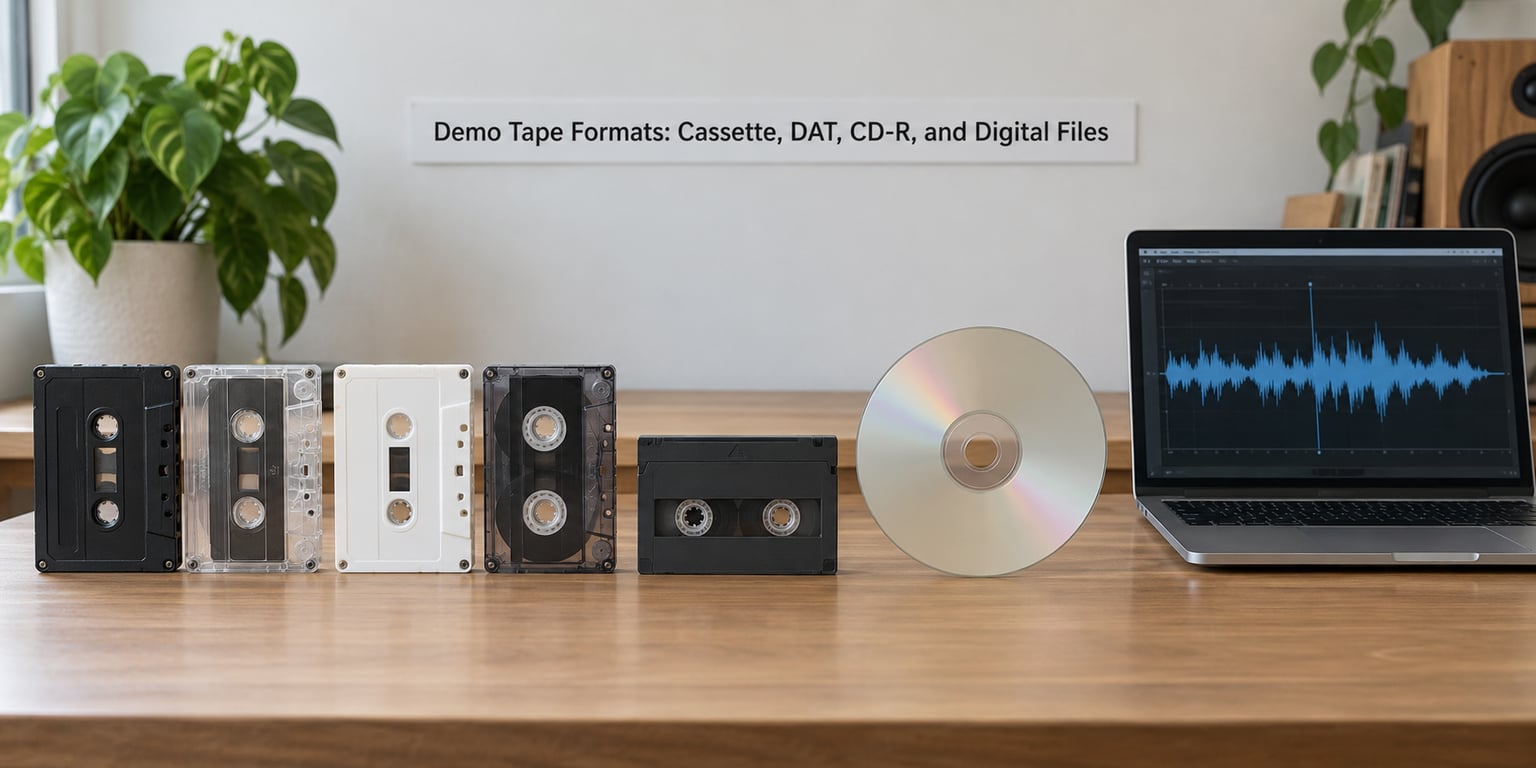
Each format decided who could make a demo, what it cost, and how far it travelled.
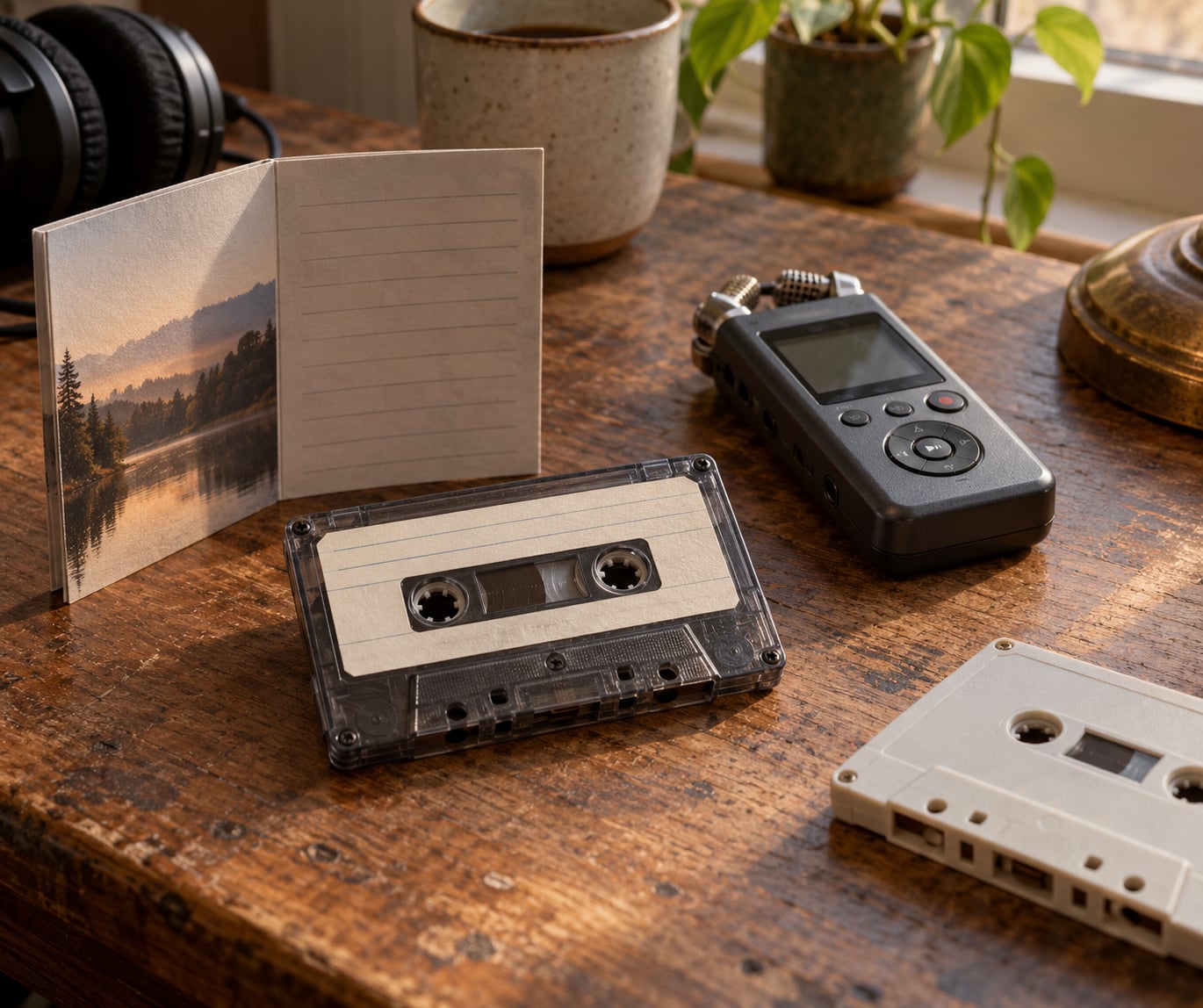
Cassette. The format of the scene. Cheap, robust, copyable by anyone with a deck, and easy to post. Its limits shaped the music: two tracks from most machines, four if you had a decent deck, hiss on everything, and no way to undo a bad take. That last point is why so many early demos sound live and immediate.
DAT. The 1980s answer for bands with money, giving digital clarity with tape handling. Smaller circles used it, mostly in studios and for professional demo sessions, and it never replaced the cassette as the currency of the underground.
CD-R. Arrived in the mid-1990s and put a burnable disc into the hands of bands that previously could not afford one. Audio quality jumped and trading got slower and more expensive, because you could no longer hand someone a physical object that was also their only copy.
Digital files. Email attachments and file sharing made sending a demo nearly free, and Bandcamp turned demos into things a band could publish directly instead of pressing. The physics of the scene changed: no physical artifact, no hand-to-hand trading, no worn J-card with a scene address and a date on it.
That physicality is not a detail. Handling the object, reading the J-card, seeing what machine it was made on, all of that is information you simply cannot get from a file.
What a Demo Tape Is and Why It Matters in Practice
A demo is the earliest snapshot of a band, and it exposes things a finished record hides. Listen for the vocal character: a singer years before they had range or control, still committed to the idea. Listen for the riffs, because an early demo often shows where the guitarist actually wanted the song to go, even when the album version followed the producer.
Look at the lineup on the J-card and compare it with the album credits. Different drummer, different bassist, different guitarist, and you have found a lineup that existed for a few months and left no official release behind.
Check the recording date. A demo made three months before a debut album tells you what the band was chasing at that moment. A demo made five years after the debut tells you they had lost the plot or were trying something nobody would accept on a label.
And listen for the room. The bass drum in a cellar, the hum of an amp in the next room, the rustle of someone stepping away from the mic to adjust something. That noise is the point. It proves the tape came from a room where music was actually happening rather than a studio built to erase it.
Why Demo Tapes Matter to Metal Fans and Collectors
Six reasons come up when people ask why demo tapes matter.
1. They capture lineups that never got an official release. A lot of heavy metal history survives in demo form only. When you can match a demo credit to a lineup that appears in no album sleeve, you have found a small piece of the band that the industry skipped.
2. They document an underground scene at the moment it existed. Compilations collecting old demos into one release are how a lot of collectors first hear a regional scene. That is a snapshot of what was being written and played before anybody outside the scene cared.
3. They show a song changing. Compare a first demo to the album cut and you can hear decisions being made: a tempo lifted, a bridge removed, a riff swapped, a vocal written around. Nothing else in the record shows you the road.
4. They explain a band better than the band does. Fans often discover a demo and realise the band’s identity was there from the start, which reframes everything that came after.
5. They resolve track listing confusion. When a demo track turns up years later on a deluxe edition, people ask whether it is half-finished. Usually it is not. Bands record a demo that already sounds like a finished song, the label prints the word demo in the credits because that is what the recording started as, and the listener is left guessing.
6. They hold the memory of a whole culture. The tape-trading scene of the 1980s and 1990s worked as a way of life in its own right, with blind buying far more common than it is now. The trading was part of the music scene, not a side effect of it.
How to Tell Whether a Demo Tape Is Rare or Valuable
There is no honest formula, and anyone who gives you one is selling something. Here is what collectors actually look at, in roughly the order that matters.
Band and era. A self-released demo from a band that later became well known is worth more than the same tape from a band that never made a record. Era matters too: 1980s thrash and early black metal demos are more actively collected than anything from the last few years.
Lineup. If the names on the J-card match the album lineup, the demo is interesting but common. If a well-known drummer or a guitarist who left the band appears, that raises it.
Pressing and markings. First press, numbered, hand-numbered copies on a coloured shell, studio or rehearsal date written on the label. Handwritten details from the people involved are worth more than a clean reissue of the same material.
Provenance. Who did you get it from, and can they say where it came from? Collectors are blunt about this: a tape with a documented chain of ownership and a good sleeve sells, and an identical tape with no history does not.
Condition and completeness. Does it play without warble on both sides, is the shell intact, is the insert present, is the J-card there? Buyers care about condition and completeness more than they care about the music, which is an odd thing to accept but a true one.
How many exist. Check the catalogue databases and specialist references for documented pressings. Pressing counts are often wrong online, and a tape claimed as a fifty-copy first pressing may have had two hundred.
One honest warning, and it applies to every collector market: resale figures are not guaranteed and they move. Most demos are worth very little. Some are worth a great deal. If a seller is framing every tape as rare, adjust your expectations accordingly.
Demos, Rehearsal Tapes, and Album Demos: What’s the Difference?
Here is the terminology ladder that sorts most of the confusion, including the deluxe edition question.
| Type | Purpose | Production level | Who hears it | Connection to a release |
|---|---|---|---|---|
| Rehearsal tape | Remember a set or learn arrangements | Whatever the room captured | The band | None |
| Demo tape | Test or communicate a song | Rough by design | Bandmates, producer, label | Version the album was built from |
| Album demo session | Rehearse the record before the studio | Professional setup, producer present | Band and label | Directly precedes the album |
| Single | Sell one song | Finished | The public | Commercial release |
| EP | Sell several songs in one package | Finished | The public | Commercial release |
| Album | Sell a full statement | Finished | The public | Commercial release |
The key distinction is intent and audience. A rehearsal tape is for the band. A demo is for someone who needs to make a decision. A single, an EP and an album are finished products sold to the public, whatever they contain.
So when a demo version turns up as a bonus track on a deluxe edition, treat the word demo as a description of origin rather than of quality. The recording is finished, the mastering is real, and the track is commercially released. It only counts as a demo in the historical sense: it is the ancestor of the song.
That is the honest answer to the confusion that shows up in forum threads, where listeners assume a track marked demo must be a rough sketch and then feel cheated when it sounds professional.
Frequently Asked Questions
Should a demo be live or recorded?
Both happen, and neither is wrong. Most first demos are recorded live in a rehearsal room because that is what fits the budget and the time available, so mistakes stay in and the room sound stays in. Studio album demos are usually tracked properly with a producer present. A live-to-two-track version sits between the two. Whatever the method, the demo should show the song, not the gear.
What is tape in music?
Tape is magnetic recording media wound onto a reel or into a cassette shell. Because it is a physical medium you can hold, copy, pass on and label by hand, tape became the default way bands and fans exchanged music before digital files existed. That physicality is why demos circulated through the underground as traded objects rather than downloads.
What makes a demo different from a rehearsal recording?
Intent. A rehearsal tape is made to remember a set or help someone learn arrangements, and nobody is trying to communicate the music. A demo is made on purpose so that a bandmate, producer or label can hear a specific song and make a decision about it. Both can be equally rough and equally unplanned.
Are metal demo tapes worth collecting?
Some are, and most are not. Band fame, lineup, pressing details, provenance, condition and completeness drive what collectors pay, and the databases often have press counts wrong. If you are buying, play it first, check it is complete, and ask where it came from. Resale figures are never guaranteed and they move with the market.
What does demo mean on a deluxe edition track listing?
It means the track started life as a demo recording, not that it is unfinished. Most bands record a demo that already sounds like a finished song, and the word stays in the credits through later reissues. A deluxe bonus track is finished, mastered and commercially released, so judge it on its own merits rather than assuming it is a rough sketch.
Conclusion
A demo tape is a rough recording of a song made before the finished version, and it matters because it is where metal bands decided what they sounded like. It preserves lineups that never got an album, scenes that never got a review, and songs in the state before producers and budgets got involved.
Start with three things. Listen for the band’s identity rather than the sound quality. Verify the context, which means the J-card, the recording date and the lineup names. Then research rarity before paying for anything, because most demo tapes are worth very little and the ones that are not are worth it because of who made them, not how rare the tape is.