
Singing high notes without strain comes down to one principle: let your vocal cords arrive at the pitch instead of hauling them there. Warm up gradually, keep your breath steady and low, keep your jaw and tongue loose, and change the shape of your vowels as you go higher. Ten focused minutes a day beats an hour of pushing, and this guide lays out exactly how to run that practice.
I have watched a lot of singers wreck a good night by panicking two bars before a chorus. The note is fine. The approach is the problem. The same thing happens in the practice room, at karaoke, and in a rehearsal with a loud amp behind you.
None of this needs gear or money. It needs a plan you can repeat, and a clear idea of what “no strain” actually feels like.
Table of Contents
- What You Need
- Step-by-Step
- 1. Start With a Relaxed Release
- 2. Establish Stable Breath Support
- 3. Warm Up Before Changing Register
- 4. Find the Edge of Your Comfortable Range
- 5. Use Vowels to Make High Notes Easier
- 6. Practice Pitch Accuracy in Small Steps
- 7. Cool Down and Recover
- How to sing high notes without strain when you are scared of the note
- Common Mistakes
- Frequently Asked Questions
- Should singers push their chest voice to reach high notes?
- How quickly can I increase my vocal range?
- Does humming help singers practice high notes?
- How long should I practice high notes each day?
- Why do my high notes feel strained even when I use more air?
- When should I see a doctor or vocal coach about singing strain?
- The First Week
What You Need
The equipment list here is short enough that you can start tonight.
- Two minutes of quiet. Somewhere you can warm up without a bandmate asking you what you are doing.
- Room-temperature water. Not iced, not hot. Sipping is better than gulping.
- A mirror or your phone camera for the two self-checks described below.
- A piano app, a tuner, or a free chromatic scale so pitch feedback comes from something other than your own ears.
- A practice note. Pick a song with one high line you are aiming at, and leave the rest alone.
Volume matters as much as any of it. Practise at a level you could hold a conversation over. Singing loudly in a small room teaches you to push, and pushing is the habit you are trying to unlearn.
Finally, plan for slow progress. Adding load every few days is how singers end up hoarse on a Wednesday. Ten minutes on five days beats forty minutes once a week, and the shorter sessions actually build range faster.
Step-by-Step
Seven steps, run in this order. Each one has a sign that it is working, and if you cannot find that sign, stay on that step rather than pushing into the next.
1. Start With a Relaxed Release

Before you sing a single note, take the machinery out of overdrive. Start with a long, quiet sigh on an “sss” sound, letting the air leave slowly rather than pushing it. Then do a few lip trills on an “uh” at a comfortable pitch. Trills are deliberately undignified, which is why they work.
Do a quick self-check while you make the sound. Put a thumb lightly under your chin: if the floor of your mouth is pushing down hard against it, your tongue is doing too much work. Put two fingers on your larynx, the ridge at the front of your throat: it should feel mostly still, not climbing toward your chin.
You know it is working when the sound costs you almost nothing. If a warmup feels like effort before you have sung a single note properly, the volume is wrong.
2. Establish Stable Breath Support
Breathe low and slow. Inhale through your nose for a count of four with your shoulders staying down, letting your lower ribs and belly expand sideways rather than lifting your chest. Then release on “sss” for a count of eight. That exercise is worth doing on its own several times a week.
The mistake almost every high-note beginner makes is arriving at the top of the song with a full, oversized breath and no plan for it. That much air with no steady management forces the throat to clamp down, which is precisely the squeezing you are trying to remove.
Use enough air that the note has a steady pulse behind it, and no more. Your breath is the raw material; support is what you do with that air on the way out, not the size of the inhale.
You know it is working when a mid-range note holds steady for eight counts on one breath with no rise in your shoulders and no urge to squeeze.
3. Warm Up Before Changing Register
Work low to high. Start in the middle of your speaking range, hum or lip trill there, and slide gently upward in small steps. Stay in the region where notes come out clear and easy.
Add a couple of “ng” sounds, sliding from low to high and back down. The back of the tongue and soft palate do the work, so there is very little for the jaw to grip. Finish with a descending siren on “woo” or “nuh”, starting near the top of your comfortable range and sliding down.
Descending into a note from above is safer than climbing up to reach it. That is the single most repeated tip across singer forums, and it holds up: the glottis can settle into a pitch far more easily than it can leap toward one.
Stop or cut the volume immediately if the voice feels tight, painful, or suddenly rougher than it did five minutes ago. That is information, not a challenge.
4. Find the Edge of Your Comfortable Range
Most beginners have never found their actual top note. They just know a song makes them uncomfortable, and they assume that is their ceiling. It usually is not.
Open a chromatic scale and ascend slowly on “nuh” or “eee”, half step by half step, staying in mixed voice or wherever the tone stays clear. Stop at the last note you can sing with a steady, unhurried tone. Then do the same descending. Note the number of semitones you covered. That is your working range today.
Compare it next week. Range moves slowly, in semitones rather than octaves, and most of what people call “range gains” are really clarity gains: the same top note, now without the wobble.
You know it is working when you can name your top note and the note below it. Numbers turn a vague ceiling into a training target.
5. Use Vowels to Make High Notes Easier
Wide vowels get harder as you climb because your tongue has to do more work, and the jaw wants to follow it up. Narrow them as you go higher and the note gets cheaper.
The usual substitutions: “ah” toward “uh”, “ee” toward “ih”, “ay” toward “eh”, “oh” toward “ooh”. Do not think of this as cheating. Rock and metal vocalists use vowel changes constantly so a high line still sounds like the lyric rather than a squeak.
Check your mouth width with the trick singers borrow from a certain movie: put your hands flat on your cheeks, fingers toward your ears. If your mouth is wider than your hands, it is too wide for a high note. Drop the jaw instead of smiling through the note. Smile pushes the jaw forward, and forward is the wrong direction up there.
Simulate a yawn to feel the soft palate lift at the back of your mouth. That wider, taller space is where high notes want to resonate.
You know it is working when the vowel changes to “uh” or “ih” and the note suddenly feels easier, not harder.
6. Practice Pitch Accuracy in Small Steps
A hard high note rarely improves by being attacked full height. Break it into pieces.
Sing the note as a short “hey” or “ho”, two syllables, landing right on pitch. Add it to a three-note fragment and repeat it five times. Then extend it into the short phrase around it. Every repetition should be quieter or equal, never louder than the one before.
Use the tuner or piano app to confirm the entrance, then stop checking and sing it again from memory. Most entrances crack because the pitch was never heard accurately before the mouth committed to it.
One more thing that costs nothing: put something over your ears so you cannot monitor yourself closely, and sing the line. The moment self-monitoring tightens, the pushing starts. You will hear the change immediately, and so will everyone in the room.
You know it is working when you can hit the note five times in a row at the same volume, and the recording sounds cleaner than it felt.
7. Cool Down and Recover
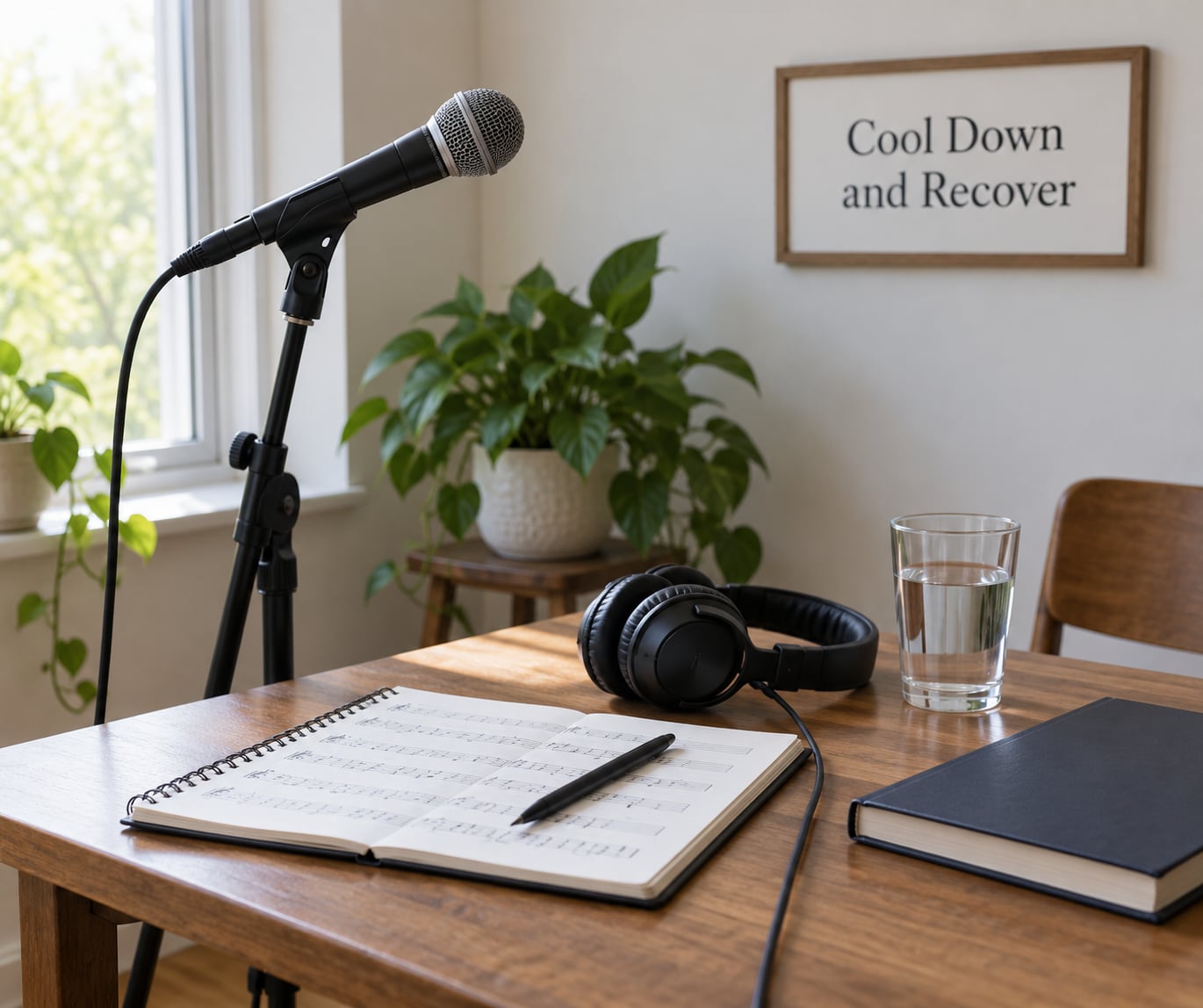
End every session with quiet humming, a few descending lip trills, and long gentle “nuh” slides from top to bottom. Five minutes. This is where you signal to your voice that the work is finished, and it makes the next session start from a better place.
Sip water across the rest of the day, aim for regular sleep, and keep dairy and heavy sugar out of the hour before you sing. Skip alcohol before practice, always. If your voice is already tired, do the cooldown only and skip the high notes entirely.
Recording yourself once a week is the cheapest diagnostic there is. If the recorded high note sounds squeezed, thin, or breathy, the problem is audible, and no amount of how-it-felt thinking will argue with it.
How to sing high notes without strain when you are scared of the note
Fear shows up physically, and the physical habits of fear are what create the strain. Heart rate climbs, breath gets shallow and high in the chest, the jaw sets, and the whole neck braces for impact. That posture is the squeeze, whatever your technique.
So treat it as a preparation problem rather than a talent problem. Know the note before rehearsal. Practise it quietly dozens of times so the pitch is boring. On the day, take a low slow breath before the chorus, not during it, and aim to arrive in the note already singing rather than jumping into it.
Sing on top of the note instead of reaching up to it. That image comes straight from vocal coaching practice and it works because it changes what your body does: settling rather than climbing.
Common Mistakes
Nearly every strained high note comes from one of these. Work down the list and see which one sounds like you.
- Pushing up from the throat. The fix is a lower larynx position and a narrower vowel. If the note feels like a lift rather than a settle, you are climbing.
- Yelling during the warmup. Warmups should be easier than the song. Cut the volume and go again.
- Taking too much breath. A huge inhale creates a burst of pressure the throat has to fight. Use a moderate breath with steady release.
- Craning the neck forward. Drop the chin slightly toward the chest. Forward neck posture adds tension to the strap muscles right where high notes need freedom.
- Practising high notes for too long. Twenty minutes of top-end work is plenty. Quality falls off before endurance does.
- Chasing range every session. Adding new high notes on top of an already tired voice is how a good day turns into a hoarse one.
- Assuming more support is always the answer. Strain is often excess vocal weight or body tension, not a shortage of breath. Less weight often fixes more than more air.
- Treating every high note as chest voice. Many rock and metal choruses sit in mixed voice or falsetto. Fronting them from chest voice is a choice that costs you the note.
Symptom to cause to fix, if you would rather diagnose than read a list:
| Symptom | Likely cause | Fix |
|---|---|---|
| Cracks on one specific note | That note sits in your passaggio, where two control systems have to coordinate | Descend into it with a siren rather than climbing up to it, rehearse it as a short fragment |
| Breathy, weak high note | Not enough weight on the cords, often with too much escape air | Slightly firmer onset, narrower vowel, more focused airflow |
| Nasal or thin tone | Mouth too wide and jaw pushed forward | Drop the jaw, narrow the vowel, run the hands-on-cheeks check |
| Sore throat after practice | Too much volume or too long a session at the top of the range | Lower volume, cap high-note work at 20 minutes, cool down properly |
| Voice cuts out entirely | Cumulative fatigue, usually built over days | Vocal rest, hydration, then rebuild at half volume for a week |
| Pitch wobbles on the way up | Breath support arriving in bursts instead of steady | Longer, quieter “sss” releases to steady the airflow |
One last correction for the low-voiced singers who show up worried they simply cannot sing high. Speaking voice says almost nothing about singing range. The common thread in beginner threads is not a lack of range; it is a habit of squeezing at the top and assuming that is what high singing is.
Rock and metal adds one more layer. Singing over a loud band teaches you to push, because you can barely hear yourself. That is why singers sound strained in a rehearsal room and fine at home. Lower the volume, use in-ear monitoring if you have it, and practise the clean high section with backing tracks at a level that would embarrass you on stage.
Frequently Asked Questions
Should singers push their chest voice to reach high notes?
No. Chest voice is built for a lower set of pitches, and pushing it upward recruits the muscles around the throat, which squeezes the vocal cords and causes cracking. High notes get easier when you let your vocal cords thin out on their own, keep the larynx low, and move through mixed voice or head voice instead. Rock and metal singers often hit a high chorus in falsetto or mixed voice for exactly this reason, and it sounds stronger than a forced belt.
How quickly can I increase my vocal range?
Treat range as a slow project measured in semitones, not octaves. Most people gain clarity and consistency in their existing range within a few weeks of daily practice, and reliable new top notes take a few months. Range training works because the cords get more efficient at thinning and coordinating, not because the voice stretches. Practising ten minutes a day for two months will beat one brutal session a week, every time.
Does humming help singers practice high notes?
Yes, and it is one of the gentlest tools you have. Humming on a closed mouth takes the tongue and jaw out of the equation, so there is almost nothing left to tense. Slide a hum from low to high in small steps, stay where the tone stays clear, and never force the top. Follow it with lip trills or an ‘nuh’ to add vowel work once the hum feels easy.
How long should I practice high notes each day?
Ten to fifteen focused minutes, most days of the week, is plenty for progress. Keep the warmup gentle and cap direct high-note work at around twenty minutes, because tone quality drops before endurance does. Take a full day off every week or two. If your voice is hoarse, sore, or noticeably weaker than normal, skip the top end until it comes back.
Why do my high notes feel strained even when I use more air?
Extra air is the most common wrong fix. When a note feels hard, most singers add breath, and the extra pressure makes the throat clamp down harder, which makes the squeezing worse. Strain is often excess vocal weight, a tight tongue, or a braced neck rather than a shortage of support. Use a moderate breath with a steady release, and check your jaw and tongue with a thumb under your chin while you sing.
When should I see a doctor or vocal coach about singing strain?
See a doctor or an ear, nose and throat specialist if hoarseness lasts more than about two weeks, if you feel pain while singing or swallowing, if your voice keeps cutting out, or if you notice frequent vocal fatigue that does not improve with rest. A qualified vocal coach can help sooner with technique problems such as a consistently rising larynx or a tight jaw. This article is general information, not a diagnosis, so anything persistent deserves a professional look.
The First Week
Start with step one tomorrow: two minutes of sighs, lip trills, and a thumb under your chin. Nothing else. Get the release right before you add any volume or any high notes, because every later step depends on it.
That is the whole method. Nobody ever learned how to sing high notes without strain by reaching harder; they learned it by releasing more, then repeating it until it was boring.