Palm muting changes a riff feel by cutting the sustain off every note so the riff stops ringing and starts punching. The short, damped notes sit closer to the kick drum, the low end tightens up, and each chug lands on the beat instead of blurring into the one before it. That is why a muted riff can sound heavier and more forward in a mix even though every note is technically shorter.
I have played it both ways more times than I can count, and the difference is bigger than most beginners expect. It is not a volume trick or a tone preset. It is a change in how the notes connect to each other and to the rest of the band.
Table of Contents
- What Does Palm Muting Do to a Riff?
- How Palm Muting Changes a Riff Feel in Metal
- Palm Muting, Riff Attack, and Sustain
- Palm Muting, Tone, and the Mix
- Why a Muted Riff Feels Tighter, Not Just Darker
- Using Mute and Release as a Dynamic Tool
- How to Use Palm Muting Without Killing the Riff
- Common Palm Muting Mistakes
- Frequently Asked Questions
- How do I know if I’m palm muting correctly?
- Can you strum while palm muting?
- Why does my palm muting sound bad?
- Does palm muting make a riff sound quieter?
- Is palm muting bad for my technique?
- Conclusion
What Does Palm Muting Do to a Riff?
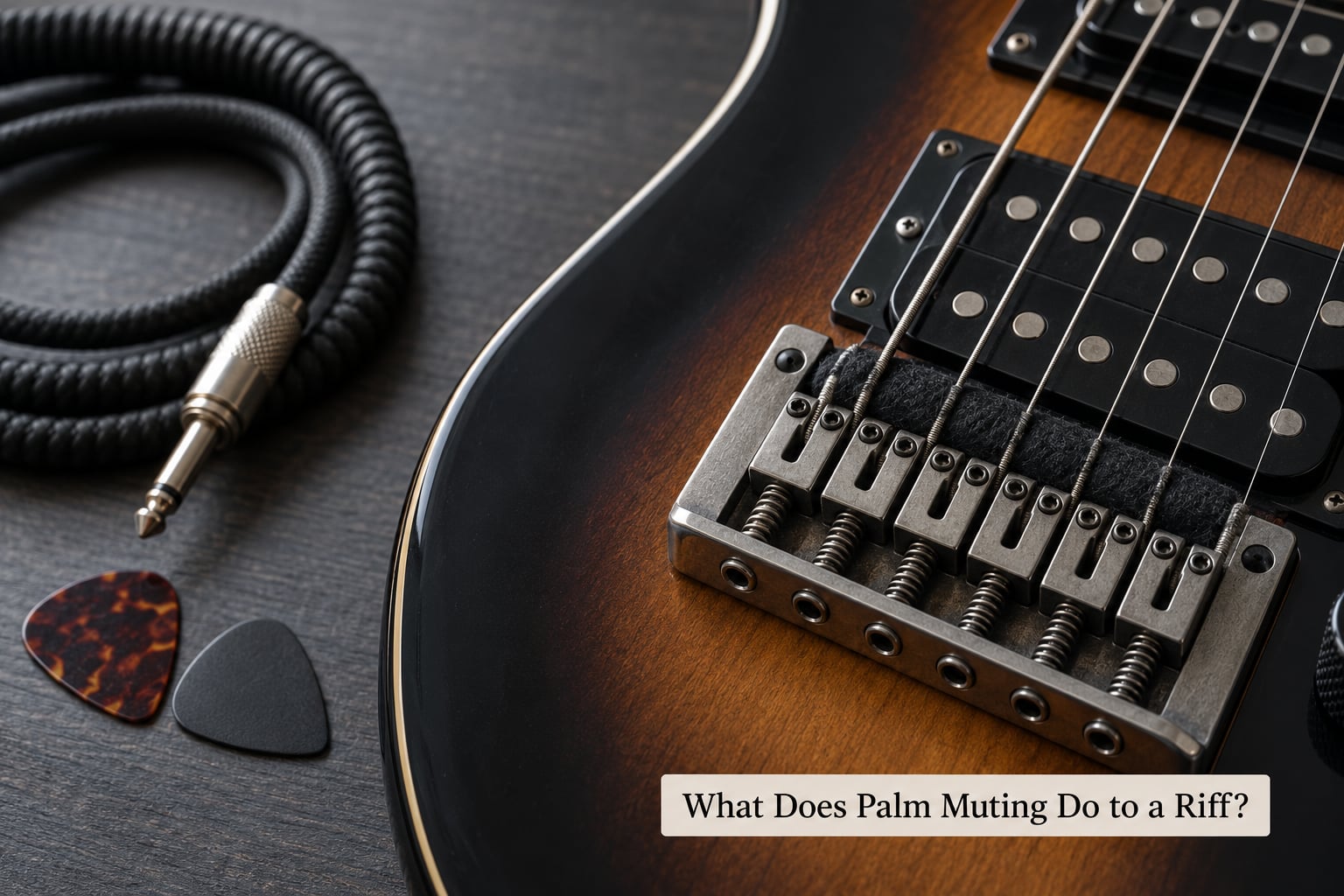
Palm muting is the technique of resting the edge of your picking-hand palm on the strings just past the fretted notes, close to the bridge, so the strings are damped almost the instant the pick strikes them. The note still sounds, but it stops ringing right away.
Three physical things happen when you do it:
- Sustain collapses. A ringing string becomes a short, clipped note with a defined end.
- Low-end bloom drops. The fat, smeared bottom of an open power chord tightens into a defined note.
- Attack becomes the point. Because the decay is short, your pick stroke and the fretting hand’s squeeze do the talking.
The palm edge sitting on the pinky side of your hand is what does the work, and the spot is usually right between where the pick meets the string and the bridge saddles. Move that contact point toward the bridge and the mute gets tighter and thinner. Move it back toward the pickup and the note darkens but stays more audible.
Depth matters more than people think, so it helps to think of three settings rather than on and off.
| Mute depth | What it sounds like | Where it fits in a riff |
|---|---|---|
| Light | Note has body but stops early, pitch stays clear | Groovy 16th-note chugs, funk rhythm playing, verses that still need to breathe |
| Medium | Percussive thump, almost no ring, pitch still readable | Standard metal chug patterns, gallops, most drop-tuning riffing |
| Heavy | Dead, choked, almost percussive; pitch can start to cry or warp | Breakdown hits and stabs where you want a drum sound more than a note |
If you can hear a difference in pitch between the notes, you are in the light or medium range. If the notes have no clear pitch at all, you have gone too deep.
How Palm Muting Changes a Riff Feel in Metal
The feel of a riff is not just its notes, it is the space between them. Open strings fill that space with sustain, and sustain is what makes a riff feel loose. Muting removes it, and the riff snaps onto the rhythmic grid.
Palm Muting, Riff Attack, and Sustain
Attack is the first thing you hear on a muted note, because there is no long tail to hide behind. That makes a clean pick stroke more important when you mute. A sloppy stroke that was hidden under sustain suddenly shows up as an uneven chug.
Think about how it works in three common spots. Short chugs on the low E are almost entirely attack; the note is a click of pick plus a thud of compressed string, and the drum and bass do the sustaining. Clipped rhythm figures, the muted 16th-note gallops and shuffling patterns in thrash and metalcore, gain their definition from the gap between one damped note and the next. Accented partial chords, where you mute a riff but let the last hit of a bar ring out, use the contrast between the two states to land harder.
The drum kit analogy from guitar forums is worth stealing. Players regularly describe a properly muted riff as playing a muted kick drum, and that is exactly the role it fills. When your chug sits in the same rhythmic space as the kick and the palm-muted guitar stays tight against the snare, the groove locks.
It also changes what the fretting hand is doing. Notes stop bleeding into each other, so you can hear whether your fingers are landing cleanly. Muted playing exposes sloppiness in a way open playing hides, which is one reason teachers push students toward it early.
Palm Muting, Tone, and the Mix
Here is the part that surprises beginners: muting does not make your riff quieter. A heavily sustained power chord spreads its energy across a wide frequency range, so each note sounds thinner and softer than it really is. Cut that bloom off and the same riff reads as thicker and more forward, because the energy concentrates into a short, dense block of sound.
That is why producers ask guitarists for it. A palm-muted rhythm part sits in front of the mix without needing to be turned up.
Tone and rig settings interact with it too. A bridge pickup is brighter than a neck pickup and usually shows off muting detail better, though a neck pickup with a light mute gives a thicker, woollier version of the same figure. Gain is the other half: with a lot of distortion, small inconsistencies in your palm get buried in the harmonics, so a heavy-mute mistake that sounds awful clean can disappear on a saturated tone. That is one more reason to practise with the gain turned down, where the articulation is audible.
Drop tunings respond well to muting for a simple reason. A low open string in a drop tuning rings for a long time and muddies everything around it. Damping it keeps the fundamental note clear and stops the low end from turning to soup.
Why a Muted Riff Feels Tighter, Not Just Darker
Dark tone is a description; tightness is a feel. Tightness comes from note separation, from every attack having its own beginning and end. Play a riff open and the notes lean into each other, so your ear hears a wash. Mute it and the ear hears discrete events, which is the same reason a snare backbeat feels driving.
Genre norms follow the same logic. Funk and R&B players mute for definition between notes, not weight. Country and bluegrass use light muting to keep chord changes clean. Blues leaves more ring for expression. Metal uses the deepest mute because the band is loudest and the guitar needs the least sustain to be heard.
Using Mute and Release as a Dynamic Tool
The most useful riffing move is treating the mute as something you switch on and off, rather than a permanent setting. Play four or eight muted chugs, then release for a single ringing chord hit on the downbeat. The open chord sounds enormous, because your ear has been given a reference point for how dead the muted notes were.
The same trick works going the other way. Hit an open chord stab in a breakdown, then drop into a tight muted figure underneath it. Players on the forums describe the same effect when they ask how to switch from palm-muted chugs to an open chord hit inside one bar without rushing: the change itself becomes part of the groove, as long as your palm is already travelling toward the bridge before you need it there.
How to Use Palm Muting Without Killing the Riff
Most of the trouble with palm muting comes from doing too much of it. A few habits keep the riff intact.
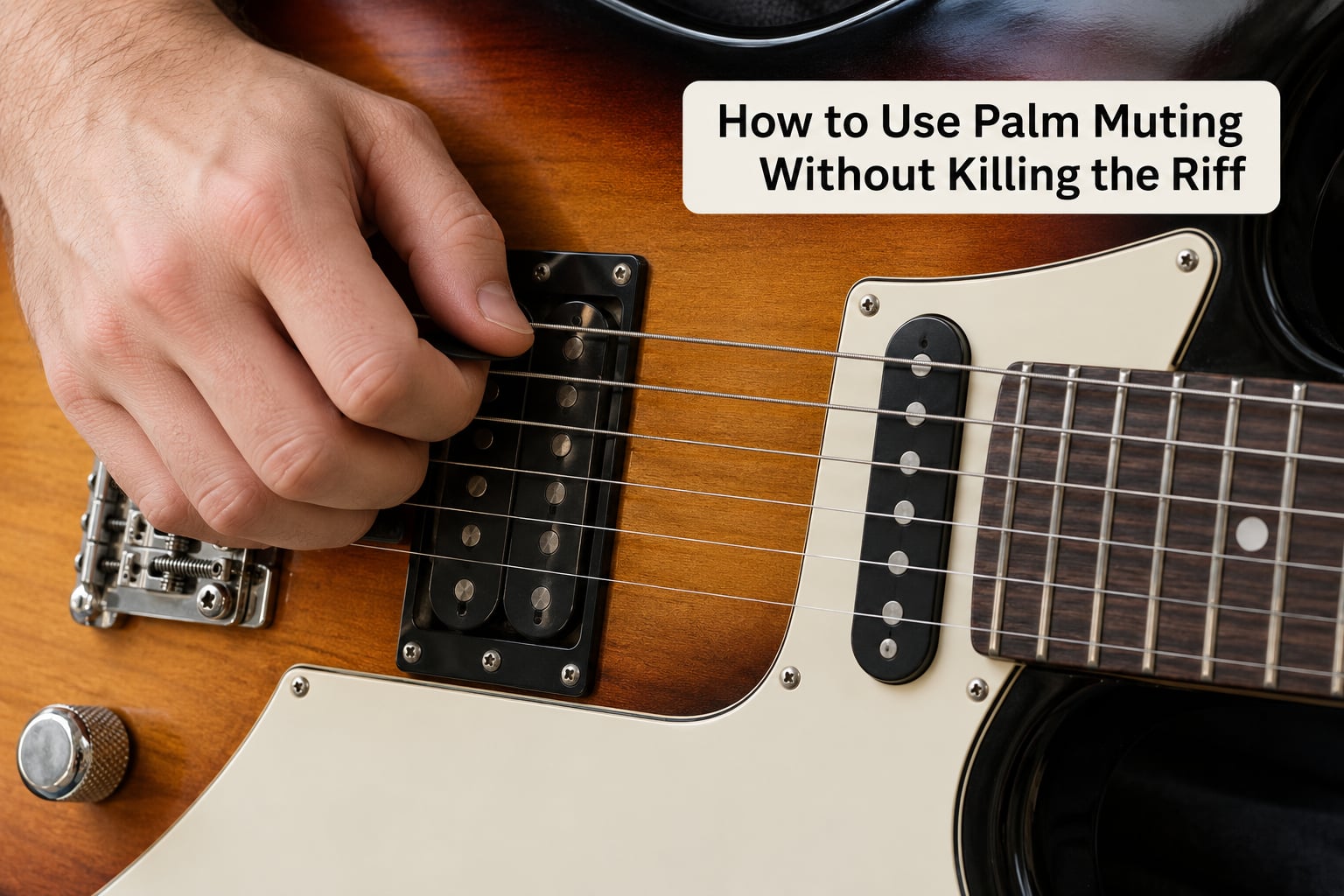
Rest the palm, do not clamp it. The weight of your hand is enough. Players who press down hard end up with a sore wrist and a forearm that locks up after a few minutes, and the pitch suffers as the palm edge pushes the string sideways. If your note sounds like it is bending or crying, you are pressing.
Find a home base spot, then only nudge it. Play a single muted note at a comfortable tempo and slide your palm forward and back in small steps until the tone stops changing noticeably between positions. Pick that as your default. Micro-adjustments of a couple of millimetres are fine during a song, but your hand should be able to find the same place twice without thinking.
Anchor the thumb for control. Resting your picking thumb on or near the bridge pickup stops the hand drifting during fast passages and makes it easy to return to the same spot every bar.
Mute only the strings that need muting. On a low-string riff, the palm naturally damps the treble strings too, which is fine. But if you want one note to ring, you can angle the palm so its edge catches the low strings and lets a higher one through. Selective muting is the trick behind clean partial chords.
Let the fretting hand handle the rest. Fret-edge muting, using the side of the index finger to kill unwanted open strings during chord changes, fixes the bleed that palm muting cannot reach. It is a separate skill and it takes practice, but the two together stop a riff from turning into a chord-shape pileup.
Check for evenness between strokes. Alternate picking is where muting betrays you, because your hand tends to lift on the return stroke. If you can hear which direction the pick moved, the mute is inconsistent. Slow the riff to 60 to 80 bpm, loop a single bar, and get it even before you add speed.
Record yourself. This is the fastest way to know whether the mute is working. You will hear pressure drifting partway through the bar long before you would notice it while playing.
Common Palm Muting Mistakes
Over-muting. The tell is a note that sounds like you are tapping the string rather than playing it. The pitch disappears and the riff thins out. Ease the pressure until you can hear the note’s pitch clearly, then back off a touch more.
Pressure drifting through the bar. Your tone darkens halfway through a phrase and nobody can say why. It usually happens because tension builds. Practise with the gain down and slow the tempo until the pressure stays constant for a full repetition.
Lifting the palm on upstrokes. Alternate picking exposes this immediately. Return strokes sound brighter because the hand comes off the strings. Anchor the thumb and keep the palm edge in contact whether the pick is going up or down.
Weak pick attack. A muted riff lives on the transient, so a lazy stroke sounds like a dull thud. Pick closer to the bridge for a brighter attack and use more wrist than arm.
Open-string bleed. High E and other unplayed strings ring behind a muted low-string riff, which is one of the most common complaints on guitar forums. Answer it with the fretting hand, not more palm pressure. Adding pressure only makes the chug worse.
Muting the whole riff with no contrast. When every note is equally dead, nothing stands out. Leave selected hits open, especially the last beat of a phrase or the last chord of a progression.
Judging the result at high gain. A huge amount of distortion smears the evidence of what your hand is doing. Turn the gain down, listen to the articulation, then bring the distortion back up.
Frequently Asked Questions
How do I know if I’m palm muting correctly?
Play a single muted note and listen for three things: the pitch stays clear rather than warbling, the decay stops quickly without cutting off abruptly, and the tone stays the same from the first note to the last one in the bar. If the pitch bends upward or the tone darkens partway through, your palm is pressing too hard. Recording the riff and playing it back is the fastest check.
Can you strum while palm muting?
Yes, and it is useful. Resting the palm on the strings while strumming dampens everything as you sweep the pick across the strings, which produces a short, chugging texture instead of a ringing chord. Just angle the palm so its edge catches the strings after the pick passes. Keep the muting partial when you want the tail of the chord to ring out.
Why does my palm muting sound bad?
Four causes cover most cases. You are pressing instead of resting, so the pitch warbles. You are muting too deeply, so the note sounds like a tap. Your palm lifts on upstrokes, so the mute is uneven. Or unwanted open strings are ringing through. Turn the distortion down, slow the riff to 60 to 80 bpm, and fix the palm contact first before changing anything else.
Does palm muting make a riff sound quieter?
No, and this trips up almost everyone starting out. An open power chord spreads its energy across a wide range of frequencies, so each note sounds soft and thin. Muting concentrates that energy into a short, dense block, which reads as thicker and more forward in a mix. That is why rhythm parts are often palm muted and still sit higher in the balance than open chords.
Is palm muting bad for my technique?
No. It is a real technique that takes the same kind of attention as any other. Working on it tends to improve your timing, your pick attack and your ability to control dynamics. The one caution is to rest the weight of your hand rather than clamping down, since pressing hard tires the wrist and forearm and can pull the notes out of tune.
Conclusion
Palm muting changes how a palm-muted riff feels because it turns ringing notes into short, percussive ones, which tightens the low end, separates every attack and locks the part to the drums. Start with one simple exercise: take a riff you already know, play it clean at the same tempo, then play it again with a light mute. The tightness, the clarity and the weight will all move, and you will hear exactly which one your current part is missing.