A blast beat is a drum pattern where a fast, repeated sixteenth-note figure runs continuously and is split evenly between the bass drum, the snare, and a hi-hat or ride cymbal, usually at 180 BPM or faster. Because every subdivision is filled, the groove never breathes, and that unbroken wall of sound is the engine behind grindcore, death metal and most extreme metal.
It sounds harder than it is to describe. The basic version is really just your kick hand, snare hand and a cymbal hand locked to the same grid, and once you can play it slowly with clean accents you can speed it up without changing anything about the shape.
If you’re chasing the sound rather than the technique, the four sections below cover what each part of the kit is doing and why certain variations exist.
Table of Contents
- What Is a Blast Beat?
- How Does a Blast Beat Work?
- What is a blast beat in common time?
- What Is the Difference Between a Blast Beat and a Drum Roll?
- Why Do Blast Beats Sound So Fast?
- What Sticking Is Usually Used for a Blast Beat?
- How Do You Play a Blast Beat?
- How Can Beginners Practice a Blast Beat Safely?
- Keep the tension out of your hands
- Stop drifting into a hammer blast
- Build control before speed
- What Musical Jobs Does a Blast Beat Do in Metal?
- Blast beats across metal subgenres
- Frequently Asked Questions
- Is a blast beat the same as a double-stroke roll?
- Do you need to play a blast beat with both hands alternating?
- How fast should a beginner play a blast beat?
- What drums and cymbals are usually included in a blast beat?
- Why do blast beats sound faster than they are?
- Is playing a blast beat hard on the hands?
- Conclusion
What Is a Blast Beat?
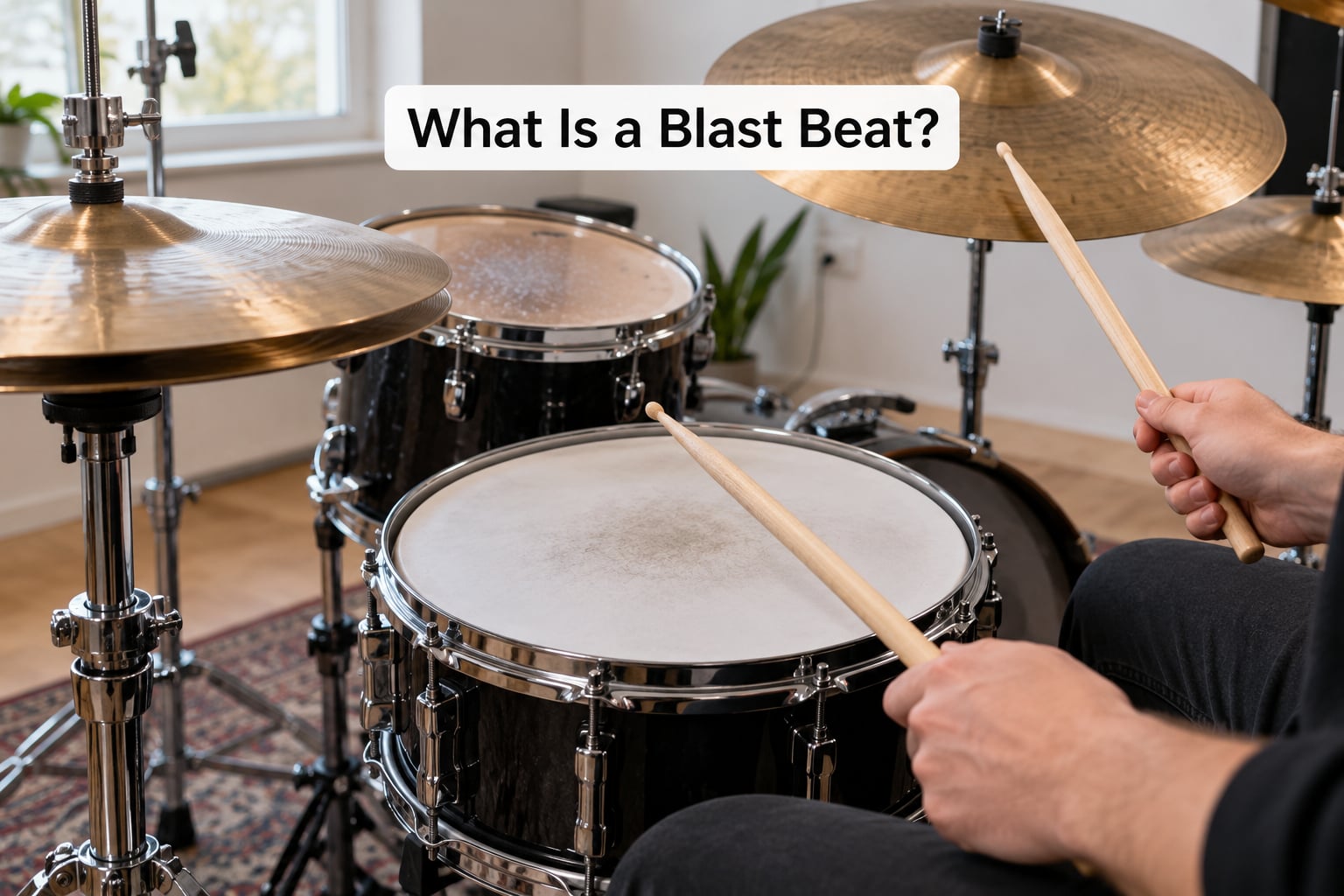
Put simply, a blast beat is a continuous sixteenth-note drum pattern divided evenly across the kick, snare and a cymbal, played fast enough that every note lands evenly with no gaps. The striking thing about it is not the speed so much as the uniformity: unlike a groove with space around the hits, a blast beat fills every subdivision of the bar.
The technique came out of hardcore punk and grindcore in the mid-1980s and became the defining rhythmic signature of death metal and black metal. Four main variations get named over and over:
- Traditional blast beat — the kick and snare alternate on every sixteenth while the cymbal hand plays steady eighths, and the snare doubles the kick.
- Bomb blast — the snare hand strikes the top of the snare drum for an accented, fat note between the main hits.
- Hammer blast — one hand alternates continuously between the snare and the hi-hat while the other plays cymbals.
- Freehand (gravity) blast — one hand plays the snare line on its own, using the stick’s rebound or a rim fulcrum, so the whole figure runs from one arm.
How Does a Blast Beat Work?
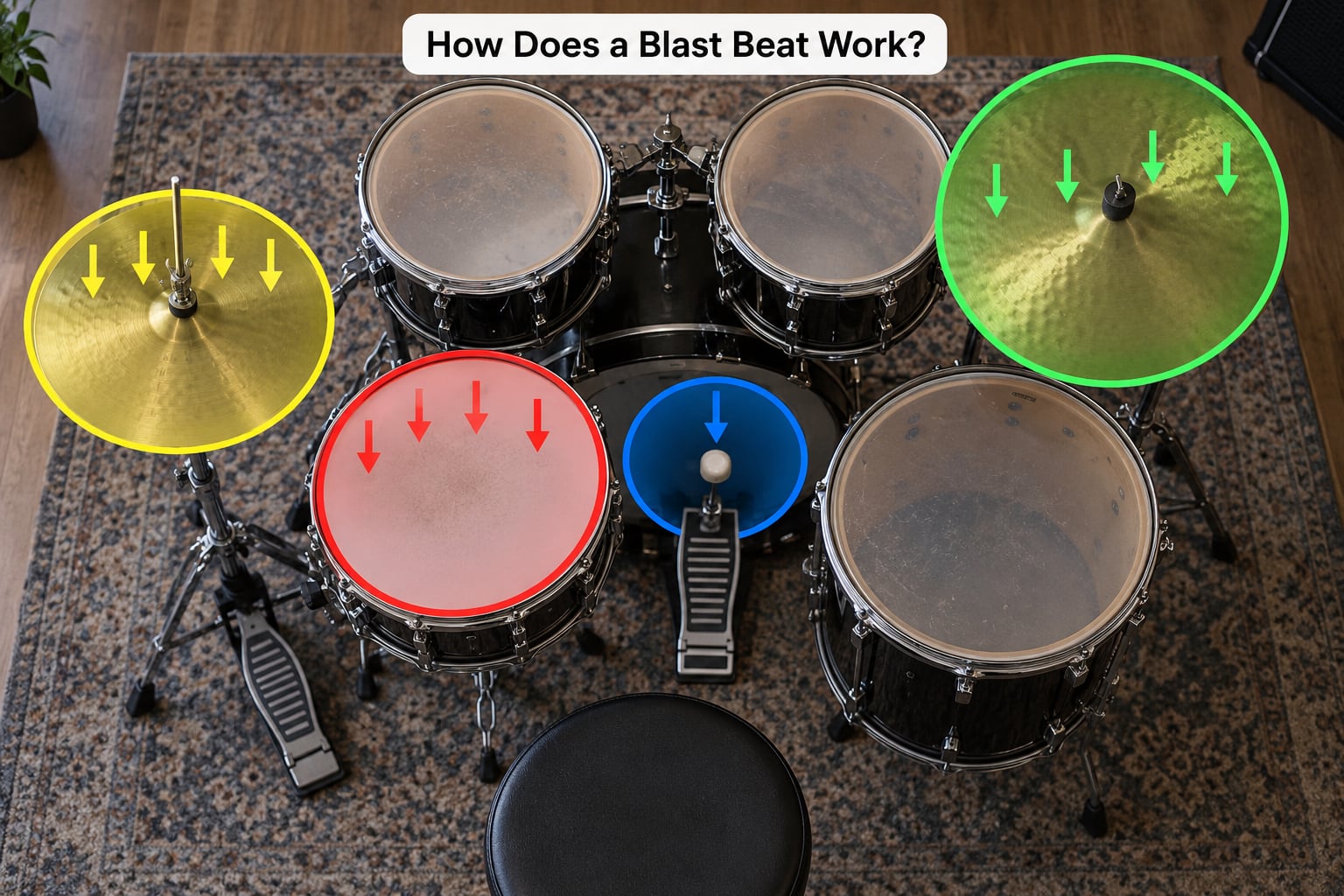
A traditional blast beat runs on one idea: each limb has its own job and none of them overlap. Working through it piece by piece is the fastest way to understand why it works.
What is a blast beat in common time?
Count a bar as eight sixteenth notes. The cymbal hand plays every other note as eighths, so it hits on 1, 2, 3 and 4. The kick foot plays the notes the cymbal hand skips, giving you an even two-way split with the snare hand.
The snare doubles the kick. Wherever your right foot lands, your left hand hits the snare, and those two limbs land together as one wall of sound. The snare-on-the-“and” figure is the part drummers mean when they talk about the standard traditional blast.
Accents sit on the downbeats. Most players hit 1 and 3 harder than 2 and 4, and some add a crash on 1 to mark the section. Dynamics are where a blast beat stops sounding like wallpaper: a flat, even pattern at one volume sounds like a machine, and slight variation across the bar keeps the ear listening.
Add the kick foot and the figure tightens further. Beginners usually play one-footed, with the kick foot hitting only eighth notes under the cymbal, which many experienced players still use. A two-footed or economy pattern splits the sixteenths between the feet so each foot does less work, and that is what most drummers graduate to once the hands are comfortable.
What Is the Difference Between a Blast Beat and a Drum Roll?
The difference is uniformity of division. A classic drum roll divides the same sixteenth-note stream between the two hands on the snare alone, so the pattern is a rudiment built from even strokes. A blast beat divides that identical stream across kick, snare and cymbal, so it is a rhythmic texture for a whole kit rather than a single-surface exercise.
That’s why the sound differs. A fast roll concentrates energy on one drum and produces a rising, swelling tone. A blast beat spreads the same energy across three voices, and the cymbal layer is what gives it the bright, hissing top that makes it cut through a mix.
Sticking follows from that split. On a roll both hands share the work on one surface. On a blast beat the hands do not alternate evenly at all — the snare plays in unison with the kick, and the cymbal hand takes eighths. The two are often confused because both are sixteenth-note patterns, but they solve different problems.
Why Do Blast Beats Sound So Fast?
Part of it is genuinely there, and part of it is perception. A drummer sustaining alternating sixteenths at 200 BPM is laying down about thirteen notes per second, which is faster than most people can pick out.
Accents do a lot of work in that illusion. When the downbeats are louder, your ear uses them as a reference frame and fills in the quieter notes between them, which makes the whole pattern feel faster than the isolated hits do. Remove the accents and the same tempo sounds slow and mushy.
The cymbal wash adds another layer. A continuous eighth-note cymbal produces a shimmering wash of overtones above the dry kick and snare, and the ear reads that brightness as speed. Low-volume contrast helps too: a blast beat played quietly, almost as a hiss with the kick underneath, can feel faster than the same pattern played loudly, because there is less low-frequency weight dragging the perception down.
Repetition matters as well. Because the figure never changes across the bar, the listener’s ear locks onto it and the pattern feels like forward motion, like something is always about to happen.
What Sticking Is Usually Used for a Blast Beat?
Traditional blast beats rely on a two-handed alternating feel in the snare line even though the snare hand plays one note per kick stroke. Drummers practise the alternating connection without the snare, using single strokes between the hi-hat and a practice pad or the snare rim, so both hands stay coordinated when the snare comes back in.
That alternating connection is what allows accented groupings. Instead of an even eight, you can play an uneven figure such as one accented note followed by five quick ones and still keep the hands balanced. Reverse sticking, where the left hand leads on the accented stroke, shows up often in bomb blasts and in transitional figures leading into a breakdown.
Grip is a personal choice, and the honest answer from experienced players is that both work. Plenty of metal drummers use a traditional grip with the traditional blast beat, and plenty of others use matched. What matters is that the contact point and rebound stay consistent, not which grip you start from.
How Do You Play a Blast Beat?
Break the pattern into pieces you can play without falling apart. Start slow, stay on the metronome, and add layers only once the previous one is clean at tempo.
- Set the grid. Metronome at 90 BPM. Count out loud: kick, snare, cymbal, snare. Play it on one surface if you need to, tapping a pad with both hands and one foot until the pattern is automatic.
- Add the cymbal hand. Keep 90 BPM and play eighths on the ride or hi-hat. Your hands and feet should land together without you thinking about timing.
- Bring in the snare. Left hand doubles the kick on every eighth. Slow down further if the accents disappear — this is the stage where the hammer-blast habit usually creeps in.
- Add accents. Play 1 and 3 louder, then drop a crash on the downbeat. Keep the pattern running at 90 BPM for a full minute.
- Move the kick. Go from one-footed eighths to the two-footed economy pattern, still slow.
- Raise the tempo in small steps. 100, 110, 120 BPM. Stay at each one for a minute or two of playing and only go up when accents still show.
- Work in bursts. Once you can play ten seconds cleanly, practise short bursts with rest after each one. Bursts build endurance without the tension that comes from grinding at max speed.
How Can Beginners Practice a Blast Beat Safely?
The most common advice from working drummers is to practise the pattern a little slower than your maximum speed with a metronome. Speed plateaus almost always come from practising at the ceiling, where control disappears and the hands learn to rush.
Keep the tension out of your hands
A relaxed grip is not a nicety here, it’s the thing that decides whether you can play for four minutes or ninety seconds. Keep the wrists loose, let the stick rebound from each stroke, and use a metronome only for timing rather than for pushing maximum speed.
Stop drifting into a hammer blast
Plenty of players learn the traditional pattern by way of the hammer blast and then have to unlearn it. When the tempo climbs and one hand starts doing all the snare and hi-hat work, that is not a failure, it is an old habit taking over. Slow down until the snare stays on its own stroke, then rebuild.
Build control before speed
Two minutes of clean playing at 120 BPM beats ten minutes of ragged playing at 160. Raise the tempo only when the accents are still audible, and rest between attempts rather than pushing through the point where the pattern turns into noise.
What Musical Jobs Does a Blast Beat Do in Metal?
A blast beat is a section-level tool, not something a drummer plays through an entire song. Its main jobs are speed, weight and contrast.
In verses, it holds a low, driving floor under the vocal while leaving room for the guitars to stay on top. At a transition, a two-bar blast with a crash on the downbeat is the cheapest way to signal that something changed. In breakdowns, dropping to a one-footed pattern or slowing to a skank beat makes the return to full speed hit twice as hard.
It also handles tempo and density shifts. Doubling the kick subdivision, or moving from sixteenths to thirty-second notes under the same accent pattern, raises the intensity without changing the drum kit or the sticking.
Blast beats across metal subgenres
The traditional blast beat is the default across death metal and its branches, and you will hear it under most death metal vocals. Old school death leans on the traditional pattern with more space around it, while technical and brutal death push the tempo up and add displaced accents and bomb blasts. Slam and melodic death usually slow things down, using the blast’s weight without its full speed.
Grindcore uses shorter, more frequent bursts and often adds a skank beat or a single-stroke roll alongside. Black metal varies widely: some of it stays at a slow, march feel with cymbal-heavy patterns, while the faster extreme styles use the same traditional figure.
Frequently Asked Questions
Is a blast beat the same as a double-stroke roll?
No. A double-stroke roll is a rudiment: one sixteenth-note stream played only by the hands, usually on the snare, with each stroke bounced. A blast beat spreads that same stream across the kick, snare and a cymbal, with the snare doubling the kick. They sound different for that reason, and the two are often confused because the note value is the same.
Do you need to play a blast beat with both hands alternating?
Not on the snare itself. In a traditional blast beat the snare hand plays in unison with the kick foot rather than alternating with the other hand, and the cymbal hand takes steady eighth notes. What you do practise is the alternating single-stroke connection, usually between the hi-hat and a pad, so both hands stay coordinated when the figure speeds up.
How fast should a beginner play a blast beat?
Around 90 to 110 BPM to start, in sixteenth notes. That feels insultingly slow, but it lets you hear every stroke and keep accents in place. Most drummers who rush into 160 BPM end up practising noise. Raise the tempo in 10 BPM steps and only move up when 1 and 3 are still louder than 2 and 4.
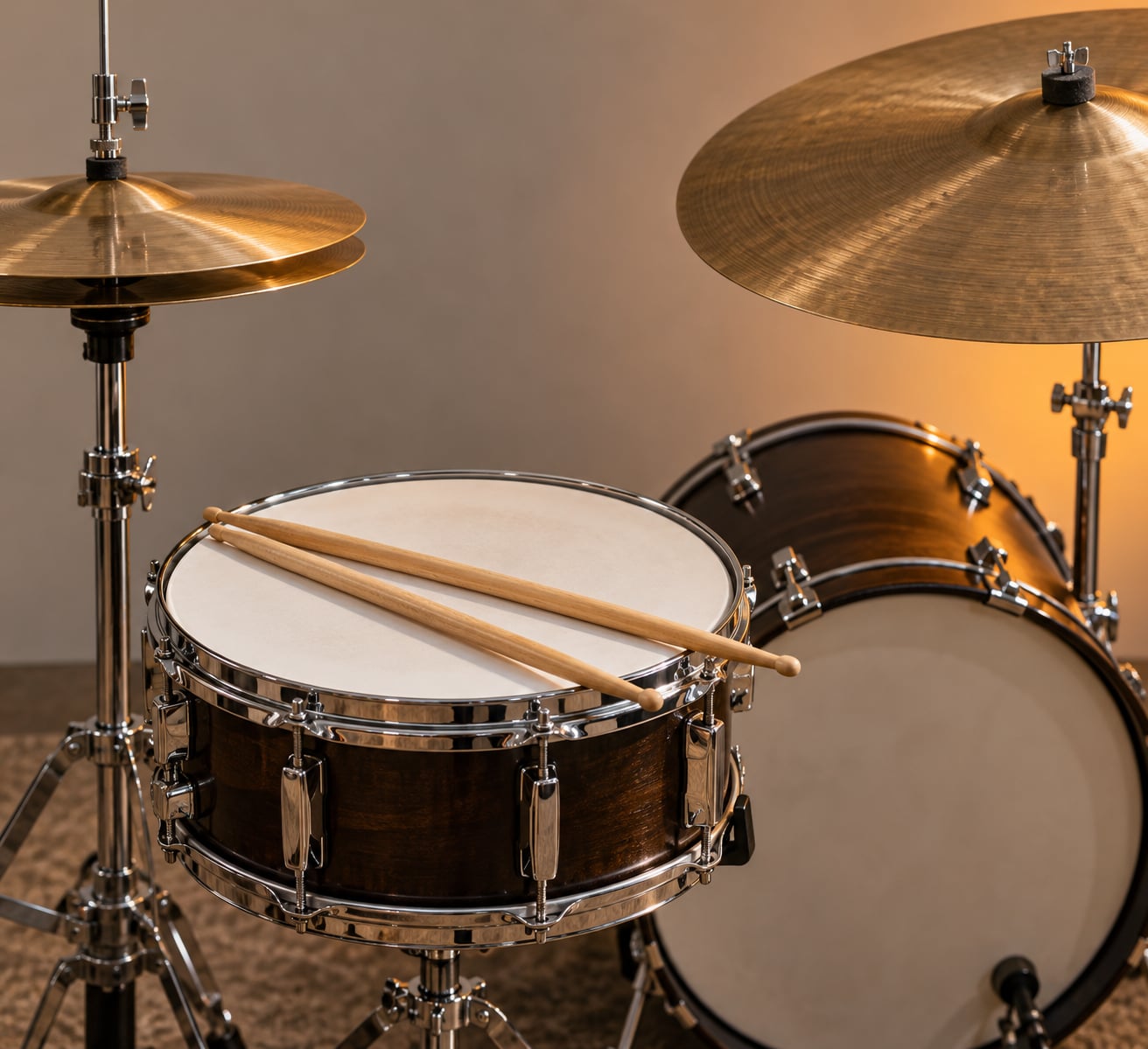
What drums and cymbals are usually included in a blast beat?
Kick, snare and one cymbal are the core three. The ride cymbal is the usual choice because of the eighth-note wash it produces, though a hi-hat works fine and many players use both. Blast beats can be written for one kick drum or a double kick, and the freehand variation adds no extra percussion at all. A crash marks the downbeat rather than joining the pattern.
Why do blast beats sound faster than they are?
Three things combine. Accents on 1 and 3 give your ear a reference frame and make the notes in between feel like they are flying past. The continuous cymbal wash adds bright overtones that read as motion. And because the pattern never changes across the bar, the ear locks onto it and hears forward momentum. Play the same figure flat and unaccented and it sounds slow.
Is playing a blast beat hard on the hands?
It can be, mostly because people practise it at full speed instead of controlled. Loose wrists, a consistent contact point and short bursts with rest after them are what build endurance. Grip tension is what gets you injured, not the repetition itself. If your forearm tightens before your hands feel tired, that is a signal to stop for the day.
Conclusion
A blast beat is an evenly divided sixteenth-note stream shared between kick, snare and cymbal, and its uniformity rather than its speed is what makes it sound the way it does. Start at 90 BPM with the snare doubling the kick and the cymbal on eighths, and only add accents once those two layers sit there without you counting.
From there, move in 10 BPM steps, keep the bursts short, and treat any drift into a hammer blast as a signal to slow down rather than push through. That approach gets you playing clean before it gets you playing fast, which is the order that actually works.