A metal vocal warm-up is a 10 to 15 minute progression of gentle exercises — breath work, lip trills, hums, slides and soft sighs — that warms the vocal folds and surrounding muscles before you add fry, growls, false chord or full-volume belts. Start with the body and the breath, move through easy phonation in the middle of your range, and introduce harsh tones only in the last third.
That order matters more than the clock. Harsh techniques put real demand on the folds: they need fast, consistent closure plus a lot of subglottal pressure pushing up from below. Do that cold and the folds are rigid, so the pressure has nowhere to go but into the tissue. Warm them first and the same effort spreads across flexible, blood-fed muscle.
One thing to get out of the way early: a longer warm-up is not automatically a better one. On r/singing, a singer asked how long to warm up before fry screaming and reported that fifteen minutes still did not feel like enough. Fifteen minutes of a gentle, progressive routine is genuinely more useful than an hour of repeated full-volume screaming, because the second one trains nothing and fatigues the folds. If your warm-up feels longer than the routine below and you are not learning anything from it, it is just load.
This guide is for rehearsal-room singers, weekend players and touring vocalists. It assumes you sing some clean material at least occasionally, because clean singing is the foundation everything else is built on. It is educational information, not medical advice — if you have persistent pain, hoarseness or a voice change that does not settle, see a qualified medical professional, ideally an ENT specialist.
Table of Contents
- What You Need
- Step-by-Step: How to Warm Up Your Voice Before Singing Metal
- 1. Set the Body and Manage Breath
- 2. Wake Up Your Voice With Gentle Phonation
- 3. Practice Vocal Fry or Growl Technique
- 4. Build a Comfortable Midrange
- 5. Connect Range With Controlled Slides
- 6. Test Bellows, Screams, and Song Sections
- Common Mistakes
- Starting at full volume
- Pushing the chin upward
- Using too much air
- Attacking the note with a hard glottal onset
- Leaning on vocal fry for everything
- Holding onto too much breath
- Trying every technique at once
- Warming up through pain
- Loading up right before playing
- Frequently Asked Questions
- How long should I warm up before screaming?
- Should I warm up my clean voice first if I only sing harsh vocals?
- What is the best warm-up video for screaming?
- How do I stop using too much air when I scream?
- What do I do if my voice is already sore before a show?
- Do I need a cool-down after the show?
What You Need
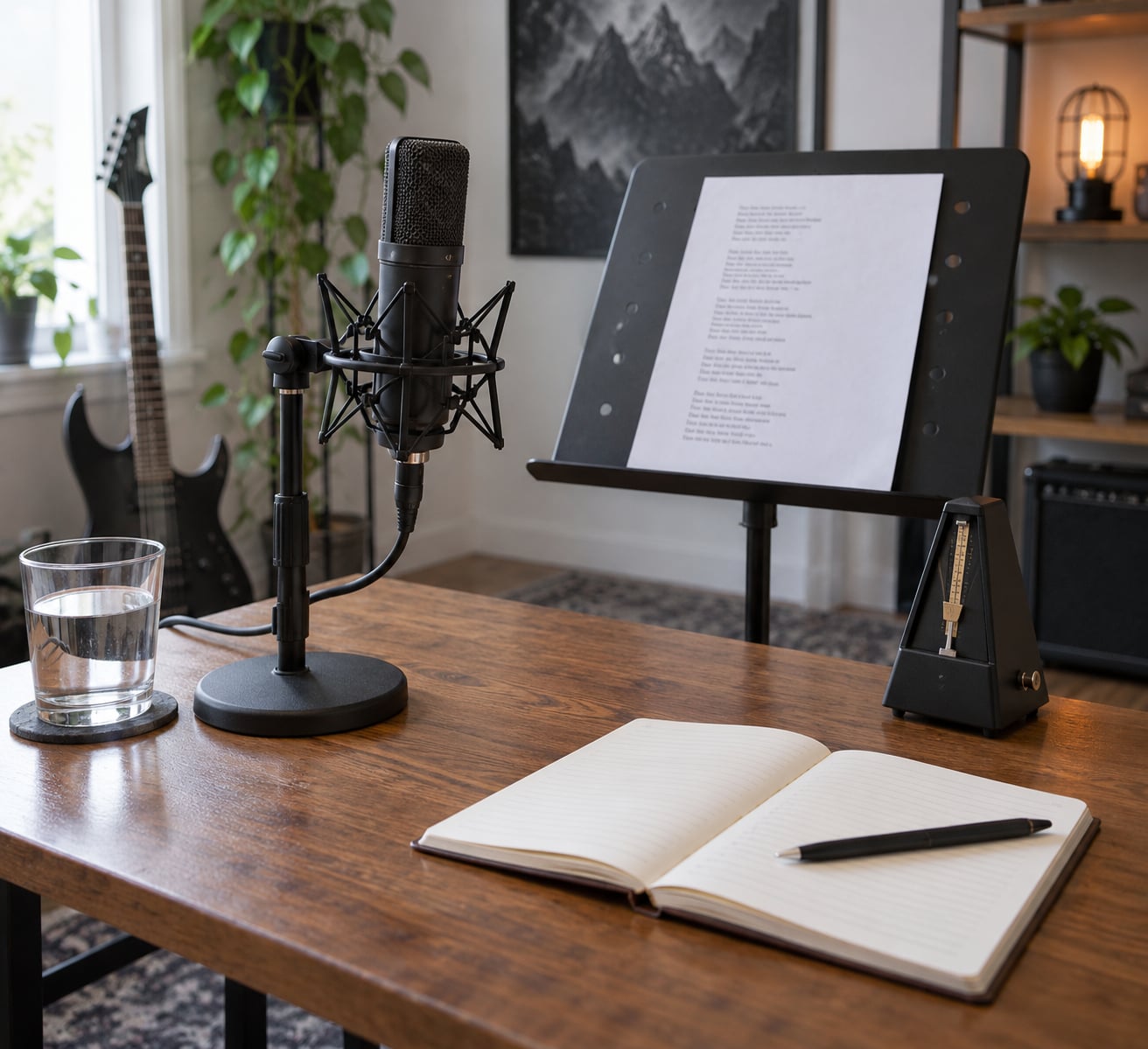
Most of this list is free. The point of a warm-up is preparation, not gear, and no device replaces gentle technique or actual rest.
- Water at room temperature. Room temperature matters more than iced. Cold water tightens the throat, and very cold water can cause some singers to cough on the first sip. Sip throughout the routine rather than downing a litre at the start.
- A room that is not bone dry. Air conditioning, central heating and dusty rehearsal spaces dry out the mucosal layer that keeps the folds lubricated. A full kettle of steam in the room for ten minutes helps more than people expect. Avoid menthol lozenges before a set — the numbing effect makes you over-project because you can no longer feel feedback from the folds.
- A mirror. You cannot see your larynx, but you can see jaw tension, a lifted chin and a collapsed posture, and all three show up in the face.
- A metronome or a backing track. A steady pulse does more than keep time. It stops you from endlessly sliding, which is where a lot of vocal strain hides.
- A pitch reference. A keyboard, a guitar or a tuner app, so slides land on notes rather than wandering around a note you are hoping exists.
- A notebook. Write down what the routine felt like today: which exercises made your throat feel freer, how long, at what projection. Vocalists who keep a log are the ones whose warm-up gives the same result twice, which is otherwise the most common complaint in the forums.
Optional but useful: a humidifier if your rehearsal space is permanently dry, and a stool or elevated heels if you rehearse standing and rehearsing sitting, because it changes your posture and therefore your support.
Two things to avoid before a set. Do not eat crumbly or sugary snacks in the last hour or two; the crumbs and the reflux are both common sources of throat noise during a set. And do not use this window to add new load — no new exercises, no max-volume attempts, no running through the hardest song at full tilt, however good you feel. Warm-up and practice are different jobs.
Step-by-Step: How to Warm Up Your Voice Before Singing Metal
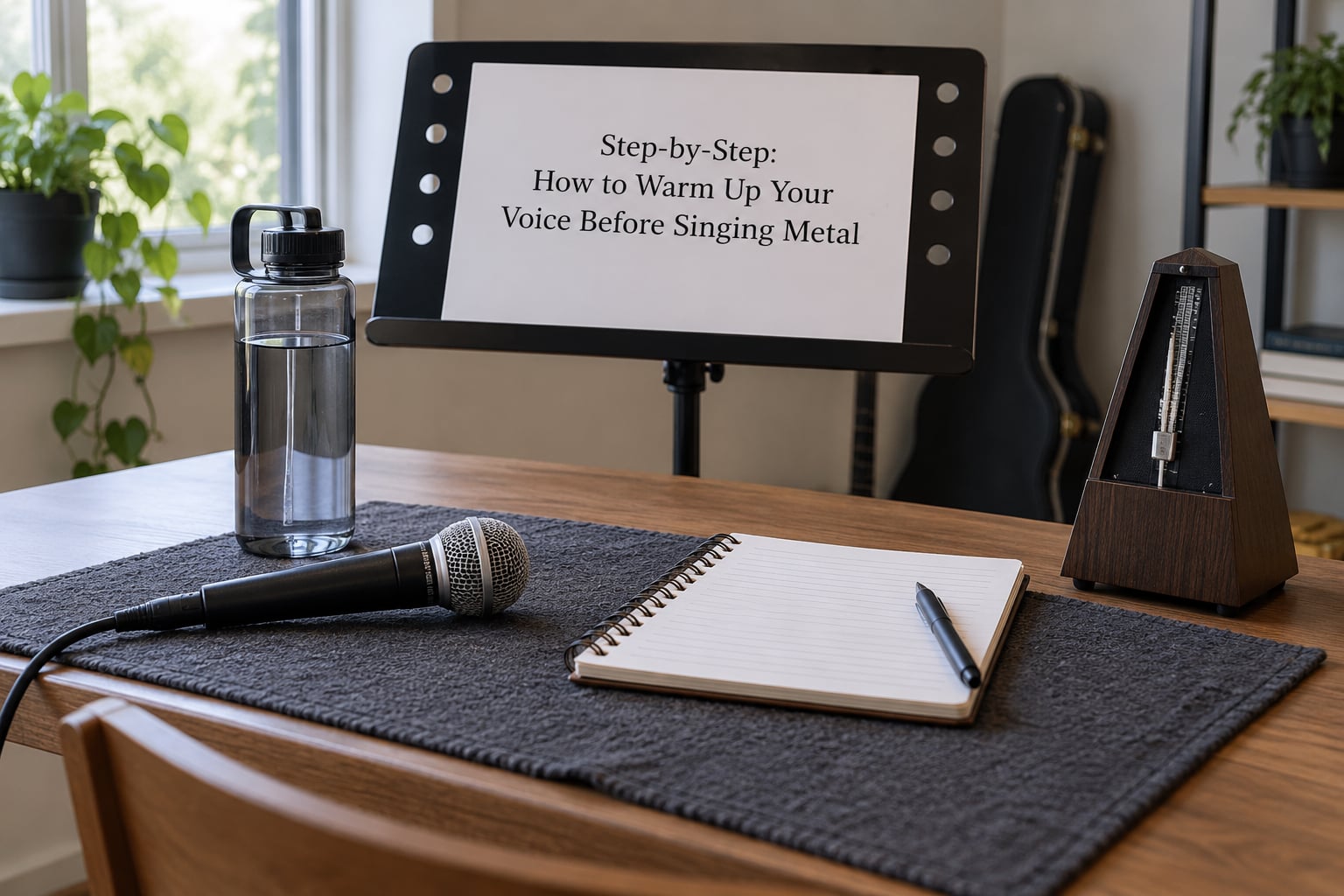
The full routine runs about 12 to 15 minutes. Each phase has a job, and the phases run from least to most demanding. If you cut a phase, cut from the top — never jump straight to phase 6 because it is the fun one.
| Phase | Exercise | Duration | What it is doing |
|---|---|---|---|
| 1. Body and breath | Posture reset, jaw and shoulder release, silent diaphragmatic breathing | 2 min | Removes postural tension and sets the breath before any sound is made |
| 2. Easy phonation | Lip trills, humming, soft “mee” on a comfortable note | 3 min | Wakes up the folds with minimal impact and calibrates breath-to-sound coordination |
| 3. Low-register grit | Gentle fry or growl placement, volume no higher than 2-3 out of 10 | 2 min | Prepares the low coordination most metal styles depend on, at low effort |
| 4. Midrange and vowels | Scales and held notes on lip trills, rotating yoh, yah and yeah | 2-3 min | Builds clear sustained tone and makes note placement feel like ordinary speech |
| 5. Range connection | Slow siren slides, wide intervals, short repeated figures | 2 min | Stretches the register without forcing the top or loading the voice at full volume |
| 6. Song test | Short excerpts at moderate volume, one phrase of belts, screams or growl at a time | 2-3 min | Confirms the voice is ready for the actual material without dumping all the load at once |
1. Set the Body and Manage Breath
Start standing, feet about hip-width apart, weight even, ribcage free to expand. The most common postural mistake among newer metal singers is pulling the shoulders up around the ears, which locks the upper chest and pushes singers to breathe high into the shoulders instead of the belly.
Unclench the jaw, let the tongue sit low and fat in the mouth, and drop the shoulders away from the ears. A quick physical check: hum quietly and keep the hum going through a sentence. If you cannot hum without swallowing, the jaw and tongue are still braced.
Now breathe in silently through the nose for four counts. Watch the lower ribs and the belly move outward while the chest stays relatively still. Pause a beat, then release through the mouth on a “ssssss” for six counts. That longer exhale is the point — it teaches you to manage a slow, controlled release, which is exactly the skill a long scream needs. Repeat about six times.
How do you know it is working? The exhale should be steady and unforced, with no wavering in the airflow, and the moment you run out of air should be gradual rather than a sudden empty feeling in the chest. The old phrase “support from the core” is vague; the physical version is that the breath leaves slowly because the ribs are controlling it, not because the throat is squeezing to hold it in. This is also the practical part of fixing the “too much air” problem, which is the single most repeated complaint in the screaming forums — most excessive air is really an uncalibrated breath, not a placement issue.
2. Wake Up Your Voice With Gentle Phonation
Now make sound, and keep it easy. Slide up and down the pitch range on a lip trill — a fluttering “brrr” made by letting air through relaxed lips while humming underneath. If the trill will not start, try humming first and add the lip flutter on the way down.
Hold the trill for about eight seconds per direction, then swap for a tongue trill — a dry “brrr” made with the tip of the tongue, no lips involved. Many singers find the tongue version harder, and that is fine; work whatever responds better. If neither works cleanly, humming on a glide up and down does the same job.
Next, settle on one comfortable note and sing “mee” in a small, speech-like voice for ten seconds. Then the same note on “nah” and “lah”. The vowel changes shift the shape of the vocal tract and tell you which vowels your voice handles most efficiently on the day.
The test for this phase is simple: the sound should be easy to start, easy to stop, and free of scratchiness. If you are squeezing to get a trill, backing the pitch down is a sign of good listening, not failure. The whole phase should sit around a 2 or 3 out of 10 on effort. Vocalists who report warm-ups that do not work consistently usually start too loud here, then spend the rest of the session chasing a sound they damaged in minute one.
3. Practice Vocal Fry or Growl Technique
Low-register work matters here because most metal styles lean on a low coordination: fry, growls, death metal rasps and unclean lows all use it. Warm it up lightly, not loudly, and definitely not at show volume.
| Style | What it is | Warm-up priority | Main risk |
|---|---|---|---|
| Vocal fry / fry scream | Fast, pressed fold closure with breath underneath; creaky at low effort, harsh when pushed | High — warm it gently, it responds to volume far more than it responds to practice | Over-voicing. Most fry strain comes from pushing, not from the technique itself |
| False chord | Uses the vestibular folds alongside the true folds to add grit; brighter and easier to project than fry | High — needs clean midrange underneath it | Squeezing the throat to add grit that should come from airflow and placement |
| Growl / death metal rasp | Deliberate vocal fry or growl used as a rhythmic and tonal effect | Moderate — low dynamic demand, but easy to over-use | Fatigue from using one placement for an entire set |
| Clean belts and high screams | Full-volume singing with strong closure and projection | High — the highest impact technique on the folds | Repeated full-volume attempts during the warm-up itself |
Start with a relaxed closed-mouth hum, like a quiet engine idling, and let it turn into a growl. Keep the jaw still and the throat wide. For a fry, aim for roughly a 2 to 3 out of 10 on projection — audible effort, but far from a full belt. For a false chord, aim for around 3. These numbers come from the coaching community consensus rather than from any physiological measurement, but they are useful precisely because they are honest: if a low fry is working, you should be able to keep talking afterwards.
Now let me be blunt about one piece of advice that circulates endlessly on video platforms: “just talk in vocal fry and make it louder.” A thread on r/screaming calls it the worst advice circulating for fry, and the objection holds up. The only real similarity between the creaky voice you have when you wake up and a fry scream is that the folds are closing. Natural vocal fry is a result of short, lax folds — loosely pressed, slow vibration. A fry scream is an active skill built on fast, deliberate closure with controlled breath. Turning one into the other through volume alone is a route to swelling and hoarseness, not to technique.
Stop the moment you feel pain rather than effort. Discomfort, tingling and a scratchy texture are all normal; sharp pain in the throat or a sudden loss of pitch is not.
4. Build a Comfortable Midrange
Metal songs still need clean, sustained tone — the choruses, the melodic lines, the parts that sit next to the harsh ones. Warming the midrange is what lets you switch between clean and harsh without the clean side falling apart from under-use.
Run scales on a lip trill, taking them up and down your comfortable range, holding each note for roughly five seconds. Rotate the vowel shape as you go: yoh for the bottom of the range, yah through the middle, yeah toward the top. These are the shapes most metal vocalists use precisely because each one lines the tongue up differently and produces a slightly different resonance for different registers.
Sing the same five-note pattern without the trill, at the volume you would use in a rehearsal room, not on stage. The goal is a sound you could use in conversation — placed, easy to start, easy to hold. If the note drifts flat when you get tired, that is fatigue information worth listening to rather than pushing through.
5. Connect Range With Controlled Slides
Range is warmed by moving through it slowly, not by arriving at the extremes. Take a siren-style slide from the bottom of your comfortable range to the top of your comfortable range over about five seconds, and back down. That is your ceiling for the warm-up, not the top of your range. A warm-up that targets the actual top of the voice on a cold instrument is a recipe for a dull, tightened sound and a wasted rehearsal.
Then work wide intervals: a note, a skip of a fourth or a fifth, back, holding each for a few seconds. Keep the metronome on. Add short repeated figures — a five-note run played three times in a row at the same dynamic — because repeats teach the folds to repeat a coordination, which is the skill you actually need on stage.
What to avoid in this phase: forcing high notes, pushing a slide past the point of strain, and any repeated belting at full volume. Belting during a warm-up is loading the instrument before it is built.
6. Test Bellows, Screams, and Song Sections
This is the only phase that touches the actual songs, and it stays moderate. Pick the track, cue it up, and sing one phrase at about a 4 out of 10 rather than a 9. Work through the clean verse, the belt, the scream and the growl as four separate short excerpts rather than running the whole song at full tilt.
Isolate the phrase that costs you the most. For a lot of singers that is a long sustained note, for others a run of quick syllables, for others a fry section that starts too loud. Give each one two attempts, then rest thirty to sixty seconds and move on. Two attempts is usually enough; the third is where fatigue stops being a signal and starts being a habit.
The useful check at the end of this phase: your voice should still feel like your voice. Not exhausted, not scratchy, not noticeably quieter than it was ten minutes ago. If it does, the warm-up worked and you can scale it. If you are suddenly blowing out air and getting no pitch, the load went in too hard, too early, or on not enough breath. Back off the volume and extend phase 2 next time.
If you only have five minutes before a set, this is the compressed version: one minute of silent breathing with a long controlled exhale, one minute of lip trills and hums, one minute of light fry or growl at 2-3 out of 10, and two minutes of the song at moderate volume, phrase by phrase. Drop the midrange scales, the wide intervals and the slides. What you do not do is spend the five minutes on a full-volume scream run, which is the most common way a short warm-up turns into a wrecked voice.
Common Mistakes
Nearly every preventable metal vocal problem traces back to one of these.
Starting at full volume
The most common and the most avoidable. Full-volume screaming on cold folds is the exact scenario a warm-up exists to prevent, and it feels productive because it produces immediate output. Start at a 3, climb to a 6, and save the 9 for the stage. Notice that the Sound On Sound forum consensus, which comes from a recording-industry audience, is that you should treat your vocal folds like any other muscle: warm up and cool down, and never attempt extreme techniques cold.
Pushing the chin upward
Lifting the chin to reach a high note tightens the front of the throat and pulls the larynx into a higher position, which is the exact opposite of what you want. Keep the chin level or very slightly down, neck long, and go to the note with breath rather than posture. Check the mirror — most singers do not realise they are doing it.
Using too much air
The most repeated complaint in the forums, and it is a support problem, not a throat problem. If a scream is a blast of air, the folds cannot close cleanly, so you push harder for the same tone and fatigue arrives fast. Practise the scream at low volume with a controlled release and let the tone grow later. There is a touring screamer on r/screaming who describes dialling the scream back to a sweet spot where the full tone is preserved while the air drops, and that is the skill, not a side effect.
Attacking the note with a hard glottal onset
Plopping straight into a full-volume scream closes the folds hard, often with a click. Onset is the single cheapest thing to fix in a warm-up: begin with air, let the folds catch up, and the note arrives cleanly instead of detonating. A breathy onset on the first syllable of every harsh phrase will change your voice faster than most techniques you can practise.
Leaning on vocal fry for everything
Fry is cheap to do and easy to overuse, which is how a singer ends a set sounding like a door hinge. Mix placements across a set, and keep an ear on which one is actually working for the song. If your clean voice has gone flat and hoarse after two weeks of fry-only rehearsal, you are using one technique to exhaustion instead of warming up a range of them.
Holding onto too much breath
Trying to bank a huge breath in the chest and then squeeze it out gives you a burst of pressure and no control, and it is one of the main sources of “too much air”. A smaller breath that is released slowly sounds better and lasts longer. Practise talking in a full sentence on one breath — if you cannot finish the sentence, you took too much air in.
Trying every technique at once
The belief that you should practise fry, false chord, growls, belts and screams in a single warm-up is a common misunderstanding. Warm up the shared foundations — breath, easy phonation, midrange, range — and let the technique-specific work be brief and focused. Varying drills day to day, the way you would vary a workout, tends to beat one fixed routine repeated identically for years.
Warming up through pain
Discomfort and scratchiness are expected. Sharp pain, sudden hoarseness or a pitch that vanishes is not, and it is a stop signal rather than a challenge. Persistent pain or a voice change that does not settle belongs with a qualified medical professional, ideally an ENT specialist, not with a forum thread.
Loading up right before playing
A full-volume sing-through in the ten minutes before a set is a warm-up in name only. Do the progressive work, then rest. Most professionals who sing night after night keep the last few minutes quiet, sipping water, and let the voice settle before the first note. The same applies to sound check: warm up before it, not during it, and treat the check itself as light rehearsal rather than a chance to test the top of your range.
Frequently Asked Questions
How long should I warm up before screaming?
Ten to fifteen minutes of progressive work is a good target, and a focused five minutes beats twenty minutes of loud repetition. One r/singing user reported fifteen minutes still felt like not enough, but the usual cause is intensity rather than length: hard, full-volume fry work leaves the folds fatigued, so more time does not help. Gradual progression, light volume early and a short rest before playing matter far more than the clock.
Should I warm up my clean voice first if I only sing harsh vocals?
Yes. Clean phonation is the foundation the harsh styles are built on, and it warms the same folds with far less impact. Establish breath support, easy lip trills and a comfortable midrange first, then introduce fry, false chord or growls in the final third of the routine. Practising harsh tones in isolation tends to build a narrow voice that fatigues quickly.
What is the best warm-up video for screaming?
The community leans heavily on a handful of named instructors. David Benites and the Extreme Vocal Institute suit beginners who want structured fundamentals. Hungry Lights (Justin Bonitz) is known for detailed projection and vowel work. Kardavox Academy and Lauren Babic cover specific techniques thoroughly. Mitchell Kinn and Jeff Rolka are better once you have a few months of clean singing under you. Watch for onsets and volume levels you could never hold for a full song.
How do I stop using too much air when I scream?
Practise the scream low and slow, and add air only after the tone is already there. A fry sitting at 2 to 3 out of 10 and a false chord around 3 should not sound like a burst of wind. If the air is escaping, the folds are not closing cleanly, and the fix is a smaller breath released slowly plus an easy breathy onset. Talking in full sentences on a single breath builds the same control.
What do I do if my voice is already sore before a show?
Reduce the plan rather than pushing through it. Drop to a clean-only, low-volume warm-up, skip fry, false chord and belting entirely, and drink water. Do not use menthol lozenges, which numb the feedback that tells you how hard you are pushing. Singing a set on a genuinely damaged voice can extend the problem, and persistent hoarseness or pain deserves a qualified medical professional, ideally an ENT specialist.
Do I need a cool-down after the show?
Yes, and it takes three minutes. Sing easy descending sirens, then sigh on a lip trill from your comfortable range down, then hum softly while you pack down. Pros treat the warm-down as part of the routine, and the Sound On Sound forum consensus is that the folds get treated like any other muscle: warm up and cool down. Skipping it is a common reason singers wake up hoarse on consecutive tour nights.
Start tomorrow with two minutes and nothing else: a long controlled exhale, then lip trills up and down at a 3 out of 10. Once that feels easy every single day, add the next phase. The singers whose warm-up gives them a consistent voice are almost never the ones with the longest routine — they are the ones who start quiet, progress honestly, and stop when something hurts.