Why minor keys sound darker in metal comes down to three lowered scale degrees. A minor scale takes the third, sixth and seventh of the major scale down a semitone each, and those shrinks pull the upper structure of the scale inward around the tonic. In metal that tightness then meets distortion, drop tunings and wide dynamics, and the result reads as weight and menace rather than the sadness most non-metal explanations insist on.
That last distinction matters more than it sounds. Sad is an emotion language borrowed from pop piano. Dark in metal is about tension that never fully resolves, low register, and an ear that keeps waiting for a landing which never arrives. Same interval, completely different feeling, because the delivery is different.
Table of Contents
- Why Minor Keys Sound Darker in Metal
- What Makes Minor Keys Sound Darker in Metal?
- How minor keys differ from the minor mode
- Which modes create the darkest metal sounds?
- How do chords and harmony make minor-key metal feel dark?
- How do riffs, solos, and melody reinforce minor-key darkness?
- How do timbre, dynamics, and production affect the result?
- What are the most common minor-key metal clichés?
- How can you write darker metal without copying a formula?
- Frequently Asked Questions
- Why does minor music often sound sad or dark?
- Is minor key the same thing as a minor scale?
- Why does the harmonic minor scale sound tense in metal?
- Do minor chords always sound sad?
- Can a major-key song feel dark?
- How do I tell whether a metal riff uses minor or Dorian?
- Conclusion: Start with the Tonal Center
Why Minor Keys Sound Darker in Metal
Minor keys sound darker because lowering the third brings it a semitone closer to the tonic, tightening the chord, and lowering the sixth and seventh does the same to the space above it. The whole scale sits in a narrower, more unsettled position than the major scale, which is exactly the ground metal builds on.
What Makes Minor Keys Sound Darker in Metal?
Four things do the work, and they stack. The lowered third changes the colour of every chord built on it. The lowered sixth and seventh remove the two notes that give a major scale its lift and its sense of forward pull. A lowered second, which is not part of the minor scale at all but shows up constantly in metal, adds a note that clashes with the tonic. On top of that, metal’s playing context removes the comfortable resolution that a pop melody would normally supply.
The third is the important one. A major third sits four semitones above the tonic, a minor third three. When the third is a minor third, the chord sits closer to the root, closer to the bass note, closer to where the ear wants to land. It is structurally harder to resolve because there is less space between the chord and its home.
The seventh is the other big lever. A major seventh is a semitone below the tonic, which creates a magnetic pull upward into the chord. A minor seventh is two semitones below, so it no longer pulls. Replace it and the music stops leaning forward. In a slow doom passage that reads as sorrow. In a fast tremolo-picked riff at 150 bpm it reads as aggression, which is the point.
| Scale | Formula | What changes from major | Metal use |
|---|---|---|---|
| Major | 1 2 3 4 5 6 7 | None | Bright riffs, major-key hooks, trad metal leads |
| Natural minor (Aeolian) | 1 2 b3 4 5 b6 b7 | 3rd, 6th, 7th lowered | Default riff material, the workhorse |
| Harmonic minor | 1 2 b3 4 5 b6 7 | 6th lowered, 7th raised | Blast beats, screaming leads, black and death metal |
| Ascending melodic minor | 1 2 b3 4 5 6 7 | 3rd and 7th lowered only | Lyrical solos, neoclassical metal, melodic hooks |
Notice what harmonic minor does. It lowers the sixth but then raises the seventh back to a major seventh, which puts a major seventh and a minor sixth a semitone apart in a scale. Played one after the other that gap is an augmented second, one of the most abrasive intervals available. A sevenstring regular summed it up plainly: harmonic minor sounds too evil to be merely dark. That is why the scale is so common in the fastest and heaviest metal.
One more correction to the usual story. The minor triad is not more dissonant than the major triad. Both are consonant chords. What changes is the surrounding context and where the harmony is trying to go. Calling minor dissonant is the single most common error in pop explanations of this, and it makes the real mechanism harder to see.
How minor keys differ from the minor mode
A key and a mode are not the same thing, and confusing them makes everything else confusing. A key is a tonal centre plus a hierarchy: which chord is home, which chords pull away from it, and which pull back. A mode is the same set of notes with a different note treated as home.
C major and A minor use exactly the same seven pitches. What changes is which one the music rests on and which chords feel like home. Play a riff so that the note C keeps landing as the arrival point and you have made A minor sound out of a C major set of notes.
Metal leans on this heavily because the tonal centre is often established by a pedal note or a root that keeps repeating rather than by a cadence. A riff built on A with the note D sounding as the arrival is in A something, and the ear builds the hierarchy around it from there. The rest of the mode follows whatever that centre is.
Which modes create the darkest metal sounds?
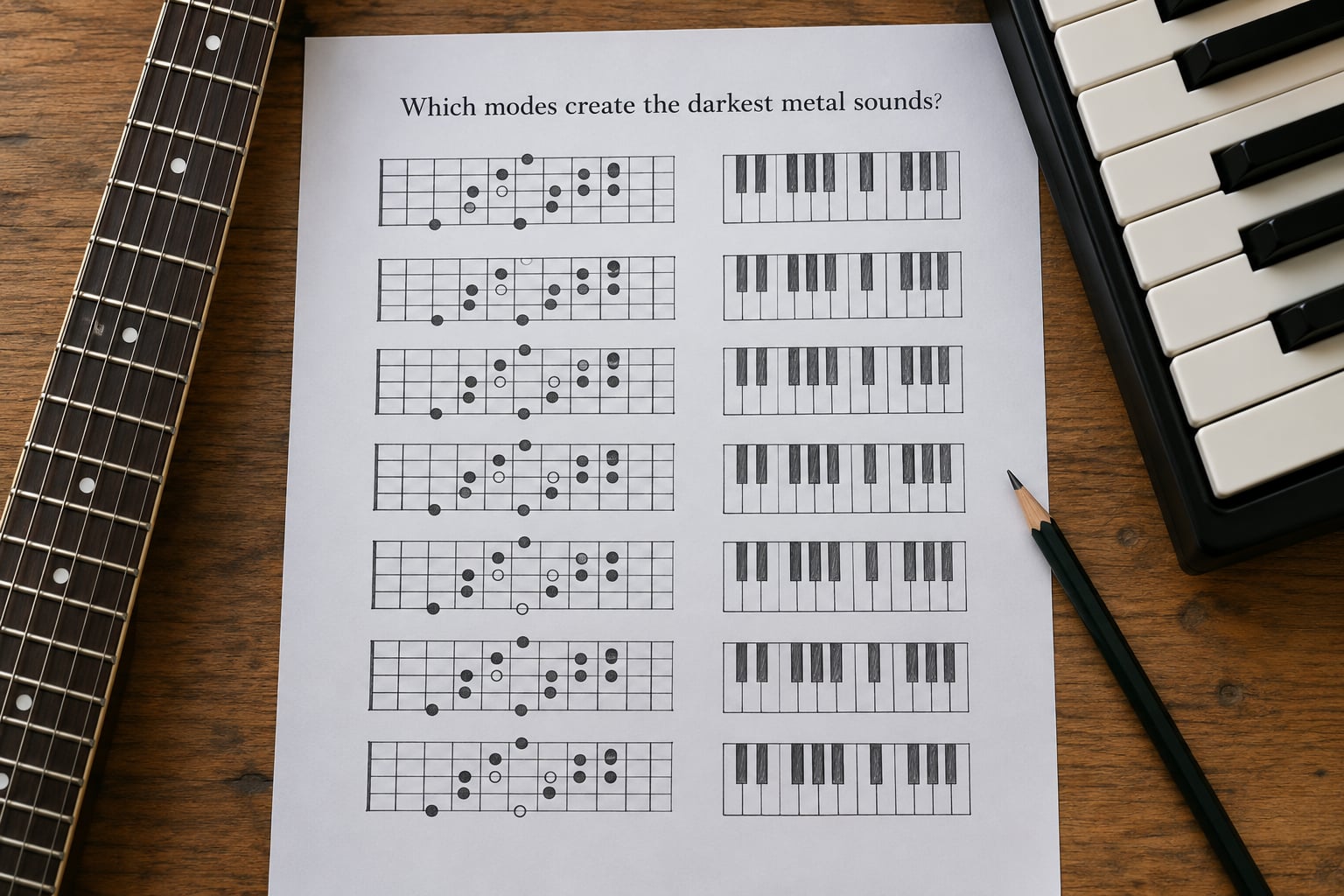
The darkest metal sounds come from the modes with the most lowered degrees against the tonal centre. Ranked from darkest to lightest, that is Locrian, Phrygian, Phrygian dominant, Aeolian, then Dorian. Aeolian is the plain minor mode, so it sits in the middle: dark, but with the awkward intervals already removed.
| Mode | Intervals | Character | Where it shows up |
|---|---|---|---|
| Locrian | 1 b2 b3 4 b5 b6 b7 | Flatted root and fifth, the tonic itself feels unstable | Brutal death metal, dissonant stabs, rarely sustained for long |
| Phrygian | 1 b2 b3 4 5 b6 b7 | Four flatted degrees, b2 grinding against the tonic | Death metal riffs, doom, Middle Eastern colour in metal |
| Phrygian dominant | 1 b2 3 4 5 b6 b7 | Phrygian with a major third and major seventh, exotic rather than sad | Soloing, tremolo leads, the desert-sounding scale |
| Aeolian | 1 2 b3 4 5 b6 b7 | Natural minor, the standard dark palette | Every subgenre, most riffs |
| Dorian | 1 2 b3 4 5 6 b7 | Minor third but a natural sixth, so it moves | Funk metal, melodic death metal, groovier riffs |
Phrygian dominant is worth its own sentence because people constantly mix it up with harmonic minor. They come from the same parent scale. Phrygian dominant is the fifth mode of harmonic minor, which means it shares harmonic minor’s pitch set but puts the fifth note in the tonic chair. Harmonic minor has the augmented second; Phrygian dominant does not, because the interval gets spelled differently against its new centre. Same notes, different colour, and a guitarist who wants the exotic sound without the augmented-second bite plays Phrygian dominant.
A HarmonyCentral thread from years back asked the sharpest question in this area: if Phrygian dominant is culturally associated with sinister in metal, is that in the scale or learned? The honest answer is both. The b2 creates genuine friction against the tonic. Which genre reaches for it, and how often, is a convention, and conventions change.
How do chords and harmony make minor-key metal feel dark?
Harmony makes minor-key metal feel dark by delaying or avoiding the arrival the ear is waiting for. In a minor key the tonal centre has a b3 above it, so the most stable chord is already darker than its major counterpart. Add diminished, augmented and borrowed chords on top and you get a progression that keeps pulling sideways.
Here are the chords a minor key actually offers, and what each one does in a riff.
- i (root, b3, 5) – home, but a dark home. Repeated, it becomes hypnotic rather than sad.
- iv (4, b6, 1) – the relative major of the parallel major. Pulls gently, adds melancholy without adding noise.
- v and V – v keeps the b7 and stays ambiguous. Raising the seventh to make V adds a major seventh, which turns the pull into a desire.
- VI and VII – borrowed straight from the parallel major. VI brightens a moment, VII darkens back down. Using both is the classic slow build.
- ii° (2, 4, b6) – the diminished chord. Tightly wound, wants to move, and is where a phrase gets its bite.
- bII (b2, 4, 6) – the Neapolitan. The b2 sits a semitone above the tonic and rubs against it directly.
- #iv° (3, 5, b7 in a natural minor frame) – common in death metal and black metal, harmonises the raised seventh, adds tritone and major-second rubs.
Progression shape matters as much as chord choice. i to v to i to iv settles into a slow, heavy loop. i to bVII to bVI to V leans down and then up, which reads as descending motion even while the harmony is functional. i to bII to bVII to i leans against the key the whole time, and that permanent lean is where a lot of extreme metal gets its unease.
Now the paradox that confuses new players. A metal power chord is a root, a fifth and a root, with no third at all. On paper it is neither major nor minor. The riff still reads as dark, and the reason is that the ear infers quality from context: which notes keep returning, how the roots move, whether a third ever appears in a lead or a vocal line, and what the bass is sitting on. A five-note riff played over a bass line that keeps a minor third audible is minor whether or not the guitar states it. The guitar simply has not said so out loud.
How do riffs, solos, and melody reinforce minor-key darkness?
Riffs reinforce darkness through shape rather than scale choice. A minor scale played ascending, cleanly and evenly will sound like a scale exercise. The same notes played in a low register, palm muted, in descending pairs with the second note left to ring, land completely differently.
What actually creates the dark read in a riff: descending contour, a low register, sustain on the flat notes, accents that fall on unresolved steps, and rhythmic placement that keeps delaying the downbeat resolution. A riff on the flat second and flat sixth pulled out with vibrato hits a different target than the same riff run at speed in one burst.
Leads get their darkness from where they refuse to go. Sitting on the b3 and b6, dwelling on the b2, or landing on the tritone and then sliding to the tonic all create pressure. A fast descending run in harmonic minor sounds aggressive mostly because of that augmented second flashing past, not because of speed or because the passage is going down.
How do timbre, dynamics, and production affect the result?
Timbre and production decide how much weight a minor key carries, because the same notes change character entirely with the signal chain. Lower tunings push the fundamental down into a range where distortion behaves differently, adding lower harmonics that read as heaviness. Palm muting thickens the low end by adding compressed noise instead of letting notes decay. High gain fills in the upper partials, and that extra density makes every interval in the scale sound more present, including the rough ones.
Compression is the sleeper. It flattens the gap between loud and quiet, which removes the breathing room that made a passage feel tense. The same riff with dynamics intact feels more dangerous than the identical riff slammed flat. Then there is the bass and the kick. When the bass reinforces the minor third, the darkness is stated outright. When the bass just doubles the root, the guitar has to imply it alone.
This is also where the honest counter-argument belongs, because the most-upvoted position in the metal subreddit is a plain disagreement: major chords, scales and keys can sound as dark or darker than minor ones. They are right. A major chord voiced high and repeated, over a drop-tuned palm-muted riff, in a production with no bright frequencies, can sound more menacing than a clean minor progression. Darkness is not a property of a scale. It is a relationship between notes, register, rhythm and delivery, and any one of those can outweigh the key signature.
What are the most common minor-key metal clichés?
Four devices show up so often they have stopped working as intended. The first is running every minor solo through diminished or melodic-minor noodling with no tonal anchor, which reads as scale vocabulary rather than melody. The second is reflexively adding the raised seventh to everything, so harmonic minor’s edge disappears because nothing is being contrasted with anything.
The third is automatic tremolo picking on any fast riff, which makes fast and light sound the same. The fourth is treating every minor riff as automatically dark, which is the mistake the earlier sections describe. Context does that work, not the chord.
Contrast fixes all four. Alternate a flat seventh against a natural sixth somewhere. Hold a single root for four bars with almost nothing on top. Slow the riff down until the sustain becomes the point. Give a listener somewhere stable to return to and the dark bits register as dark instead of blending into a wall.
How can you write darker metal without copying a formula?
Writing darker metal without a formula starts with choosing a tonal centre and committing to it, then deciding which intervals you are allowed to leave unresolved. Pick the centre, build the riff from the root and the notes that pull away from it, and treat every added dissonance as a choice rather than a reflex.
A workable process, roughly in order. Choose the tonal centre first and keep one note sounding under the riff long enough to establish it. Pick your dissonance deliberately: the b2 for grinding, the tritone for menace, the augmented second for the sharpest edge. Then vary one parameter at a time, because changing everything at once means you cannot hear what caused the effect. Riff in one register, then the same riff an octave down, with the low end left to the bass. Play the riff at half speed with full sustain, then at speed with tight muting. Add a melodic line that states the b3 explicitly, then remove it and hear whether the riff still reads as minor.
Finally, check the result against three questions. Can you name the tonal centre in one word? Is there one moment where the tension peaks? Does the release, if there is one, arrive somewhere the listener did not predict? If the answer to the last question is no, the progression is probably resolving too predictably, which is another way of saying the riff is not doing much.
Frequently Asked Questions
Why does minor music often sound sad or dark?
Lowering the third, sixth and seventh pulls the scale inward around the tonic, so there is less space between the notes and their home. That tightness is heard as unstable. Whether it reads as sad or menacing depends on tempo, volume and timbre more than on the key itself.
Is minor key the same thing as a minor scale?
No. A minor key is a tonal centre plus a hierarchy of chords that pull toward it and away from it. A minor scale is just seven pitches in a fixed order. The scale supplies the notes; the key decides which one is home and which chords feel resolved.
Why does the harmonic minor scale sound tense in metal?
Harmonic minor lowers the sixth but raises the seventh back to a major seventh. Those two notes sit a semitone apart in the scale, so playing one then the other produces an augmented second, an interval that wants to move immediately. Metal uses it for screaming leads, tremolo runs and blast-beat riffs.
Do minor chords always sound sad?
No. A minor chord at a slow tempo with long sustain reads as mournful, but the same chord palm muted at high speed in a drop-tuned riff reads as aggressive. Power metal, folk and jazz all use minor for triumphant and hopeful moods. The key sets a colour, the delivery sets the emotion.
Can a major-key song feel dark?
Yes, and regularly. Darkness comes from register, distortion, sustained dissonance, dynamics and unresolved progressions, all of which work in a major key. Voices on metal subreddits make this point constantly and correctly: a high-voiced major chord over a heavy drop-tuned riff can be more menacing than a plain minor one.
How do I tell whether a metal riff uses minor or Dorian?
Play the note that keeps returning. That note is the tonal centre, whatever the scale is called. Dorian shares natural minor’s notes except for a raised sixth, so a natural sixth sitting over a minor third points to Dorian rather than Aeolian. If you never hear the raised sixth, treat it as Aeolian and stop arguing about the label.
Conclusion: Start with the Tonal Center
Darkness in metal is relational, not a property any one scale carries. The lowered third, sixth and seventh tighten the material around the tonic, the flat second and augmented second add friction on top, and distortion, register and dynamics decide whether the whole thing lands as grief or as weight.
So do this first: pick a tonal centre, keep one note sounding under the riff until it feels like home, and then add exactly one interval of friction on purpose. Everything after that is arrangement.