Guitar harmonies in metal are two or more guitar parts played in parallel at fixed intervals, usually thirds, sixths, fifths or octaves, so a single riff thickens into a wall of sound. Understanding how guitar harmonies became a metal staple means tracing that move from one distorted riff in 1969 to the interlocking leads and extended-range voicings you hear now.
Harmony did not arrive in metal as decoration. It arrived as the thing that turns a riff into an event. One guitarist playing a heavy riff gives you weight; two guitars locked in parallel give you breadth, and that breadth is what fills an arena and gives a crowd something to sing.
The rest of this piece follows the thread in order, from power-chord riffs through the twin leads of Judas Priest, the harmonised riffs of Iron Maiden, thrash runs and neo-classical arpeggios, and the modern scene where harmony lives in odd voicings and two-handed tapping. Each section names the device and the records where you can hear it.
Table of Contents
- Why Do Guitar Harmonies Matter in Heavy Metal?
- How Did Guitar Harmonies Become Common in Metal?
- From Riffs to Chordal Movement
- How Guitar Harmonies Became a Metal Staple
- What Is the Key Change from a Riff to a Chord Progression?
- How Did Classical Harmony Influence Metal Guitar?
- How Did Thrash Metal Turn Harmony into Motion?
- How Did Melody and Harmony Shape Modern Metal?
- Which Songs Best Demonstrate Guitar Harmony in Metal?
- How Can Guitarists Use Metal Harmony Without Sounding Generic?
- Frequently Asked Questions
- What is the difference between a riff and a chord progression?
- Why are power chords so common in heavy metal?
- Do metal guitarists need to know classical music theory?
- Is using modes important for writing metal guitar harmony?
- Which metal guitarists are known for innovative use of harmony?
- What is an easy way for beginners to hear harmony in metal songs?
- What to Listen For First
Why Do Guitar Harmonies Matter in Heavy Metal?
Harmony matters in metal because it does three jobs at once: it widens the sound, it gives riffs direction, and it creates contrast. A single rhythm guitar leaves a hole in the middle of the arrangement. A harmonised pair fills that hole without adding a new idea, so the riff stays mean but stops sounding thin.
It is worth being precise about what metal harmony is not. It is not usually full chord progressions played as jazz voicings, and it is not what most metal rhythm playing is. The backbone of most metal is still the power chord, a root and a fifth with no third, because those two notes survive distortion without turning to mud.
What harmony adds is a second line. That line can be a third above the riff, a sixth, an octave, or a fifth. Under distortion the two parts blur into one wide tone, which is why a harmonised riff sounds bigger than the sum of its notes.
Harmony also creates the emotional contrast metal lives on. A verse built on harmonised riffs is anthemic and bright; the same riffs harmonised in minor thirds a semitone apart turn menacing without changing tempo or volume. That is a compositional lever, not a volume trick.
None of this defines metal. Plenty of heavy music is a single guitar, and plenty of harmony-rich music is not metal. What harmony did was become the default expectation, so that a metal band with two guitarists and no sense of what to do with the second one sounds unfinished.
How Did Guitar Harmonies Become Common in Metal?
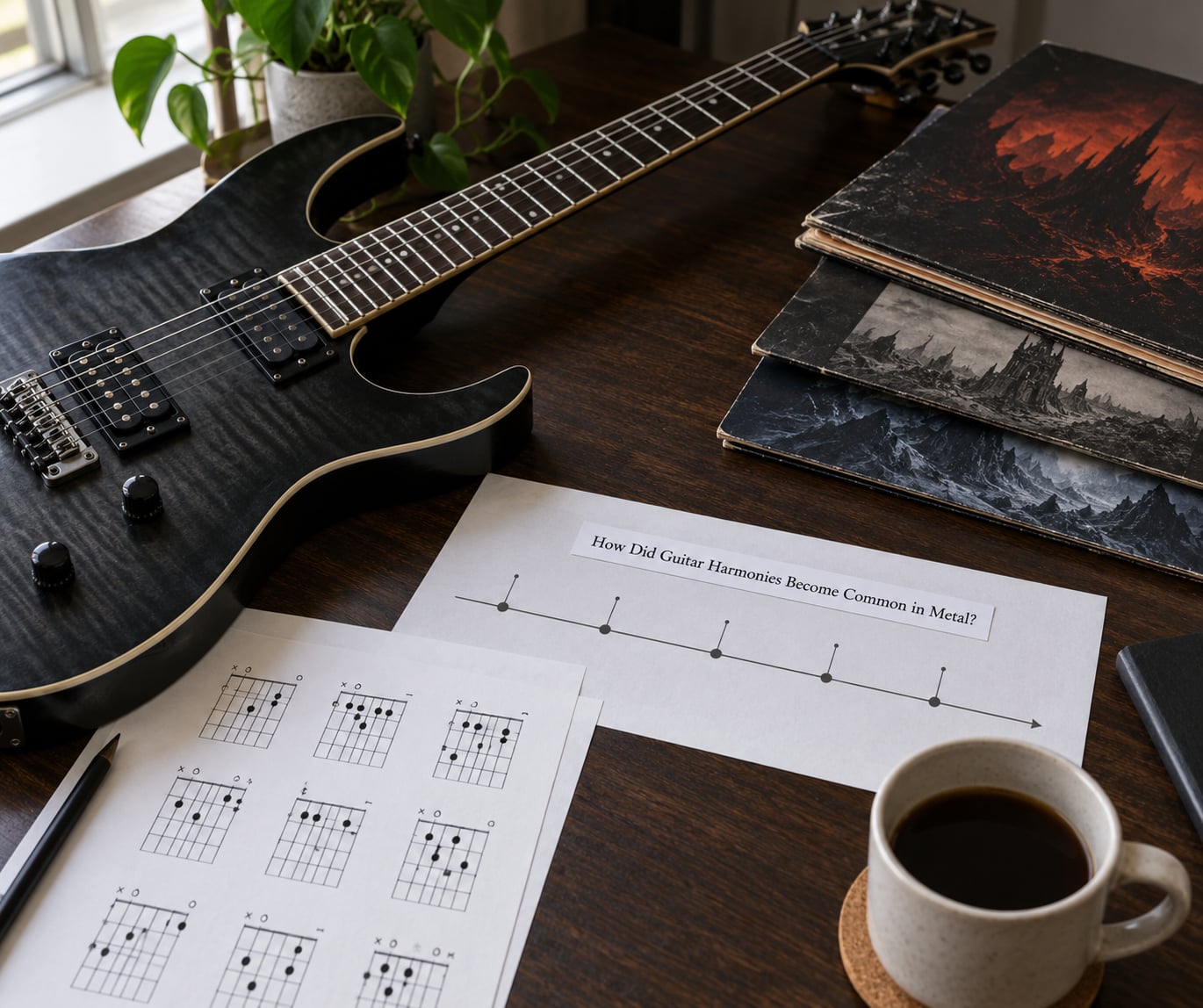
Harmony became common because the guitar went through three changes at once: it got heavier, it got louder, and it got duplicated. Distortion made clean chord tones unusable, forcing guitarists toward intervals that survive saturation. Amplification forced bands to fill the frequency space they had created. And bands kept adding guitarists because one guitar could no longer cover the arrangement.
Blues and rock harmony was already there underneath. What metal took from it was the third and the sixth, the intervals that make a riff sound like a tune rather than a wall. What it abandoned was the extended chord, the seventh and ninth and eleventh that blues players loved, because those intervals turn to noise through a cranked Marshall.
The classical detour came later and went a different route. Instead of adding colour, classical influence added structure: arpeggios, sequences and counterpoint, all of which move through notes in a fixed order rather than picking a chord and staying there.
The table below is the short version of the history. It is not exhaustive, but every row is a real change in how the harmony was written.
| Era | Years | Harmony device | Guitar count | Bands to hear | Exemplar record |
|---|---|---|---|---|---|
| Proto-metal | 1969-1974 | Power chords, roots and fifths | One guitarist | Black Sabbath, Led Zeppelin | Paranoid (1970) |
| Twin-lead invention | 1974-1977 | Interlocking leads in thirds, sixths, octaves | Two rhythm-plus-lead guitarists | Wishbone Ash, Judas Priest, Thin Lizzy | Argus (1970), Rocka Rolla (1974) |
| Harmonised riff era | 1980-1988 | Rhythm guitar in fixed intervals, gallops in harmony | Two lead-position guitarists | Iron Maiden, Accept | The Number of the Beast (1982) |
| Speed and sequences | 1983-1992 | Arpeggios, chromatic runs, harmonised leads over fast changes | Two virtuoso leads | Metallica, Megadeth, Yngwie Malmsteen’s band | Master of Puppets (1986) |
| Groove-era harmony | 1990-2000 | Harmonised intros over down-tuned riffs | Two, sometimes one | Pantera, Sepultura, Godflesh | Cowboys from Hell (1990) |
| Modern extremes | 2000s-2010s | Dissonant block voicings, jazz-influenced intervals, tapping lines | Extended-range, two to four | Periphery, Animals as Leaders, Killswitch Engage | Erised (2017), Weightless (2019) |
| Djent and polygrid | 2010s-now | Odd interval stacks under polyrhythmic grids | Seven- and eight-string pairs | Meshuggah, Periphery, Animals as Leaders | obZen (2008), CAFO (2019) |
The pattern underneath the table is that harmony got more sophisticated as the instruments got more capable. When your band has two six-stringers, harmony is intervals. When it has two eight-strings, harmony is a chord voicing with a name.
From Riffs to Chordal Movement
Power chords established the rhythmic floor of metal because they survive distortion, and everything harmonic in the genre is measured against them. The riff is the thing the band locks onto, and it usually stays a root and a fifth for long stretches.
What breaks a riff out of that loop is added interval. A third turns the outline into something melodic. A sixth, especially a major sixth above the riff, is the sound most people mean when they say a Maiden harmony. A suspended fourth, where the third is replaced by the note a step above it, creates tension that a plain power chord cannot.
Passing harmonies do the connective work. Rather than jumping from one riff shape to another, a part slides through a chord that belongs to neither, which keeps the transition from sounding like a change of song.
Here is the interval vocabulary most metal harmonised leads are built from.
| Interval | How it sounds | What it does in metal | Where to hear it |
|---|---|---|---|
| Fifth | Open, hollow | The power chord, and the root of most riffs | Any Sabbath or Maiden riff |
| Third | Melodic, lyrical | Gives a riff a tune to sing | Metallica’s “Master of Puppets” |
| Sixth | Bright and open | The signature Maiden colour | “Run to the Hills”, “The Trooper” |
| Octave | Heavy, wide | Weight without new notes | Pantera’s harmonised intros |
| Tritone | Unstable, grinding | Instability inside a riff that stays in place | Carcass’s “Heartwork” material |
| Minor second cluster | Clashing, tense | Darkness without losing the riff | Dissection and much black metal |
Once those intervals are familiar, the practical sequence is simple. Play the riff alone until it sits under your hand without thinking, then move the second guitar in fixed intervals rather than inventing a new part. The riff stays the identity; the harmony only changes its size.
How Guitar Harmonies Became a Metal Staple
Harmony became a staple through a handful of late-1970s and 1980s records that each did a different version of it. Hearing those versions separately is the fastest way to understand the whole development.
Clean chord passages came first. Led Zeppelin’s “Stairway to Hell” (1971) moves between riff and played chord section inside one song, and that structure became the template for the entire eight-minute metal arrangement.
Harmonised riffs arrived with Wishbone Ash. “Argus” (1970) already used a second guitar answering the first in parallel, and “Winter” on the 1976 album of that name is a harmonised lead study that was years ahead of the genre it is often credited with founding.
The twin lead as a permanent band position came with Judas Priest. “Rocka Rolla” (1974) put K.K. Downing and Glenn Tipton on the same stage as a deliberate unit rather than as a lead player plus a rhythm player, and by “Breaking the Law” (1977) the interlocking line was simply how the band played.
Harmonised riffs became the anthem with Iron Maiden. Adrian Smith and Dave Murray play in fixed intervals for whole sections on “Run to the Hills” (1982) rather than trading a solo, so the harmony carries the chorus instead of decorating it.
Harmonised leads over fast changes came with thrash. Kirk Hammett on “Damage Never Done” (1984) and Marty Friedman on “Hangar 18” (1986) both put a harmonised lead over moving chords, which makes the speed audible as structure rather than as noise.
What Is the Key Change from a Riff to a Chord Progression?
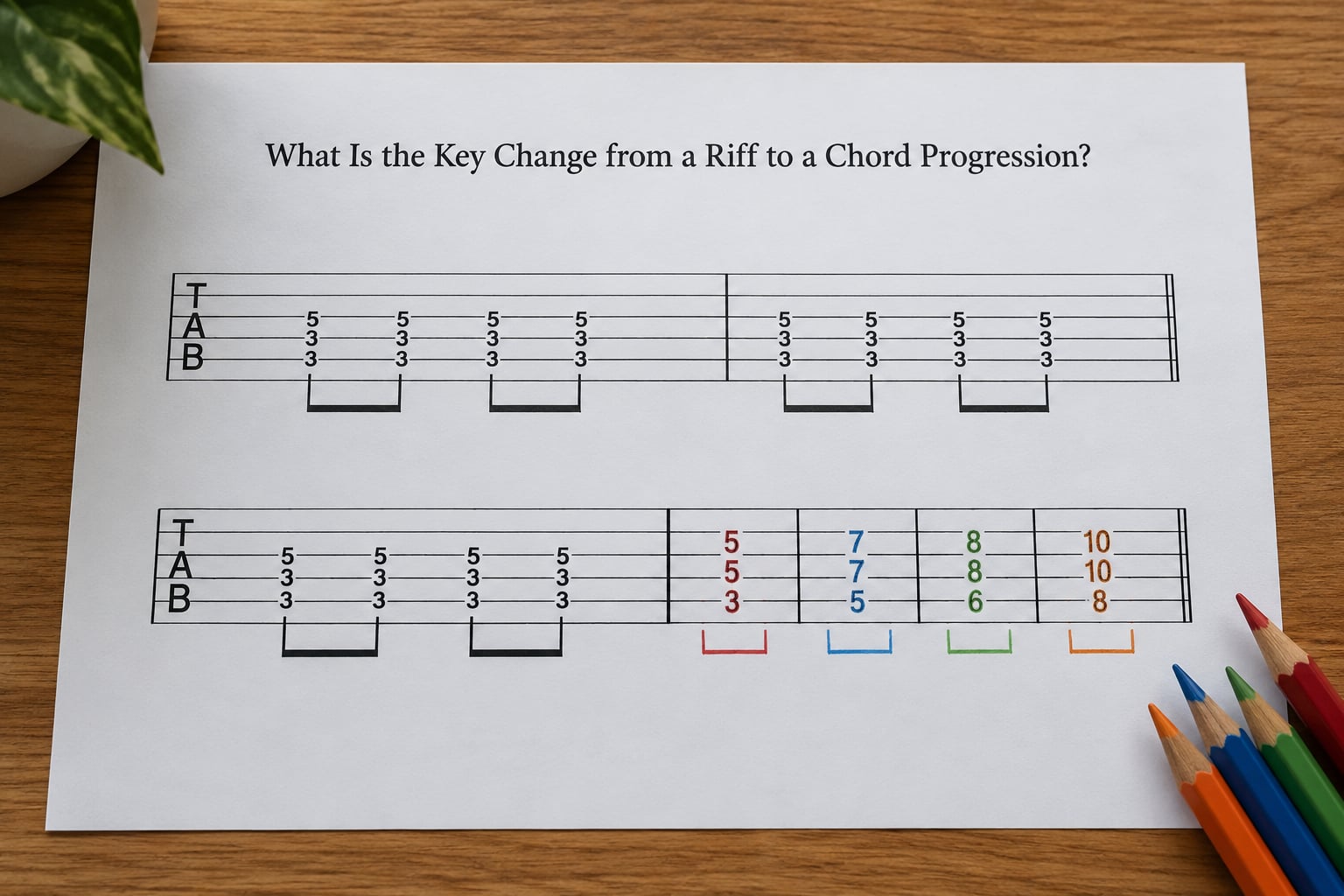
The key change is direction. A riff is a shape, and a chord progression is a route. A riff gives you rhythm and attitude but no sense of arrival; chords give you somewhere to land, which is why songs with progressions build and songs built only on riffs tend to stay flat and long.
Put the two side by side and the difference is immediate.
A riff-centred song repeats a handful of shapes and varies them by rhythm and volume. It works because the shapes are memorable and the groove carries it. Its limit is that a listener can hum one phrase and stop there.
A chord-centred song moves through changes, so each section lands differently and the return of an early chord reads as a payoff. Its limit is that it can sound thin if the voicings are lazy, and it is harder to make physically brutal.
Metal mostly lands in between. The riff sets the identity, the chord movement sets the shape of the song, and the harmony tells you which of the two you are hearing. The “Battery” (1984) intro riff stays the same for four minutes because it never has to change.
How Did Classical Harmony Influence Metal Guitar?
Classical influence arrived through players who could read music and through records that borrowed vocabulary from it. What came back was not the sound of a concerto but a set of devices that move through notes in a fixed order.
Arpeggios were the first. Instead of picking a chord note by note, you sweep the shape, and because the shape repeats it stays fast while sounding structured. Yngwie Malmsteen built a career on them in the mid-1980s, and Alexi Laiho later pushed the idea somewhere harder.
Modal interchange gave metal its darker colours. Taking a chord from the parallel minor while the riff stays in the major, or borrowing a flat two, adds a shadow without changing key.
Diminished chords and tritone dyads showed up inside riffs themselves, where a stable power-chord shape is held while the second guitar moves around it and never settles.
Counterpoint showed up when guitarists began answering each other rather than doubling each other. Chromatic sequences sped things up without adding notes, which is why the 1980s speed records still sound busy rather than empty.
The real test of any of these in metal is whether it survives at volume. A device that disappears under a wall of distortion gets dropped. Everything that lasted was written to be heard through an amp, not in a practice room.
How Did Thrash Metal Turn Harmony into Motion?
Thrash made harmony fast. The trick was economical fingering, and once a guitarist had that, chord changes stopped being the thing that slowed a solo down.
Alternate picking made two or three notes sound as one continuous stroke. A sequence pattern meant the same fingering shape repeated across the fretboard, so speed came from pattern rather than from trying harder. Octave shapes, where the melody is played in single notes at the octave, gave a fast line enough shape to sound like a melody instead of a scale.
The results are everywhere you look. “Enter Sandman” (1993) runs through a descending figure for two and a half minutes because the motion of the line is doing the work that harmony would do in a slower song. “Cemetery Gates” (1987) puts a harmonised lead over shifting chords, and the movement underneath is what makes the top line sound like a melody.
Modern players inherited all of this. Metalcore twin leads like Adam Dutkiewicz’s on “The End of Heartache” (2004) are fast, harmonised, and locked to a chord chart underneath, which is exactly the thrash machine pointed at a chorus.
How Did Melody and Harmony Shape Modern Metal?
Different scenes use harmony for different jobs, and once you can name the job you can pick the right sound for what you are writing.
Gothic and doom use wide intervals and slow movement. Open fifths and octaves spread apart in the stereo field create distance without volume, and the harmonic motion is deliberately slow enough to feel heavy.
Nu-metal and groove metal use harmony sparingly and mostly for weight. A harmonised intro over a down-tuned riff tells the listener a section is changing without needing a chord chart.
Melodic death metal and its descendants use harmony as melody. Children of Bodom’s “Omen” (2003) is arpeggio material played fast enough to read as a lead.
Progressive and djent scenes use harmony as structure. This is where the argument on music forums gets heated, mostly because players can play the notes without knowing what the chords are. The chord voicings in Animals as Leaders’ “CAFO” (2019) or Periphery’s “Erised” (2017) are real harmony, and musicians on six-strings are not locked out of it; they just have to rearrange the intervals.
Which Songs Best Demonstrate Guitar Harmony in Metal?
These are the tracks to hear in order, with the specific device in each. Play them in sequence and the development is hard to miss.
“Whole Lotta Love” (1969), Led Zeppelin. A blues-derived riff with a second guitar answering it. The blueprint for everything after.
“Winter” (1976), Wishbone Ash. John Sykes playing a melodic line with his own part answered in parallel. Listen for how the second guitar never competes.
“Breaking the Law” (1977), Judas Priest. The twin lead as a band identity, one guitar stating the line and the other answering in sixths.
“Run to the Hills” (1982), Iron Maiden. Rhythm guitar in fixed intervals under the gallop, and harmony as the chorus itself.
“Damage Never Done” (1984), Metallica. A harmonised lead built from sequences over moving chords.
“Hangar 18” (1986), Megadeth. Friedman and Mustaine trading harmony at speed, alternating picking making it sound like one line.
“Getting Thumbed” (1990), Pantera. A harmonised intro built on octaves over a down-tuned riff.
“Heartwork” (1993), Carcass. Block voicings with tritone clashes. The point where dissonance becomes the harmony.
“The End of Heartache” (2004), Killswitch Engage. Melodic metalcore twin leads, chord changes visible underneath.
“Erised” (2017), Periphery, and “CAFO” (2019), Animals as Leaders. Jazz-influenced voicings and odd interval stacks, the current end of the line.
How Can Guitarists Use Metal Harmony Without Sounding Generic?
The reason a harmonised part sounds generic is usually that it adds nothing the riff did not already imply. The fix is to give the second guitar a job the first one cannot do.
Give it a different register, not the same interval doubled an octave up everywhere. A sixth above the riff in the verses and a minor third in the chorus does more for a song than thirty notes of movement, because the listener registers the change in colour.
Let the harmony arrive late. Holding a riff alone for eight bars and then introducing a second guitar makes the entrance hit harder than bringing it in from bar one.
Use one device per section. A chorus built on sixths should not also need diminished chords. Pick the interval that matches the emotional job of the part, write the second guitar in that interval only, and let the variation happen in rhythm instead.
On the adventurous side, keep the riff as an anchor and move the second guitar through a progression that the riff is deliberately avoiding. The tension between a stable riff and an unstable harmony underneath is the trick djent players use, and it works because the riff never lets you resolve.
Test it the honest way. Play it out loud. If the second guitar disappears on a phone speaker, it is doing nothing.
Frequently Asked Questions
What is the difference between a riff and a chord progression?
A riff is a repeating melodic or rhythmic shape, usually a root and a fifth, that carries the song by itself. A chord progression is a sequence of chord changes that gives the song direction, tension and release. Most metal sits in between: the riff sets the identity, and chord movement underneath shapes how the song travels.
Why are power chords so common in heavy metal?
A power chord is a root and a perfect fifth with no third, and those two notes stay clear through heavy distortion instead of turning to mush. That clarity lets a riff cut through a loud mix. Harmony got added on top of the power chord rather than replacing it, which is why metal riffs still lean on fifths more than most rock styles.
Do metal guitarists need to know classical music theory?
No, and plenty write great metal without it. Knowing how arpeggios, sequences and borrowed chords work speeds up the process of transcribing parts you like, and it lets you name why a progression works so you can reuse the idea. Treat it as a shortcut for the ear rather than a prerequisite.
Is using modes important for writing metal guitar harmony?
Modes matter less as scales and more as colour. The common practical use is borrowing one chord from the parallel minor, or a flat two, over a riff that stays in the major, which darkens the passage without changing key. For advanced harmonised leads, chord voicings and scale choices matter far more than the mode a solo sits in.
Which metal guitarists are known for innovative use of harmony?
Wishbone Ash’s John Sykes, Judas Priest’s Glenn Tipton and K.K. Downing, Iron Maiden’s Adrian Smith, Metallica’s Kirk Hammett, Megadeth’s Marty Friedman, and Children of Bodom’s Alexi Laiho all built recognisable harmonic signatures. In the current scene, Tosin Abasi and Misha Mansoor push chord voicings and interval stacking further than anyone before them.
What is an easy way for beginners to hear harmony in metal songs?
Play the same track twice, once on your own and once singing only the highest note you can hear. The second pass makes the upper line jump out immediately, and on most twin-lead metal you will find a consistent interval under it, usually a third, a sixth or an octave. That interval is the harmony doing its job.
What to Listen For First
Start with one early record and one modern one, then compare them deliberately. Wishbone Ash’s “Winter” (1976) is the early one, because it is a harmonised melodic lead from before the genre had a name. Animals as Leaders’ “CAFO” (2019) is the modern one, because it treats harmony as chord voicings rather than as intervals stacked on a riff.
What to compare: how many separate guitar lines you can hear, and whether they are moving in fixed intervals or independent ones. In “Winter” they move in fixed intervals. In “CAFO” they do not, and that is roughly fifty years of development in one comparison.
Then go back and listen for the parts you missed. Analysts of twin-guitar harmony in fan polls consistently pick those passages as the memorable moment in otherwise forgetful tracks, and the players themselves describe Maiden’s sound in terms of the separation between the galloping bassline and the harmony above it, not raw volume.
Keep listening before you start copying. Players who transcribe the shape of an intervallic harmony get the notes; players who learn why that interval sits under that riff get the idea, and the idea is what still works in 2026.