How tritone intervals create tension in metal comes down to three things: six semitones of distance, no shared root with anything around them, and where you place them in the riff. A tritone is any interval of six semitones, or three whole steps, between two notes.
Metal leans on that interval because it lands exactly between the perfect fourth and the perfect fifth, so neither note settles against the riff’s tonal centre and the tension keeps building instead of releasing.
Most players learn riffs by ear long before they learn to name intervals. That is why a lot of guitarists can play a b5 lick on instinct and still get stuck when someone asks them what notes those two strings are making.
This guide covers the mechanics first, then gets into riffs, chords, bass, vocals and composition, so you can hear the interval in records you already own and write it yourself.
Table of Contents
- What Is a Tritone Interval?
- Where the Devil’s Interval Label Came From
- Why Does a Tritone Sound So Unstable?
- How Tritone Intervals Create Tension in Metal
- How Metal Musicians Use Tritones in Riffs
- Tritone Riff and Guitar Examples for Metal Guitarists
- Tritones in Chords, Solos, and Bass
- Tritones in Vocals and Metal Arrangements
- When Does a Tritone Become Too Much?
- How to Write Metal Music With Tritone Tension
- Frequently Asked Questions
- What is a tritone interval in music?
- Why is the tritone called the devil’s interval?
- Is a tritone always considered dissonant?
- How do I write a metal riff with a tritone?
- Does a tritone need to resolve in metal music?
- What is the difference between an augmented fourth and a diminished fifth?
- Conclusion
What Is a Tritone Interval?
A tritone is the only interval in the standard system that is spelled in two different names while sounding identical. The name comes from the Latin, three whole tones, which is an older way of counting that treats two semitones as one tone.
Because standard notation counts the letter names on the staff as well as the semitones, the same six semitones gets written two ways. C up to F sharp spans four letter names, making it an augmented fourth. C up to G flat spans five, making it a diminished fifth. Play both and you get the identical sound.
| Feature | Augmented fourth | Diminished fifth |
|---|---|---|
| Interval size | Six semitones | Six semitones |
| Staff letter names | Four (C to F) | Five (C to G) |
| Spelling in C | C to F sharp | C to G flat |
| Natural pull | Outward, away from the centre | Inward, toward the centre |
| Typical spelling in metal | C, F sharp | C, G flat |
| Guitar label | sharp 11 or b5 | flat 5, b5 |
That outward versus inward distinction is the part most theory pages skip. An augmented fourth sounds like two notes being pushed apart, so it usually resolves by moving outward to a sixth. A diminished fifth sounds like two notes being sucked together, so it usually resolves inward to a third.
Guitarists rarely care about the spelling, which is exactly why the distinction feels arbitrary when you first meet it. Fret 8 and fret 6 are six semitones apart on adjacent strings regardless of what you call them. The naming only matters when you are reading a chart, writing for strings, or tracking voice leading by ear.
Where the Devil’s Interval Label Came From
The label diabolus in musica, the devil in music, is real, but the story usually told with it is not. There was no medieval church ban on singing tritones. The r/musictheory community wiki traces the label to Johannes Fux in his 1725 counterpoint treatise, Gradus ad Parnassum, and points out that medieval theory used the word tritone only for the augmented fourth.
What did happen in the medieval period is that singers avoided the interval. Carlo Gesualdo, a Renaissance madrigalist, used tritones deliberately for grief and longing, well before metal got anywhere near the idea.
Why Does a Tritone Sound So Unstable?
Two reasons do most of the work. First, the tritone sits precisely halfway between the perfect fourth and the perfect fifth, which are the two most consonant intervals after the unison and octave, so it inherits the unsettled feeling of both without enjoying the stability of either.
Second, a tritone contains no shared root. A perfect fifth implies a root note and two notes that agree about which note they orbit. The two notes of a tritone point at nothing in particular, and neither one is prepared by any other note in the interval.
Your ear is built to expect a resolution. When a note moves by half step it pulls strongly toward a destination, and when it moves by step it implies a line. A tritone has no internal tendency like that, which is why your ear keeps asking it where it is going.
None of this makes the interval useless. It means its tension is an open question rather than a problem, and different traditions answer that question differently. A Bach chorale resolves it because the style demands it. Death metal sometimes refuses to.
How Tritone Intervals Create Tension in Metal
In metal, the tritone creates tension by being held, emphasised and unresolved against a riff that otherwise knows where it is. Six mechanisms show up again and again.
- No common tone. Surrounding riff notes belong to the chord or the scale. The tritone pair shares nothing with them, so nothing smooths over the roughness.
- Refusal of the tonal centre. In E minor, a tritone built on G and D both sit outside the notes that define the key, so the riff sounds like it is being pulled off balance.
- Emphasis on the downbeat. Land a tritone on beat one, or let it ring through the start of the bar, and the ear treats it as the structural note rather than a passing decoration.
- Sustain. Distorted low riff notes ring out for seconds. A tritone left ringing has no reason to move and therefore no place to move to.
- Register. Tritones high on the fretboard sound thin and vicious. Tritones in the low register sound huge and threatening. Same interval, completely different weight.
- Contrast. A clean, consonant verse riff makes a tritone in the following chorus sound like a door being kicked open. Tension depends on what surrounds it.
Notice that the mechanics are all about placement rather than the notes themselves. The same two notes sound like a stable blues shuffle in one context and a breakdown in another.
How Metal Musicians Use Tritones in Riffs
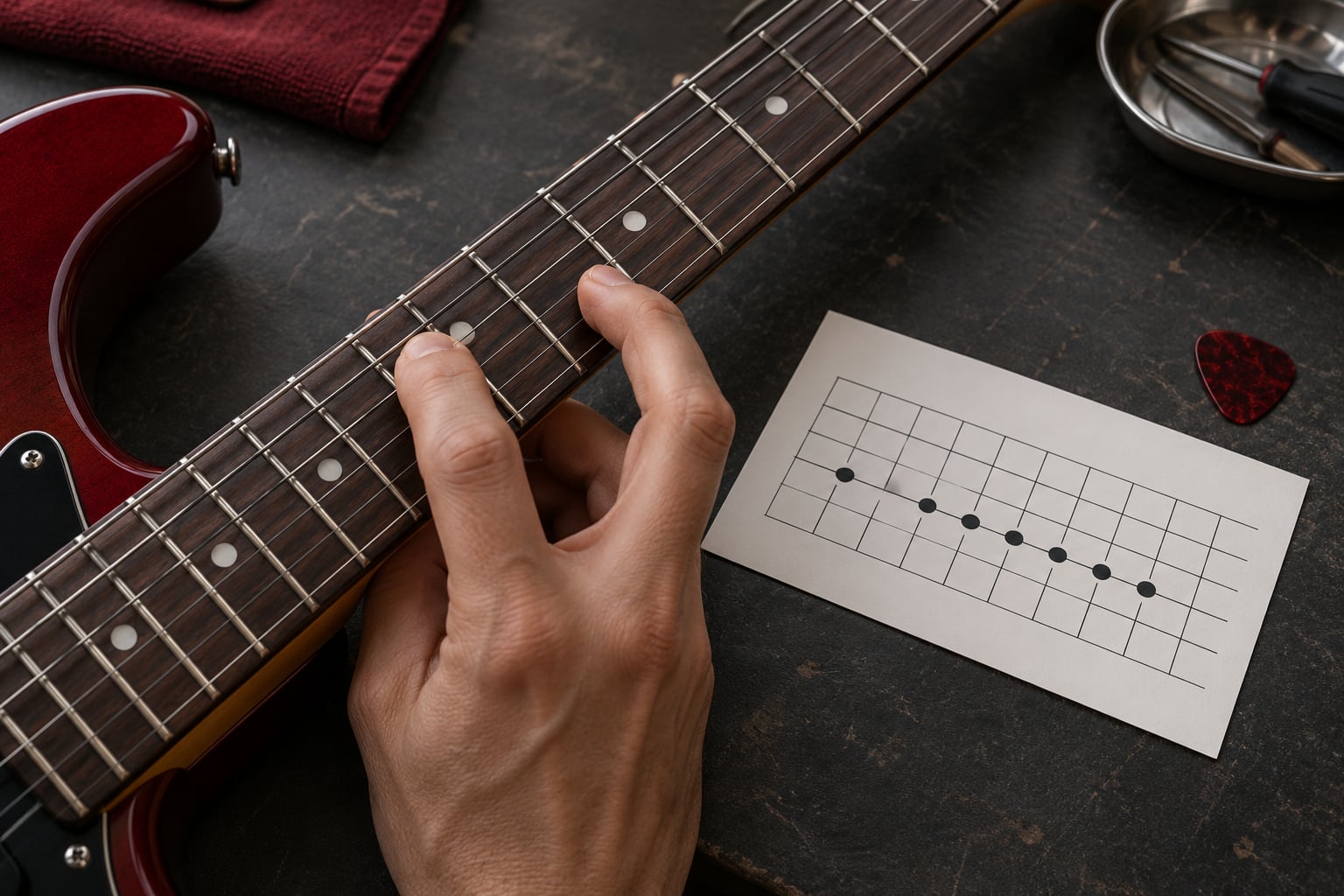
The commonest move is simply fretting power-chord shapes one fret apart, which puts six semitones between the notes on adjacent strings. Players rarely think of it as an interval, but that shape is the tritone in its purest form.
Other placements worth trying:
- Minor-second rubs. Tritone against the b2 of the same chord adds a bite that a clean tritone does not have. This is the Mayhem approach that r/BlackMetal players describe as tritone plus b2.
- Chromatic movement. Sliding one note of the tritone by a half step each bar keeps the ear adjusting to a target that keeps shifting.
- Pedal tones. Holding one note under a moving tritone keeps re-forming the interval against a fixed reference, so tension never drains.
- Syncopation. Placing the tritone on the off-beat keeps the ear braced for it, which makes it feel like an ambush.
- Slow harmonised passages. Tritone double stops under a sustained vocal line work because the vocal stays consonant while the guitars stay wrong.
Tritone Riff and Guitar Examples for Metal Guitarists
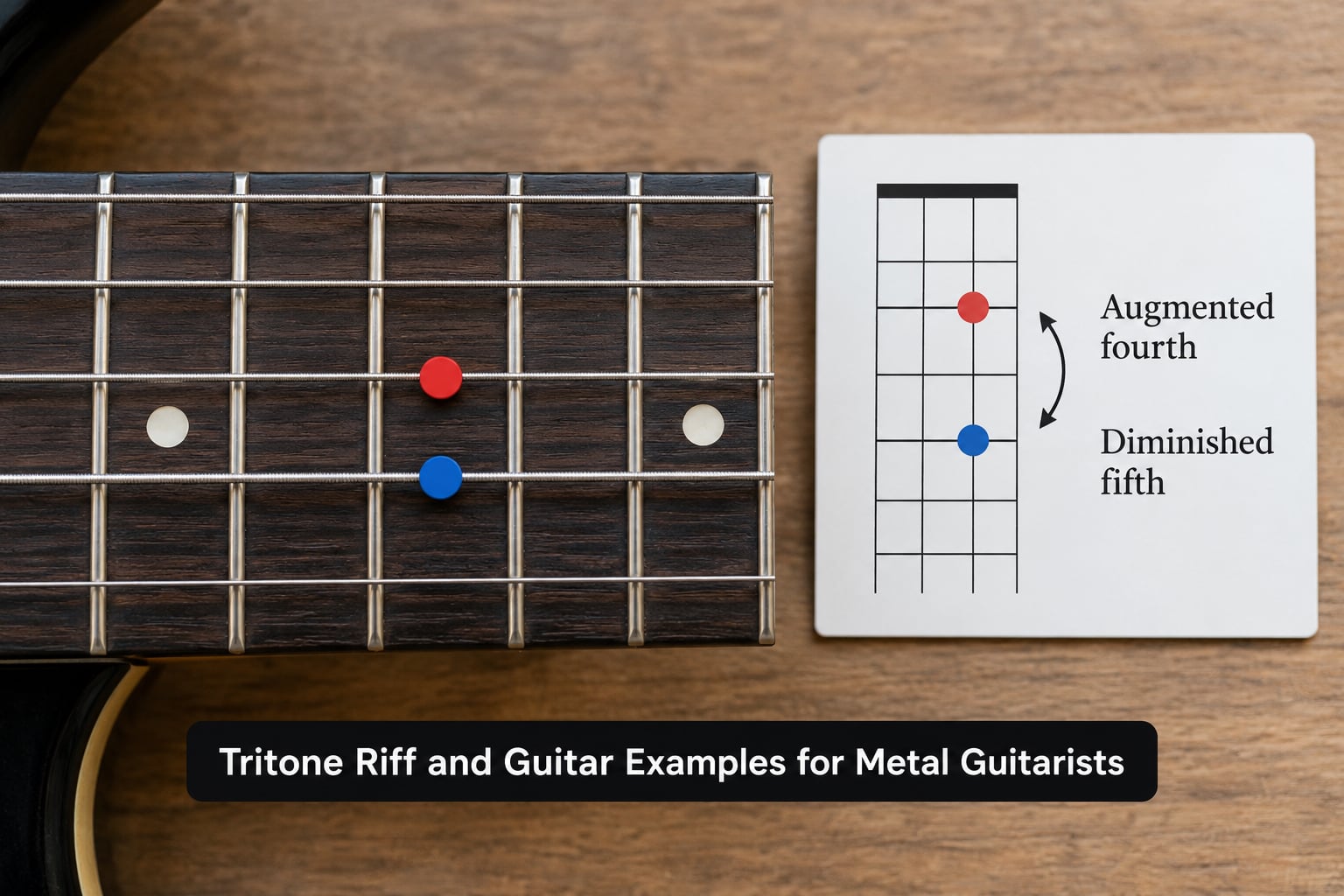
Three shapes cover most of what you need. Read them in any key; the shape is what matters.
Example one, augmented fourth. Take an E power chord on the 5th fret of the 6th and 4th strings. Move the top note up three frets and you have G and C sharp, an augmented fourth that leans outward and wants to spread to a fifth or sixth.
Example two, diminished fifth. Same root, move the top note up two frets instead of three. G and C flat sound identical to the previous pair but pull inward, and that inward pull is what makes it sound heavier over a low root.
Example three, tritone inside a moving power chord. Play an E power chord, then a D power chord on the next downbeat while holding the top note of the E on the 4th string. The held C sharp against D is a minor second, and C sharp against the returning E a fifth later is where the crunch lives. The tension comes from the clash, not from one clean interval.
Practise the third example slowly with a metronome before you speed it up. Most of the difficulty is not the notes, it is muting the ringing strings so each new interval arrives clean.
Tritones in Chords, Solos, and Bass
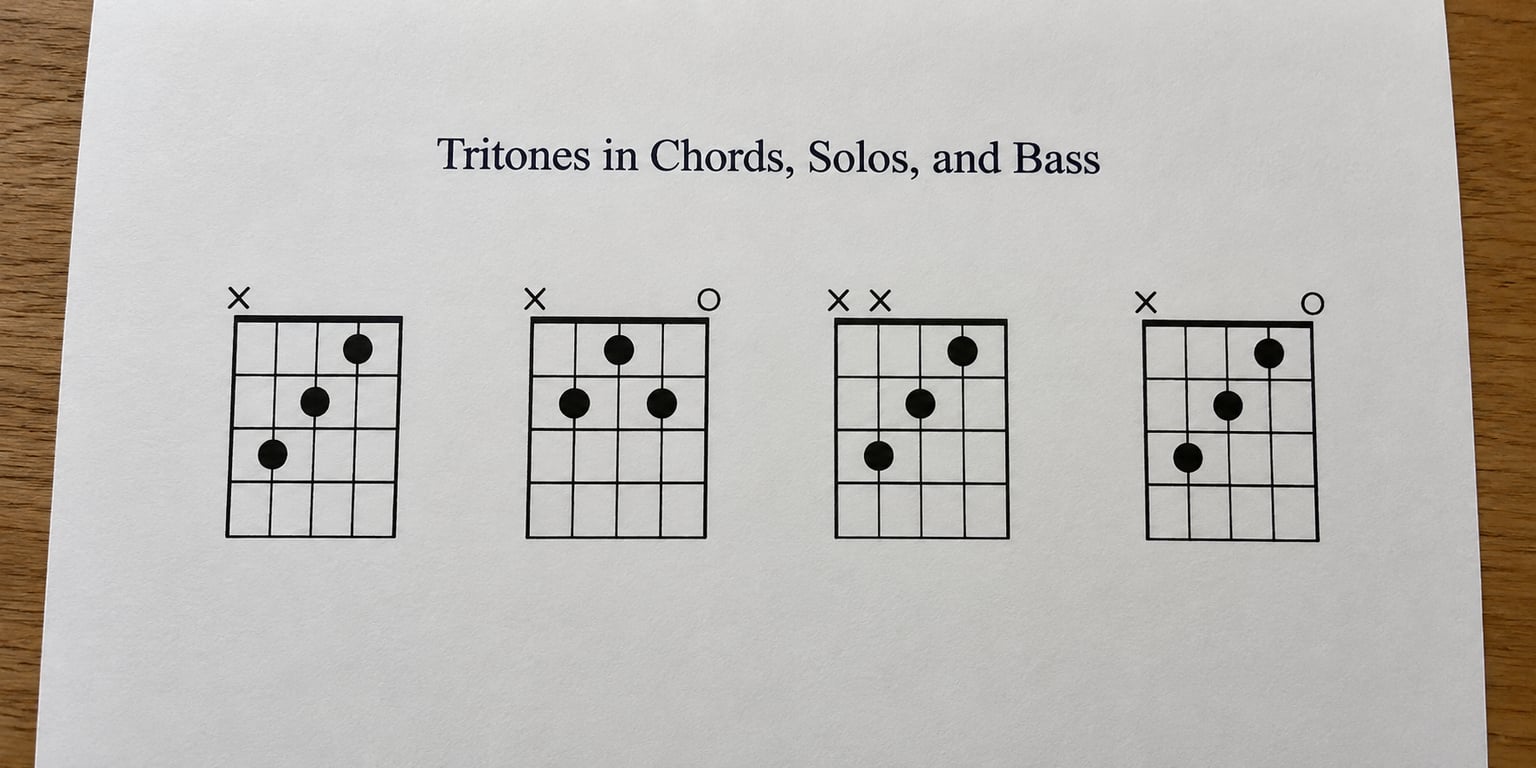
In chord terms the tritone is the engine of the dominant seventh, because the third and seventh of that chord are six semitones apart. That is also the interval the dominant wants to resolve. The seventh drops by half step and the third moves up by half step, and the tension becomes the cadence.
Metal uses the same structure in less polite ways:
- Diminished and half-diminished chords stack two minor thirds, which puts a tritone between the outer intervals. They work as passing chords because they have no root and therefore no home.
- Augmented chords stack two major thirds and sound bright and suspended. Useful for the moment before a drop.
- b5 and bII chords put a tritone against the root directly. The flat 2 major chord, borrowed from the Phrygian mode, is the standard tritone substitution for a dominant, and it fits a phrygian riff without any accidentals.
- Solos use tritones to change direction. Slide into one, leave it hanging for a beat, then resolve it by half step and you have written a phrase with an event in it.
- Bass keeps the tritone in the low register where it is felt more than heard. A root and a b5 under a false fifth is a huge, simple shape, and plenty of metal basslines are nothing more than that with a passing note.
In dropped tunings the interval does not change size, but it does change where it lives under the hand. The same shape lands on different strings, and open tunings push the note into a lower, thicker register where the roughness is felt in the chest.
Tritones in Vocals and Metal Arrangements
Harmonised vocals are where tritones are easiest to hear and most often accidental. Sing a clean chorus, then double it a tritone above and the whole chorus changes colour without changing a single melody note.
Three arrangements worth trying:
- Harmonised thirds replaced by tritones in the pre-chorus, so the bridge sounds like the same song being played on a broken instrument.
- Octave displacement, where the harmony sits an octave away from the vocal and the tritone reads through the gap rather than in the middle of the mix.
- Close tritones under a sustained vocal in the last chorus, held long enough that the singer has to fight them.
The caution is tuning. A close tritone that is out of tune by a few cents stops sounding dangerous and starts sounding wrong, because beating frequencies take over from dissonance. Check the interval on a tuner before you let a singer commit to it, and keep the tritone in the guitars if the vocal is already carrying enough strain.
When Does a Tritone Become Too Much?
A tritone stops creating tension when the listener stops expecting it to resolve. In practice that happens in four ways: you repeat the same tritone too many times, you put it so high in the mix that it becomes texture rather than event, you stack several of them so nothing stands out, or you withhold a payoff for the entire song.
Forum threads on this subject keep circling the same question, and the useful answer is a threshold rather than a rule. The same unresolved interval that sounds glorious under a clean verse can sound like a mistake under four distorted guitars competing for the same space.
Context decides how much dissonance a listener will accept. Play the riff alone and you are listening to a shape. Play it after eight bars of consonant material and you are listening to an event. Play it in the fourth minute of an album and you are listening to fatigue.
Give the ear somewhere to land. Even a short rest, a single consonant chord, or a riff that drops a whole tone away will re-set the tension so the next tritone bites again.
How to Write Metal Music With Tritone Tension
A workable process takes about twenty minutes for a riff and one pass of honest listening.
- Pick the tonal centre first and write one clean consonant riff in that key. You need a home before the dissonance means anything.
- Choose the target note. A b5 against the root is the most reliable starting point; the b4 or the b6 gives more variety with less bite.
- Delay the resolution. Hold the tritone for twice as long as feels comfortable, then release it by half step. Most players cut it short out of instinct.
- Vary the rhythm. Same interval, different placement. Move it off the downbeat for one phrase and the effect changes completely without new notes.
- Add movement under it with a pedal tone, a descending run or a bass line so the ear has something to hold while the tritone sits still.
- Test it loud, and then quiet. If it only works at volume it will collapse in the mix. Play it on headphones and listen for whether you can still identify the key.
Step six is the one most writers skip. A riff can sound crushing through saturated monitors and turn to mud once bass and kick are underneath it.
Frequently Asked Questions
What is a tritone interval in music?
A tritone is any interval of six semitones, or three whole steps, between two notes. Because notation counts letter names as well as semitones, the same six semitones get written two ways: an augmented fourth such as C to F sharp, and a diminished fifth such as C to G flat. On guitar the shape is identical. It sits exactly between the perfect fourth and perfect fifth, which is why it feels unsettled.
Why is the tritone called the devil’s interval?
The label diabolus in musica, the devil in music, comes from the treatise Gradus ad Parnassum by Johannes Fux, published in 1725. The popular story that medieval churches banned the tritone is a myth. Singers did avoid it, and the medieval word tritone referred only to the augmented fourth, but no church legislated against the interval. Renaissance composers such as Carlo Gesualdo used it deliberately for emotional effect.
Is a tritone always considered dissonant?
No, and the word depends on context. In common-practice harmony the tritone is unstable and expected to resolve, so it is heard as a dissonance. In metal, and in blues or rock generally, it can function as a stable colour once the ear accepts it as the centre. What always remains is the absence of a shared root between the two notes. That is structural, and it is why the interval never fully settles.
How do I write a metal riff with a tritone?
Write a clean consonant riff in your chosen key first, so there is a home to push against. Then place a b5 against the root and let it land on a downbeat rather than as a passing note. Hold it longer than feels comfortable and release it by half step. Fret two power-chord shapes one fret apart on adjacent strings if you want the interval without thinking about it.
Does a tritone need to resolve in metal music?
It does not have to, and many extreme styles treat non-resolution as the point. Death metal and black metal both lean on tritones that stay put under tremolo picking or palm muting, because the sustained clash does the work a chorus would otherwise do. Longer forms still need a payoff somewhere. Give the ear a rest, a consonant chord or a sudden move away before the next tritone.
What is the difference between an augmented fourth and a diminished fifth?
They sound identical, six semitones, and the difference is spelling plus the resolution that spelling implies. An augmented fourth uses four letter names, such as C to F sharp, and tends to resolve outward to a sixth. A diminished fifth uses five letter names, such as C to G flat, and tends to resolve inward to a third. Guitarists can ignore this entirely, since the fretboard shape is the same.
Conclusion
A tritone creates tension in metal because it splits the difference between two very stable intervals, shares no root with anything around it, and can be held far longer than harmony rules normally allow. Where you place it, how long you sustain it and what follows it decide whether it reads as menace or as noise.
Start by listening for three things in the next metal record you play: which two notes sit six semitones apart, whether they land on the beat, and what releases them. Once you can hear those three details, writing how tritone intervals create tension in metal into your own riffs is straightforward.