Naming a metal band comes down to three jobs: pick a small pool of words that fits your music, combine them with a formula that has already worked for real bands, then prove the name is free before you print it on a shirt. Get that order wrong and you spend six months stuck on a name a band in Finland already uses.
It takes most bands a weekend, not a month. The work is less inspiration than elimination, and the steps below are the order I would run them in.
Table of Contents
- What You Need Before You Name a Metal Band
- How to Name a Metal Band, Step by Step
- Step 1: Define Your Band’s Direction
- Step 2: Choose the Name’s Main Idea
- Step 3: Brainstorm Name Directions
- Step 4: Make It Easy to Say and Remember
- Step 5: Check for Existing Bands and Conflicts
- Step 6: Test the Name with People
- Step 7: Choose and Protect the Final Name
- When Your Band Spans Multiple Subgenres
- Common Mistakes That Ruin Metal Band Names
- Frequently Asked Questions
- Should a metal band name sound aggressive?
- How do I check whether a metal band name is already taken?
- Do I need a unique domain to name my metal band?
- Can a metal band change its name after releasing music?
- Should band names use abbreviations or special symbols?
- How many band name ideas should I create before choosing?
- Conclusion: Lock the Name, Then Brand It
What You Need Before You Name a Metal Band
Four things, and you should have all four before a single name goes on a list.
A defined sound. Not a genre label, a description you could give a stranger in one sentence. Deathcore with folk clean vocals is a different naming problem than funeral doom recorded at half speed.
A word bank. Twenty to forty words drawn from the imagery your music actually uses. Nothing from a generic list of “scary metal words” you copied but never thought about.
Two or three naming criteria. For most bands that means spellable after one hearing, short enough for a wordmark, and genre-plausible. Decide yours before you fall in love with a candidate, or you will rationalise anything.
A checking method. Know exactly which four places you will search to prove a name is free. We cover that in detail in Step 5.
How to Name a Metal Band, Step by Step
Step 1: Define Your Band’s Direction
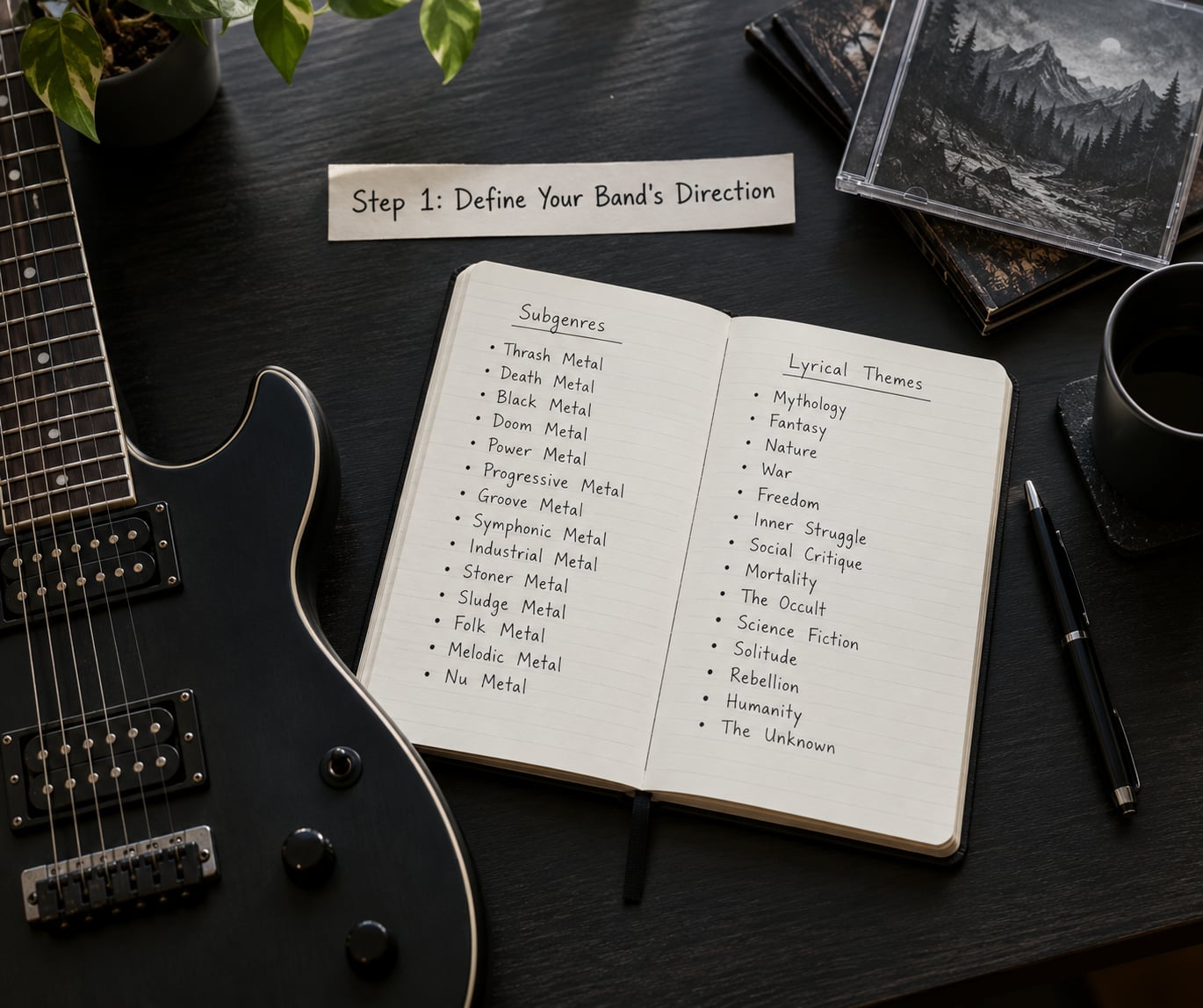
Write three sentences: what your band sounds like, what your lyrics are about, and who you are trying to reach. “Fast, ugly, short songs about dying badly” is more useful to a namer than “deathcore with atmosphere.”
Then name your influences, including the ones that do not fit your subgenre. A band with Sepultura’s riffing and Sleep Token’s presentation has a naming problem half traditional metal bands never face.
Step 2: Choose the Name’s Main Idea
One idea, carried through every candidate. Mythology, warfare, anatomy, the occult, decay, nature, machinery, or a single abstract emotion.
The reason to pick one lane is that two ideas produce mush. A Norse-mythology plus cyberpunk name gives the listener nothing to hold, and it gives your logo designer two visual languages to fight over.
Test the idea against your songs. If you picked decay and nothing in your catalogue decays, you picked the wrong pool.
Step 3: Brainstorm Name Directions
Generate in categories rather than in one sitting. Single punchy words. Adjective plus dark noun, the pattern behind Morbid Angel. Noun plus plural noun. Compound words that read as one word. Invented words with hard consonants. Phrases lifted from a lyric you wrote.
Set a target of forty to sixty candidates across at least six categories. Volume is what solves the “all my ideas sound the same” problem, because you are comparing across structures instead of grinding on one.
Keep the ones that pass your Step 1 test immediately. A name that does not fit your identity is dead even if it is available.
Step 4: Make It Easy to Say and Remember
This is where most bands lose their best name. A name that is brilliant written and impossible to relay over a PA in a loud room costs you a promoter call, a festival introduction, and every person who tries to search for you.
Run four checks. Say it once to someone who has never heard it and ask them to spell it. Say the initials out loud and listen for an accident. Count the syllables and cut anything past four. Picture it in a single-line wordmark at the size of a patch on a sleeve.
Long names fail that last test quietly. Eleven letters on a tour poster is fine; eleven letters wrapped around a circle on a back print is not.
Step 5: Check for Existing Bands and Conflicts
Run this order, cheapest signal first.
- Metal-Archives. Search the band name field, then the aliases field. The database is global, so a band in Brazil with your name blocks you in the same way a band in Ohio does. This is not a technicality to argue, it is how the scene actually works.
- Google in quotes. Put the full name in quotation marks. Then the name with “band” appended. You are looking for a label, a festival, a game, a clothing brand, or a completely unrelated business that already owns the word.
- Bandcamp. Try the URL slug directly. Bandcamp slugs are globally unique, so this is a fast hard check that most bands skip.
- Social handles. Check Instagram, Facebook, X, TikTok, YouTube and Threads at the exact handle you would want, not a close variation. Handles are first-come, first-served and rarely released.
- Domain. Check .com, .net, and the country code your listeners actually use.
- Trademark databases. A search on the USPTO database in the United States, or EUIPO in Europe, tells you whether anyone has filed the mark for music or merchandise. File yourself before you file with anyone.
Do steps one and two the moment a name reaches your shortlist, not after you have committed. Finding out at step six that a band has used your name for nine years is the expensive way to learn the same lesson.
Step 6: Test the Name with People
Show three to five finalists to people in three groups: musicians who play with you, fans of your subgenre, and one person with no music context. The last group tells you most about a name that only insiders will get.
Ask two questions. “What do you think this band sounds like?” and “How would you search for them?” Disagreement on the first question is a signal about clarity. A wrong answer on the second is a signal about spelling.
Do not treat any single reaction as the vote. You are collecting evidence, not running an election, and the person who says “it’s fine” and moves on has told you something useful too.
Watch for an unwanted association surfacing. If two people independently bring up the same joke about the name, that is your audience’s opening line at every show, and you should decide now whether you can live with it.
Step 7: Choose and Protect the Final Name
Pick the name that passes every check, not the name that scored best. The best candidate is the one with no blockers: free on Metal-Archives, no live handle, open domain, no trademark conflict.
On the day you decide, claim the handles and the domain immediately, even with placeholder art. Then file a trademark application for the band name if you have released music, sell any merch, or have a name distinctive enough to be defending later.
Metal operates on a first-to-file culture. Whoever sets the first release with the name keeps it in practice, and the longer you wait, the harder that gets.
When Your Band Spans Multiple Subgenres
If you play death metal, deathcore, slam and black metal in the same set, no naming convention will fit all four. Pick the direction you want people to find you under and name for that, then let the variety live in the music.
This is the single most common naming frustration in metal musician forums, and the usual mistake is trying to encode the whole sound in the name. A name can only point somewhere. It cannot summarise a setlist.
Common Mistakes That Ruin Metal Band Names
Copying an existing band too closely. If your name only works because it reminds people of a band you like, it is a tribute at best. Change at least one element and make the wordmark yours.
Picking exhausted vocabulary. A MetalForTheMasses thread put a number on it: 1,194 metal bands carry the word “death” in their name, with hundreds of duplicates inside that list alone. Same story for curse, rot, plague and abyss. Usable, but you will never rank for it.
Ignoring how it sounds when shouted. Names with clusters of soft consonants vanish under a PA. Hard consonants and dark vowels carry; nothing else does.
Using symbols that cannot be searched. A thorn, an umlaut or a dagger may look great in a logo, and it will break every text search, hashtag and spoken reference to the band. Spell it plain.
Overcomplicating it. Four-word names with Latin suffixes and apostrophes belong to a specific 2010 death metal moment. They are hard to say, hard to fit on merch, and nobody remembers them by the second show.
Naming before you have a sound. If the band changes direction in year two, the name becomes the thing holding you back.
Skipping the availability check. The most common dealbreaker, and the cheapest to avoid. An hour of searching saves a year of confusion.
Frequently Asked Questions
Should a metal band name sound aggressive?
Not by default. Aggression in metal usually comes from the riffs and the delivery, so a name can stay plain and still belong to the genre. What matters more is that the name carries the imagery your lyrics actually use. A doom band named after a slow coastal process feels right; the same name on a blast-beat act reads as a joke. Pick the register that matches the music, not the one that matches a genre stereotype.
How do I check whether a metal band name is already taken?
Search Metal-Archives first, including the alias field, since the database covers bands worldwide. Then run the name in quotes on Google, try the slug on Bandcamp, check every social handle you would want, and look for a domain. Finally search the USPTO or EUIPO trademark databases for existing filings in music or merchandise. Do the first two checks as soon as a name reaches your shortlist, not after you have committed to it.
Do I need a unique domain to name my metal band?
You do not need it to choose a name, but you should grab it the day you decide. Every band wants the same handle, and they are first-come, first-served with almost no resale market. Check .com, .net and the country code your listeners actually use. A matching domain also makes merch and email setup painless later, and it costs almost nothing to hold for a year.
Can a metal band change its name after releasing music?
Yes, and it happens often, but it is expensive. Festival promoters, playlist editors, distributors and search results all key off the old name, so a switch resets your visibility and splits your audience. If you must change, keep the new name close enough to the old one that fans connect them, release a short statement explaining why, and update your handles and links in the same week. Set your handles before the announcement, never after.
Should band names use abbreviations or special symbols?
Almost never. Abbreviations, umlauts, thorn symbols and daggers look strong in a logo and break text search, hashtags, spoken references and plain-text ticket listings. They also create unfortunate acronym accidents, where the initials spell something you did not intend. If a symbol matters to your identity, keep it in the logo artwork and leave the written name fully plain, with every letter searchable.
How many band name ideas should I create before choosing?
Forty to sixty, generated across at least six distinct structures, then narrowed to three or five for real checking. The volume matters more than the count because it forces you to compare across shapes rather than grinding on one idea until you either love it or give up. If you cannot produce forty, you are probably stuck in a single word bank and should step away for a day before going back.
Conclusion: Lock the Name, Then Brand It
Naming a metal band is one decision followed by a lot of filtering. Define what the band is, choose a single imagery pool, generate forty candidates across different structures, cut the ones that fail on pronunciation and length, then run the finalists through Metal-Archives, a quoted search, Bandcamp, handles, domain and trademark databases.
Start tomorrow with the identity sentences and the word bank. Everything after that is checking, and checking is fast.