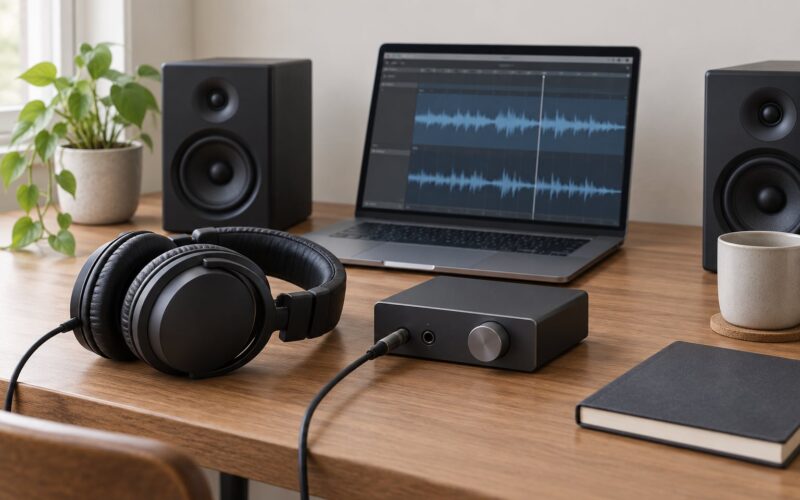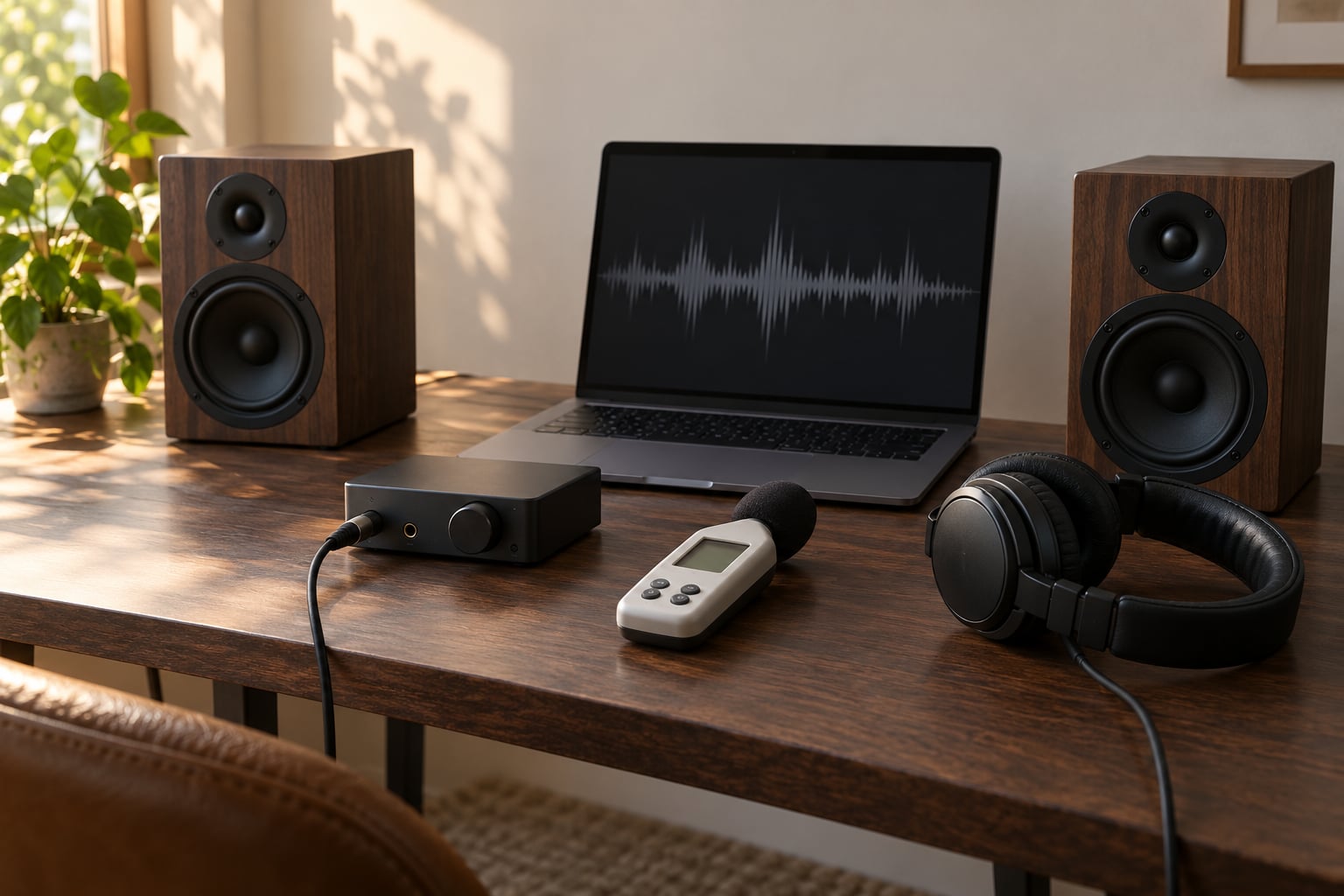
Speakers win for loud, room-filling metal where you want the guitars to hit like a live band. Headphones win for detail, isolation and late-night sessions where the neighbours matter. If you can only afford one start-up, pick the option that matches when and where you actually listen.
That verdict is simple. The reasoning behind it is not, because metal is harder to play back well than most genres, and the failure mode is different on each side of the comparison. On a pair of bookshelf speakers it is midbass. On headphones it is masking.
I have gone back and forth between a nearfield speaker setup and a pair of open-backs more times than I care to admit, and the honest summary is that the two answer different questions. One is about the room. The other is about the mix.
Table of Contents
- Bookshelf Speakers vs Headphones for Metal at a Glance
- Bookshelf Speakers vs Headphones: Quick Comparison
- Soundstage and Instrument Separation
- Bass Impact and Low-Frequency Control
- Noise Isolation and Shared-Room Listening
- Comfort, Convenience, and Repeatability
- Equipment and Room Requirements
- Which Should You Choose?
- Frequently Asked Questions
- Are bookshelf speakers loud enough for heavy metal?
- Do I need a subwoofer to hear the bass in metal?
- Why does metal sound better on speakers than headphones?
- Why do metal guitars sound muddy on headphones?
- Are hi-fi review scores useful for metal?
- Can headphones replace a stereo system for metal?
- Conclusion
Bookshelf Speakers vs Headphones for Metal at a Glance
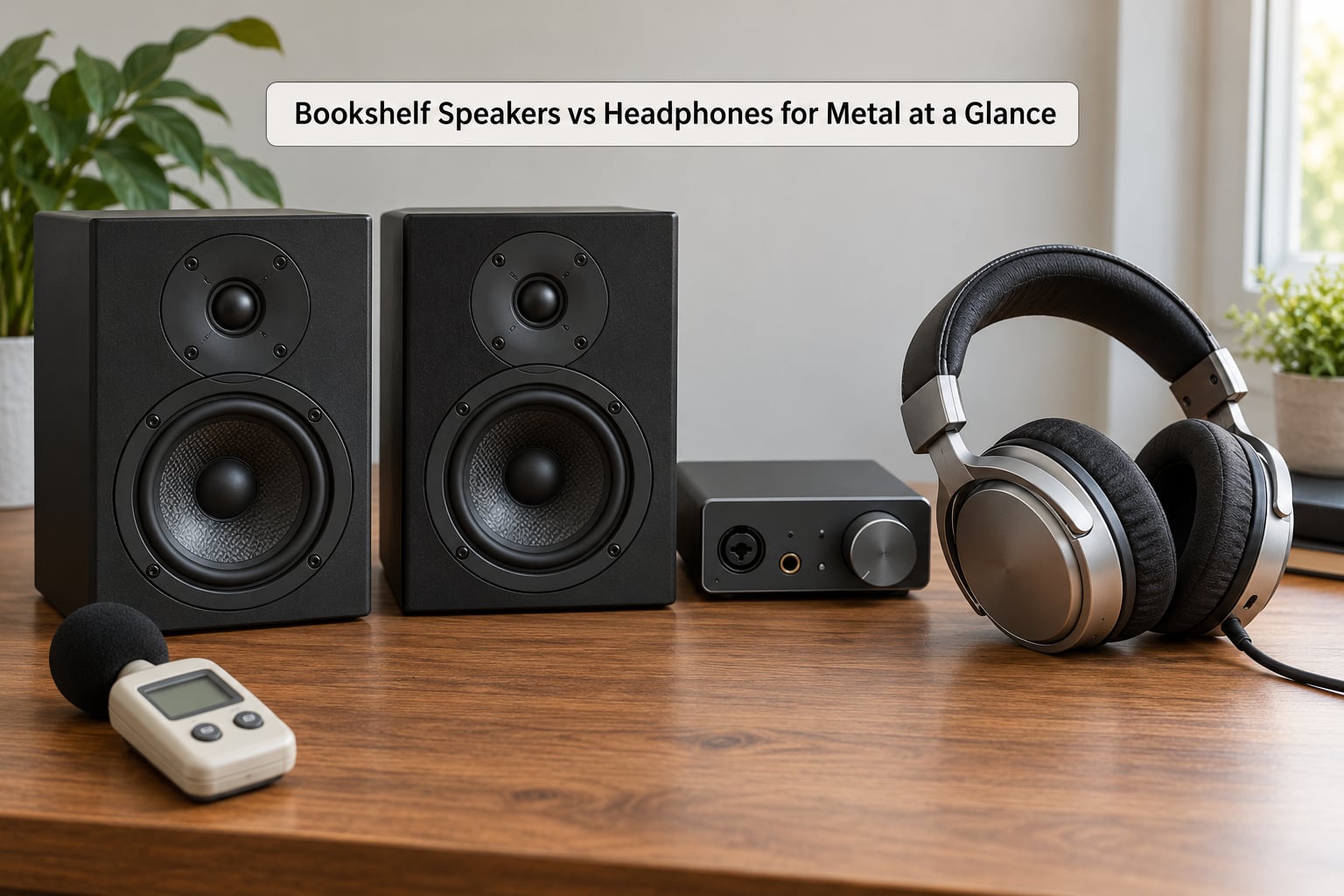
Here is the short version across the dimensions that actually decide it for guitar-heavy music. Bass impact, soundstage and the volume ceiling sit on the speaker side. Isolation, portability and EQ freedom sit on the headphone side. Everything else is a footnote.
| Factor | Bookshelf speakers | Headphones |
|---|---|---|
| Soundstage width and depth | Wide, deep, room-dependent | Intimate, fixed by the driver |
| Instrument separation | Good at distance, needs room placement | Excellent, nearfield by design |
| Bass impact | Fills the room at high volume | Concentrated, no room involvement |
| Midbass (the metal problem) | Weak unless the woofer is large | Depends on tuning, fixable with EQ |
| Maximum volume | High, room permitting | Limited by comfort and hearing |
| Noise isolation | None, you leak sound both ways | Excellent on closed-backs |
| Room requirements | Placement, stands, treatment | A desk and a chair |
| Extra gear | Amplifier, DAC, cables | Usually a headphone amp or none |
| Portability | Fixed to one room | Travels with you |
| Sharing | Everyone hears it | One listener at a time |
Bookshelf Speakers vs Headphones: Quick Comparison
A bookshelf speaker, also called a standmount, is a small two-way speaker designed to sit on a stand rather than on the floor. It sends sound into a room, so the room shapes what you hear. Headphones send sound straight into a sealed space at your ears, so nothing else in the room gets a vote.
That difference explains nearly everything else. Speakers can be louder and wider because they are moving air in an open space. Headphones are more consistent, more portable and easier to shape, because the acoustics never change once you put them on.
Metal cares about that difference more than jazz or classical does. Dense guitar layers need space around them to stay readable, and low end needs body to land at all.
Soundstage and Instrument Separation
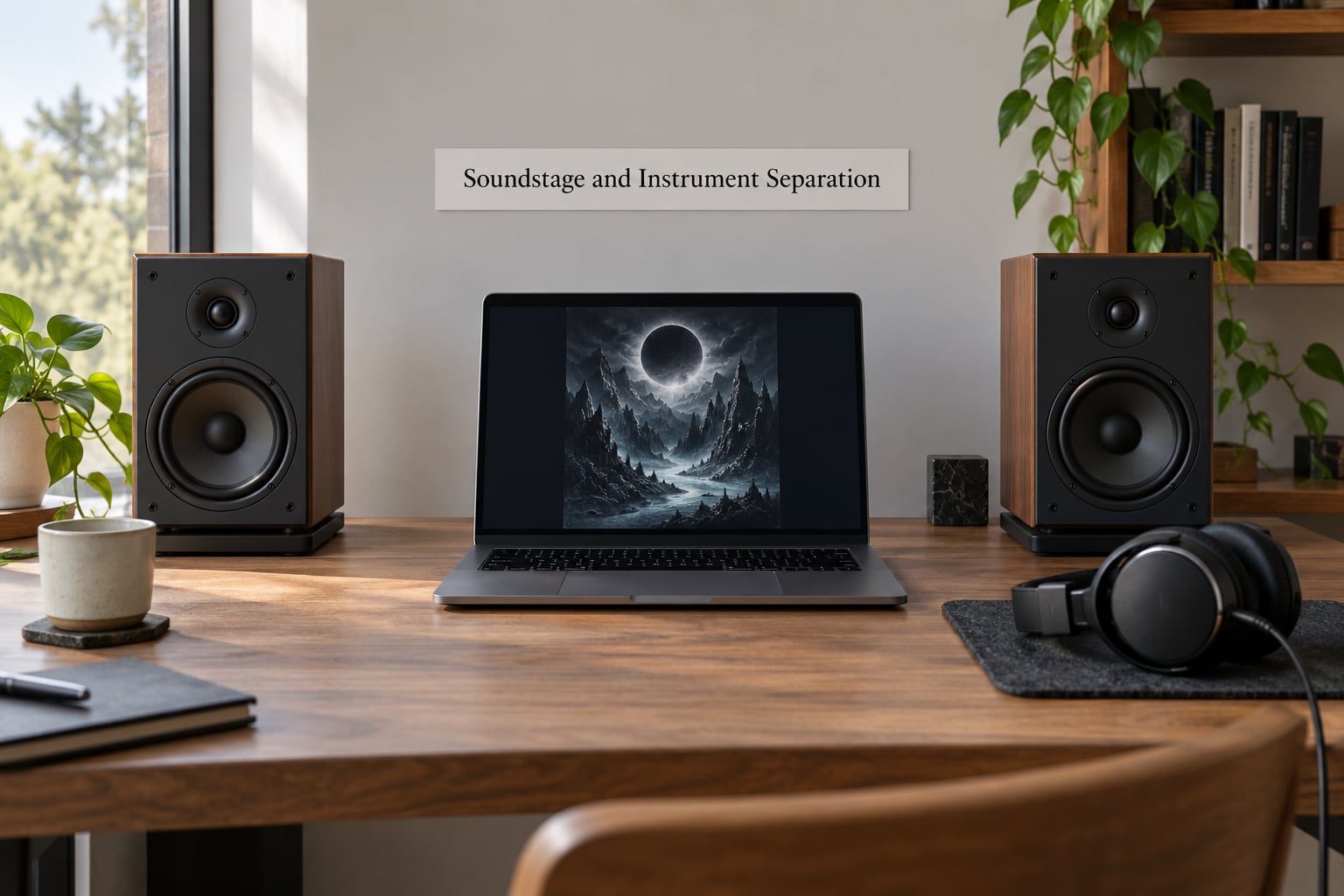
Speakers give you the bigger soundstage, and for metal that is not a gimmick. On a death metal record the rhythm guitar sits in one place, the lead in another, the bass in the centre and the blast beats behind everything. On good speakers at a proper distance those sources occupy distinct positions. On headphones they collapse inward, closer to your skull, which some listeners find more immediate and others find cramped.
Soundstage width matters here for a practical reason rather than an aesthetic one. Metal mixes are dense, and two distorted guitars recorded in the same frequency range will smear into each other if the system cannot place them. Wider playback separates them. Instrument separation and vocal intelligibility improve together, and you catch lyrics you missed before.
The catch is that speakers only deliver this when the room cooperates. Push them too close to a wall or sit between them and you lose the width and gain a boost in the low mids that will blur the guitars all over again. The image moves with your chair.
Headphones hold the image still. Wherever you sit, the bass is centred under your chin and the guitars stay put. Imaging on a good pair of open-backs is excellent, and the price of that consistency is a stage that feels smaller than a room.
Bass Impact and Low-Frequency Control
Speakers produce low end that arrives from in front of you and fills the space around you. Headphones produce low end that arrives at your ears and stops there. Neither is more correct, but they feel different in a way that changes how a metal record lands.
The key variable on the speaker side is woofer size. A 5-inch driver in a small standmount will play loud and stay tidy, but it will not produce the midbass thump that a kick drum and a distorted bass guitar both need in order to register as impact rather than noise. Listeners on the StereoNET metal and hi-fi thread described exactly this: getting powerful midbass from bookshelf speakers is the tough part of the whole exercise.
Speaker-side forum advice over the years has converged on the same answer. High-efficiency horn-loaded designs and larger-woofer speakers handle metal playback better, with 8-inch woofers coming up repeatedly alongside models from Klipsch, Cerwin-Vega, Paradigm, Usher and Dynaudio. The trade is brightness. HiFiVision posters made the same point from the other side of the scale, warning that bright speakers which suit metal at high volume become tiring over a long session.
Headphones flip the problem. On a closed-back pair, low end accumulates around your head and lifts the floor under everything, which buries the guitars and cymbals into a haze. That is the masking complaint that shows up again and again in metal listening threads, along with listeners chasing bass through EQ because flat studio headphones sound thin on the genre.
A parametric EQ is the fix. You can raise the low shelf, cut the 200 to 400 Hz region where the guitars sit, and reshape the response without touching anything else in the room. Nobody can EQ a room into behaving the same way twice.
One practical point worth repeating from the forum crowd: some listeners flatly refuse a subwoofer because mids should come from the front and not from a corner. That is a legitimate preference, and a large standmount or a floorstander solves it without giving in on placement.
Noise Isolation and Shared-Room Listening
Headphones win the isolation argument outright. A closed-back pair at a moderate level keeps your late-night listening entirely to yourself, which matters in a shared apartment, a thin-walled flat or a house with a sleeping child. Speakers at the volume metal demands leak in both directions and there is no fixing that with better equipment.
The same fact turns into a headphone advantage for your ears. Metal listeners push volume harder than most listeners, because the genre was mixed loud and often mastered louder still. A system that gets you there at a lower setting is worth a lot over a decade of daily listening.
Speakers win the social argument. When friends are over, the album is part of the room. When you are playing along on guitar, or gaming, or working with music on in the background, a single pair of speakers beats swapping cups around. Whole-room listening also changes the impression of the music, because low end reflects off surfaces and you hear the parts of the record that sit behind everything in the mix.
There is a middle path plenty of people overlook: nearfield monitoring on a desk. Small standmounts placed close to you behave far more like headphones in terms of imaging and bass definition, while still letting someone else hear the music if they want to.
Comfort, Convenience, and Repeatability
A metal session can run three hours. Over that span, headphones win on comfort as long as the fit is right and the clamping force is not aggressive, and they win on repeatability because the response never changes with the hour, the furniture or where you moved the chair.
Portability is the other obvious one. Headphones go to work, go on a train, go to a rehearsal space. A speaker setup stays exactly where you built it, which is a feature when your listening happens in one room and a limitation when it does not.
Speakers are simpler once they are set up, though. They sit there, they take the same input, they are already EQed to the room. There is no fussing with a DAC, no remembering which adapter, no re-pairing.
Equipment and Room Requirements
Speakers come with real overhead. You need an amplifier with enough current for high-volume metal, cables, stands at the right height, and enough distance from the walls for the image to open up. Sensitivity and impedance decide how hard your amp has to work, and buying efficient horn-loaded designs buys you amplifier headroom and a lot of volume without strain.
Add a subwoofer and you also need a crossover, either in the amplifier or as a separate unit. Add room treatment and you are into basic panels and bass traps, which do more for clarity than most upgrades people buy instead.
Headphones need far less. Most open-backs and many closed-backs are happy straight out of the box, and a desktop DAC or a small amp only matters once you want more volume, lower distortion or a balanced input for long sessions.
One last thing applies to both, and it is upstream of everything else. Lossless files beat compressed ones, and MP3 hurts metal harder than it hurts most genres because dense guitar content is exactly what lossy encoders throw away first. Vinyl still has its own appeal for reissues and box sets, though a mediocre pressing of a compressed master will lose the argument to a clean lossless file every time.
Which Should You Choose?
Choose bookshelf speakers if you listen loud, mostly in one room, often with other people around, and want the guitars to have physical weight. If your budget only reaches one side of this comparison, put more of it into larger standmounts or a floorstander rather than a premium pair of small bookshelf speakers, and keep the amplifier clean.
Choose headphones if you listen late, share walls, want to hear detail and cymbal decay at low volume, or travel. Go open-back for grit, soundstage and long critical sessions. Go closed-back when isolation matters more than the last bit of air in the mix.
Choose both when you make or mix music, or when you have found that each one exposes something the other hides. Speakers tell you how the record sits in a room. Headphones tell you what is actually in the mix. For a metal listener who cares about production, hearing both is genuinely more information than either alone.
Frequently Asked Questions
Are bookshelf speakers loud enough for heavy metal?
A competent standmount can play metal at a healthy level, but the limiter is usually the woofer, not the volume knob. Small 5-inch drivers get thin and harsh when pushed, and distortion creeps in before the amplifier gives up. If metal at high volume is your main use, look at larger woofers, efficient horn-loaded designs, or floorstanders instead of asking a small bookshelf to do a floorstander’s job.
Do I need a subwoofer to hear the bass in metal?
Not strictly, but you need low end from the front of the room or the kick and bass lose their sense of direction. A large standmount or floorstander handles it without a sub. If you add one, use a proper crossover and be honest about placement, because a sub in a corner delivers rumble more reliably than music. Some metal listeners refuse subs entirely on placement grounds, and that preference is reasonable.
Why does metal sound better on speakers than headphones?
Speakers reproduce the reflections and room decay that make a loud mix feel loud, so guitars and cymbals sit in an acoustic space rather than against your eardrums. Headphones deliver more detail and repeatability, but they remove that room. If metal sounds muffled on headphones, the likely cause is low end covering the mids, and a parametric EQ cutting the low-mids while lifting the low shelf will fix it.
Why do metal guitars sound muddy on headphones?
Distorted guitars occupy the same frequency range as vocals and snare, so dense mixes mask easily. Closed-back headphones make it worse because bass reflects around your head and raises the floor under the mids. Open-backs help, and EQ helps more: trim the 200 to 400 Hz region slightly and lift the low shelf to taste. Also check the master, because a clipped loudness-war master will sound muddy everywhere.
Are hi-fi review scores useful for metal?
Barely, and the metal community is blunt about why. Published ratings and measurements are usually made with classical, jazz and pop, using tracks without dense sustained distortion. A speaker can measure beautifully and still have no midbass impact. Use scores to rule designs out, then audition with your own records and listen specifically for kick drum weight and vocal clarity.
Can headphones replace a stereo system for metal?
For private listening, absolutely. Modern open-back and closed-back headphones give more detail per unit of money than most entry-level speakers, and they remove room and placement from the equation entirely. What they cannot replace is room-filling volume and shared listening. If you never play metal loud with other people in the room, a speaker system is optional rather than essential.
Conclusion
Bookshelf speakers vs headphones for metal comes down to one question: are you listening to the record, or listening through the room? Play metal loud, share it, and want the guitars to hit with weight, and bookshelf speakers win. Listen late, care about every cymbal and want a system that stays consistent, and headphones win.
Start with the listening problem that annoys you most right now. If it is thin, fatiguing low end, do not buy a second pair of headphones, size up the speaker. If it is a noisy apartment and muddy guitar layers, buy headphones and learn one EQ preset. Whichever you choose, audition with your own records, at the volume you actually use.