To reduce vibration from a turntable, start by finding where the movement comes from, then move the deck onto a heavy, level stand away from walls and speakers, and only then add isolation underneath. Most of the work is placement. Hardware adjustments and professional service come last.
A tonearm is a light, delicately balanced mechanism. Even a small push from a footstep across the room can move the stylus out of the groove, and the result is a skip, a crackle, or a runaway howl that can stress an amplifier. The fixes below run in order of cost and effort, so you can stop as soon as the problem goes away.
Table of Contents
- What You Need
- How to Reduce Vibration From a Turntable: Step-by-Step
- 1. Identify Whether the Movement Is Floor, Wall, or Furniture Vibration
- 2. Place the Turntable on a Heavy, Level Stand
- 3. Decouple the Turntable from the Surface
- 4. Check the Platter, Mat, and Record Fit
- 5. Balance and Align the Tonearm Correctly
- 6. Fine-Tune Speed and Diagnose Remaining Motion
- Common Mistakes
- Frequently Asked Questions
- Why does my turntable vibrate when someone walks across the room?
- Is a turntable isolation mat better than isolation feet?
- Does closing the turntable lid reduce vibration?
- Can a turntable be placed on a wall-mounted shelf?
- How do I tell whether vibration is coming from the motor or the room?
- When should I have a vibrating turntable professionally serviced?
- Conclusion
What You Need
Most of the diagnostic work needs almost nothing. A spirit level is ideal, though a phone with a level app works well enough for a furniture top that looks flat to the eye.
You also want the turntable manual. Setup instructions differ between gimbal-bearing, belt-drive, and direct-drive decks, and the manual is the authority on which adjustment does what.
For the later steps, useful additions are a thin felt or rubber mat, a set of isolation feet rated above the weight of your deck, and a cushioned material such as cork or closed-cell foam for cutting vibration at the contact point.
None of that is necessary for the first two checks, and it is worth saying plainly: the free fixes in the earlier steps solve the problem for a large share of setups. Buy something only after you have moved the deck and watched it still move.
How to Reduce Vibration From a Turntable: Step-by-Step
Work through these six steps in order, and run the check at the end of each one before moving on. Most setups are solved in the first two steps, so resist buying anything until you reach step three.
1. Identify Whether the Movement Is Floor, Wall, or Furniture Vibration
Have someone walk across the room while a record plays. If the stylus jumps, you are dealing with structure-borne vibration arriving through the floor.
Next, play something loud through your speakers from the listening seat and watch the platter. Visible shaking means acoustic feedback, which is a different problem entirely.
Put a hand on the furniture the deck stands on while the walking test runs. If the top moves, the furniture is passing it straight through.
Success check: with the walker in place, the record either skips or it does not. Either result tells you which branch to work on next.
2. Place the Turntable on a Heavy, Level Stand
Move the deck away from the wall and off any hollow cabinet, stacked storage unit, or press-board shelf. Hollow furniture rings and transmits every bump, and a wall within a few inches turns the building into a second speaker cone.
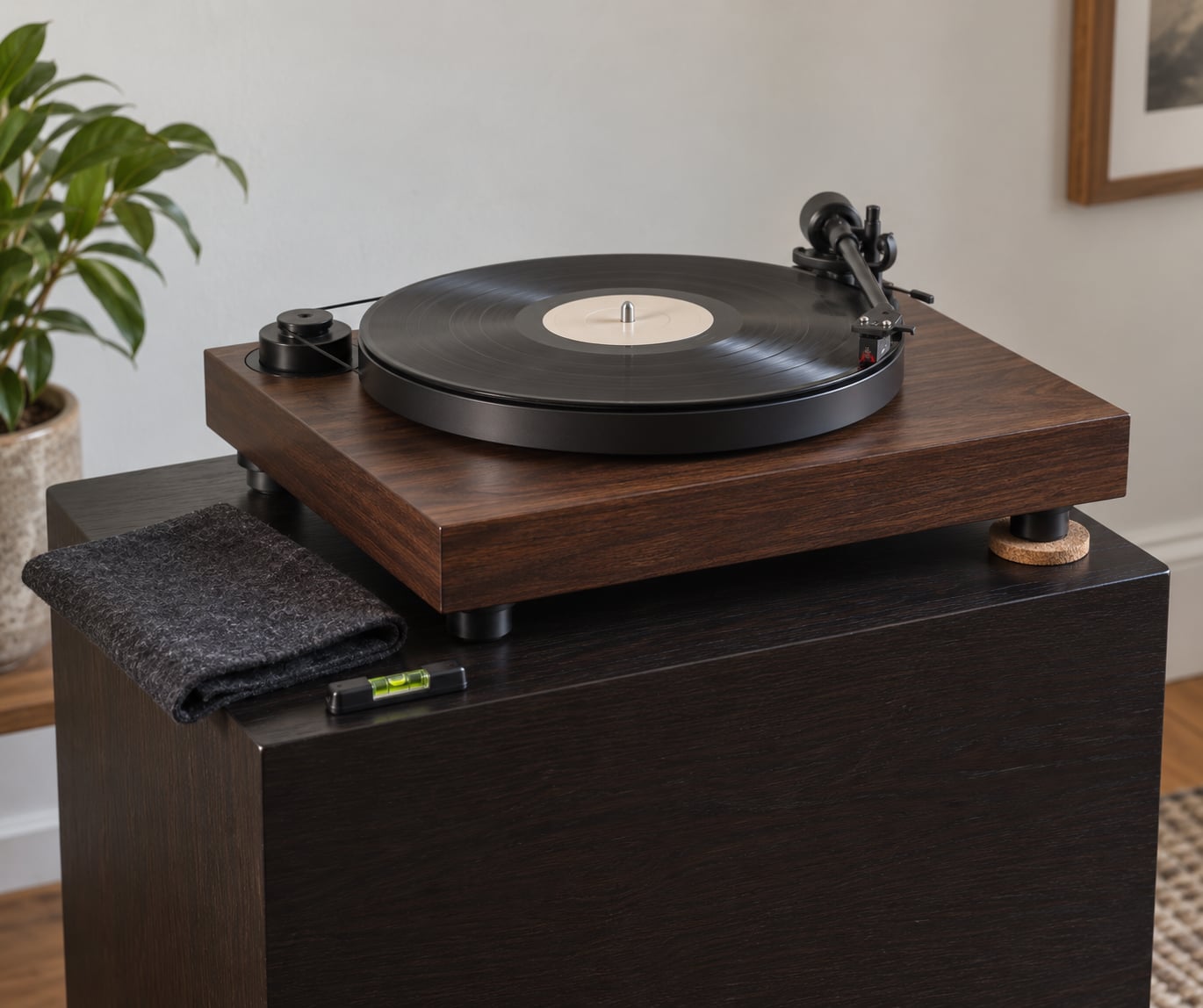
Choose a stand that can carry the deck without flexing, and check that the load sits on the frame rather than on a hollow centre panel. Then level the top with a spirit level.
Record collectors have found for years that simply adding mass under a weak shelf, such as a butcher block or a stone tile, removes a surprising amount of movement. It is the most repeated free fix in turntable forums.
Success check: the same walking test, same person, same pace. If the skips are gone, stop reading and enjoy the record.
3. Decouple the Turntable from the Surface
Now break the mechanical path between the deck and the stand. An isolation mat under the plinth, or feet at each corner, absorbs the energy before it reaches the table.
Size matters more than brand. Feet should be rated well above the total weight of the turntable, and a mat should be slightly larger than the plinth so the deck cannot rock off it.
Check that nothing blocks a vent, a control, or the underside of the platter. Leave the tonearm bearing and the arm rest clear so the arm still swings freely.
Success check: knock lightly on the stand top with a knuckle, then immediately touch the deck. You should feel far less than you hear.
4. Check the Platter, Mat, and Record Fit
Spin the platter by hand before the motor is on. Any wobble or grinding means a bearing, a rim seating problem, or a warped part, and no amount of isolation will fix it.
Confirm the mat sits flat and is not pinching the record label. A mat that is too small lets the edges of a large 12-inch record overhang and wobble slightly as it spins.
Check the spindle for burrs and confirm the record drops on without a fight. A record pushed fully down against the spindle can sit unevenly and skip at the first bass note.
Success check: the record should spin with the label clear of the light, and nothing should be visibly pumping or pulsing.
5. Balance and Align the Tonearm Correctly
Set the arm up the way the manual describes: correct alignment for the cartridge, then vertical tracking force, then anti-skate, then cueing height. Skipping gets blamed on vibration often when it is really a setup problem.
A tonearm set too light tracks poorly in the inner grooves and distorts. Set too heavy, it wears grooves faster and exaggerates any small amount of environmental movement.
If the arm needs constant readjustment to stay in the groove, the bearing may need cleaning, or the counterweight may be loose. Follow the manufacturer’s procedure rather than turning screws at random.
Success check: play a well-cut record and watch the stylus. It should sit still in the groove at any volume.
6. Fine-Tune Speed and Diagnose Remaining Motion
Check rotational speed with a strobe or a reliable turntable app. Speed that drifts produces a pitch wander, which plenty of listeners mistake for instability and blame on the deck.
Compare behaviour with the dust lid open and closed. A lid that resonates with the room can add a narrow peak without causing any skip, and some decks simply sound and behave better without one.
If a single record skips while others play clean, the record is warped. If the whole setup moves with footsteps after every fix above, the source is the building and the answer is a different surface, not a different deck.
Success check: a full side of a good pressing plays without a repeat and without the pitch drifting audibly.
Common Mistakes
Stacking the turntable on an unstable cabinet is the most common error. If the cabinet wobbles under a firm push, everything you do on top of it is a wasted effort, so fix the cabinet first.
Over-isolating a single component causes trouble too. Feet that are too soft for the deck’s weight let the plinth move as one heavy mass on a weak spring, and mixed foot types under the corners make the deck sit unlevel.
Using soft furniture that rocks under a light push creates the same problem in a different form. Felt pads on a hollow cabinet reduce nothing.
Tightening tonearm adjustments unnecessarily turns a tracking problem into a worn-arm problem. If the arm skips, the cause is more often setup, dirt, or a warped record than a weak suspension.
Finally, assuming every vibration comes from the motor sends people to service a deck that was never the issue. Most decks run smooth at their correct speed, and motor noise is usually the least likely explanation compared with structure-borne movement or acoustic feedback.
Frequently Asked Questions
Why does my turntable vibrate when someone walks across the room?
Footsteps send a pressure wave through the floor, up the table leg, into the plinth and on to the stylus. The tonearm is light enough that a small shove lifts the tip out of the groove. Adding mass under a weak shelf, moving the deck to a solid stand, or decoupling it with rated feet all shorten that path.
Is a turntable isolation mat better than isolation feet?
A mat spreads the load evenly and suits heavier, plinth-style decks, while feet give more adjustment and fit a table top that needs a thinner profile. Both work if they are rated above the deck weight. Pick feet when the clearance under the plinth is tight, and a mat when you want the whole base decoupled at once.
Does closing the turntable lid reduce vibration?
Usually not, and it can occasionally make things worse. A hinged lid acts as a light panel that can resonate with the room, adding a narrow peak without touching the record. Some listeners prefer the sound of a closed lid, others not, so compare the two on the same record and keep whichever plays and sounds better to you.
Can a turntable be placed on a wall-mounted shelf?
Yes, and it often helps, because a shelf removes the deck from the floor path entirely. Use a shelf rated for at least several times the deck weight, fix it into studs rather than plasterboard, and check it stays level after the weight is on it. Isolation still helps on a shelf, since the wall itself flexes when a heavy truck passes.
How do I tell whether vibration is coming from the motor or the room?
Turn the volume all the way down and start the platter. Any movement that remains is coming from the deck or the surface, not from your speakers. Then have someone walk past. If the reaction only appears with music playing, it is acoustic feedback or structure-borne movement from the room, and the motor is not the culprit.
When should I have a vibrating turntable professionally serviced?
Arrange service when the platter itself wobbles or grinds, when the arm will not hold a steady tracking force, or when a full side of several good records skips in the same place. Those point to a bearing, a counterweight, or a suspension fault that adjustment cannot correct. Placement and isolation cannot repair a mechanical fault.
Conclusion
Begin by putting the turntable on a heavy, level stand away from the wall, then run the walking test. If the movement is gone, you are finished and nothing else is worth buying. If structure-borne movement is still there, add decoupling at the contact point, check the platter and the arm, and leave the motor alone until a service visit is genuinely warranted.