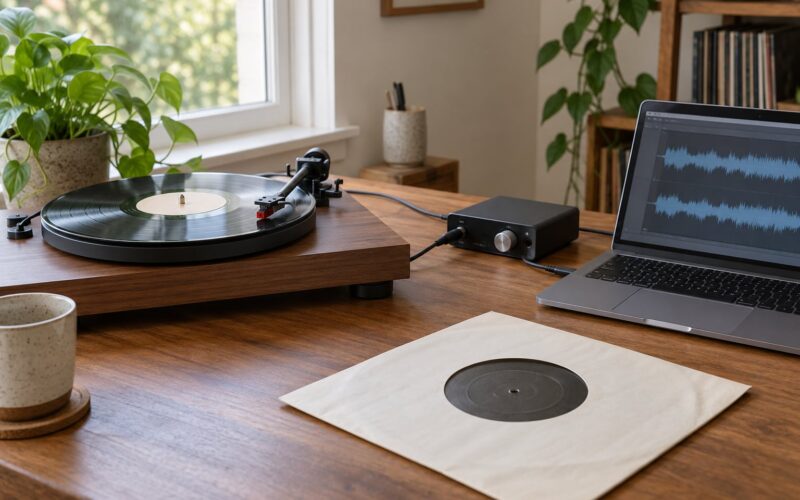
Short version: what a phono preamp does is correct two things a record gets wrong. A cartridge’s output is thousands of times weaker than any other source in your system, and the lacquer was cut with an altered frequency balance on purpose.
A phono preamp — usually called a phono stage — takes that tiny signal, lifts it to line level, and applies the RIAA equalization curve that puts the tonal balance back where it belongs. If your turntable or amplifier already has one built in, you do not need to buy anything, and we will get to how to check in a minute.
Table of Contents
- What Does a Phono Preamp Do?
- Why Vinyl Records Need a Phono Preamp
- What a Phono Preamp Does to the Signal
- What a phono preamp does to a moving coil signal
- What a Phono Preamp Does vs. a Line Preamp
- How to Tell If Your Turntable Has a Built-In Phono Preamp
- Choosing a Separate Phono Preamp
- Do You Need One for Every Record Player?
- Common Phono Preamp Problems to Check
- Frequently Asked Questions
- Can I use a phono preamp with a normal line input?
- Is a phono preamp the same as an amplifier?
- Do I need a phono preamp for a turntable with built-in USB?
- What gain setting should I use for moving-magnet and moving-coil cartridges?
- Why does my vinyl sound too bass-heavy through a line input?
- Is a more expensive phono preamp always better?
- What to Do First
What Does a Phono Preamp Do?
A phono preamp takes the millivolt signal from a turntable cartridge, amplifies it to line level, and applies RIAA equalization, the standard curve that reverses the bass and treble shaping used when the record was cut. It also provides the clean ground reference that keeps hum out of the signal. Without one, a turntable is either far too quiet to hear properly or, plugged into a line input, thin and badly bass-heavy.
In practice the work breaks into three jobs.
1. Gain to line level. A moving magnet cartridge puts out roughly 5 millivolts at 1 kHz. A moving coil cartridge might manage 0.1 to 0.7 millivolts. Line level — the level a CD player, tuner or streamer delivers — is about 1 volt RMS. The phono stage supplies the amplification in between, usually around 40 decibels for a moving magnet and 58 decibels or more for a moving coil.
2. RIAA equalization. Records are cut with reduced bass and lifted treble so more music fits into the groove. The phono stage applies the inverse of that curve on the way out. This is a frequency correction, not extra volume, and it is the single biggest reason a record played through a plain line input sounds wrong.
3. Grounding and noise control. A turntable needs a ground wire connected to a ground post on the phono stage. A low-noise input circuit keeps the noise floor low enough that quiet musical passages are still audible. Get this part wrong and you get a constant buzz that no amount of cleaning will fix.
Amplification and equalization are separate jobs. The gain stage makes the signal big enough to work with; the RIAA network changes how it sounds. A well-designed stage does the second job with passive capacitors and resistors so it adds almost nothing of its own.
Why Vinyl Records Need a Phono Preamp
Records were cut the way they were for engineering reasons, not aesthetic ones. A lacquer disc rotates at a constant speed, so the stylus moves fastest through the outer edge and slowest toward the label. A groove holds far more music when the bass sits lower in level and the treble sits higher.
Lift the treble and cut the bass, and more of the mix fits into the same groove before the cutting head runs out of headroom. That technique is called pre-emphasis on the record side. Playing the record back without correcting for it produces exactly what you would expect: bloated, boomy bass and a harsh, scratchy top end.
RIAA is the industry standard curve that describes this process, standardized in the 1950s by the Recording Industry Association of America and based on the NAC/NAB and FFRR/Decca curves in use at the time. Other labels used their own shapes early on, which is why a few manufacturers still offer selectable curves for those specific recordings. For anything pressed after the mid-1950s, RIAA is the only curve you need.
The signal size is the other half of the problem. A magnetic cartridge is a generator: a tiny magnet and coil, moving a fraction of a millimetre. That motion produces a voltage in the microvolt-to-millivolt range, and low frequencies produce even less of it — a low-output moving coil cartridge can manage around 100 microvolts, and only a tenth of that at 20 Hz.
Nothing else in your system is that small. A power amplifier expects a volt or so. So the chain needs a stage that can do two things at once: make the signal enormous compared to the noise floor, and reshape the frequencies before that signal ever reaches the speakers.
That combination is rare enough that it is worth naming clearly. A phono preamp is not a volume control, not a general-purpose preamplifier, and not a power amplifier. It is a specialist circuit with one job.
What a Phono Preamp Does to the Signal
Follow the path from groove to speaker and the logic is easier to see. Each stage has a distinct role, and the two that matter most — gain and frequency shaping — happen in separate places.
| Stage | What it does | Typical figure |
|---|---|---|
| Cartridge | Converts groove motion into voltage | 5 mV (MM) to 0.1 mV (MC) |
| Input and loading | Presents a defined impedance and capacitance to the cartridge | 47k ohms and 100 pF for MM |
| Gain stage | Multiplies the voltage without changing the tone | About 40 dB (MM), 58 dB and up (MC) |
| RIAA network | Applies the inverse of the cutting curve | Passive RC shelving filters |
| Output stage | Delivers the finished signal at line level | About 1 volt RMS |
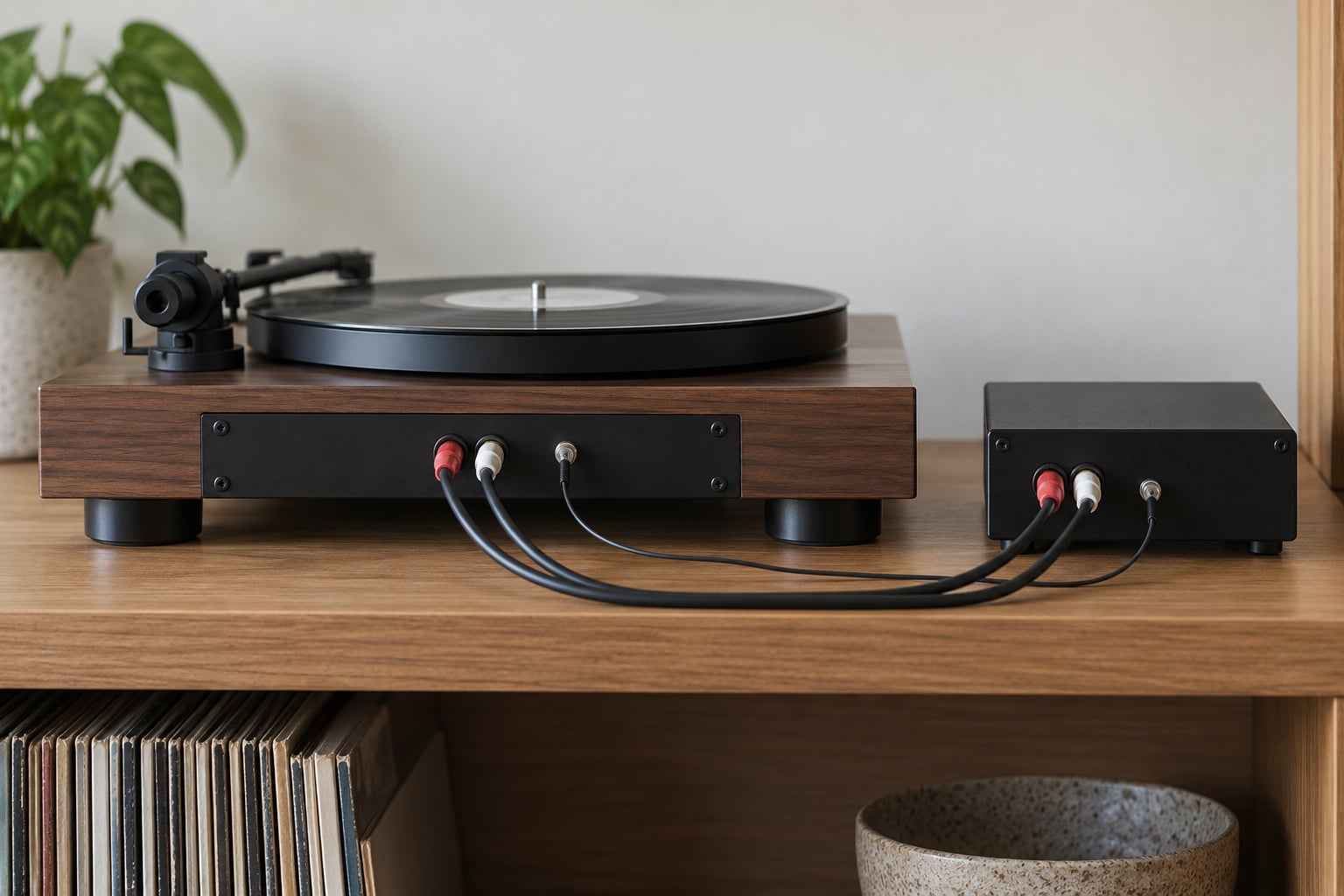
The cartridge signal travels on a pair of RCA cables with a separate ground wire on a spade lug or bare wire. That single ground connection matters more than most beginners expect, and we will come back to it in the hum section.
The input stage is where loading happens. Presenting the cartridge with a specific impedance — typically 47,000 ohms for a moving magnet — sets how the cartridge’s own electrical characteristics shape the sound. Too high and the treble rolls off. Too low and the frequency response peaks in a way that can make records sound harsh and shouty.
The gain stage adds volume and nothing else. It is the stage most likely to run out of headroom if you match a low-output moving coil cartridge to a moving-magnet setting, which is why the volume creeps up toward maximum and the sound starts to compress.
The RIAA network sits inside the feedback loop of the gain stage, so its filtering is effectively amplified along with the signal. It is passive — resistors and capacitors, usually with precise tight-tolerance parts — and it is where the tone of the whole system is decided.
What a phono preamp does to a moving coil signal
A moving coil cartridge generates more voltage than a moving magnet for the same groove speed, but its moving parts are lighter, so the output collapses much faster at low frequencies. That falling output means a phono stage has to supply a lot more gain, and gain is not free — every extra decibel adds noise and a chance of distortion.
Two extra challenges come with it. The moving coil cartridge’s low internal impedance means the preamp’s input has to present a low load, usually somewhere between 50 and 1000 ohms, selectable to match the cartridge’s recommended value. And that load interacts with the cable capacitance between cartridge and preamp, which is why moving coil stages often offer adjustable input capacitance as well.
For low-output moving coils — some of the finest cartridges ever made — enthusiasts often use a step-up transformer instead of electronic gain. It raises the voltage passively, adds almost no noise, and is then followed by a stage needing far less gain. A single switched-gain box that handles both moving magnet and moving coil is a compromise, and a dedicated stage or a step-up transformer paired with a modest stage usually wins.
What a Phono Preamp Does vs. a Line Preamp
A line preamp does the same job a phono stage does, except it skips the part that only vinyl needs. Both take a small signal and deliver a bigger one, and both exist because amplifiers want sources arriving at a consistent, healthy level.
A general line preamp takes an already line-level source — a CD player, a streamer, a game console, a TV — applies a volume control and maybe a tone or balance control, and passes it along. It does not need RIAA equalization, because no one cut that source with a pre-emphasis curve. It also does not need 40 or 60 decibels of gain, because the signal arriving at it is already the right size.
A phono stage is that, plus two things no line preamp does: enormous gain from a very small signal, and the RIAA curve. That is why you cannot route a turntable into an auxiliary input and turn the volume up to compensate. You would need to multiply the voltage a thousandfold, and an ordinary line input simply will not do it.
Neither of them is a power amplifier. The power amplifier is the part that takes the line-level signal and delivers the current needed to move a speaker cone. Some equipment combines all three roles in one chassis — an integrated amplifier with a built-in phono section, or a receiver with a PHONO input — and the signal path is identical to what a separate phono preamp plus separate preamp would do.
That is also why a turntable with a built-in stage is a complete solution on its own. Plug its line output into any amplifier, preamp or powered speakers, and the work is already done.
How to Tell If Your Turntable Has a Built-In Phono Preamp
Most people with a modern turntable and a normal amplifier already have a phono stage and never find out they own one. Here is the check, and it takes about two minutes.
Look at the back of the turntable for a switch, button or selector labelled PHONO and LINE, or PHONO and PHONO plus LINE. That is a built-in stage being switched in or out. Next, read the RCA output labels: PHONO OUT or PHONO LEVEL means the cartridge signal comes out raw and you need a phono stage elsewhere. LINE OUT or PHONO plus LINE OUT means the stage is already in the box.
Then check for a ground post. A small screw terminal, often marked GND, next to the RCA outputs is there to accept the turntable’s ground wire, and it only exists on a phono-level output. If you find one and the player also offers a LINE output, you can use either path.
Finally, look at your amplifier or receiver. A labelled PHONO input with its own ground post is a phono stage built into the amplifier, and it does the same job.
| What you find | What it means | Do you need one? |
|---|---|---|
| PHONO/LINE switch on the turntable | Built-in stage, switchable | No — use the built-in stage or bypass it |
| Turntable has both PHONO OUT and LINE OUT plus a ground post | Built-in stage with a raw output too | No — pick either path |
| Turntable has PHONO OUT only, no LINE OUT | No built-in stage | Yes, unless your amplifier has a PHONO input |
| Receiver or amplifier has a labelled PHONO input and ground post | Phono stage inside the amplifier | No |
| Amplifier only has AUX, CD and line inputs | No phono stage anywhere | Yes — you need an external phono preamp |
If you have a USB output on the turntable, that tells you nothing about whether a phono stage exists. A USB-equipped player almost always has one internally, since USB recording needs a line-level feed. Confirm with the manual rather than assuming.
The manual is the last check, and it is the fastest one. The specifications section will say whether the output is phono level or line level, and will tell you what the ground post is for.
Choosing a Separate Phono Preamp
Only buy one if your chain genuinely has no phono stage, or if you want to bypass a fixed, poor one. Once you are in that position, match the unit to the cartridge rather than the other way round.
Cartridge compatibility first. Does the stage support moving magnet only, or both moving magnet and moving coil? A moving-magnet-only stage is all a lot of people need, and it is usually quieter because it uses less gain.
Gain and gain switching. Moving magnet wants about 40 decibels, moving coil wants 58 decibels or more. Switchable-gain stages exist and are convenient, but a stage designed for one cartridge type does its own job better. On a switched box, more gain is not automatically better — running a moving magnet into the moving-coil setting usually just adds noise.
Loading. Look for the input impedance the stage presents and check it against your cartridge’s recommended value. 47,000 ohms and around 100 pF is the conventional pairing for moving magnets. Moving coils need a lower, often adjustable load between 50 and 1000 ohms.
Noise and distortion. Signal-to-noise ratio and total harmonic distortion are quoted for every phono stage, usually referenced to 1 V output. The differences between decent units are small; the difference between a cheap built-in circuit and a competent external one is not. If you cannot interpret the numbers, more digits here do not mean more music.
Inputs and outputs. RCA is universal. Some stages add balanced XLR outputs for a shorter path into an amplifier, and a headphone output with its own volume is genuinely useful if you listen to records without a full system. A USB output matters only if you plan to rip records to digital.
Bypass. If your turntable’s built-in stage can be switched out, you have the freedom to try an external stage later and compare. If the stage is hardwired, you are stuck with it, which is worth knowing before you buy the player rather than after.
And a note on what to ignore: cable marketing, weight, and how many features are on the front panel. The gain, the loading, the noise floor and whether the RIAA network is well made are what you are buying. Everything else is furniture.
Do You Need One for Every Record Player?
No. Players fall into two groups, and which group yours belongs to is decided by what is printed next to the RCA sockets.
Players with a built-in phono stage take the cartridge signal, boost and correct it, and hand out a line-level signal from the LINE or PHONO OUT sockets. Connect that to any amplifier, integrated amp, receiver or powered speakers. Done.
Players without one hand out the raw cartridge signal from a PHONO OUT socket, usually alongside a ground post. That signal needs a phono stage downstream, either in your amplifier or in a separate box.
The awkward group is the player that has both. Those give you a choice: use the built-in stage into a line input, or switch the built-in stage off and feed the raw output into a PHONO input on the amplifier. Owners who add an external stage almost always end up doing the second, which is why switchable players remain popular years after launch.
What you must never do is feed a phono-level output into a line input, or run a built-in stage into an amplifier that already applies RIAA. That is the double-preamp mistake. Two RIAA curves stacked together cut the treble twice and lift the bass twice, and you get a thin, scooped, lifeless record. It sounds worse, not better, and no amount of volume control fixes it.
Stacking a second stage to add gain is the same idea in reverse: more electronics in the path, more noise, no improvement. Forum regulars who have tried it report the honest outcome — a slightly higher noise floor and nothing else.
Common Phono Preamp Problems to Check
Almost every phono problem has one of a handful of causes, and you can diagnose most of them without opening anything.
The record is too quiet. The most common cause is a line input being used for a phono output. Second most common is insufficient gain for the cartridge. Third is a ground wire that is not connected at all, which on some setups simply kills the signal. Check the input label first; it takes ten seconds and fixes most of these.
Way too much bass, or a boomy sound. That is what a line input does to a phono-level signal: the RIAA boost is still in the signal and the bass runs away. It can also mean two RIAA curves are being applied. Moving the cable from AUX to PHONO is the fix.
Thin, tinny or scratchy. The mirror image of the last problem, usually a phono input receiving an already-corrected line signal, so the treble is lifted twice. It can also come from over-emphasis or from a worn stylus, which is a record problem rather than an electronics one.
Constant hum or buzz. Hum at a steady pitch almost always means a ground problem. In practice it is the loose ground wire between the turntable and preamp more often than anything else, and a great many people have diagnosed their own buzz that way. Then the ground loop, then interference.
A ground loop happens when the turntable and the amplifier each have their own path to earth, and the signal rides between the two. Fixes, roughly in order of how often they work:
1. Seat the ground wire firmly on the ground post. Bare wire, spade lug or banana plug, depending on what the post takes, tightened properly.
2. Run the ground cable as a separate conductor if you can, and keep it away from the power cable. Interference pickup rises sharply when the two run parallel.
3. Move the preamp or turntable away from a power transformer or a motor. A motor or an amplifier with a large toroidal transformer in the same rack is a common culprit.
4. Try a different wall outlet for the turntable, and make sure the system is not split across two circuits.
5. Only after the rest fails, try a ground loop isolator in the signal path. It works, but it is treating a symptom, so fix the connections first.
Poor stereo separation or a narrow soundstage. This one usually is not the preamp. Check that both channels are connected, that nothing is half-unplugged at the RCA sockets, and that the cartridge is properly aligned. A bent or misaligned stylus costs you imaging before it costs you anything else.
Frequently Asked Questions
Can I use a phono preamp with a normal line input?
You can connect a phono preamp to a line input, but you would have to turn the output down very low, because the preamp already delivers line level and the line input expects it. The usual direction is the reverse: a line-level source into a phono input, which gives you thin, tinny sound. Use the phono input where one exists, and reserve line inputs for CD players, streamers and other line sources.
Is a phono preamp the same as an amplifier?
No, it does a different job. A phono preamp takes the very small signal from a cartridge, amplifies it, and applies RIAA equalization. A preamplifier controls volume and switches sources. A power amplifier takes the finished line-level signal and supplies the current that moves the speakers. An integrated amplifier can contain both a phono stage and a power amplifier, which is why one box can handle the whole chain.
Do I need a phono preamp for a turntable with built-in USB?
Almost certainly not. A player with a USB output has to produce a line-level feed for the recording process, which means it contains a phono stage internally. You can confirm by looking for a PHONO and LINE switch on the back or a LINE OUT socket. If you only ever want to listen, use the LINE OUT into your amplifier and leave the USB port alone.
What gain setting should I use for moving-magnet and moving-coil cartridges?
Moving magnets produce roughly 5 mV, so about 40 dB of gain is the usual match. Moving coils produce 0.1 to 0.7 mV and need 58 dB or more, often with a selectable load between 50 and 1000 ohms. Very low-output moving coils sometimes work best with a step-up transformer in front of a moderate stage. Match the stage to the cartridge rather than switching gain to the highest available setting.
Why does my vinyl sound too bass-heavy through a line input?
Because a line input does not undo the way the record was cut. Records are mastered with reduced bass and lifted treble, and only the RIAA curve in a phono stage reverses that. Send a phono-level output into a line input and the bass boom while the treble sounds scratchy. Move the cable to a PHONO input, or add a phono preamp if the amplifier has no such input.
Is a more expensive phono preamp always better?
Not always, and the differences are usually smaller than the price suggests. If your turntable has a switchable built-in stage and you are using it, a modest external unit may sound the same to you. The gains show up with low-output moving coil cartridges, long cables, or a genuinely poor built-in circuit. Judge a stage on gain range, loading options and noise floor rather than price or the number of features.
What to Do First
Check whether something in your chain already has a phono stage, before anything else. Look for a PHONO and LINE switch or a LINE OUT on the turntable, a PHONO input and ground post on the amplifier, and read the specifications in the manual. In most setups that check ends the investigation, and no purchase is needed.
If nothing has one, match the unit to the cartridge rather than to a price list. Identify whether the cartridge is a moving magnet or a moving coil, then choose gain and loading to suit it, and buy the cheapest stage that meets those requirements. Use the ground post properly on day one, because that connection is behind most of the hum problems beginners run into.
And if you hear hum, check that ground wire before you start shopping for anything else.