The fastest way to organize records by genre or artist is to pick one primary rule, apply it everywhere, and stop adding tiers. Most collectors end up somewhere in the middle: genre crate first, then alphabetical by artist inside it, then album year within the artist. That hybrid handles both browse-by-vibe and find-one-record-fast, and it holds up past a few hundred LPs.
This guide walks through that system step by step, plus the four alternatives worth knowing, the hardware that makes each one work, and the filing conventions that stop arguments about where The Jam belongs.
Table of Contents
- What You Need
- Step-by-Step: How to Organize Records by Genre or Artist
- 1. Audit the Collection and Decide What You Are Sorting
- 2. Decide How You’ll Organize Records by Genre or Artist
- 3. Build a Consistent Labeling Scheme
- 4. Create and Complete a Catalog
- 5. Sort and Group the Records
- 6. Store Records by Format and Access Pattern
- 7. Add Cross-References and Listening Filters
- 8. Maintain the System
- Common Mistakes
- Quick Tips for a Collection That Stays Usable
- Frequently Asked Questions
- Should I organize my records by artist or genre?
- What is the easiest way to catalog a record collection?
- Should vinyl records be stored alphabetically by artist?
- How do I organize records when I own several formats?
- How do I reorganize a messy record collection without it taking weeks?
- Conclusion
What You Need
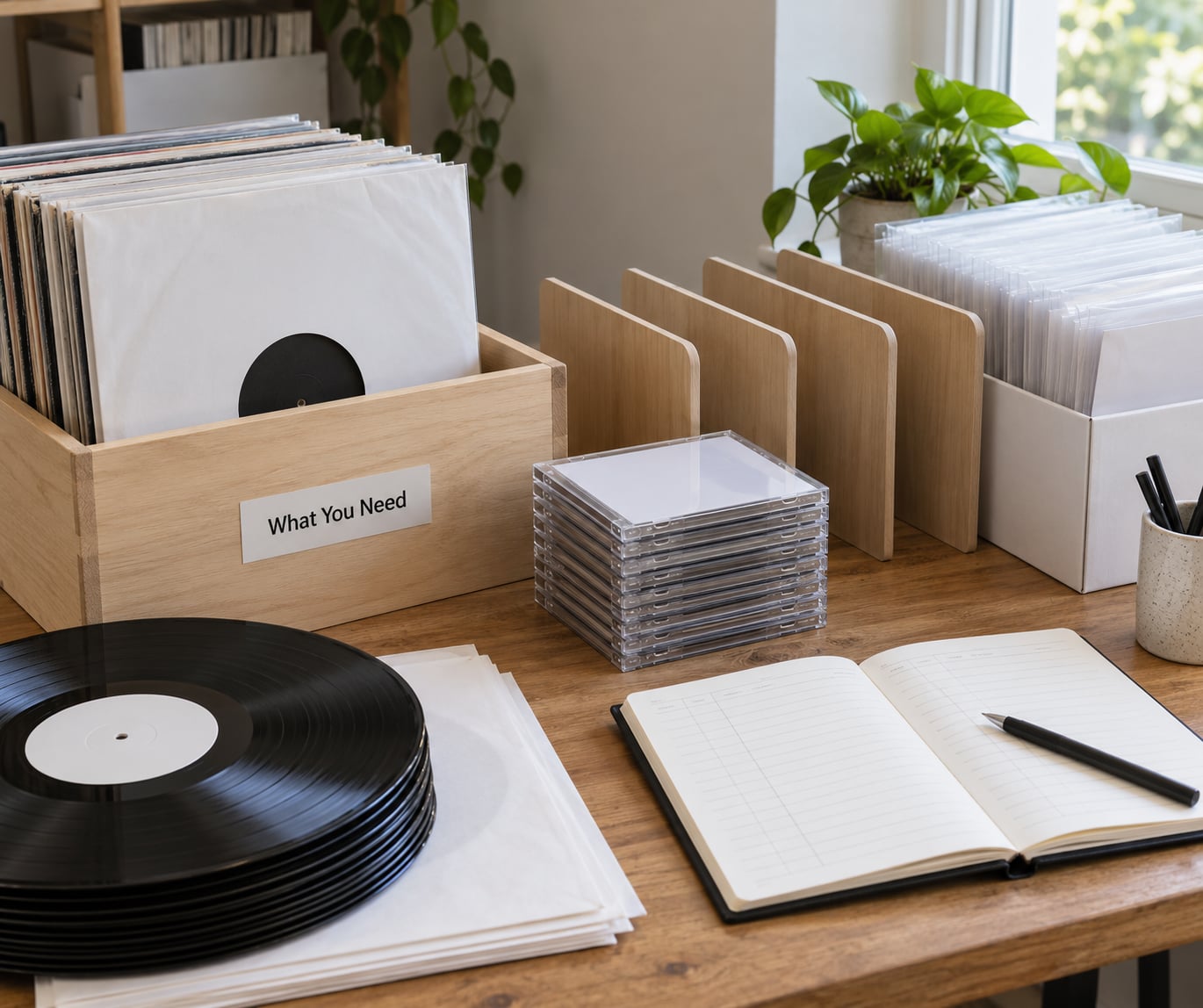
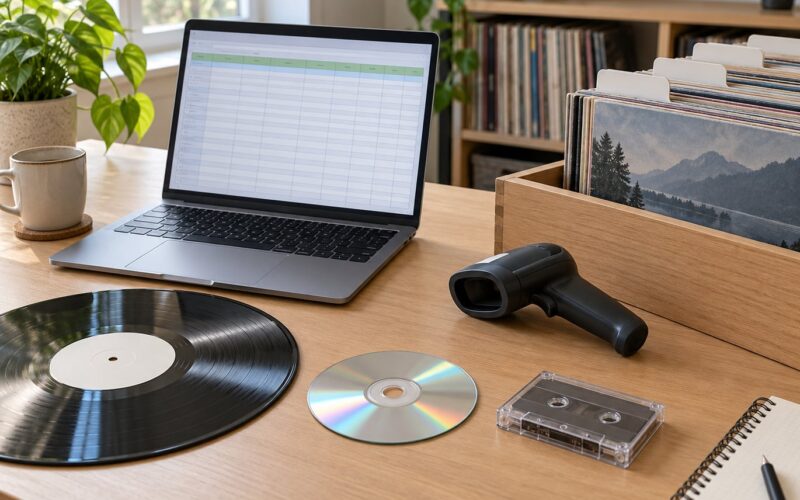
You need very little, and almost none of it costs money. The essentials are dividers, labels, a catalog, and shelving that holds records upright without crushing the sleeves.
- Dividers for each category, sized for 12-inch sleeves. Acrylic dividers bend under the weight of a full crate, so card or thin plastic is sturdier. Cheap DIY versions cut from cardboard LPs and stiff envelopes work fine.
- Labels that fit the divider tab. A label narrower than the tab will slide out once someone pulls records.
- A catalog — a spreadsheet, a notebook, or a collection log. Discogs is the closest thing to a standard here.
- Crates or shelves that hold LPs vertically. Anything that keeps them upright, supported, dry and off the floor will do.
- Archival sleeves and outer poly for anything rare, plus dividers for formats that need their own section.
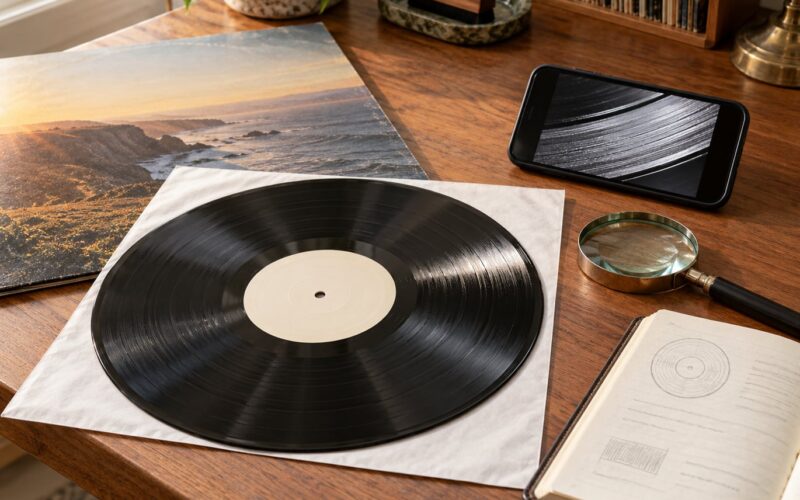
- A scanner or phone camera, optional, for cataloging covers and matrix numbers.
One honest warning about hardware. Cheap flat stacks fail fastest, because the bottom records bow and the sleeves crease. If your storage is the problem, fix storage before you fix filing.
Step-by-Step: How to Organize Records by Genre or Artist
1. Audit the Collection and Decide What You Are Sorting
Count what you have before you touch anything. Pull the collection out in one sitting, group it into three piles — yours, borrowed, and unidentifiable — and count each format separately: 12-inch LPs, 7-inch singles, CDs, cassettes, digital files.
While the piles are out, note missing sleeves and inserts. An album with no inner sleeve is a damaged album, and you want to know that now rather than after it spends a year on a shelf. Set a time box: two or three evenings, one shelf or one crate at a time. A sort that never finishes is worse than the mess it replaced.
2. Decide How You’ll Organize Records by Genre or Artist
Write your rule down before you file anything, and write it in one sentence. Something like: “Heavy metal alphabetically by artist, everything else by album title.” Ambiguity is what causes re-sorting in six months.
Here is how the main systems compare.
| System | Best for | Watch out for | Scales well to |
|---|---|---|---|
| Alphabetical by artist | Following discographies, finding one specific album fast | Browsing for a mood; multi-genre artists get scattered | Several hundred LPs |
| By genre | Pulling something to play by feel; DJ crate prep | Big genres like rock swallow a whole shelf | Under 150 LPs, or with alphabet chunks inside |
| Genre, then artist, then year (hybrid) | Most collections that grow over time | Slower first pass than a pure single-rule sort | 1000+ LPs |
| Chronological by release date | Listening sessions that follow a band’s or a decade’s arc | Takes the album out of sight of its siblings | Under 200 LPs |
| By record label | Collectors chasing a specific pressing or era | Scattered across eras; rarely what guests want | Small focused collections |
The decision rule is short. Under 150 records, genre alone is fine. Past that, genre needs alphabet subdivisions inside each crate, and at that point you are halfway to the hybrid anyway. Once you are past a few hundred records, alphabetical by artist is the safer primary rule, because it never collapses into one unusable category.
That is the consensus collectors keep landing on. On r/vinyl, Discogs threads and store blogs, the hybrid answer comes up independently again and again: sort roughly by genre, then be specific within each division. One Discogs discussion describes doing exactly that — house, techno, funk, with detail only where each division needs it.
3. Build a Consistent Labeling Scheme
Decide what goes on a divider before you make any dividers. A category label plus an optional sub-label is usually enough: “THRASH” and beneath it “Bay Area”, or “M —” as an alphabet tab.
For individual records, put detail in the catalog rather than on the sleeve. A tidy spine or a small slip inside the sleeve can carry the artist and album, and that is the limit for most collections.
Settle the naming edge cases now, because they are the ones that generate arguments later:
- Leading “The”: file under the next letter, so The Jam sits in J. Pick one rule and apply it to every artist on every divider, including in the catalog.
- Names starting with A: alphabetize on the following word, so A Tribe Called Quest files under T.
- Multi-genre artists: pick a home shelf and note the other placements in the catalog rather than duplicating the record.
- Accents: alphabetize as if the accents were removed, so soad is filed with S.
- Compilations, soundtracks and various-artists releases: give them one clearly labeled section, or file them under the headliner with a catalog note. Pick one and write it into the rule sentence.
4. Create and Complete a Catalog
The catalog is what makes the physical sort worth doing. Columns: artist, album title, release year, format, catalog number, label, genre, and notes. For a metal shelf, the catalog number matters more than it does elsewhere, because two pressings of the same record are different objects with different playing surfaces.
A row might read: artist, album title, year, format, catalog number, label, subgenre, condition note. Keep it in a spreadsheet or log it in Discogs, which also gives you a place to note what you are still hunting for. That want-list is the part collectors say saves money, because it stops impulse buys of something you already own.
5. Sort and Group the Records
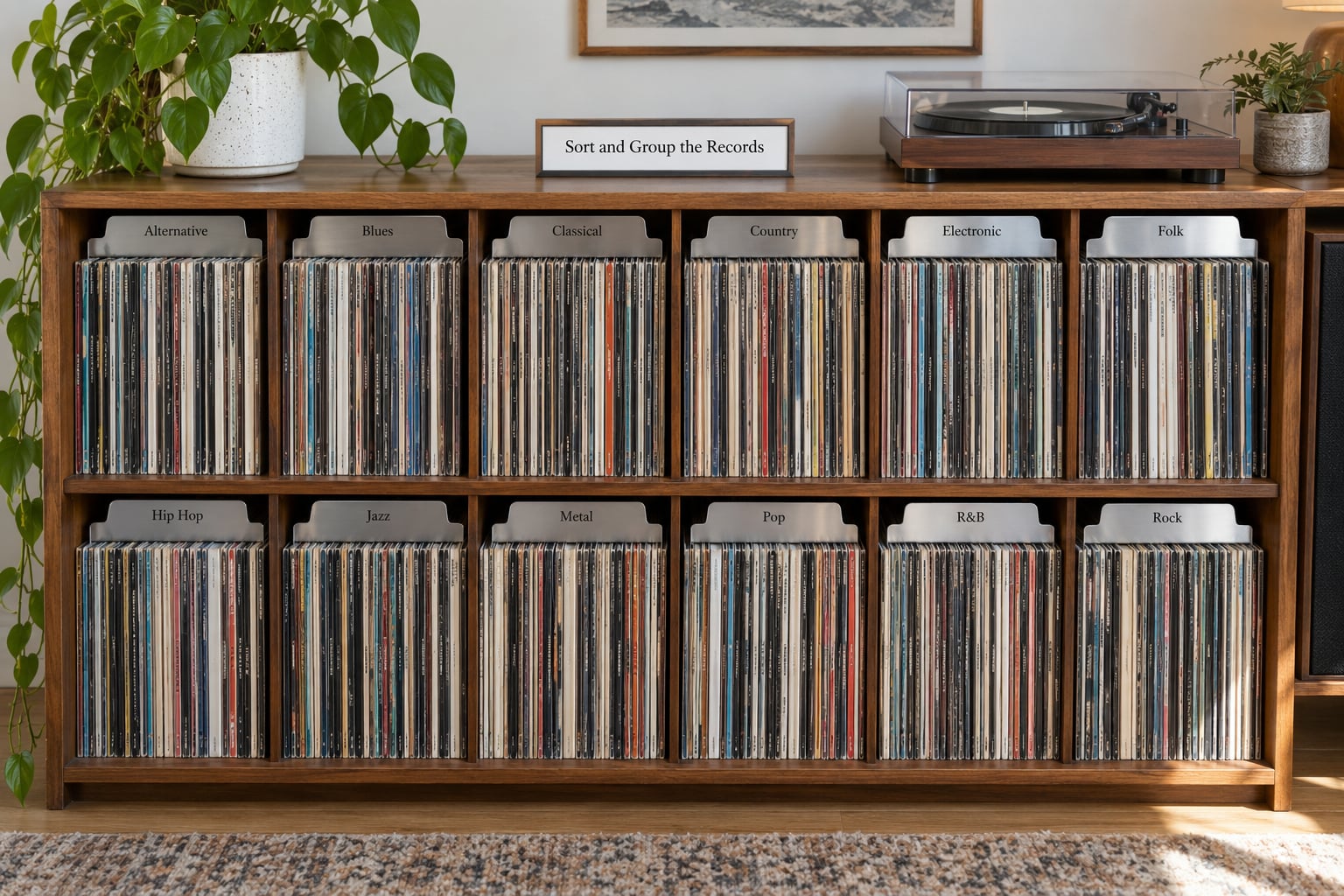
File in passes, not one heroic weekend. Do one crate, fill its catalog rows, move on. Twenty focused minutes beats a Saturday that ends with a pile still on the floor.
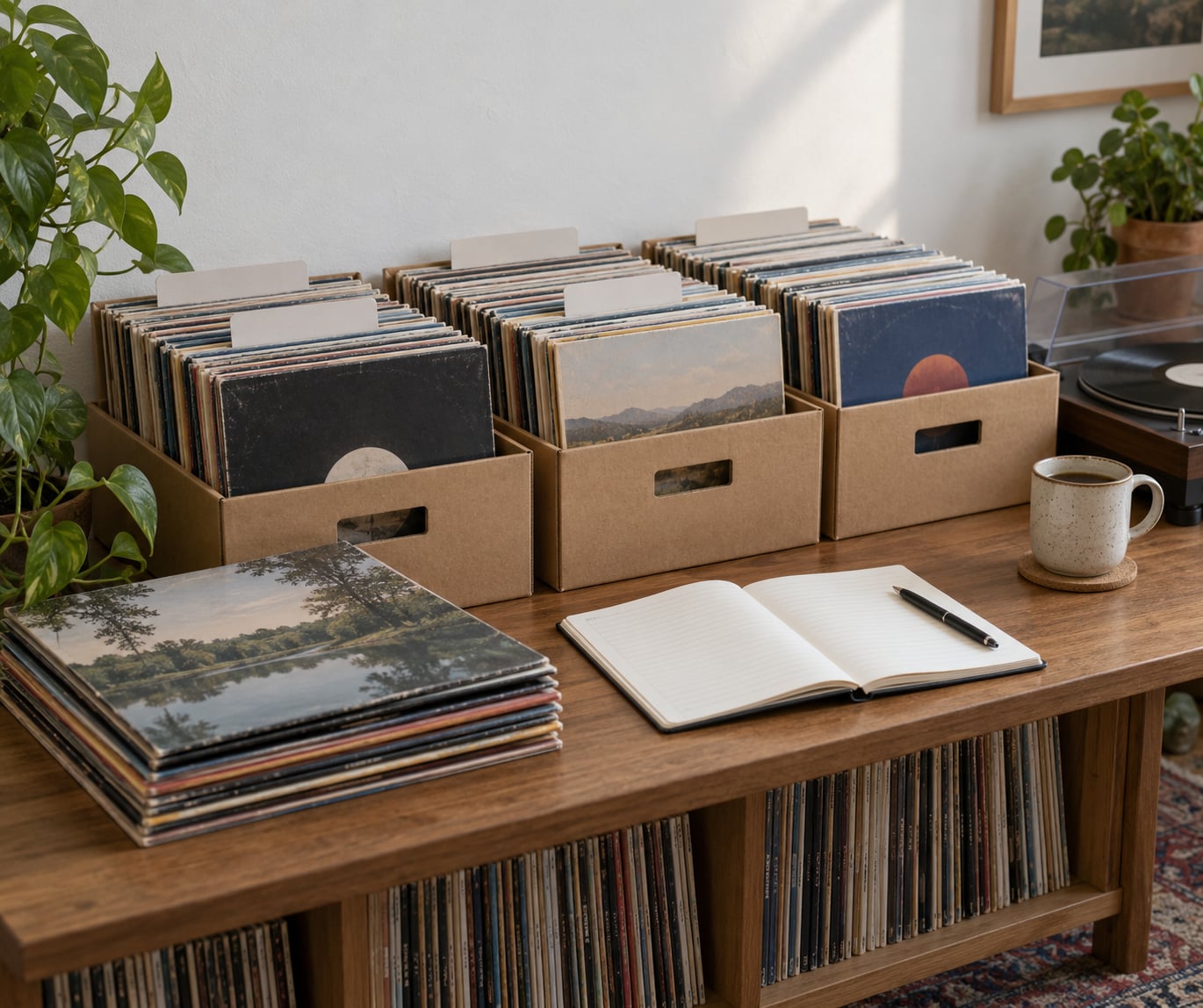
Inside a genre crate, break large categories into alphabet ranges so they stay browsable: A–C, D–G, H–L. Divider tabs carry the range, not just the letter. Then run each artist alphabetically, and put that artist’s albums in release order underneath so a live record from 1994 sits with the studio records rather than at the end of the shelf.
Artists with a deep catalog deserve a single run instead of being split across crates. If someone owns eight or nine LPs by one band, they become a block within the genre, not four separate entries.
For a metal collection, subgenre dividers work well as the genre tier: thrash, death, black, doom, grind, crust, then hard rock and heavy metal as catch-alls. Pick roughly six to ten top-level categories. The moment you find yourself making dividers nobody can name from across the room, you have gone one tier too deep.
6. Store Records by Format and Access Pattern
Format changes the storage problem. LPs stand upright in crates or on shelves, supported along their length and spaced so you can read the spine without pulling five records out. CDs go in a separate section, jewel cases and all, since they stack differently and take up half the space. Boxed sets live flat if they are too wide for a shelf, ideally with the box stored so the record inside stays vertical.
Access pattern decides position more than tidiness does. Anything you played in the last month belongs at eye level and closest to the turntable. Reference albums you want to find once a year can sit on a high shelf. Rare records get one labeled section that you do not reorganize casually.
Keep everything dry and away from direct sun. What destroys records is heat, damp, pressure from stacked piles, and a record leaning unsupported until the sleeve gives up — all avoidable, and all more common than a bad cleaning routine.
7. Add Cross-References and Listening Filters
The physical arrangement and the catalog do not have to match exactly, but the catalog should be able to. Add fields for genre, format, era, and ownership, and you can pull useful views out of it later: every thrash LP you own, every live album, every record you have on loan to someone who never gave it back.
Those same fields feed listening filters in whatever app or player you use, so a genre shelf and a genre playlist can be built from one list. That is the real payoff of cataloging: sorting stops being a chore you repeat and becomes a thing you query.
8. Maintain the System
Give new arrivals an intake routine. When something comes home, it gets a catalog row and a shelf position the same evening, or it goes in a single “to file” crate you empty weekly. Records in that crate are how a system quietly stops working.
Re-check the catalog every few months and take duplicates to a charity shop or a record shop. When you move, or change shelving, treat it as a fresh sort with an existing catalog: you already know where every record belongs.
Common Mistakes
- A category tree with too many tiers. Four levels of divider means nothing fits anywhere. Flatten to six to ten top-level categories and let the catalog carry the detail.
- Two spellings for one artist. Metallica and Metalica in different crates guarantees a lost record. Pick the spelling printed on the release and use it everywhere.
- Recording every possible fact. You will abandon a catalog that takes two minutes per record. Artist, title, year, format, catalog number is enough; add the rest only when it changes a decision.
- Ignoring format differences. LPs, CDs and cassettes have different catalog numbers and different jobs. Give each its own section and its own format field.
- Flat storage or stacked piles. Records stored flat or leaned at an angle warp and crease. Upright, supported, no more weight than the sleeve can carry.
- Rebuilding the whole collection repeatedly. Re-filing is satisfying and produces zero new records. Set a rule that a system runs for a year before you touch it again.
Quick Tips for a Collection That Stays Usable
- Test any new system on one shelf for a month before it touches the rest of the collection.
- Keep purchase research and listening organization separate; one wants wishlists, the other wants browsable shelves.
- Use one authoritative artist spelling across dividers, catalog and digital files.
- Leave a little empty space on each shelf. A jammed shelf cannot be re-sorted.
- Photograph each finished shelf. It is proof the system works, and it makes moving house faster next time.
- Show a guest or roommate where a record goes once, then leave the divider labels as the instruction.
Frequently Asked Questions
Should I organize my records by artist or genre?
Organize by artist if you usually browse for a particular band, follow discographies, or want an intuitive shelf order. Organize by genre if you mostly explore thrash, traditional metal, death metal, or whatever else you play by feel. Past a few hundred records, alphabetical by artist usually holds up better, because a genre category such as rock or metal grows too large to browse.
What is the easiest way to catalog a record collection?
The easiest method is a spreadsheet, note-taking database, or collection app with one row per album. Record the artist, album title, year, format, catalog number, genre, and notes, and add a photo of the cover only for records you care about. Discogs works well if you want the same data that sellers use, including pressing details.
Should vinyl records be stored alphabetically by artist?
Alphabetical artist order is usually the most practical physical arrangement, with album titles in release order beneath each artist. Genre can sit above it as a shelf or divider tier, which gives you browsing by mood without abandoning fast lookup. If a genre grows too large, split it into alphabet ranges such as A to C and D to G.
How do I organize records when I own several formats?
Keep each format distinct, because LPs, CDs, cassettes, and digital files have different catalog numbers and different uses. Store them in separate sections, add a format field to every catalog entry, and give box sets their own shelf rule since they often need to sit flat. A single catalog with a format column keeps the whole collection in one searchable list.
How do I reorganize a messy record collection without it taking weeks?
Work in phases and never more than one shelf or crate per session, with a firm time box. Count and triage the collection first, decide the rule in one written sentence, then file one crate completely, including its catalog rows, before moving on. Keep new arrivals in a single to-file crate and empty it weekly so the sort never rebuilds itself.
Conclusion
Start by counting the collection and writing your rule in one sentence, then sort one shelf to test it. Most people land on the hybrid: genre crate first, artist A-Z inside it, album year under each artist. Standardize a handful of divider labels, keep a catalog with artist, title, year, format and catalog number, and the system will still work when the collection doubles.