Short answer: vinyl color does not, by itself, change what you hear. A blue record carries the same master, the same lacquer cut and the same groove geometry as a black one. What moves your noise floor is the pressing plant, the structural additives in the compound, the weight of the disc and how carefully it was cooled and inspected.
There is a real physical story underneath the folklore, though. Black is not a neutral choice: carbon black does a job in the PVC. When that pigment is swapped for dye, titanium dioxide, glow powder or glitter, the compound’s behaviour changes slightly, and in some cases that changes come through the stylus.
The honest answer to what colored vinyl does to sound quality is that color is a proxy, not a cause. Read the rest of this and you will be able to tell which pressing traits actually predict how a record sounds, and which ones only tell you what it looks like on a shelf.
Table of Contents
- What Colored Vinyl Does to Sound Quality: the Direct Answer
- How Colored Vinyl Is Made
- Can Pigments and Materials Change the Sound?
- What Colored Vinyl Does to Sound Quality During Playback
- Where audible differences can actually originate
- Does Heavier or Thicker Vinyl Sound Better?
- Why Metal and Hard Rock Masters Complicate the Question
- Colored Vinyl vs. Black Vinyl: What Usually Matters
- How to Judge a Pressing Before You Buy
- Frequently Asked Questions
- Does colored vinyl sound better than black vinyl?
- Is clear vinyl louder or quieter than black vinyl?
- Does 180-gram or 200-gram colored vinyl sound better?
- Can you hear the color of a vinyl record?
- How can I tell if a colored vinyl pressing is high quality?
- Conclusion
What Colored Vinyl Does to Sound Quality: the Direct Answer
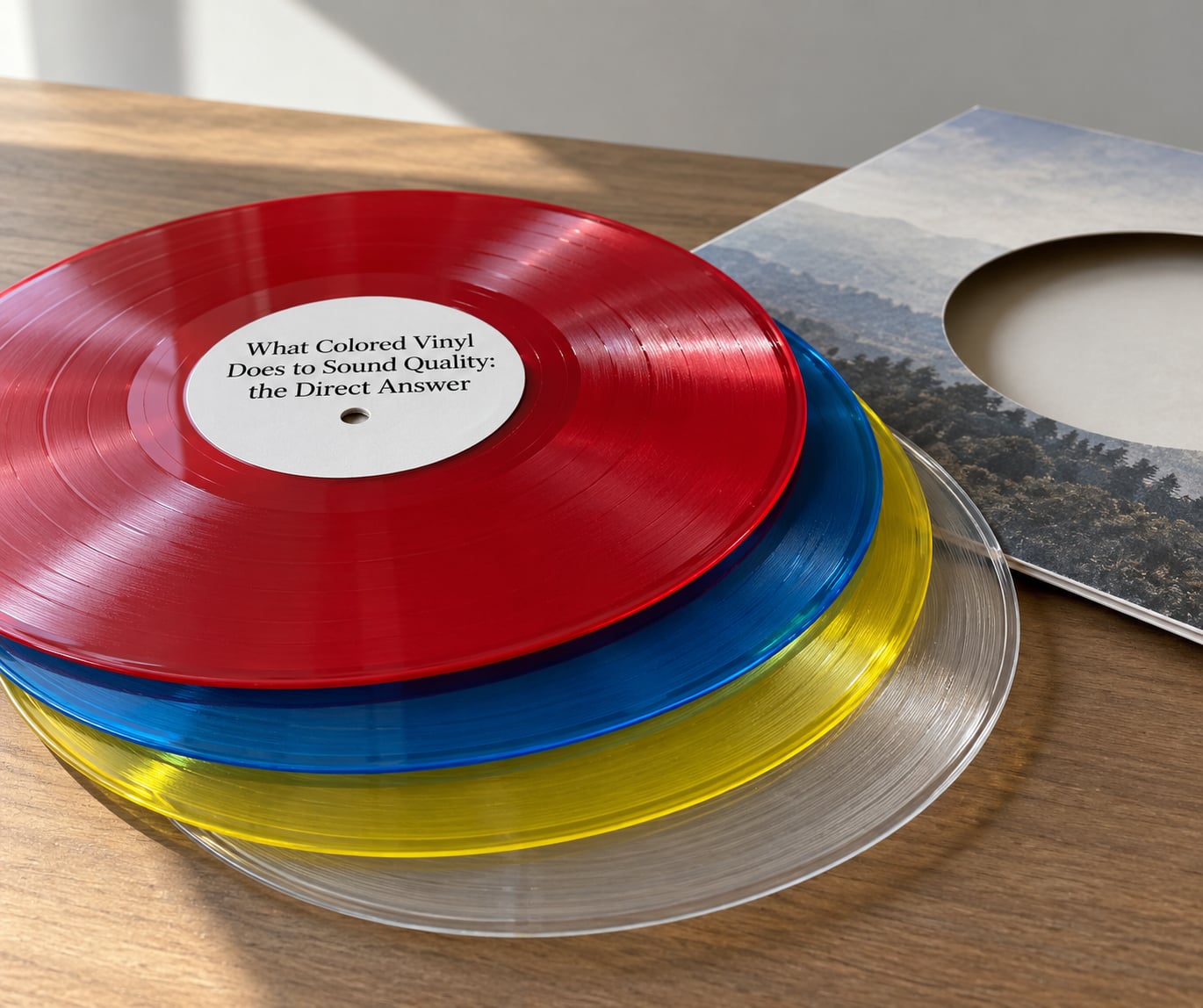
Color itself has no sonic advantage. What colored vinyl does to sound quality is indirect: some colorants dilute the stabilizing role of carbon black, some compounds cool unevenly, and multi-color and glitter blends are harder to press consistently.
The audible result, when there is one, is usually more surface noise — the faint crackle and hiss between notes and in the quiet parts of a track. It is rarely a change in the music itself. Bass response, dynamics and the shape of the sound come from the master, the cut and your system.
Two collectors comparing the same album on different copies will often disagree completely about which pressing is quieter. That disagreement is normal, and it tells you something useful: you cannot predict noise from color alone. You have to look at the matrix, the weight, the mastering credit and the condition of the specific copy in front of you.
How Colored Vinyl Is Made
A record is roughly 80 percent polyvinyl chloride by weight. The rest is a stabilizer, a plasticizer, lubricants and pigment. Black vinyl uses carbon black, which is cheap, stable and easy to disperse through the compound.
Colored vinyl replaces part of that carbon black with a colorant chosen for the effect you want:
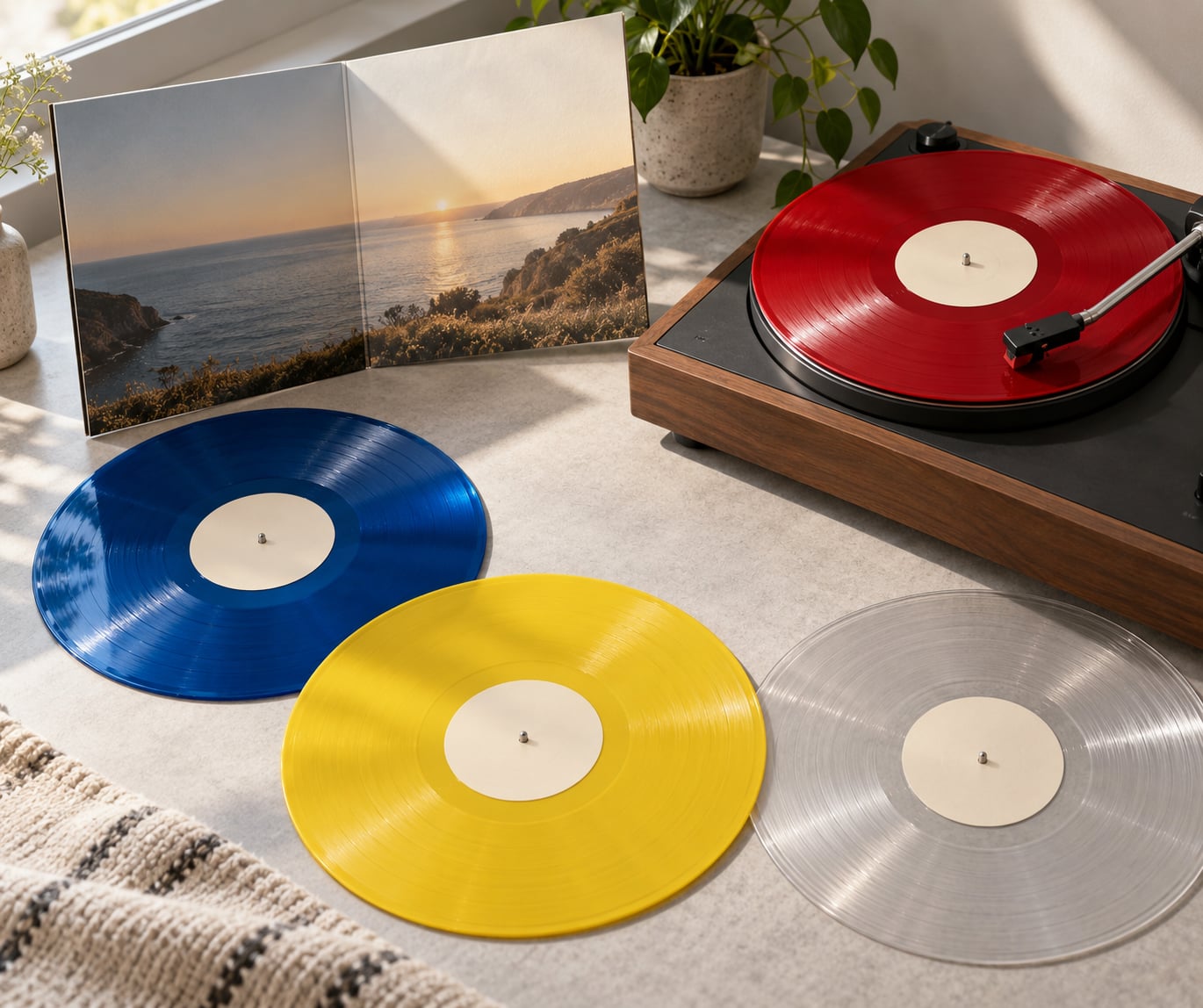
- Clear and translucent vinyl uses little or no pigment at all, so light passes through the disc. Smoke and colored-smoke variants add a light dye.
- Opaque solid colors mix dye or pigment through the whole batch, which is the most straightforward colored pressing to manufacture.
- Marbled and swirled vinyl blends two or more batches before or during moulding, so the swirl pattern varies from disc to disc.
- Splatter vinyl drops flecks of pigment into an already-tinted disc during forming, which puts solid chunks of material through the press.
- Glitter, glow-in-the-dark and half-and-half pressings add suspended solids or bond two discs along the label area, and both are more demanding to produce.
- Picture discs print an image on the label and often use a thinner, softer base than a standard record.
Multi-layer and multi-color combinations change the manufacturing process in a way solid colors do not. Each additional batch has to be blended, weighed and cooled on its own schedule before it reaches the press, and the disc spends longer in the mould.
Can Pigments and Materials Change the Sound?
Some of this is measurable, some of it is not, and the honest answer is that the physical chain is short. Once a lacquer disc is cut and a stamper is made from it, the groove walls are fixed geometry. Nothing a pigment does to the compound happens on the surface your stylus touches, because the pigment sits throughout and beneath the playing surface.
So the way color reaches your ear is indirect. Colorants can change how the melt flows and how evenly it cools, which changes how faithfully the groove walls freeze. A compound that cools unevenly or holds onto stress warps, and a warped record cannot be tracked cleanly. Additional solids can also stiffen the disc, which raises the tracking force your cartridge needs and adds wear.
The ranking below reflects tendencies reported across pressing plants and collector forums, not a guarantee about any individual copy. Treat it as a prior, not a verdict.
| Color or type | Relative surface noise | Why |
|---|---|---|
| Black (unrecycled) | Lowest, 1 of 10 | Standard compound, longest-established production routine |
| Clear and translucent smoke | Close to black, 2 of 10 | Minimal pigment load, though less stabilised |
| Solid opaque colors | Low to moderate, 3 to 4 of 10 | Uniform dye load, straightforward pressing |
| Marbled and two-tone | Moderate, 5 of 10 | Multiple batches and a seam where layers meet |
| Splatter | Moderate to higher, 6 of 10 | Solid pigment flecks, less uniform fill |
| White | Higher, 7 of 10 | Titanium dioxide load can stiffen and embrittle the compound |
| Glitter and glow-in-the-dark | High, 8 of 10 | Suspended solids sit in the melt and stress the groove walls |
| Picture disc | Highest, 9 of 10 | Thinner base, often a different material and shallower wear tolerance |
For comparison, a budget black pressing with poor QC and a warped edge can sit at 8 out of 10. That is why anyone who tells you color is the whole story has not compared a good colored copy against a bad black one.
What Colored Vinyl Does to Sound Quality During Playback
Play a record and you are moving through a chain, not a single object. Each link can add noise or lose detail, and only one of them is the disc itself.
Where audible differences can actually originate
- Source master. If one copy was cut from a different master, no amount of color reasoning matters. Comparing a colored reissue to a first pressing compares two masters.
- Lacquer and stamper. The cut is done on lacquer, then electroformed into a metal stamper. A poor cut means thin, distorted or uneven grooves at the source.
- Press quality. Fill temperature, pressure, cycle time and cooling decide whether those grooves were reproduced faithfully.
- Groove geometry. Deeper or better-shaped sidewalls track more cleanly and resist mistracking on warpy material.
- Record surface. Dust, fingerprints and a hungry cleaning brush all raise noise more than most color choices do.
- Stylus and cartridge. A worn or under-tracked stylus audibly narrows the groove it reads, which flattens detail and boosts crackle.
- Phono stage. A stage with too little gain or the wrong loading adds hiss of its own.
- Speakers and room. Room reflections and speaker placement can outweigh every difference discussed in this article.
Notice how many of those links have nothing to do with pigment. The colored disc influences exactly one of them, and only indirectly.
Does Heavier or Thicker Vinyl Sound Better?
Sometimes, but weight is a proxy for manufacturing care rather than a cause in itself. A 180 gram disc resists warping better than a 140 gram one because more mass damps vibration and takes longer to deform under a warped platter or a heat-damaged shelf.
Be careful with the word thickness. Gauge describes the base thickness of the compound before features are added. A 180 gram splatter or a 180 gram half-and-half disc is not uniformly heavier across its surface than a plain 180 gram record, because the added material sits on one side or in patches. Multi-layer discs stack two thinner bases, which is why they can feel heavy while behaving like thin vinyl.
Fit matters more than the number on the sleeve. A heavyweight pressing that sits slightly out of flat will skip and mistrack exactly like a light one, and a light pressing that is dead flat will track quietly. Judge the copy, not the label.
Why Metal and Hard Rock Masters Complicate the Question
Heavy, compressed mastering raises everything: the average level, the apparent loudness, and the noise floor underneath it. When a mix is pushed so the loudest and quietest parts sit close together, playback headroom shrinks and any noise in the groove becomes more obvious against dense music.
That is why the colored-versus-black argument gets so heated in metal and hard rock circles. In those records the gaps between notes are short and the distortion floor sits close to the music, so a copy with slightly more surface noise is easier to hear. The same difference on a quiet acoustic record may be inaudible.
Two things get confused here. Mastering style is a creative choice by an engineer, not a measure of pressing quality. And a loud master from a good plant can sound better than a gently mastered copy from a poor one. Compare versions of the same mastering before drawing conclusions about color.
Colored Vinyl vs. Black Vinyl: What Usually Matters
| Factor | Black vinyl | Colored vinyl |
|---|---|---|
| Origin | Carbon black pigment, the default compound | Same PVC base with dye, titanium dioxide, glow powder or glitter substituted or added |
| Manufacturing consistency | Most predictable, longest-running production routines | Solid colors close behind; multi-color, glitter and picture discs less predictable |
| Collectability | Plentiful, standard repressings are easy to find | Limited runs, color-specific variants, higher collector interest |
| Playback differences | Lowest typical surface noise | Equal to slightly noisier depending on colorant load, copy by copy |
| Pressing variations | Widely available across many plants and eras | Often tied to one label, one plant and one run size |
| Price | Usually lower, easy to compare across pressings | Generally higher for limited editions, and varies widely by run size |
Neither color guarantees better sound. A well-pressed white record can outplay a careless black one, and the reverse happens just as often. What separates them is the plant, the weight, the cut and the individual copy.
How to Judge a Pressing Before You Buy

Color tells you almost nothing. These checks tell you a great deal, and most of them cost nothing.
- Read the matrix and runout etching. The etched area near the runout groove carries the mastering engineer initials, the mastering house and the side letters. Retailer photos of the runout are the fastest way to compare a reissue against an original.
- Identify the pressing plant. Each plant uses its own matrix code. Knowing the plant lets you weigh reviews that mention warping, crackle or quiet copies, because plant reputation predicts QC better than any color.
- Check the mastering credit. If a colored edition credits a different engineer or mastering house than the version you already own, it is a different master, not a colored copy of the same thing.
- Note weight and speed. Heavier pressings usually warp less; a 45 rpm doubling of an album is the most reliable upgrade available.
- Look for warp and seam reports. Owners describe a pinched label edge or a rim that will not sit flat on a table. That is a return condition, not a sound characteristic.
- Play both on the same system. Same cartridge, same phono stage, same speakers, same room, similar volume. Match the level, play the same track, then swap discs without touching anything else. Anything you hear now is real rather than imagined.
If you only remember one thing, remember the swap test. Most people cannot hear a difference, and the ones who can are usually hearing the copy, not the color.
Frequently Asked Questions
Does colored vinyl sound better than black vinyl?
No. Black is the quieter default because carbon black is the pigment the industry optimised around, but a well-pressed colored copy can beat a careless black pressing outright. Judge each record by its matrix, weight, plant and condition rather than by pigment. If you are choosing between two copies of the same mastering, pick the heavier, flatter one that looks well-kept.
Is clear vinyl louder or quieter than black vinyl?
Clear vinyl is usually quieter than most other colored formats, and slightly noisier than good black. With little or no pigment in the melt, it is close to the standard compound in consistency. Listeners regularly place clear second only to unrecycled black. You will not hear it play louder; any difference you notice will come from surface noise, not level.
Does 180-gram or 200-gram colored vinyl sound better?
Weight helps mainly by resisting warp, which keeps the stylus tracking cleanly. It is not the pigment doing the work. Note that gauge describes base thickness only, so a multi-layer colored disc can weigh more without being thicker everywhere. A flat light pressing often tracks more quietly than a warped heavy one, so check the individual copy before paying extra for the weight.
Can you hear the color of a vinyl record?
Not directly. The groove walls are fixed when the record is pressed, and pigment sits under the playing surface, so color never touches the stylus. What you can hear is whatever color did to the compound: surface noise from a heavier colorant load, or mistracking on a warped multi-color disc. Run a matched A/B test on the same system and most listeners hear no difference at all.
How can I tell if a colored vinyl pressing is high quality?
Look for four things: a matrix number with a plant code, a named mastering engineer, a stated weight, and a flat, evenly coloured disc with no dye streaking. Split or half-and-half pressings deserve extra caution because of the seam where layers meet. Picture discs, glitter and glow-in-the-dark editions are display pieces, so buy them for the shelf and choose a black pressing for the listening.
Conclusion
Ask what colored vinyl does to sound quality and the answer is that it has no sonic advantage and, for most pressings, no meaningful sonic penalty either. What it reliably has is visual appeal and a smaller run, which is exactly why collectors want it.
Start with the mastering. Check the matrix and pressing plant, weigh the copy in your hands, look for warp, and play a favorite track on both versions through the same system before you commit. That sequence tells you more in five minutes than any color chart ever will.