Remastering changes a classic album by rebuilding the final master from the best surviving source: a cleaner noise floor, corrected frequency balance, restored dynamic range, and a level that suits modern playback. The songs themselves are usually untouched. What you hear is the same recording, filtered and levelled by a mastering engineer who never touched the instruments.
That distinction matters more than the word on the box. Some reissues are genuine rescues of a decaying tape, and some are just the same master made louder. Knowing the difference lets you pick a version worth owning instead of the one with the loudest sleeve.
Table of Contents
- What Does Remastering a Classic Album Actually Change?
- Why Do Bands and Labels Remaster Old Records?
- How Remastering Changes a Classic Album
- What you can actually hear change
- The six-step remastering process
- Source Tapes: Why the Original Transfer Matters
- What Restoration Removes and What It Should Preserve
- How Mastering Choices Change Clarity, Weight, and Dynamics
- How remastering changes a classic album’s tone without changing a note
- How to Tell Whether a New Remaster Is an Improvement
- Why Can an Older Master Sound Better?
- Remaster, Reissue, Remix, or Replica?
- What Details Can Change Beyond the Sound?
- How Collectors Should Compare Different Album Editions
- Frequently Asked Questions
- Is a remastered version of a classic album always better?
- What is the difference between a remaster and a new mix?
- Are original pressings better than remastered editions for heavy metal albums?
- How can I tell if a remaster has been over-compressed or made too loud?
- Why do deluxe editions include tracks that were not on the original album?
- Conclusion: Choose the Master for the Listening Experience You Want
What Does Remastering a Classic Album Actually Change?
Remastering rebuilds the finished master of an existing recording. An engineer finds the best source available, transfers it at high resolution, removes noise and defects, corrects tonal imbalances, sets the overall level, and matches the tracks to each other so the album plays evenly from start to finish.
Four other words get mixed up with it constantly. Mastering is the discipline itself, applied to any release whether new or old. Mixing happens earlier, when the individual tracks are balanced into the stereo image. Restoration is the cleanup portion of remastering. Replication cuts a new disc or lacquer from an existing master without changing the audio at all.
Why Do Bands and Labels Remaster Old Records?
Preservation is the honest reason. Master tapes shed high frequencies over decades, and a tape that sat in a warm warehouse can be far worse than one that was played once. When the only surviving copy is a first-generation dupe, the noise floor is baked in and the treble is gone.
The commercial reasons are just as common. A label wants a reason to reissue a catalogue, and a remaster gives them a fresh product with something to say about it. Anniversary dates help, and the mid-2010s wave of 40th anniversary reissues was really a format and catalogue-clearing exercise as much as anything artistic.
Getting a band’s or an estate’s agreement on remastering is its own negotiation. Bands with strong opinions about their old records sometimes refuse, which is why some catalogues still show the same master they had in 1991.
How Remastering Changes a Classic Album
The audible changes fall into a predictable set. Here is what to listen for, and how a typical job gets there.
What you can actually hear change
- Noise floor. Tape hiss, print-through buzz and crackle drop, so quiet passages sit deeper without anything being added.
- High frequencies. Cymbals and lead guitars come back out of the mix because the dull rolloff of an old master is no longer there.
- Low end. Bass that a previous master trimmed for vinyl or CD can return, which is why some remastered metal records sound heavier than the pressing you grew up on.
- Dynamics. A well-judged job widens the gap between the loud and quiet parts. A loud one closes it.
- Stereo image. Cleanup can pull instruments further apart, or pull them into the middle if it is pushed too far.
- Track-to-track level. The quiet song before the loud one stops being a jolt.
The six-step remastering process
First, source selection. The engineer lines up every candidate tape and picks the one with the least damage, not the one with the best story. A second-generation copy made in the 1980s on a better machine often beats a first-generation original that has been through a decade of bad storage.
Second, transfer. The tape plays through a calibrated machine into a high-resolution converter, usually capturing well above CD quality so there is headroom for corrective work. A transfer done at CD resolution leaves no space to repair anything later.
Third, cleanup. Hiss, rumble below the musical range, clicks and dropouts get addressed here, gently where possible.
Fourth, corrective equalisation. This is where a remastered album’s character is decided. Muddy low-mids get cleared, harshness gets tamed, and the tonal balance of one track is matched to the rest of the album. This is the step that can make an album sound clearer or simply louder-looking, depending on the engineer’s taste.
Fifth, level and compression. Levels are set for the format, and the album is assembled so it plays at a consistent loudness without pumping the quiet parts up to meet the loud ones.
Sixth, quality control. The new master is compared against the previous edition, mostly to make sure nothing was lost that should have been kept.
Source Tapes: Why the Original Transfer Matters
Everything downstream depends on what came off the tape, and no amount of skill recovers information that was never captured. Generation number matters: a first-generation master is the mixdown itself, while later copies were themselves copies of copies.
Tape formulation matters too. Studios moved through formulations with different frequency response, hiss levels and headroom, so a record made in 1985 and one made in 1993 from similar material can sound like different bands. The console the mix was printed through, its state, and how the tracks were summed all leave fingerprints too.
Some tapes also carry undocumented processing. A borrowed limiter, a rushed EQ decision, a fade applied by someone who assumed a later fix would happen. Those quirks travel forward, and a remasterer working from the same tape will either reproduce them deliberately or correct them.
What Restoration Removes and What It Should Preserve
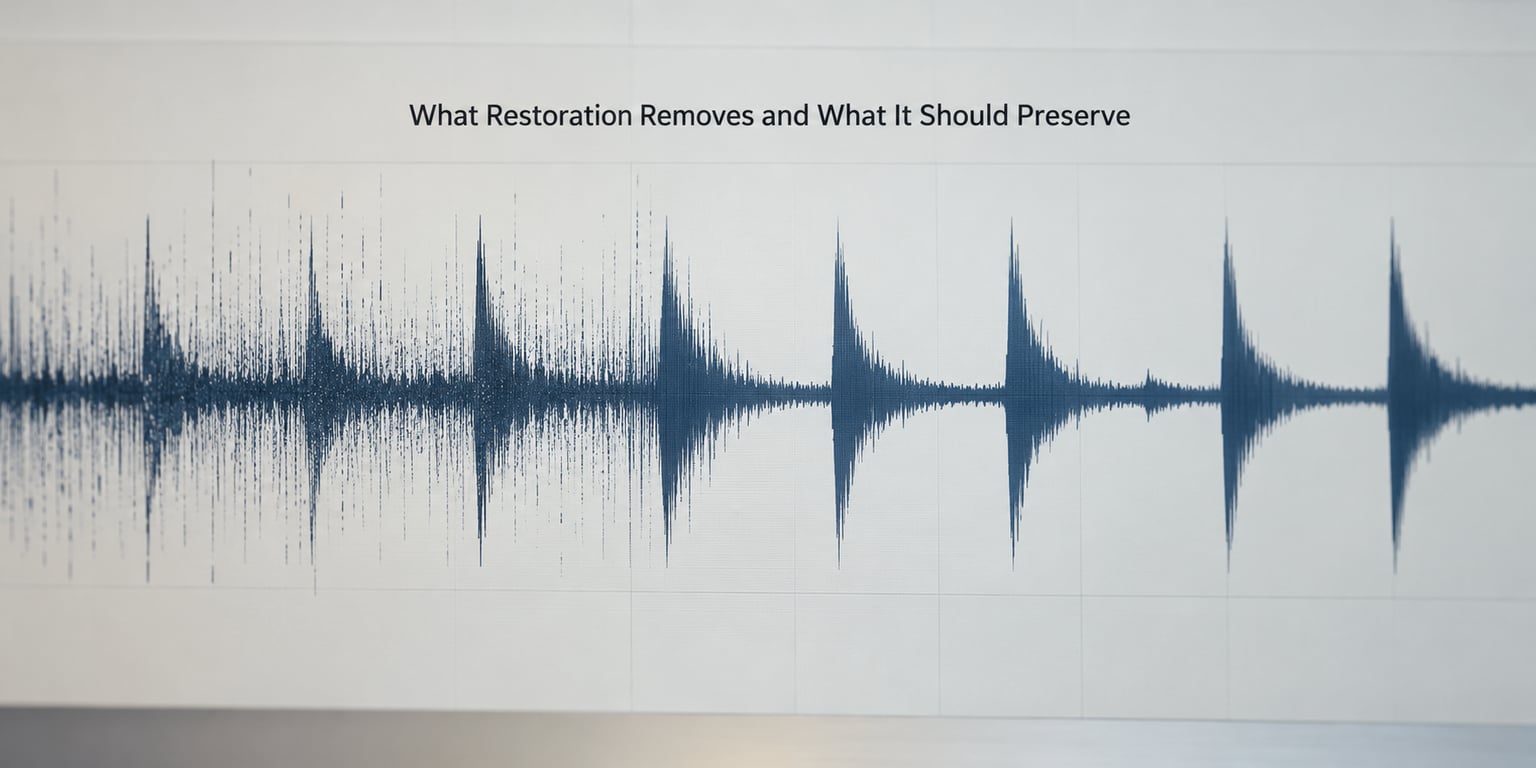
Good restoration removes artefacts that were never music: hiss, clicks, pops, rumble, and the occasional dropout where the oxide flaked off. It also repairs the damage a copy chain inflicted, including the dullness that comes from passing through too many generations.
The failure mode is noise reduction used as a blunt instrument. Multiplicative noise reduction profiles mistake quiet musical detail for noise, so a decay at the end of a cymbal crash or the noise floor under an acoustic guitar gets flattened along with the hiss. The result sounds strangely clean and strangely dead at the same time.
A useful test is the waveform itself. A properly restored transfer loses the fuzzy band of hiss under the music while the musical peaks stay exactly where they were. If those peaks have shrunk, something got taken that should not have been. In forum threads on r/audioengineering and GearSpace, the recurring complaint is not over-cleaning but over-processing of the sound itself, which happens after the cleanup stage.
How Mastering Choices Change Clarity, Weight, and Dynamics
Equalisation sets tone, limiting sets loudness, and compression sets the distance between loud and quiet. Those three decisions, plus stereo width and channel balance, account for nearly every subjective difference between two editions of the same album.
How remastering changes a classic album’s tone without changing a note
Raise the low-mids and a record feels thicker and heavier. Roll off the very bottom and it feels tighter and less boomy. Lift the top octave and guitars gain bite, or turn brittle on a mix that never had that energy. None of these moves alter the performance, and all of them change how you read the performance.
Channel balance gets overlooked. A mix printed slightly hotter on one side than the other, then mastered without correcting it, will pull the whole stereo image off centre. Metal records with wide double-kick drums and panned rhythm guitars are the most obvious place to notice, because a lopsided low end is much easier to hear than a lopsided melody.
Loudness is where the loudness war lives. A master pushed until it is as loud as possible ends up with a compressed, lifeless sustain and inter-sample peaks that clip on playback. The band turns up the system to hear it, the engineer turns it down, and everybody loses.
How to Tell Whether a New Remaster Is an Improvement
Run the same checks in the same order on both versions. Consistency is what makes the comparison useful.
- Match the level. Play both at the same volume. A remaster that is simply louder will always sound better in a blind test, and that is exactly the illusion to avoid.
- Check the noise floor. Put on a quiet passage, then the gap between tracks. Is the hiss lower, or has the quiet parts been pumped up to match?
- Listen to the balance first and the detail second. Start with tonal balance. Do the bass and vocals sit where they should, or has someone turned up a frequency to compensate for something else?
- Look for detail that sounds musical. Individual picks on a guitar, brush noise on a snare, tape noise under an acoustic passage. If detail appears only where the waveform was quiet, suspect noise reduction.
- Check dynamics. Find a transition from quiet to loud. Does it build, or does the quiet part jump up to meet the loud one?
- Check the fade. Outros and fades are where over-processing shows up first.
Setups vary more than people admit, so take notes on what you hear on each system rather than trusting a first impression on one pair of speakers.
Why Can an Older Master Sound Better?
Because the old master may simply be closer to the mix. Bands and engineers have often argued since the 1980s that making an album loud enough to match the loudest single is bad practice, which means some of the best-sounding masters are also the quietest ones.
Later remasters can also be built from the wrong thing: a CD rather than the tape, or a later remaster that was itself compromised. Once a bad master becomes the only source, every generation after it inherits the same problems. A 1990s CD can hold more dynamic range than a 2015 reissue made from it, which is exactly what collectors on The Gear Page and r/audiophile keep running into.
Original pressings have their own value, but only partly for sound. A first pressing can carry a different mix, an uncut song, or a genuine improvement made by the band before the format settled.
Remaster, Reissue, Remix, or Replica?
The label on the sleeve often tells you less than you would hope. These are the terms worth knowing.
| Release type | What changes | What stays |
|---|---|---|
| Remaster | The master audio, rebuilt from source | The mix and the songs |
| Remix | The mix itself, rebuilt from the multitracks | The performances |
| Re-recording | New performances | Nothing but the songs |
| Reissue | Packaging, track list, bonus material, sometimes audio | Usually the original master |
| Replica | Only the cut, from an existing master | All of the audio |
An expanded or deluxe edition tells you the track list grew. It says nothing about whether the original tracks were re-mastered.
What Details Can Change Beyond the Sound?
Artwork gets rescanned, often at higher resolution but sometimes cropped tighter and losing the original layout. Track lists get revised when a song turns out to be longer than believed, or gets trimmed back to the original radio edit with a note. Liner notes get rewritten, credits get corrected, and photographs get replaced with session pictures nobody had seen before.
Bonus material is the biggest variable. It can be genuine outtakes that have never been heard, or a stack of live tracks from a short tour stop recorded on a four-track. Check the dates and the credits before assuming a deluxe edition improves on the original.
How Collectors Should Compare Different Album Editions
Start with the sleeve, then verify. Read the mastering credit and the source claim. If the packaging says the master came from the original analog tapes, that is a real statement, and one you can check against reviews that mention tape hiss or a wide stereo image.
On a physical copy, the matrix number in the runout groove is more reliable than the catalogue number, because a label reuses catalogue numbers across territories and formats. Compare the matrix against known-good pressings before you commit.
Format matters less than people think for the audio itself, and more for the transfer quality inside it.
| Format | Resolution | What to look for |
|---|---|---|
| Original LP | Analog, band-limited | First pressing, mono or stereo mix differences |
| Original CD | 16-bit, 44.1kHz | Whether it predates the loudness era |
| SACD / Blu-ray Audio | 24-bit or DSD, 96/192kHz | Whether the audio is unique to that release |
| Hi-res download | 24-bit, 192kHz | Whether it was made from the tape or a CD |
| Streaming | Lossy, normalised | Which master the service actually uses |
Finally, check dynamic range values. The DR Loudness War database logs measured dynamic range for thousands of releases and versions, and a remaster measuring a few dB less than the original is a clear signal that something was taken away. On streaming, loudness normalisation flattens much of this anyway, which is why the difference between a brick-limited remaster and a careful one often shows up more on a good system than on a phone.
Frequently Asked Questions
Is a remastered version of a classic album always better?
No. A remaster is better when it starts from a better source, such as an original analog tape or the best generation multitrack, and applies restrained correction. It is worse when the source was an existing CD, when the noise reduction flattened quiet detail, or when loudness was pushed until the dynamics collapsed. The word remastered on a sleeve is a claim, not a measurement.
What is the difference between a remaster and a new mix?
A remaster works from the finished master and changes the tone, noise floor and level while leaving every note and every mixing decision alone. A new mix goes back to the multitracks and rebuilds the balance, the stereo placement and sometimes the song itself. Remixing can move an album much further from the original performance than remastering ever does.
Are original pressings better than remastered editions for heavy metal albums?
Often, though it depends on the album. Many classic metal records were mastered quietly in the 1980s, so a careful tape-based remaster can genuinely open up the guitars and tighten the low end. What to avoid is a reissue cut from an existing CD with heavy compression on top. Check the source claim and measured dynamic range before buying either version.
How can I tell if a remaster has been over-compressed or made too loud?
Play the two versions at matched volume and listen to the quiet parts. If the gap between a soft verse and a loud chorus has shrunk, the remaster is compressed harder. Sibilance that bites, guitars that crackle on sustained chords and a low end that sounds one-note are further signs. A measured dynamic range value in the DR Loudness War database confirms what your ears suspect.
Why do deluxe editions include tracks that were not on the original album?
Because labels treat a reissue as a product as well as a restoration. Additional tracks increase the perceived value of a set, whether they are finished songs, outtakes or short live recordings. Some of it is genuinely unreleased material, and some of it is filler. Read the track credits and dates, and compare the original album tracks to see whether the audio was remastered too.
Conclusion: Choose the Master for the Listening Experience You Want
Start by identifying the source. If the mastering credit and packaging say the original analog tapes were used, the remaster has a real chance of sounding better. If the provenance is vague or the source was a previous CD, your expectations should be low.
Then compare two versions at the same volume on the system you actually listen on, and decide which sound you prefer rather than which one is newer. Take the presentation and the collectability into account after the audio, not before.