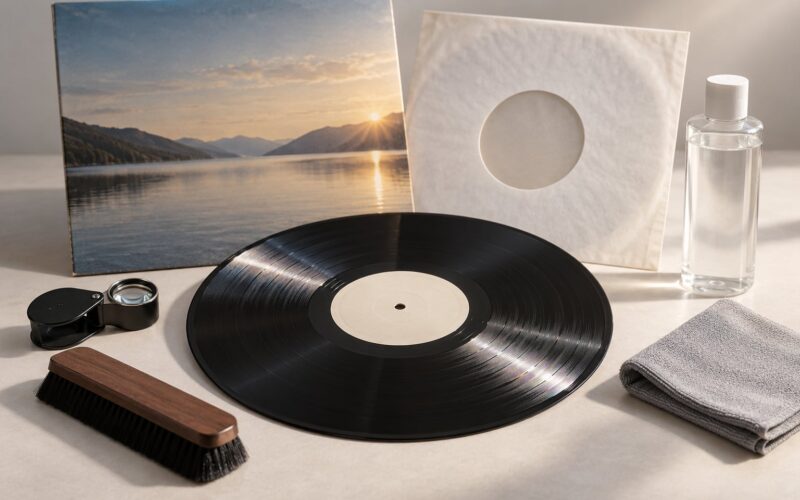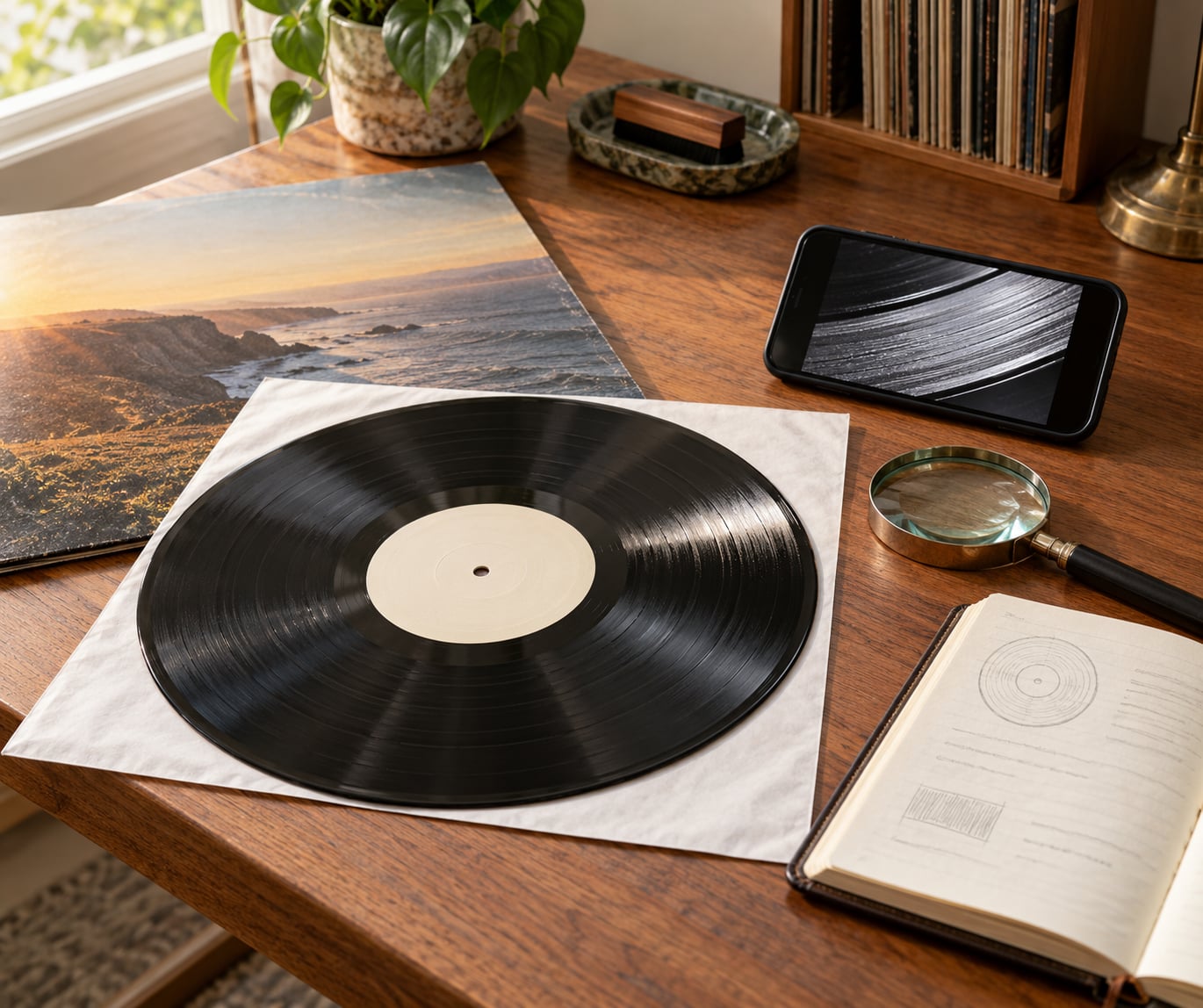
A first pressing is the earliest batch of an album to come off the manufacturing line, made from the original master with the original label design, jacket, inner sleeve and inserts. To find first pressing vinyl, you read the physical evidence on the record first, then confirm that reading against Discogs.
The evidence lives in three places: the etched matrix number in the dead wax area between the last groove and the label, the catalog number and label design printed on the disc, and the packaging details that usually change before anything else does. A full check takes about ten minutes per record once you know where to look.
One warning before we start, because it trips up experienced collectors too. A matrix number is an indicator, not a proof. Factories pressed records out of order, ran several plants at once, and sometimes shipped an earlier batch to one territory months after a later batch went to another. Treat every check below as evidence that narrows the possibilities, never as the last word.
Table of Contents
- What You Need
- Step-by-Step
- How to Confirm the Album and Edition
- How to Find First Pressing Vinyl From the Runout Groove
- How to Check the Sleeve and Packaging
- How to Evaluate the Seller and Listing
- How to Make the Final Buy or Pass Decision
- Common Mistakes That Cost Collectors
- Frequently Asked Questions
- What matrix number should a first pressing have?
- Are all records with the lowest catalog number first pressings?
- How can I tell if a sealed record has been resealed?
- Does the label design prove that a record is a first pressing?
- How do I identify a reissue or repress from another country?
- What should I ask a seller before buying vinyl?
- Conclusion
What You Need
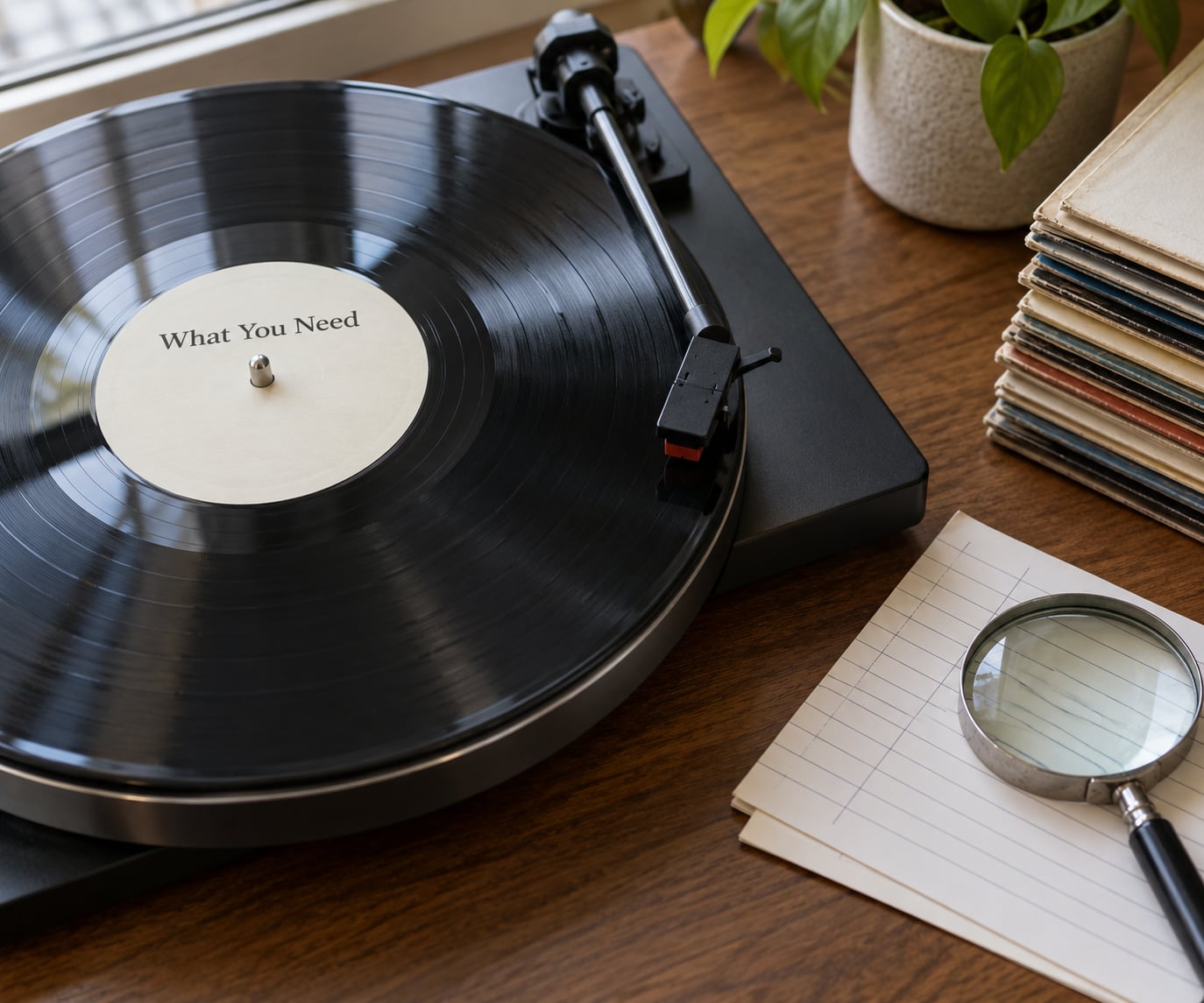
You need four things, and three of them are free.
- A disc reader with good side lighting. Matrix numbers are etched into a surface that reflects light at a shallow angle. A bright lamp held low and to the side of the disc makes a hand-etched number jump out; overhead light makes it vanish.
- A magnifier. A cheap 10x loupe is enough for most catalog numbers and copyright lines. For runouts, a phone camera held at a shallow angle with the light source off to one side works surprisingly well when you cannot get the disc out of the sleeve.
- The Discogs release page for that exact album, open on a phone or second screen before you start. Reading the runout cold and searching for it afterwards takes ten times longer.
- A record cleaning brush and a soft cloth, if you are inspecting a used copy. You cannot judge a runout groove, and you cannot judge seam splits or sleeve wear, on a dirty record.
Two optional items earn their keep quickly. A small notebook for catalog numbers as you spot them at record fairs, because you will not remember them an hour later. And a stylus microscope if you grade regularly, since the same optics that make the runout readable also show you pressing defects and seam splits.
On the seller side, gather three pieces of information before you pay anything: the catalog number, the country of manufacture, and a photograph of the runout area on the side the listing does not show. Everything else is negotiation.
Step-by-Step
How to Confirm the Album and Edition
Start by pinning down which release you are actually looking at, because “first pressing” only means something relative to one country and one edition. A UK first press, a US first press and a Japanese first press of the same album are three different records with three different dates, and all three can legitimately be called first pressings.
Take the catalog number off the label or the rear sleeve and search it on Discogs with the artist and title. When several results come back, filter to the format you have and to the country printed on the jacket. Then read two fields most people skip: the Notes section, which lists known variations for that release, and the Identifications section, which shows what those variations actually are.
While you are in the release entry, note the four edition types you will meet. They get confused constantly, and mixing them up is how collectors end up paying first pressing money for a promo.
| Edition type | What it is | Typical tells |
|---|---|---|
| First pressing | The earliest production batch of a release in one country | Earliest matrix number for that side, original label artwork, no barcode on the sleeve, no obi strip |
| Reissue | A later pressing of the same audio, usually with new packaging | Different label design or logo, copyright line updated, barcode on the rear sleeve, insert set reduced |
| Test pressing | A small pre-production run made to check the pressing process | Plain or white labels, plain or test jacket, hand-stamped numbering, sometimes marked NOT FOR SALE |
| Promo copy | A small run sent to radio, press or reviewers | White label with hand-written details, plain inner sleeve, promotional markings on the jacket |
The terminology splits in the community in a way that is worth naming. “First pressing” means the first batch. “Original pressing” means a pressing from before the artwork or packaging changed, which can be several batches or several years. For most records the two are the same thing, and for the exceptions they are not.
How to Find First Pressing Vinyl From the Runout Groove
The matrix number is etched into the dead wax, the smooth band between the last music groove and the label. It is the single most useful piece of evidence on the record, and it is also the most skipped.
Read it as three parts in this order: the mastering plant or prefix, the catalog number, and the side suffix. On many UK pressings you will see a format like A-1-1-1 or A-4-1. Here the A is the side, the 1 is the first cut of the lacquer for that side, and the final 1 or 2 is the stamper, meaning which pressing die made the copy. So A-1-1 is the first copy off the first die on side A, and A-1-2 is the second copy off the same die.
That last distinction is where a lot of confident advice online goes wrong. A lower number is not automatically an earlier pressing. Some collectors will chase an A-1-1 stamp even when a lower-numbered run was made months earlier at a different plant, and on some records the A-1 copies were produced at a later date than a run of plain A-1 stampers elsewhere. Read the entry on Discogs before you decide the number means something.
Look at how the number was made too. A hand-etched matrix sits slightly proud of the surface and has an uneven, slightly wobbly look at the edges. A laser-etched matrix is cut flat and consistent, usually in a plain sans-serif font, and the runout frequently includes a machine prefix such as GZ for the Columbia, CBS and Sony plants. Many labels switched from hand-etching to laser around the early 1980s, so a laser-etched runout on a record whose first press was hand-etched tells you the pressing is later.
Now read the other markings sitting in the same band, because they each rule things out:
- Mastering engineer credits. Initials such as RL for Robert Ludwig or LH for Lee Hulko appear beside the matrix and date the cut. If Discogs shows a reissue mastered by a named engineer in 2014 and the runout says STEREO with no credit, that is your answer.
- Plants and plant prefixes. RCA Victor records often put the catalog number on one side and a stamper code on the other in a format like 1234-1S. That leading digit maps to the stamper, and the letter to the plant, which is how you date a copy to a specific pressing die.
- STEREO, MONO or SRC. A MONO marking rules out the stereo version outright. On US hip-hop pressings, collectors check the runout for an SRC stamp and the side two label for an embossed EAST mark as original-press tells.
- Half-speed and from-tape notes. Text such as MASTERED FROM ANALOGUE TAPE or a half-speed credit marks a remastered reissue, and it will appear in the runout as often as on the sleeve.
- Made in Japan text. Japanese pressings almost always carry an obi strip, and usually a Made in Japan line on the label or sleeve.
Then cross-check the number against the Discogs matrix field for that release. If the release entry lists two known runs and your etching matches neither, that is a signal worth chasing in the forum thread rather than a reason to assume fraud.
How to Check the Sleeve and Packaging
Packaging is where reissues are easiest to catch, because changing the jacket is cheap and changing the master is not. Compare what you have against the earliest version shown in the Discogs images.
A barcode on the rear sleeve is the single fastest disqualifier. Barcodes did not appear on vinyl packaging until the late 1970s, so their presence on an album people call an original rules that version out. Other tells: an updated copyright line or publishing line, a revised BMI or ASCAP credit, a thinner board than the original, a laminated inner sleeve where the first press had a plain printed one, a missing insert, poster or lyric sheet, and gatefold artwork that differs in detail rather than in overall design.
Smaller things count too. The weight and finish of the jacket board, the type of spine printing, whether the inner sleeve is printed on both sides, and whether the record itself sits in a lined or unlined inner. None of these is decisive alone. Together they are usually enough.
For speed formats, look for the label text and the physical cues together: 33rpm records are marked 33 1/3 RPM on the label and use a Microgroove designation, 45rpm singles are marked 45 RPM or 7 inch, and 78s usually carry no RPM marking at all, have a much larger centre hole or a different adapter, and hold far fewer minutes per side.
How to Evaluate the Seller and Listing
A first pressing claim in a listing is a claim, not a detail. What matters is whether the seller has given you anything that can be checked.
Good listings photograph the runout. That single habit separates sellers who know what they have from sellers copying a description. They usually name the catalog number, state the country of manufacture, describe the label design, and note the matrix number rather than saying first pressing and stopping there.
Red flags, roughly in order of how often they turn out to be real. A generic matrix with no catalog number in the text. A runout photo that is blurred, badly lit, or cropped so tightly that the catalog number sits outside the frame. A first pressing claim on an album whose first press did not exist in that territory. An ungraded or as-is listing priced at first pressing levels, which either means the seller has not looked or means the copy is not one. And a jacket that does not match the label in the same listing, which is the signature of a reissue assembled with an old sleeve.
Check the seller’s history before the copy. A seller with a long record of accurate grading and who answers runout questions with photos is worth paying a little more to. Ask for the missing photo rather than guessing.
How to Make the Final Buy or Pass Decision
You buy when three independent groups of evidence agree: the runout etching matches the earliest documented run for that side, the label and catalog number match that same version, and the packaging matches the earliest sleeve. If all three line up and the condition is honest, the copy is a first pressing.
You pass when any two of them disagree with each other, when the seller cannot produce a runout photo, or when the price is being justified entirely by the words first pressing with no evidence attached.
One case deserves a separate rule: when a lower-numbered stamp is involved, or when the release has documented territory differences, go to the Discogs community thread for that master or release and ask with your etching in hand. Somebody who has compared the runs has usually seen your exact combination before. Write the record into your collection notes as what you verified and what you are assuming, because that habit is what stops a second pressing from quietly becoming a first pressing three years later.
Common Mistakes That Cost Collectors
Assuming the lowest catalog number means first pressing. Catalog numbers were reused across territories, and a suffix letter often indicates a later issue in the same series. Use the catalog number to find the release, never to judge it. The etching decides.
Trusting the words in the listing. First pressing, original pressing, VG+ and mint are all used loosely, and collectors report unverified reissues listed as first presses often enough that it should be your default assumption. Ask for the runout photo.
Reading a low stamper number as an automatic win. The A-1 copy is not automatically the earliest pressing, and a low stamper number does not guarantee better sound. A stamper degrades over years of use, which is the whole argument behind original pressings sounding better, so the lowest number is a preference rather than a fact. Check the release entry for what the numbers correspond to.
Ignoring territorial pressing. If you want a UK first press, a UK first press is what you buy. A US first press is a different record with a different date, and collectors who mix them end up with entries that cannot be graded or valued properly.
Looking at the sleeve last. Barcodes, updated copyright lines and reduced insert sets take seconds to check and settle a lot of arguments that runout discussions never resolve.
Treating Discogs as the answer rather than the reference. Discogs entries are crowd-sourced and occasionally wrong or incomplete. When an entry contradicts the record in your hands, the record wins and the entry needs updating.
Two smaller habits pay off fast. Take a photo of the runout every time, even for copies you are not buying, because you will want to compare it against something six months later. And log the matrix number in your collection notes rather than just writing first pressing, since that is the only entry you can actually verify later.
Frequently Asked Questions
What matrix number should a first pressing have?
There is no single required number. On UK pressings the format is usually side-cut-stamper, so A-1-1 means the first copy off the first die on side A. Look for the lowest run documented for that specific release on Discogs rather than assuming a pattern, and remember that factories sometimes ran later numbers at an earlier date than lower ones at a second plant.
Are all records with the lowest catalog number first pressings?
No. Catalog numbers were reused across territories and reissues, and a letter suffix often marks a later issue in the same series. A catalog number only tells you which release family to open on Discogs. The etching in the runout, the label design and the packaging decide whether a specific copy is a first pressing.
How can I tell if a sealed record has been resealed?
Factory shrink is thin, even, and tight to the jacket corners with no bubbles, wrinkles or re-folded lines. Reseals show a doubled edge, a slightly warmer seam, or cellophane that feels thicker or loses its gloss unevenly. Sealed copies also tend to keep the original inner sleeve in place, so check that the disc and sleeve inside match each other and the jacket.
Does the label design prove that a record is a first pressing?
It helps a lot but it rarely proves anything alone. Labels get redesigned and reused, and the same label design can appear on a first pressing and a reissue years later. Treat a distinctive original label, such as a solid colour or an early logo, as strong supporting evidence, then confirm with the runout etching and the catalog number.
How do I identify a reissue or repress from another country?
Compare the runout etching, the catalog number, the label design and the sleeve artwork against the Discogs entry for the territory you are holding. Barcodes, updated copyright lines, obi strips and changed mastering credits all point to a later issue. If the country on the jacket does not match the country in the release entry, you are looking at an import pressing.
What should I ask a seller before buying vinyl?
Ask for a photograph of the runout area on both sides, the catalog number, the country of manufacture, and a straight statement of the matrix numbers. Ask whether the copy is unplayed and whether it has been graded by anyone. A seller who answers with clear photos is telling you what the record is; a seller who repeats the words first pressing is telling you what they hope you will pay.
Conclusion
Find the exact release first, using the catalog number to open the right Discogs entry for the right country. Compare what the entry documents against the record in front of you: the etching in the runout, the label design, the sleeve details and any barcode. Then ask for clear evidence, especially a runout photograph, before you commit to a first pressing claim.
Collectors who learn to do this on ten records they already own will be able to identify a first pressing vinyl copy in about the time it takes to read a runout groove. That is the whole skill, and it takes a weekend to get comfortable.