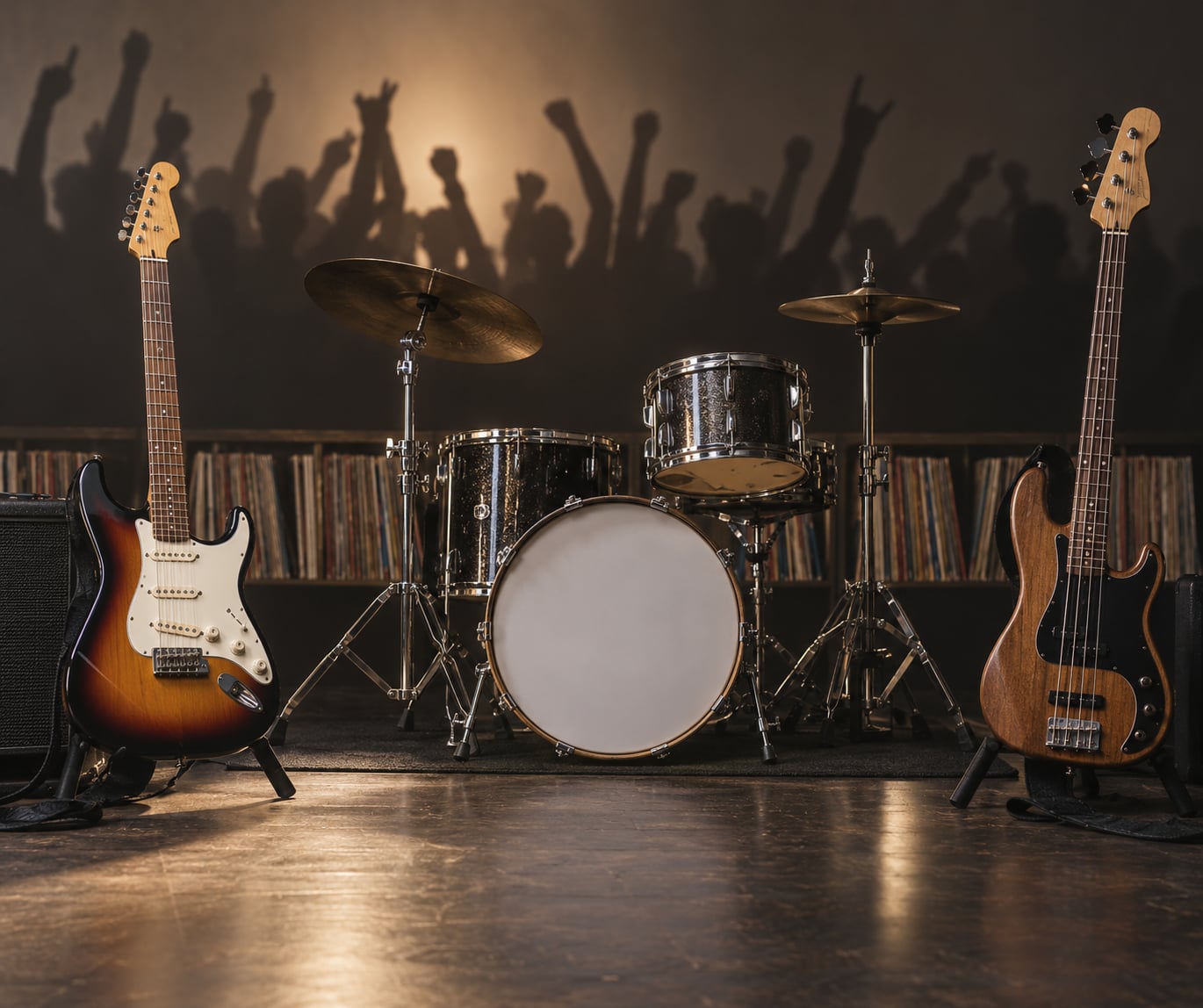
Metalcore blended hardcore and metal by keeping metal’s riffs, drop tunings and heavy ensemble sound, then importing hardcore’s breakdowns, mosh-driven dynamics, short songs and shouted vocals. The result is not a compromise between two genres but a third thing with its own rules.
That distinction matters because a lot of people can hear metalcore and cannot place it. It sits close to thrash, close to hardcore, and close to nu-metal, and it borrows heavily from all three. I have spent years explaining the genre to friends who think it is “just fast metal,” and the honest answer is that the speed is the least interesting part.
The blend is easiest to understand by looking at what each parent genre supplied and how the two sets of habits collided. Once you hear the collision, the label stops being confusing.
Table of Contents
- How Metalcore Blended Hardcore and Metal
- The Hardcore Ingredients
- The Metal Ingredients
- Metalcore’s Core Musical Formula at a Glance
- How Breakdowns Changed the Blend
- Breakdowns: Impact Is Not Automatically Heaviness
- How Vocals Unified and Divided the Styles
- How Metalcore Blended Hardcore and Metal in the Vocals
- Rhythm, Song Structure and the Loss of Downbeats
- The Evolution of the Metal-Hardcore Blend
- Early Metalcore: Breaking the Boundary
- Later Metalcore: Expanding the Formula
- Metalcore Compared with Its Main Influences
- Why Metalcore Is More Than Fast Metal or Hardcore with Riffs
- A Listening Path for Understanding the Blend
- Frequently Asked Questions
- What does it mean that metalcore blended hardcore and metal?
- Did metalcore come from hardcore punk or metal?
- Why are breakdowns important to metalcore?
- Is metalcore just crossover thrash with faster drums?
- How is metalcore different from modern metal?
- Conclusion
How Metalcore Blended Hardcore and Metal
Metalcore blended hardcore and metal by splitting the difference down the middle and then building new material on top of it: hardcore’s pace, physical performance and song architecture on one side, metal’s riffs, harmony and musicianship on the other. Where the parents clashed, metalcore usually invented a third option rather than picking a winner.
The most obvious example is the breakdown. Hardcore had one for years, a brief drop in tempo that let a singer talk or a crowd start moving. Metalcore turned it into a structural pillar, a long, riff-led passage that the whole song is built around. That single change did more to make metalcore its own genre than any vocal style or tuning choice.
The Hardcore Ingredients
Hardcore punk stripped punk down to speed and volume and then added rules about how to live. Straight edge, the youth crew scene, DIY labels, shows booked in basements, and a vocal delivery that was almost entirely shouted or spoken at full volume. Songs were short, often under two minutes, built from one riff and a beatdown.
Metalcore kept the running time discipline for its first decade, the shouted delivery, the DIY release culture, and above all the physicality. A metalcore show still works because the band plays short sections of controlled intensity and hands the crowd something to do inside each one.
The Metal Ingredients
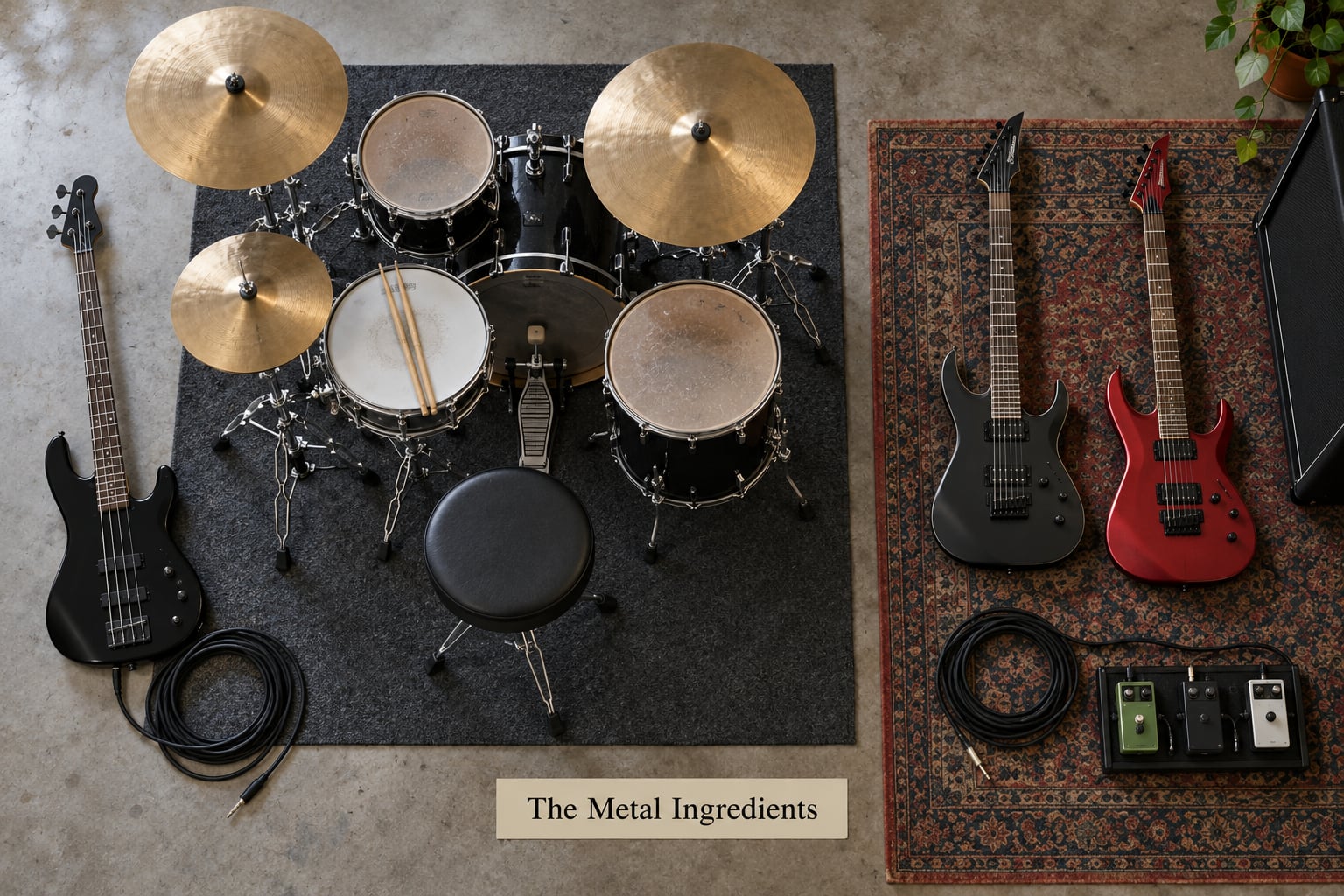
From metal, metalcore took riff-centered songwriting, expanded guitar vocabulary, harmonic movement, backbeat drumming, low tunings, and the idea that an album is a serious object with cover art worth looking at. The riffs that define metalcore are metal riffs: syncopated, chromatic, built on perfect fifths and tritone figures rather than on power chords alone.
It also took the band-as-ensemble idea. Two guitarists trading leads, a bass player who moves, and a drummer who treats the kit as a lead instrument rather than a timekeeper.
Metalcore’s Core Musical Formula at a Glance
Here is the blend feature by feature, with the metalcore use of each trait and the sound that produces. It is the quickest way to see that most metalcore traits are inherited rather than invented.
| Element | Hardcore punk | Metal | What metalcore does with it |
|---|---|---|---|
| Tempo | Very fast, often approaching blast-beat speed | Wide range, mid-tempo on thrash staples | Holds hardcore speed, drops into slow half-time breakdowns for contrast |
| Vocals | Shouted, barked, spoken | Screamed, growled, or clean and melodic | Shouts and barks dominate, clean singing enters later as a hook |
| Rhythm section | Punk backbeat, simple and driving | Double bass, blast beats, tom work | Punk backbeat in fast sections, metal double kick underneath breakdowns |
| Guitar work | Power chords, one riff, no solos | Chromatic riffs, scales, solos, varied technique | Drop tunings and metal riff vocabulary, solos used sparingly and percussively |
| Song structure | Short, verse to verse, fast | Longer arcs, intros, solos, instrumental sections | Verse, chorus, breakdown, repeat, with an outro borrowed from metal |
| Performance | Stage dives, slam dancing, constant motion | Headbanging, guitar posing, command of the stage | Slam dancing during breakdowns, headbanging during riffs, alternating |
| Themes | Discontent, community, refusal, boredom | Fantasy, horror, war, mythology, introspection | Inner conflict, social pressure, doubt, written in a dense image-heavy style |
| Production | Rough, cheap, fast, deliberately unpolished | Layered, mixed loud, saturated | Modern takes keep metal’s clarity but aim for the hit single, later retreating |
Read the right-hand column twice and the pattern is clear. Metalcore did not average the two parents. It kept one behaviour in the fast sections and swapped in the opposite behaviour at the breakdown, then leaned on that alternation as the whole identity of the band.
How Breakdowns Changed the Blend
The breakdown is where the two genres were forced to negotiate. In hardcore, a beatdown is a pause, a short groove in the middle of a song where the tempo dips and the crowd resets. In metalcore it became a destination, a long passage of sustained, syncopated riffs that a song is built to reach and to leave.
Mechanically, it works like this. The guitars drop to a low tuning and play a riff built from the strings themselves, palm muted, with the low string ringing open between attacks. The drummer stops the double kick and plays a simple heavy pattern instead. The singer stops singing and starts shouting a short repeated line, and the room answers.
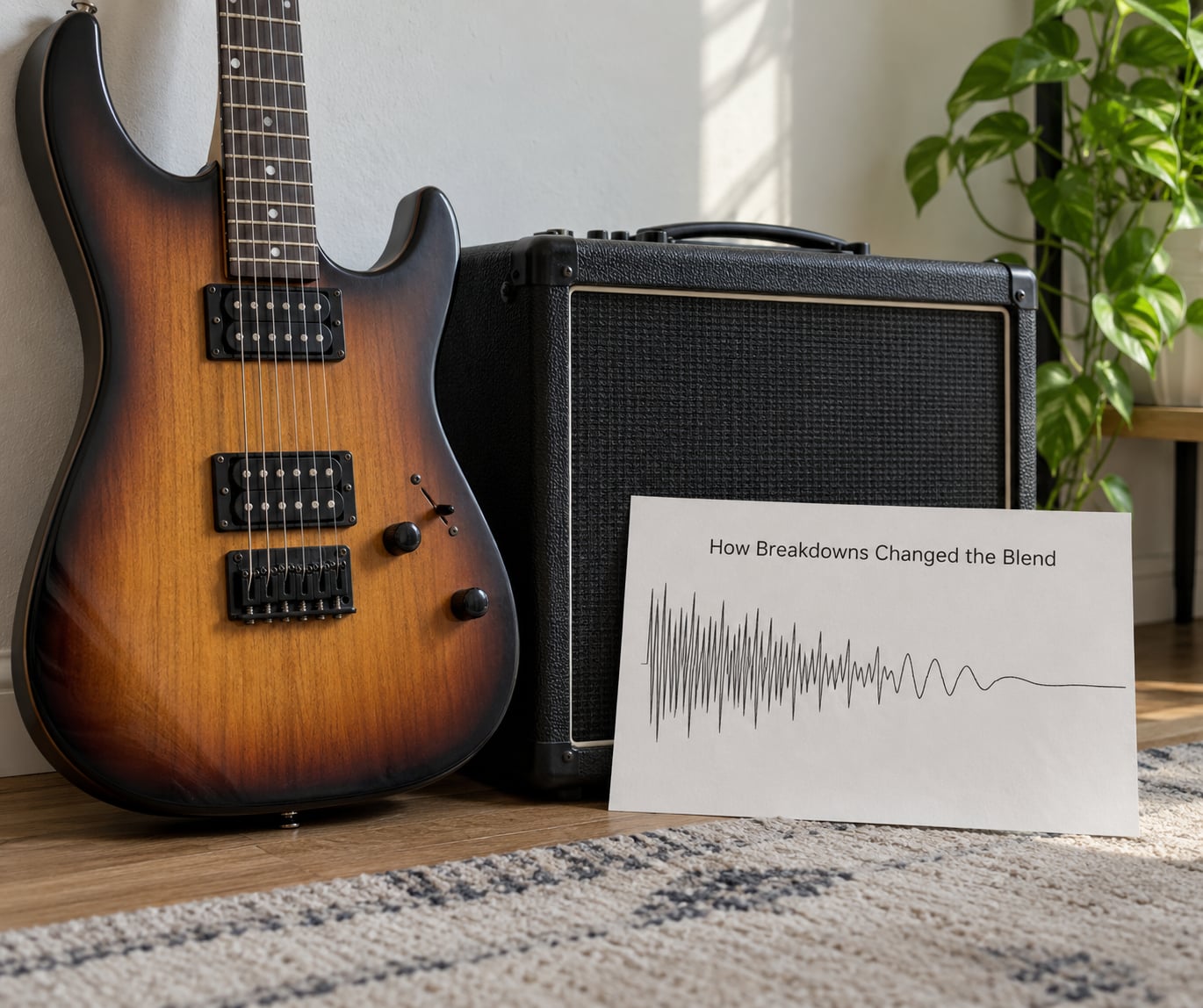
Four things happen at once, and that is why a breakdown works in a way a tempo change alone does not. It releases tension built over the previous section, it resets the rhythmic grid so the next verse lands harder, it gives the crowd something physical to do, and it turns a song into a narrative with a destination.
It is also the part that annoys people. The single most common complaint about modern metalcore, consistently raised in listener forums, is that the breakdown becomes a formula within an album. Hear one every third track and the destination stops feeling like a destination.
Breakdowns: Impact Is Not Automatically Heaviness
Impact is not the same thing as heaviness, and slow does not automatically mean heavy. A breakdown played as half-time with no riff content, no rhythmic tension and no vocal weight is just a quiet part. The breakdowns that define metalcore are usually busy: they contain syncopation, movement between strings, and a chant layered over the top.
This is where the metal side wins the argument inside the genre. A hardcore beatdown needs almost nothing from the guitarist, and many did nothing. A metalcore breakdown is a showcase, and that is why listeners who know nothing about the genre history still recognise it instantly.
How Vocals Unified and Divided the Styles
Vocals are where the blend is most visible, because metalcore kept both approaches and made the switch between them a feature. The fast sections are shouted, barked or delivered with the strained, throat-heavy tone hardcore used. The melodic core, when a band has one, is sung clean, and the switch between them is designed to hit like a change in pressure.
The shouts exist for a practical reason as much as an aesthetic one. A shout is intelligible in a loud room, which is exactly where a breakdown needs to be, and it gives the crowd a line to return rather than a melody to follow.
How Metalcore Blended Hardcore and Metal in the Vocals
Over time the metal side gained ground in the vocal department. Death metal and melodic death metal contributed the low-register growl, the blast-beat pairing of a voice and a rhythm that is nearly one sound, and later the technical clean singing with long sustains and wide vibrato. Bands that had been pure shouters added a sung chorus and kept the breakdown screams.
The result is the contrast most listeners actually mean when they say metalcore has two voices. Metal supplied range, pitch and melody. Hardcore supplied delivery, urgency and the shout.
Rhythm, Song Structure and the Loss of Downbeats
Metalcore combined the rhythmic strengths of both parents and then wrote around the spaces between them: kick emphasis, syncopation, off-beat snare placement, and a persistent reluctance to land on the predictable downbeat, which is what makes the fast sections feel like they are slipping rather than marching.
Structurally, the standard metalcore song is closer to metal than to hardcore. A quiet or atmospheric opening, a verse, a chorus, a breakdown, a second verse with variation, a bridge or guitar feature, and an outro. That is a long way from the ninety-second hardcore song, and it exists because metal taught the genre to develop a tune instead of stating it.
Where hardcore still governs is duration. Even in an era of five-minute tracks, metalcore songs are built from short units, usually a few bars, repeated with changes. The song rarely wanders; it moves between blocks.
That combination, a metal-length arrangement built from hardcore-sized pieces, is arguably the most underrated part of the fusion. It is why metalcore can carry a crowd through a long festival set without ever feeling slow.
The Evolution of the Metal-Hardcore Blend
The blend did not appear fully formed. It went through a foundation phase, a fusion phase, an expansion phase and a division phase, and each stage left a mark on how the genre sounds now.
| Era | What was happening | What to listen for |
|---|---|---|
| Late seventies to early eighties | Hardcore punk forms out of the New York scene alongside a rising thrash underground in California | Short shouted songs on one side, fast riff-driven playing with vocals on top on the other |
| Mid-eighties | Crossover thrash puts punk attitude and metal instrumentation in one band | Punk speed, metal riffs, spoken or shouted passages, groove |
| Late eighties | New York hardcore bands start using metal riffs, tunings and influences directly | Drop tunings arriving early, breakdowns becoming longer, metal weight in the guitars |
| Early nineties | Metalcore coalesces as a named style in its own right | Hardcore-fast verses, extended riff breakdowns, gang vocals, short and heavy records |
| Late nineties | Breakdowns multiply and vary; extreme metal influences arrive in full | Different breakdown types per song, blast beats, more technical guitar work |
| Two thousands | Clean vocals, singles and festival touring push metalcore into the mainstream | Sung choruses, polished production, breakdowns placed for maximum crowd response |
| Current era | A revival of the heavier, less polished earlier sound runs alongside the polished one | More weight, less gloss, breakdowns used less often per album but heavier when they land |
Early Metalcore: Breaking the Boundary
The bands that fused the two directly in the early 1990s did it by taking the hardcore scene’s ethics, short runtime and stage behaviour and putting metal’s guitar vocabulary underneath. Converge, Earth Crisis, Shelter, One King Down, Merauder and Overcast all worked from Massachusetts and the surrounding Northeast, and their records made the argument more clearly than any description can.
Two of those names explain the genre’s split personality on their own. Shelter and Earth Crisis carried the straight edge, vegan and radical-politics lineage of NYHC and fused it with metal weight. Converge, Jacobs Trouble and Bane kept the melodic singing and the twin guitar attack while borrowing hardcore’s pace. Almost every argument about what metalcore is or is not traces back to which of those two paths a listener heard first.
It is worth knowing that the word metalcore originally meant crossover thrash, the punk-metal wave of the mid-eighties. The modern usage was a later renaming, and that history explains why so many listeners hear the term and picture something different from what plays in a metalcore set today.
Later Metalcore: Expanding the Formula
From that base the genre grew in several directions at once. Some bands went heavier and more extreme, which produced deathcore with blast beats, guttural low vocals and breakdowns that function as horror-film sound design. Some went technical and fractured, which produced mathcore, with odd meters and breakdowns that swing rather than sink. Some kept the hardcore lineage loudest. Some took synthesizers into the breakdown and produced the electronic-influenced branch that later fed post-hardcore and adjacent scenes.
Across all of them the underlying grammar stayed the same. Alternate hardcore-speed intensity with metal weight, put a breakdown at the hinge, and use a vocal contrast to keep the difference legible. A band can be decades and continents away from the early 1990s and still be recognisably built this way.
Metalcore Compared with Its Main Influences
The fastest way to see the blend is to place metalcore beside the four genres it is constantly mistaken for. Each column below describes the typical case, not every band.
| Feature | Metalcore | Hardcore punk | Crossover thrash | Death metal | Modern metal |
|---|---|---|---|---|---|
| Vocals | Shouts and barks dominant, clean singing on the hook | Almost entirely shouted or spoken | Shouted, spoken, sometimes sung clean | Low growls and death growls, occasionally clean | Wide range, heavily melodic, vocal effects common |
| Breakdowns | Long, riff-led, structurally central | Brief beatdown used as a pause | Rare, usually a groove rather than a section | Used, but less central than blast beats | Less common, often replaced by a build or a drop |
| Guitar work | Drop tunings, syncopated riffs, occasional solo | Power chords, minimal variation | Groove-oriented riffs, funk influence | Tremolo picking, fast runs, extreme technique | Riff-led with heavy use of pedal tones and effects |
| Song structure | Verse, chorus, breakdown, arranged development | Short, repetitive, verse to verse | Short, groove-based, few breakdowns | Long, arranged, instrumental sections | Verse and chorus with a strong melodic hook |
| Themes | Inner conflict, pressure, doubt, often abstract imagery | Discontent, community, politics, direct language | Street life, anger, partying | Horror, death, war, nihilism | Emotion, loss, relationship, spectacle |
| Performance expectation | Slam dancing in breakdowns, headbanging in riffs | Constant movement, stage dives, circle pits | Headbanging and stage presence | Headbanging, corpse-dancing circles | Headbanging, crowd command, festival movement |
The takeaway is that metalcore sits in the middle on almost every axis. It is slower than hardcore, faster and more melodic than death metal, and heavier and more rhythmically aggressive than modern metal.
Why Metalcore Is More Than Fast Metal or Hardcore with Riffs
The most common misunderstanding is that metalcore is a speed gimmick applied to either metal or punk. It is neither, and the proof is in the parts of the genre that have nothing to do with tempo. The lyrics, the stage conduct, the release culture, and the rhythmic approach all point to a distinct identity rather than a hybrid with no character of its own.
Start with the scene. Metalcore inherited hardcore’s physical vocabulary and extended it. The slam dance is not a metal behaviour, and neither is the stage dive or the circle pit that forms during a breakdown. Fans consistently describe a crowd moving in a breakdown as the moment the genre does what it is for, independent of any label, which tells you the behaviour is the point rather than an accident.
Then the lyrics. Metalcore writes about inner pressure, doubt and social suffocation in dense, abstract language, which is a metal habit, but it does it inside a scene whose DIY record labels, hand-made artwork and word-of-mouth touring look nothing like the metal industry that disliked the crossover. That mismatch is why metalcore got attached to emo and scene culture it never had any lineage in, and why metal listeners who would happily buy a melodic death metal record often refuse the association.
Finally, the rhythm. Hardcore and metal are both forward-moving, but metalcore does something specific with where the beats land, placing emphasis on the kick and moving snare placement off the expected beat so the groove keeps sliding. That is an identifiable construction, not a tempo setting.
So no, metalcore is not fast metal, and it is not hardcore with a better guitar tone. It is a genre built around one deliberate contrast, and once you are listening for that contrast you will stop needing the label to sort it for you.
A Listening Path for Understanding the Blend
Five stages, short and chronological. Each one adds a component, so you hear each ingredient arrive.
Stage one: the metal side, alone. Start with mid-eighties crossover thrash, where punk energy meets metal instrumentation without any trace of metalcore. Listen for the groove, the riff-based verses and the shouted delivery. This is the “hardcore with riffs” version, and knowing what it sounds like makes stage two obvious.
Stage two: the hardcore side, alone. Play New York hardcore from the early eighties. Fast, short, loud, one riff, a beatdown, no solos. This is the equipment metalcore was going to build on top of.
Stage three: the fusion, early 1990s. Play early Converge, Earth Crisis, Shelter and Overcast records in that order. Listen for the breakdown arriving as a full section rather than a beatdown, the tunings dropping, and the gang vocals appearing. This is where the genre is born.
Stage four: the expansion, late nineties. Move to bands that pushed the extremes, from deathcore to mathcore, and to the bands that brought clean singing into the formula. Listen for how many different things can occupy the breakdown slot, and how the clean chorus changes the tension of a song that is otherwise a shout and a riff.
Stage five: the branch points and the current revival. Finish with the electronic-influenced branch, the mainstream polished era, and then the current run of heavier records that deliberately sound under-produced. Listen for what the polished era gained and what the revival gives back.
Across all five stages, one test holds: find the breakdown, and ask whether the song is built to reach it. If yes, you are hearing the metalcore grammar regardless of what decade or subgenre it comes from.
Frequently Asked Questions
What does it mean that metalcore blended hardcore and metal?
It means the genre combined two different sets of habits rather than averaging them. Metalcore kept metal’s riffs, drop tunings, backbeat drumming and vocal weight, and added hardcore’s breakdowns, short song units, shouted delivery, DIY release culture and slam-dancing crowds. The blend works through contrast: fast hardcore-style intensity alternates with slow, riff-led metal weight, and the song is structured around the switch.
Did metalcore come from hardcore punk or metal?
From both, at the same time, and the honest answer is that the two scenes fed each other for years before anyone named the result. Hardcore bands picked up metal riffs and tunings, and metal bands picked up hardcore’s speed and stage energy. The word metalcore was originally used for crossover thrash, the punk-metal wave of the mid-eighties, so the modern name is actually a later reuse.
Why are breakdowns important to metalcore?
Because the breakdown is the section where both parents meet and the only structural element metalcore genuinely owns. Hardcore had a short beatdown; metalcore made it a long, riff-led passage with palm-muted low strings, a simple heavy drum pattern and a shouted chant. It releases tension, resets the rhythm, gives the crowd something to do, and turns a short song into one with a destination.
Is metalcore just crossover thrash with faster drums?
No, though the two are easy to confuse. Crossover thrash is a groove-oriented punk-metal hybrid with spoken passages, funk influence and almost no breakdowns. Metalcore takes the same general union of punk attitude and metal instrumentation and reorganises it around a breakdown, drop tunings, staccato riffing and gang vocals. Faster drums are a feature, not the identity. The comparison is close enough to mislead people and wrong enough to be worth knowing.
How is metalcore different from modern metal?
Modern metal leads with melody, vocal effects and a polished hook, and its breakdowns, when they exist, are brief builds rather than destinations. Metalcore leads with rhythm and contrast, keeps the vocal delivery mostly shouted or barked, structures the song around a breakdown, and expects the crowd to move physically during it. Guitar work is riff-led and percussive in both, but modern metal favours sustained lead lines where metalcore favours tight syncopated riffs.
Conclusion
How metalcore blended hardcore and metal is easier to see as a set of decisions than as a formula. Hardcore supplied pace, brevity, the shout, the DIY scene and the physical show. Metal supplied riffs, tunings, harmony, backbeat weight and the idea of an album as an object. Metalcore joined them with one structural invention, the breakdown, and then built everything else around the alternation between them.
If you listen for one thing first, listen for the switch. Notice how a song moves from fast, shouted, syncopated intensity into a slow riff-led passage the crowd is shouting back at the band, and how the riff after it lands harder because of the pause. That movement, repeated across a whole album, is the blend. Everything else is a detail on top of it.