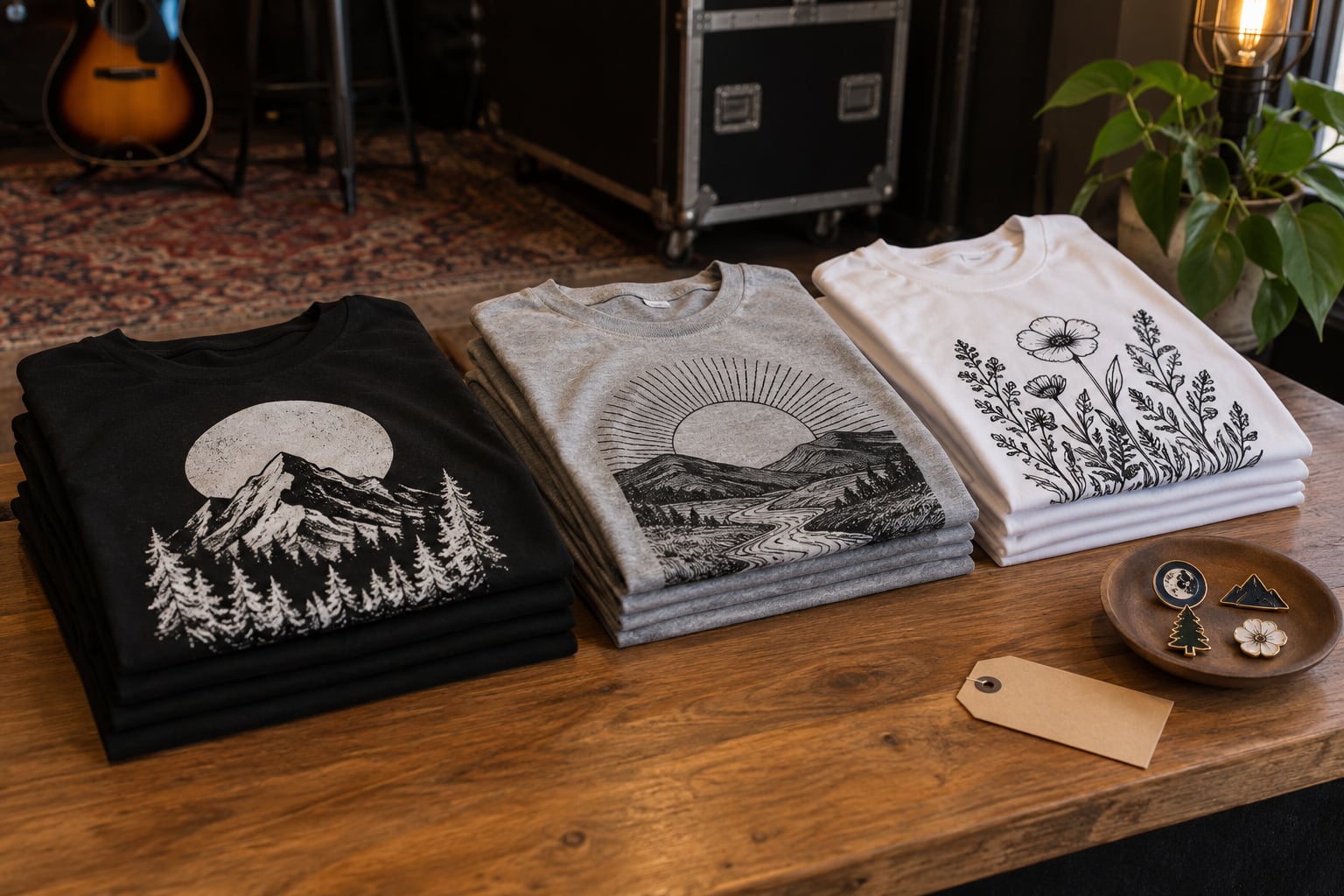
Why band shirts cost so much at shows comes down to five things: the blank garment and the printing on it, a commission the venue takes off every sale, freight and supply costs that jumped after 2020, minimum order quantities that punish small runs, and a tour that needs to pay for fuel and lodging before it pays anyone. A standard tee at a merch table in the US now usually sits between 35 and 50 dollars.
I have bought enough of these to feel the sticker shock personally, and I have read enough band budgets to know where the money goes. Neither side of that gap is a mystery, and most of it is not profit.
Table of Contents
- Why Band Shirts Cost So Much at Shows: Typical US Prices
- How band shirt prices have moved over the past 25 years
- What Affects the Price
- Ways to Save on Band Shirts
- Frequently Asked Questions
- How much should a band T-shirt cost?
- Why is concert merchandise so expensive now?
- Who sets the price: the band, the venue, or the merch company?
- Are concert shirts cheaper after the tour ends?
- Do band shirts hold their resale value?
- Is it appropriate to wear band merch to the concert?
- Start With the Design and the Official Seller
Why Band Shirts Cost So Much at Shows: Typical US Prices

These are typical US ranges. They vary by region, by tier of artist, and over time, so treat them as a benchmark rather than a quote.
| Item | Typical US range (USD) | What you get | Why it lands there |
|---|---|---|---|
| Standard cotton tee | 30 to 45 | Mid-weight blank, one or two print locations | Cheapest run size, simplest print |
| Heavyweight premium-blank tee | 45 to 60 | Retail-fit cut, thicker cotton, woven or printed tag | Better blank costs more before printing starts |
| Long sleeve with tour dates | 55 to 80 | Longer garment, more ink, dates printed per run | More fabric, more setup, smaller quantity |
| Limited colorway or venue-exclusive tee | 60 to 120 | A run that will not be reprinted | Scarcity, not better construction |
| Hoodie | 80 to 130 | Heavy fleece, often embroidered or puff-printed | Two to three times the blank cost |
| Sticker or patch | 5 to 20 | Cheap item, near-zero blank cost | Low price, high margin, cheap impulse buy |
| Vinyl at the table | 35 to 60 | Standard retail pressing | Venue markup on a format fans cannot test |
The pattern in that table matters more than any single line. A hoodie costing three times a tee is not a scam, it is a heavier garment with more ink and a much higher blank cost. A limited colorway costing twice a standard tee is not better made, it is simply gone once it sells.
How band shirt prices have moved over the past 25 years
Ballpark US prices for the cheapest official tee on a headline tour, before any adjustment for inflation:
| Era | Cheapest official tee (USD) | What changed |
|---|---|---|
| 2000 | about 20 | Tour merch was a sideline, often run by the merch company |
| 2010 | about 25 | Bon Iver and Arcade Fire era designs began circulating online |
| 2015 | about 30 | Online stores made leftover stock permanent fixtures |
| 2020 | about 35 | Supply costs and freight climbing, tours paused |
| 2026 | about 40 to 50 | Streaming payouts fell further, so merch carries more of the tour |
None of that is a pricing committee deciding to gouge anyone. Blanks got pricier, freight got pricier, and the band’s other income did not keep pace.
What Affects the Price
Here is the cost stack behind a mid-range tee, and why official merch is not simply a T-shirt plus a logo.
- The blank garment. A budget blank and a heavyweight retail-fit blank are different products. Cotton weight, fabric construction, sizing consistency and whether the tag is woven or printed all move the price, and the fan usually feels the difference more in year three than on day one.
- Artwork and setup. Every design needs a screen or a digital file prepared, separated by colour, and proofed. That setup cost is the same whether the band sells fifty shirts or five thousand.
- Printing method. Screen printing gets cheaper per shirt as quantities rise because the screens are already made. Direct-to-garment printing has no setup but costs more per unit, which is why it suits runs of a few dozen and why a spot for a date list on the front can be expensive.
- Embroidery and specialty finishes. Embroidered logos, puff print, foil and woven sleeve patches add real cost per unit. A hoodie with an embroidered chest logo is a different order from a hoodie with a printed one.
- Royalties and licensing. Songwriting splits and label fees come out of gross merch revenue on many deals. Nobody itemises this on the table, but it is part of the price.
- The venue cut. Venues typically take a commission of roughly 20 to 30 percent off the top for letting a band sell inside the building. This is the single most misunderstood line on the receipt.
- Tour overhead recovery. Fuel, lodging, crew wages, insurance and cancelled-date risk get folded into the price of the shirt. A local act quoted in a 2022 touring budget feature said fuel alone ate 60 to 70 percent of its tour budget.
- Minimum production quantities. Shirts are made in runs of a hundred or more per design. What does not sell becomes warehouse inventory, so the price includes a risk premium.
- Scarcity and format. A venue-exclusive colourway or a numbered run has fewer units to spread costs across, and scarcity is itself priced in.
Who actually sets the number is the question fans ask most, and the answer is usually the band or their manager. In a 100-plus comment thread on r/TrueAnon, fans argued about whether the venue or the merch company was driving the shelf price; the merch company sets cost, the band sets price, and the venue takes its percentage afterward.
Illustratively, on a 45 dollar tee sold at a venue that takes a quarter:
| Where the money goes | Rough share |
|---|---|
| Venue commission plus selling staff | 9 to 13 dollars |
| Blank garment and printing | 12 to 18 dollars |
| Merch company production, logistics and payments | 5 to 8 dollars |
| Tour overhead recovery | 5 to 8 dollars |
| Band and artist share | 3 to 6 dollars |
Notice where the profit sits. That is also why a 250 dollar hoodie from a rapper can exist alongside a 70 dollar Metallica tee that fans praise for feeling better.
Ways to Save on Band Shirts
You cannot renegotiate the venue commission, but you can change where and when you buy.
- Check the official online store first. Bands that sell at the table almost always list the same items online afterward, often at a lower price because no venue takes a cut and the card fees are known in advance. Searching for a tour-specific design after the run often beats buying it on the night.
- Use the official presale. Presale windows and fan club early access sometimes open online days before the show. Nothing about the shirt changes; only the demand at the table does.
- Skip the exclusive and take the standard. A venue-exclusive design carries a scarcity markup and nothing else. The standard tee is usually the same garment with a different print.
- Buy one design, not four. Merch tables are laid out to encourage a basket. Every extra item is another royalty split, another margin, and another thing you did not plan on.
- Set a number before you join the line. Fans on r/TouringMusicians and r/Blink182 describe the same pattern: decide what you want in advance and refuse the add-on at the table. It is far easier outside the queue.
- Ignore resale prices as a signal. A bootleg at 60 dollars after a show does not mean the official shirt was good value. It only means someone sold a fake after people missed out.
- For families, split the cost. The most common complaint in fan threads is a 200 dollar ticket followed by 200 dollars of children’s shirts. Decide the kid budget before you leave the house.
Frequently Asked Questions
How much should a band T-shirt cost?
For a standard tee on a mid to large tour, expect roughly 35 to 50 dollars at a US merch table. Heavyweight premium blanks usually run 45 to 60 dollars, long sleeves with tour dates 55 to 80, and hoodies 80 to 130. Small club shows and local support acts price lower. All of these are typical ranges that vary by region and change over time.
Why is concert merchandise so expensive now?
Blank garment and printing costs rose after 2020, freight and packaging got more expensive, and print minimums mean small runs cost far more per shirt than large ones. On top of that, streaming pays a fraction of a cent per play, so merch has become a larger share of what touring acts actually take home. Venue commission of about 20 to 30 percent comes out before the band sees anything.
Who sets the price: the band, the venue, or the merch company?
The merch company sets the cost of producing and supplying the shirt, and the band or their manager sets the retail price. The venue takes a commission off the top of every sale, usually 20 to 30 percent. That is why the same shirt can cost less online after the tour, since no venue commission applies to an internet sale.
Are concert shirts cheaper after the tour ends?
Frequently, yes. Once a run is over, leftover stock usually moves through the band’s official online store with no venue commission attached, so the same item can cost noticeably less. Tour dates and city names that only existed on a table design also tend to lose their premium. Check the official store before paying table prices.
Do band shirts hold their resale value?
Very few do. Most official shirts sell well below their original price on resale sites once the run ends, because there is no hard supply limit and printing can be repeated. Scarce, small-run or genuinely discontinued designs sometimes hold value, but the resale market mostly trades in fakes and mislabelled listings. Buy for the design, not the return.
Is it appropriate to wear band merch to the concert?
Wear whatever you like. Wearing the shirt of the act you paid to see is completely normal, and plenty of fans pick up a tee at the show specifically to wear that night. Wearing a different band’s merch to watch someone else is the choice people argue about, usually because it can read as a statement. There is no rule, only context and your own preference.
Start With the Design and the Official Seller
The first question is not why a shirt costs 45 dollars, but whether it is official and where the identical item costs less. Check the band’s own store, compare the fabric weight and print locations against what is on the table, and then decide whether a venue-exclusive colourway or a numbered run is worth a premium over the standard design.
Most of the time it is not, and you get the same shirt for less.