Why your ears ring after a show is mostly a matter of how much sound your inner ear absorbed and for how long. A loud set can push your hearing past its comfortable limit, and the ringing you hear on the walk home is your nervous system filling in a gap, not a band still playing.
For most people it fades within a few hours to a couple of days. It is worth taking seriously anyway, because the recovery window is the only warning your ears give you before damage stops being reversible.
Table of Contents
- Why Your Ears Ring After a Show
- What Happens to Your Hearing During a Show
- Why Your Ears Ring After a Show: Temporary Symptoms or Tinnitus?
- How Loud Is Loud Enough to Cause Ringing?
- What Can Make the Ringing Worse?
- What to Do When Your Ears Ring After the Music Stops
- Can Loud Music Cause Permanent Hearing Damage?
- How to Reduce the Risk at Your Next Show
- When Should You See a Doctor for Post-Show Ringing?
- Frequently Asked Questions
- How long should your ears be ringing after a concert?
- Do earplugs prevent hearing damage at metal shows?
- Can one very loud concert permanently damage my hearing?
- Why do my ears feel blocked after a show?
- Does aspirin or ibuprofen make tinnitus worse?
- When should ringing after a loud show prompt a hearing test?
- What to Do First After the Noise Stops
Why Your Ears Ring After a Show
Intense, prolonged sound overloads the tiny hair cells inside your cochlea, the fluid-filled organ of the inner ear. Those cells temporarily lose sensitivity, your brain fills the gap with its own tone, and you hear tinnitus. The sound is not physically sitting in your ear. When the cells recover, the phantom tone fades.
The distinction that matters is duration. Ringing that shows up in the car park and is gone by breakfast is a temporary threshold shift. Ringing that is still there a week later, or that keeps coming back after every loud show, is a different situation that deserves a proper hearing assessment.
One show does not automatically mean permanent damage. Repeated exposure is what tends to compound, so the useful mindset is not panic after a single loud night, it is noticing the pattern and changing something before it sets in.
What Happens to Your Hearing During a Show
Sound moves through the eardrum, across three tiny bones called the ossicles, and into fluid in the cochlea. That motion bends thousands of sensory hair cells, each tuned to a narrow range of frequencies. A kick drum at 60 Hz loads up the low end. A sustained guitar wall and a shouted vocal sit in the middle, where most of a mix lives and where ears are most sensitive.
Now add the room. A small, reflective venue with low ceilings and hard surfaces bounces sound back into itself, so the level at the bar can rival the level on stage. Peak levels during a loud live set routinely climb into the 100 to 110 dB range, with the source directly in front of you higher still.
Hair cells under that kind of load tire out and stop responding normally for a while. This is the temporary threshold shift. Sounds at the affected frequency seem muffled or dull, and the brain, which expects signal from that band, produces a substitute tone. That is the ringing.
Sometimes the ear feels blocked too. Forum regulars describe a stuffy, congested feeling in the ringing ear alongside slightly worse hearing, and it usually settles within about half a day. It is common after a loud night and is not on its own a sign of permanent injury.
Why Your Ears Ring After a Show: Temporary Symptoms or Tinnitus?
Tinnitus is simply the name for hearing sound with no external source. Almost everyone hears it briefly at some point. What people want to know is whether the sound they have right now is a short reaction to yesterday’s noise or something that needs medical attention.
| What you notice | When it usually shows up | Typical duration | What it points to | When to act |
|---|---|---|---|---|
| Ringing or a hum after one loud show | Immediately after, or on the drive home | A few hours to about two days | Temporary threshold shift from a single high exposure | Rest and reduce noise. Check in again if it passes a few days |
| Ringing after several shows in one weekend | After the second or third night of stacked exposure | Several days, sometimes longer | Cumulative exposure the ears have not recovered from between sets | Get a hearing test if it is still there after a week of quiet |
| Ringing that persists on most days regardless of shows | Not tied to any single event | Ongoing, fluctuating | Persistent tinnitus that needs clinical evaluation | Book an audiology appointment |
| Ringing with sudden hearing drop, severe vertigo or discharge | Sudden onset | Immediate | Not noise-related; needs urgent assessment | Same-day medical care |
Nobody can diagnose you from a chart, including us. Only a qualified clinician, ideally an audiologist or ENT specialist, can tell you what your specific symptoms mean. What the table gives you is a sense of which bucket you are standing in.
One detail people worry about unnecessarily: some people hear a high pitch, others a low hum or a rushing sound. Both are tinnitus. The tone varies with the frequency band your hair cells are protecting, so a different pitch does not mean a different problem.
How Loud Is Loud Enough to Cause Ringing?
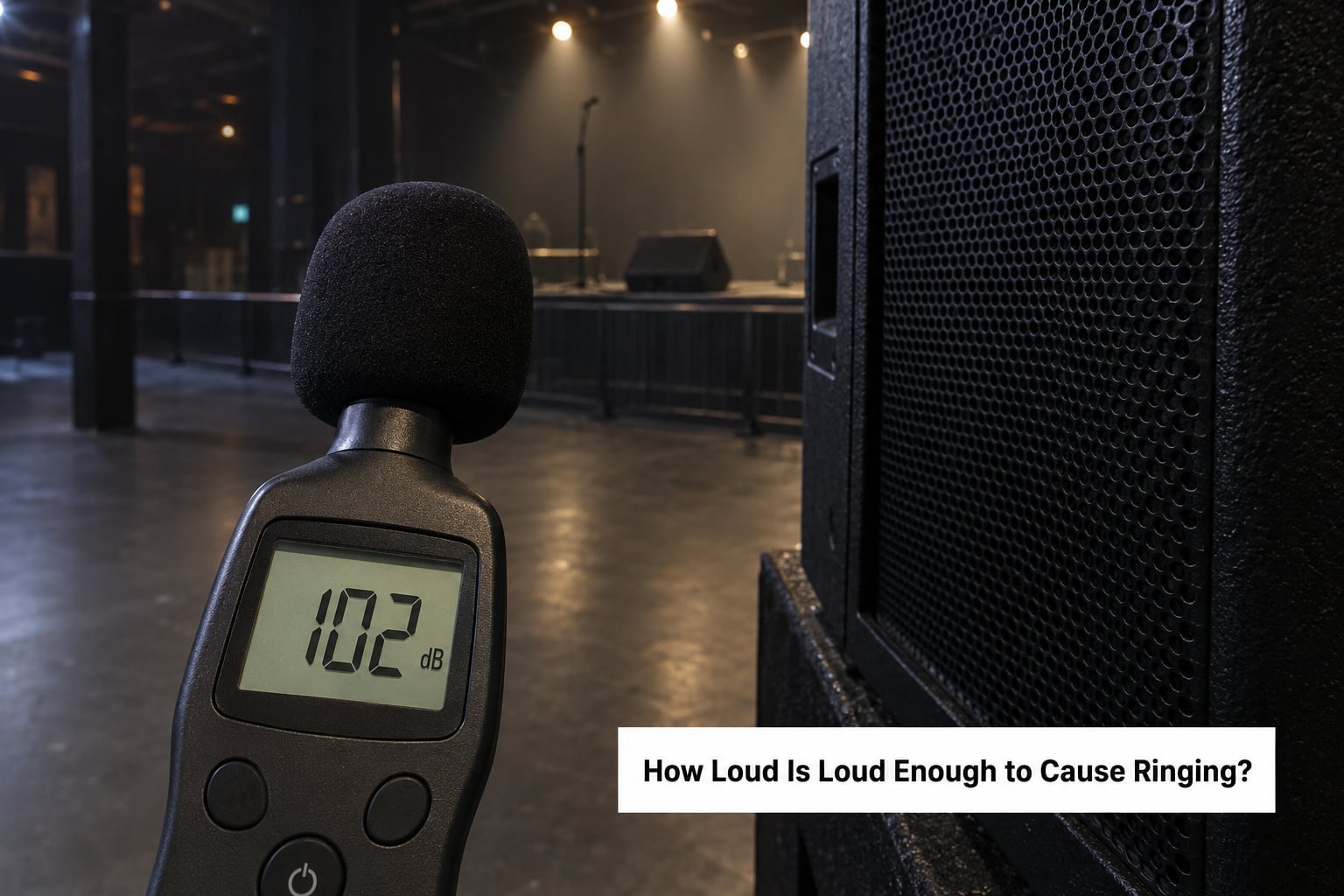
There is no universal safe volume. What matters is the combination of how loud the sound is, how long you are exposed, how far you are from the source, how often you repeat it, and how your own ears happen to be that day. Decibels are logarithmic, so a 10 dB increase is roughly a doubling of perceived loudness and a doubling of the strain on the ear.
| Sound | Approximate level | How long before risk builds |
|---|---|---|
| Quiet room at home | 30 to 40 dB | No meaningful risk |
| Normal conversation | 60 dB | No meaningful risk |
| Busy city street | around 85 dB | Roughly 8 hours at the daily limit |
| Bar or club floor, loud DJ set | 100 to 108 dB | About 15 minutes down to 1 to 2 minutes |
| Small club, front of stage | around 105 dB | Under 5 minutes |
| Arena floor, loud band | 105 to 110 dB | About 1 to 2 minutes |
| Directly in front of a stack | 110 to 115 dB | Seconds to well under a minute |
| Arena upper bowl, same show | around 95 dB | Roughly 30 minutes |
These time windows come from NIOSH guidance, which sets 85 decibels averaged over an eight-hour day as the recommended exposure limit for workers and uses a 3 dB exchange rate. Each additional 3 dB halves the safe time. At 100 dB that works out to about 15 minutes, and at 120 dB the window shrinks to under ten seconds.
That is the number most readers find startling. An hour at the front of a loud arena floor is not one exposure, it is four or more stacked ones. And the venue does not reset the counter between bands, because your ears do not either.
What Can Make the Ringing Worse?
Position is the biggest lever most people never think about. Standing at the barrier puts the speaker array roughly a metre from your head at levels that fall off quickly with distance, so moving ten metres back changes the dose more than any earplug you can buy.
Long sets without a break are the second one. Three bands back to back with twenty-minute gaps is a different exposure from one band with ninety minutes of quiet between sets, even when the average level looks identical on a meter. Festival weekends stack this further, since the ringing starts each night while it is still recovering from the night before.
Earplugs that do not fit do almost nothing. Foam plugs that have been rolled too thin or too thick leak, and cheap filtered plugs vary wildly in how much they actually attenuate. Plenty of people leave them half in after the first song without noticing.
Then there is the habit of ignoring it. Treating short-lived ringing as nothing is how a person ends up with a baseline hum they cannot switch off, because the episodes quietly stop fully recovering.
For the people who work the room rather than attend it, exposure is steadier and less obviously intense. Stage crew take hours of line checks with wedges and backline at close range. Front of house engineers sit at a mixing desk all evening with the PA pointed at them. Both groups often skip protection because the noise feels constant rather than peaky, which is exactly backwards.
What to Do When Your Ears Ring After the Music Stops
There is no instant off switch, and anyone promising one is selling something. What you can do is stop adding to the problem and give the ear the quiet it needs to settle.
- Get away from noise. Move into a quiet room rather than the street, the night bus or a club afterparty. The ear recovers in low-noise conditions, and more exposure delays that.
- Keep the volume down for a day or two. Skip headphones, speaker-based calls and loud podcasts. Background sound at a low level is easier on a sensitised ear than anything through earbuds.
- Use soft, steady ambient sound at night. A fan, a dehumidifier or low-level white noise can make the ringing less noticeable in a quiet bedroom, which helps sleep. Keep it below conversation volume.
- Note when it started. Write down the date and the show. Duration is the single most useful piece of information an audiologist will ask for.
- Watch for the accompanying symptoms. Muffled hearing, ear fullness, slight dizziness and fatigue in the next day or two are common. Track whether they improve together.
- Keep future shows quieter, not quieter-sounding. When you go back out, protection is what changes the outcome.
There is a version of this advice that needs saying plainly, because it circulates in forum threads: what does not work. Ibuprofen and other painkillers are not a tinnitus treatment, and taking them for this is not a good idea. Ear candling has no basis in how the ear works. Popping or clicking your ears to try to clear the pressure can add injury. Alcohol does not settle the ringing and tends to make sleep worse, which makes it more noticeable the next morning.
Do not use cotton swabs or anything else to dig at your ears afterward. You would be disturbing skin that was never part of the problem.
Can Loud Music Cause Permanent Hearing Damage?
Yes, and the way it happens is well understood. Repeated high-level exposure can produce lasting changes in hearing that do not recover the way a temporary threshold shift does. Government health bodies including the National Institute on Deafness and Other Communication Disorders describe noise-induced hearing loss as permanent, and they treat prevention rather than treatment as the main line of defence, since there is no established way to undo it.
A single extremely loud exposure, the kind that leaves you hearing a dull roar for days, can contribute to lasting change on its own. That scenario is uncommon enough that one show rarely means permanent damage, but it is real and it is the reason the rings should not be dismissed every time.
Repetition is the more common route. Each show you recover from teaches you that you can handle it. Five years of that is not five separate incidents, it is one long exposure with recovery periods in between, and the ears never fully return to where they started.
Ringing by itself does not prove permanent damage. Plenty of people who notice a hum after a loud night have a completely normal hearing test afterwards. What a test tells you, and what it cannot tell you, is one of the better reasons to get it done instead of guessing.
How to Reduce the Risk at Your Next Show
Protection works best when it is boring and consistent. Standing behind a second row and wearing the same plug every time beats any equipment you only reach for when things sound particularly intense.
Distance is the cheapest control you have. Sound pressure drops sharply with distance from a speaker, so the further you can get from the stack, the better. Higher floors and further-back positions in an arena are measurably quieter than the barrier, even though the music sounds better up close.
Take breaks. Stepping outside for ten minutes between sets gives the ear a recovery window that a solid block of three bands does not. It also puts a bit of distance between you and the person spilling a drink, which matters for reasons that have nothing to do with decibels.
Lower in-ear monitor volume if you play live or rehearse. Musicians routinely push monitors and wedges to levels they would never set for an audience, because you need to hear yourself and the rest of the band at once.
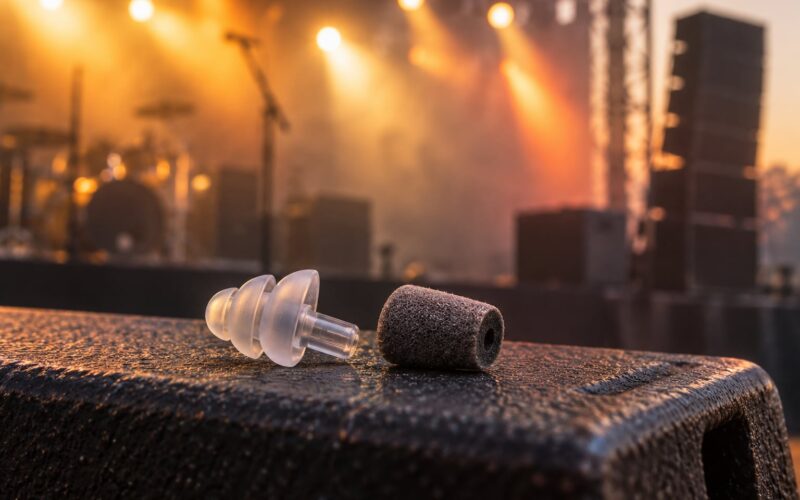
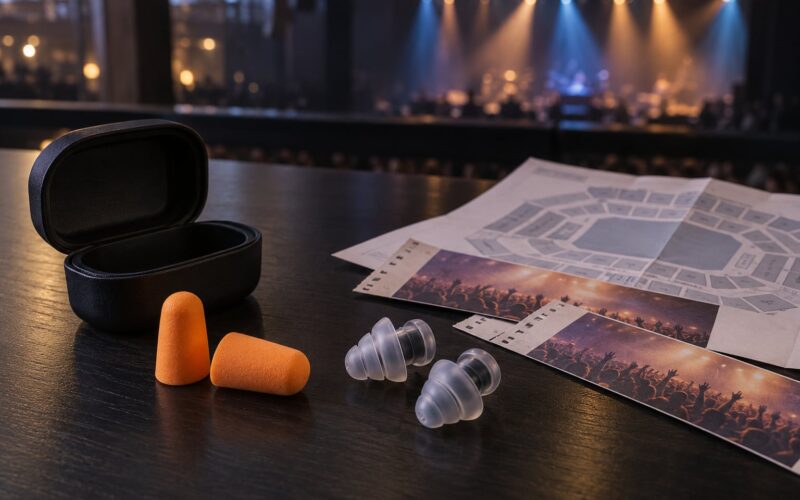
Know which protection you are actually using. Disposable foam plugs cut a lot of high-frequency sound and less low, which flattens music but reduces peak levels. High-fidelity filtered plugs use a filter that lets a controlled amount of sound through while cutting peaks, so the music keeps most of its shape. Custom-moulded plugs are fitted to your ear and are the most consistent, though they cost more and take an appointment. Over-ear defenders protect well and are impractical for most crowds unless you are in the pit or on crew.
Check the Noise Reduction Rating and apply it honestly. A lab figure is measured under ideal conditions and real-world fit is rarely ideal, so treat the number as a ceiling rather than a promise.
When Should You See a Doctor for Post-Show Ringing?
There is a version of this question that keeps people away from shows for years, and it is worth settling directly. Ringing that appears right after a loud show, fades within a day or two, and leaves your hearing as it was is the expected pattern for an overexposed ear. That experience on its own does not mean you should stop going out.
The same forums where people panic also hold the reassurance. Regulars in r/tinnitus describe the symptom lasting several days and clearing, and the bluntest summary in r/Excision is that it is completely normal when you subject yourself to loud noise without protection. The practical takeaway is not to fear the ringing, it is to change the exposure before it becomes a pattern.
Book a hearing test rather than a general appointment when ringing is still there after a week or two of low noise, keeps returning after each show, or has become a permanent background sound you cannot switch off. An audiologist can map your hearing, compare the affected frequencies against your history, and tell you whether you are looking at a recovering temporary shift or a lasting change.
See a doctor promptly if the ringing comes with sudden hearing loss in one ear, discharge, significant ear pain, or vertigo severe enough to stop you standing. Sudden single-sided hearing loss is treated as urgent because the window for recovery is short, and it is not something to wait out.
Worth raising at the same time: ordinary sounds feeling sharp or painful after a loud night is a separate thing called hyperacusis. It often shows up alongside tinnitus and it is the symptom more likely to keep people home, so mention it rather than assuming it is anxiety. It normally settles as the ear recovers.
Frequently Asked Questions
How long should your ears be ringing after a concert?
Most post-show ringing fades within a few hours, and often within one to two days. Longer episodes of three to seven days are reported often enough to be ordinary. A week or more of ringing without any loud exposure is beyond the typical window, so arrange a hearing test. Sudden hearing loss, severe vertigo or ear pain needs same-day medical care rather than waiting.
Do earplugs prevent hearing damage at metal shows?
They reduce exposure, though they cannot make a loud show risk-free. Foam plugs cut a lot of high frequencies and less low ones, which dulls the music. High-fidelity filtered plugs tame peaks while keeping more of the mix intact. Fit matters more than the label: a plug worn loosely protects very little, and rated protection is measured under ideal conditions.
Can one very loud concert permanently damage my hearing?
A single extremely loud exposure can contribute to lasting hearing change, though it is uncommon, and most one-off shows do not cause permanent damage on their own. Repeated high-level exposure across many shows is the more usual route to lasting change. Ringing alone does not prove permanent injury. If it is still present after a week or two of quiet, have an audiologist check.
Why do my ears feel blocked after a show?
A stuffed, congested feeling in the ear after loud music is common and usually settles within about half a day, often alongside slightly reduced hearing and the ringing itself. It tends to ease once the ear recovers from the noise. See a doctor if the fullness persists for more than a week or comes with pain, discharge or significant hearing loss.
Does aspirin or ibuprofen make tinnitus worse?
Some anti-inflammatory painkillers can worsen tinnitus at higher doses, and salicylates such as aspirin are a recognised trigger for some people, so they are not a fix for post-show ringing. Nothing taken at the counter stops it. Keep the ear quiet, avoid further loud exposure, and take any medication questions to a pharmacist or your doctor.
When should ringing after a loud show prompt a hearing test?
Ask for an audiology appointment when ringing persists beyond a week or two of low noise, keeps returning after every show, or has settled into a permanent background sound. An audiologist can map your hearing and compare it against your exposure history. A test is also worth having before you book another loud run of shows.
What to Do First After the Noise Stops
Get away from loud sound and stay there. Keep the volume low for the next day or two, use soft ambient noise at night so the ringing is less obvious, note the date the ringing started and roughly when it changes, and keep an eye on muffled hearing, ear fullness and any dizziness.
If it fades within a couple of days, you had an overexposed ear and a very loud night. If it is still there after a week of quiet, keep it that way with protection and distance rather than a familiar volume. If it comes with sudden hearing loss, severe vertigo or pain, get to a doctor the same day.
None of this stops the ringing tonight. It decides whether the next show is the one that finally makes you reach for protection. Updated for October 2026.