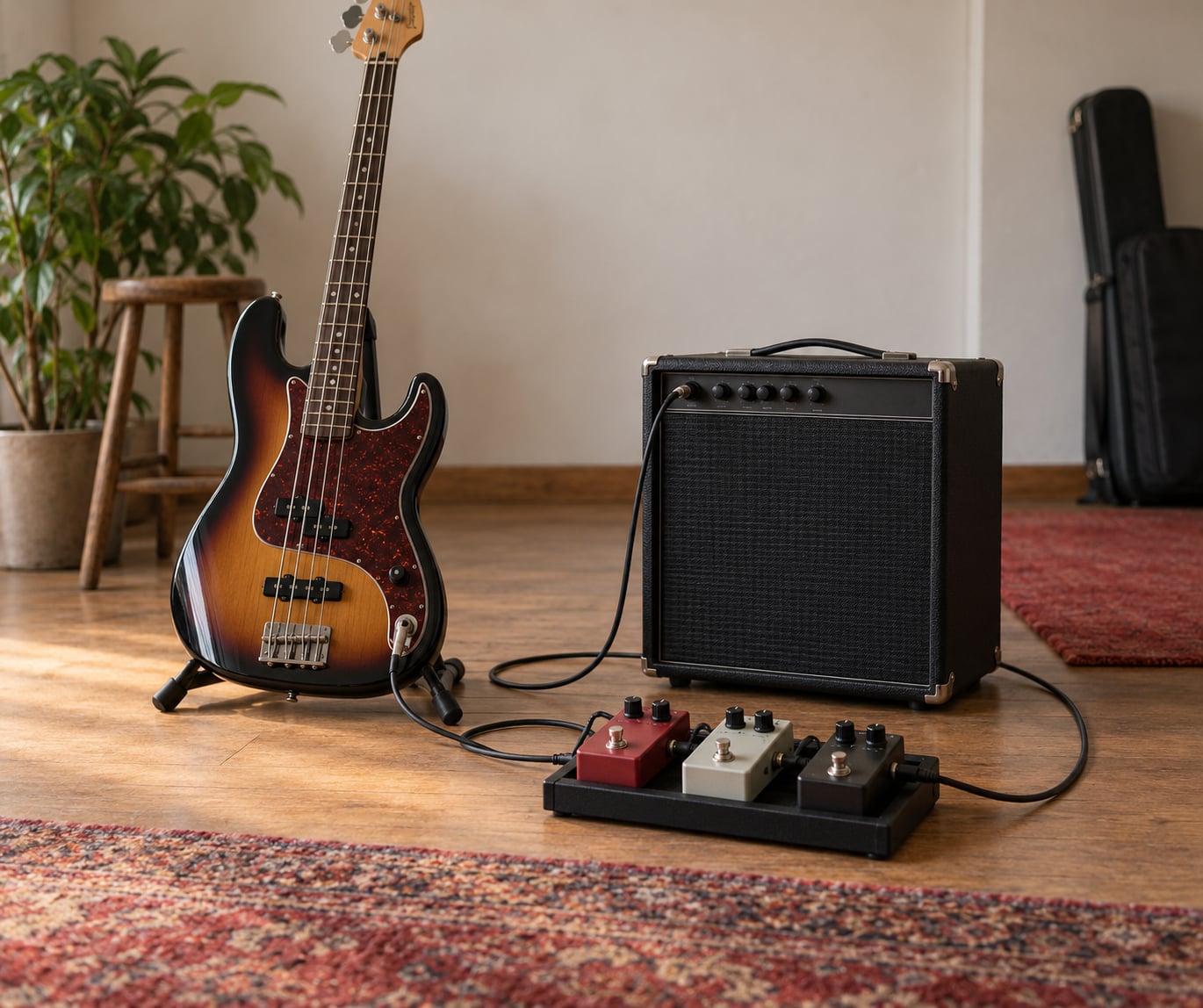
How metal bass players get that gritty tone is not one magic pedal. It is a signal chain: split the bass into a clean path and a drive path, high-pass the drive path around 250Hz so it tightens before it saturates, and blend the two back together so distortion adds bite without swallowing the low end.
That single idea resolves most of the arguments you will read about this topic. Players spend months stacking fuzz pedals trying to make a bass sound heavy when what they actually wanted was harmonics sitting on top of a clean fundamental. Once you hear those two layers running in parallel, the muddy-versus-clear debate stops being a tradeoff.
It also explains why the tone so often disappears in a band mix. A bass that only carries weight at 60Hz has nothing left to say once an 8-string guitar and a kick drum are sitting on the same frequencies. Grit, in this context, is mostly upper-harmonic content, and upper harmonics are what survive on a small PA and on a phone speaker.
This guide takes about ten minutes to read and a weekend to dial in. Start with the instrument and amp fundamentals, add controlled saturation, then use EQ and compression to make the tone work with the band. Skip to the signal chain section if you already have a working amp.
Table of Contents
- The Anatomy of a Gritty Metal Bass Tone
- How Metal Bass Players Get That Gritty Tone at the Source
- Choosing an Amplifier and Cabinets for Aggressive Tone
- Distortion and Saturation: Grit Without Losing Definition
- EQ, Compression, and the Low-End Control Problem
- How to Recognize a Tone That Fits the Band
- Frequently Asked Questions
- What amp settings give a gritty metal bass tone?
- Do metal bassists need a distortion pedal to get a gritty sound?
- Should I record a metal bass through an amp or DI?
- Why does my distorted bass sound muddy instead of aggressive?
- What is the best effects order for a gritty bass tone?
- Can a bass with passive pickups produce a heavy metal tone?
- Conclusion
The Anatomy of a Gritty Metal Bass Tone
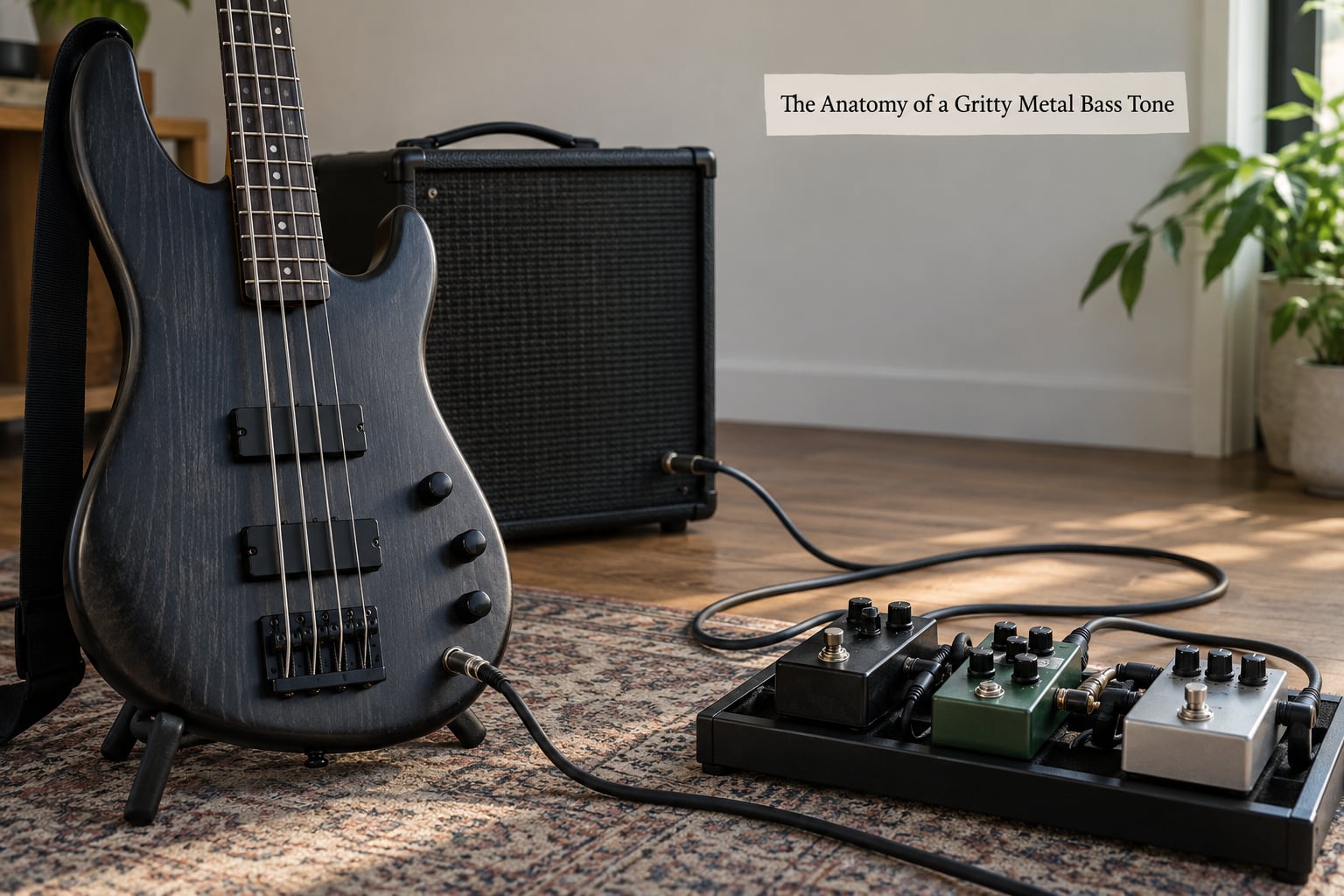
A gritty metal bass tone is a thick, aggressive bass sound built from three layers: distortion that adds upper-harmonic bite, a parallel clean signal that preserves low-end weight and note definition, and EQ shaping that tightens the low end while scooping the mids so the bass does not clash with distorted guitars.
None of those three layers is optional on its own. Dirt without clean underneath sounds like a broken speaker. Clean underneath with dirt on top but no EQ sounds like a fight between two instruments. The tone is the combination, and it is worth learning the vocabulary before you start shopping for anything.
- Grit – the buzzy high-frequency harmonic content that distortion adds. It is what makes a bass cut through, and it lives well above 1kHz.
- Clank – percussive, transient-heavy attack. Comes from the pick contacting the string and from mid-forward EQ, and it is what modern metalcore players chase.
- Scoop – a deliberate cut around the 400Hz to 800Hz range so the bass does not compete with the guitars for the same space.
- Fizz – harsh sibilant artifacts in the top octaves, sometimes called the can of bees. It is the number one failure mode players report.
- Blend – the control that mixes a clean bass layer with a distorted one. Bass dirt pedals have one, guitar distortion pedals do not.
- Compression – the levelling stage that keeps the low end steady whether you are palm-muting eighths or hitting a sustained note.
One more term worth knowing is saturation. Saturation is soft clipping: the signal is pushed past the linear range of a circuit, harmonics get added, and the wave shape rounds off. Distortion, fuzz, and tube overdrive are all forms of saturation, and they do not sound remotely alike.
How Metal Bass Players Get That Gritty Tone at the Source
Before a single effect, the tone is already partly decided. A heavy string gauge, a set of active pickups, a bridge sitting far back on the neck, and a right hand that plays harder than it needs to will get you closer than any pedal order.
Strings and setup. Fresh strings come up constantly in player forums as the cheapest clarity upgrade there is. Stale strings deaden the top end, and top end is what you are trying to boost. A slightly heavier gauge adds bite and helps low frequencies stay tight under compression. If your tone sounds dull no matter what you plug in, change the strings first.
Flatwounds are the counter-move. Players who find gritty tones getting harsh report that flatwounds smooth the top and pull the emphasis back toward the lows and mids. Roundwounds give you attack; flats give you control.
Pickups. Passive pickups with a fairly hot, low-impedance design put out a stronger signal than many players expect, which makes it easier to drive an amp or a preamp into saturation. Active pickups give a compressed, extended-range sound, and users report reaching a target aggressive tone faster in passive mode than with an aggressive active EQ curve fighting them.
Bridge position. A bridge seated closer to the neck produces a thinner, more nasal tone with the emphasis in the upper mids. Closer to the bridge gives more low end and more midrange bite. Players chasing clank often move toward the bridge.
Right hand. Fingerstyle players get their attack from the plucking force and from how close the fingers sit to the string. Pick players get it from pick material, angle, and how much the pick digs into the string before release. Palm muting is a technique rather than a setting: rest the edge of your picking hand on the bridge and you remove the low end, the sustain, and most of the attack, which is exactly why it is so common in heavy riffs.
How Metal Bass Players Get That Gritty Tone: The Signal Chain
Here is the routing that most working rigs end up at, whether the split happens with a blender pedal on stage or on two tracks in the DAW. The order matters less than the fact that both paths exist.
- Split the signal. Send the raw bass to two paths at once. On stage that is a blender pedal such as a Boss LS-2 or an EHX Switchblade Pro. In the studio it is a DI plus a second amplifier or impulse response track.
- Filter the clean path. Put a low-pass filter on the clean layer so it handles the weight. Rolling off somewhere in the 2kHz to 4kHz region keeps the clean layer from competing with the drive layer up top.
- Filter the drive path before it saturates. A high-pass filter set around 250Hz before the drive stage is the single most repeated recommendation in the player forums I read for this topic. The distortion then has less low-frequency material to mush together, so the result is punchier and far more mix-friendly.
- Shape after the drive. Scoop the mids once the grit is there. Distortion adds midrange energy, and guitars are already stacked in that range, so a post-drive cut around 500Hz to 700Hz is often the difference between a bass that sits under the band and one that fights it.
- Blend. Start with the drive quieter than you think and bring it up. If the blend is at maximum, you are hearing only harmonics. Most players settle somewhere with the clean layer clearly in front and the drive layer sitting on top as bite.
For fingerstyle players, keep the clean layer dominant. Plucked attack gets lost under heavy drive faster than picked attack, so the blend leans toward clean unless you are playing riffs rather than lines.
Choosing an Amplifier and Cabinets for Aggressive Tone
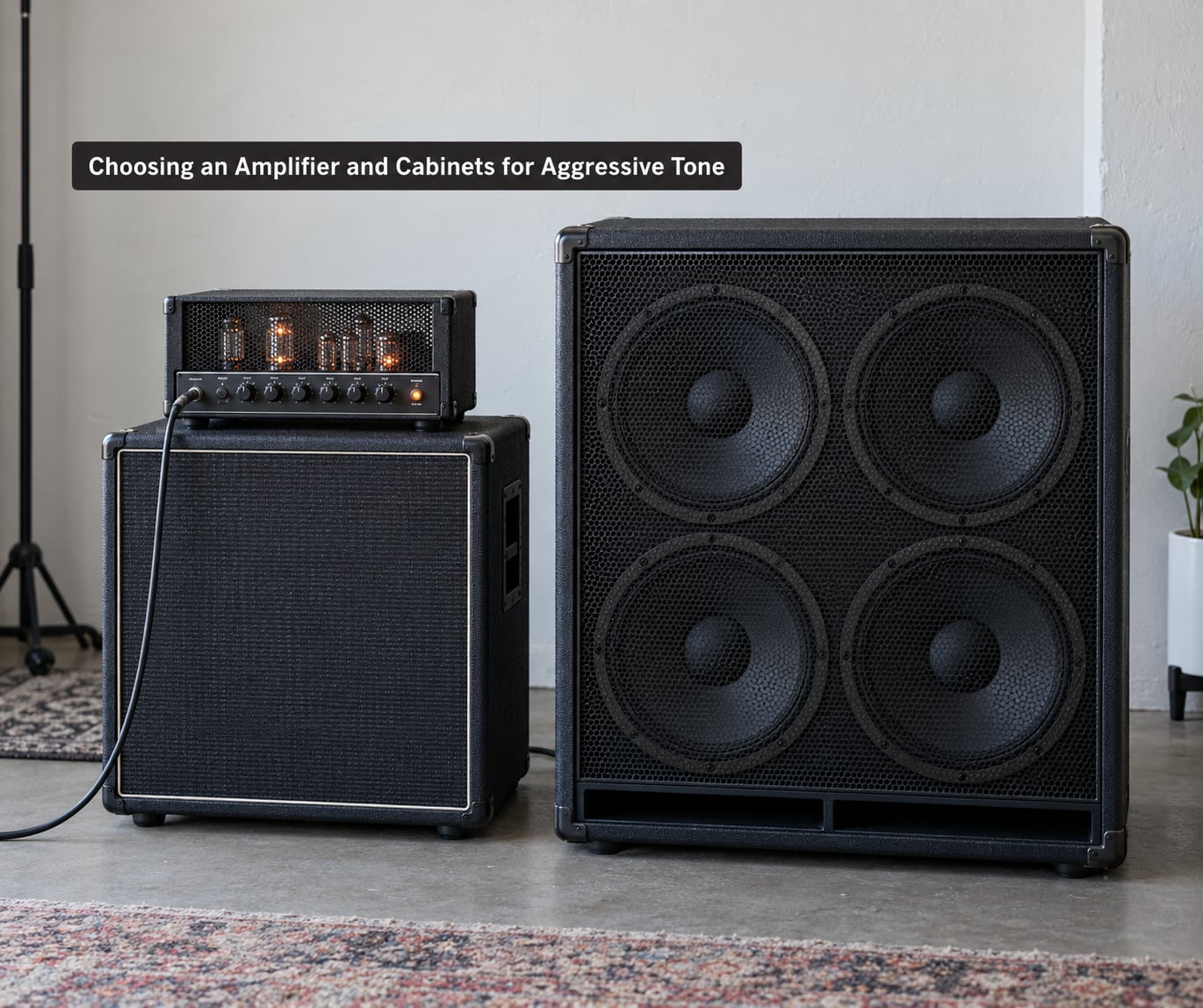
The amp is the tone’s foundation and, more often than not, its source of dirt. There are four approaches and they produce noticeably different results.
Solid state. Clean, tight, and very predictable. Most solid-state heads have a drive circuit of some kind, and when it clips it clips hard. With a high-pass filter in front of it and a blend behind it, a solid-state drive channel will cover the gritty part of the job.
Tube. A low-wattage tube amp pushed toward the edge of breakup gives the smooth, round saturation most players describe as the sound they are chasing. This is the approach repeatedly named in forums as power tube overdrive, and it is a different animal from preamp clipping: softer, more compressed, less fizzy. Jack Bruce and Lemmy are the reference points people keep coming back to.
Hybrid. A tube preamp feeding a solid-state power section. You get most of the preamp character without needing a power amp to match.
Modeling. Modern amp and cabinet simulators can place a virtual tube preamp, a compressor, a drive block, and an impulse response in one routing, which is a bi-amp style setup in a single unit. Fractal Audio players describe combining these blocks as the equivalent of splitting the signal, which is exactly what it is.
Cabinet size and placement. A 4×10 gives tight, punchy low end and plenty of mid/high definition from the ten-inch cones. A 8×10 or a 4×12 moves more air and adds high-frequency output, which is also how fizz sneaks into a live rig. Raising the cab off the floor by a few inches, or angling it toward your ears, fixes a surprising number of tone problems that are really room problems.
Room acoustics matter as much as the amp. A bright, reflective practice room makes everything harsh; a heavily treated rehearsal space does the opposite. Before blaming the pedal, try moving the cab a foot to the left.
Distortion and Saturation: Grit Without Losing Definition
Not all dirt is the same, and picking the wrong kind is the most common reason a bass ends up sounding like a kazoo instead of a bass. Four approaches come up constantly.
Fuzz. Fuzz is extreme, square-wave clipping. On bass it collapses the fundamental, and players describe the result as unmusical. The Boss ODB-3 is the pedal everyone asks about for metal, and it is also the one most often described as too fuzzy. It is not a bad pedal; it is a different goal.
Overdrive. Soft clipping, gentle harmonic addition, pitch preserved. A passive tone control with a compressor in front of a tube preamp can produce smooth overdrive with no pedal at all.
Distortion. Harder clipping with more harmonics. Guitar distortion pedals fall here, and a surprising number of players use them on bass successfully. Blur ran a RAT on bass, and T.M. Stevens made the Metal Zone famous for exactly this approach.
Preamp saturation. Clipping inside the amplifier’s preamp. Bright, aggressive, and fizzy compared to power tube overdrive.
Power tube overdrive. The power stage pushed into breakup. Smooth, round, and the sound most people mean when they say gritty without the fizz.
There is an inverse strategy worth trying before you buy anything. Set your overdrive pedal’s gain to zero, blend it fully wet, and let the amp supply the dirt. One heavily upvoted answer on TalkBass describes this exact setup. The pedal becomes a blend control rather than a dirt source.
How the gain and bass controls interact is the practical part. Turning up gain and turning down bass in roughly matched amounts keeps the perceived weight steady while the grit increases. Turn up gain alone and the low end collapses. Palm-muted riffs tolerate much more gain than walking lines do, and lead passages need less still, since the harmonics are doing the talking.
EQ, Compression, and the Low-End Control Problem
Frequency shaping is where grit becomes usable. These are starting points, not rules, and they assume the parallel blend described earlier.
| Frequency or stage | What it controls | Starting point |
|---|---|---|
| 40Hz to 60Hz | Sub weight and headroom | High-pass around 35Hz to 45Hz; anything below is felt, not heard |
| 100Hz to 200Hz | Fundamental body and mud | Trim here first when the tone is thick and formless |
| 400Hz to 800Hz | The clash zone with guitars | Scoop 3dB to 6dB after the drive stage |
| 800Hz to 2kHz | Clank and midrange bite | Small boost, or none if the drive is already adding it |
| 4kHz and up | Attack and fizz | Low-pass or boost carefully; this is where the bees live |
| Compression | Consistency of low end | Slow-ish, moderate ratio, after the blend |
The muddy problem has a standard answer. Turn the gain down, add a high-pass filter before the drive, and scoop the mids after it. If it is still formless, the blend is too far toward the dirty layer.
The fizzy problem has a different answer, and this is where most advice goes wrong. Players instinctively pull the treble knob down, which thins the whole signal including the attack you were trying to build. Low-pass filtering above the problem band is the recommended fix: keep the top-octave energy, remove only the harshest content. On stage that means a pedal or amp with a low-pass control, or turning off a tweeter or hi-fi speaker that is spiking the top end.
Passive tone controls and active treble cuts follow different contours, and players who fight an active EQ curve sometimes find that rolling passive treble back while boosting active treble gives a low-treble, high-mid boost without the buzz.
How to Recognize a Tone That Fits the Band
A gritty tone in isolation is easy. A gritty tone that works is a judgement call, and there is a practical way to make it.
Play the riff with nothing else. Then play it over a kick and snare loop. Then put a guitar on it. Each addition changes the answer, and most problems show up at step two or three rather than step one.
Check it in two volumes. Rehearsal volume tells you about clarity. Show volume tells you about low-end survival, because the stage adds its own low-frequency reinforcement and rooms that felt controlled at practice level can turn to mud in a club. If the tone only works in one of those conditions, it is not finished.
When the bass disappears, work out which of the three things is at fault. A tone problem is frequency content you can fix with EQ or gain staging. An arrangement problem is the bass being asked to occupy space the guitar already owns. A mix problem is the guitars sitting too low or the whole record being too loud in the low mids. Bumping the bass volume fixes the third one and none of the others.
Metallers have used this signal-splitting approach with varying degrees of intent for decades. Geezer Butler and Lemmy built very different tones, and Billy Sheehan’s crossover technique of splitting highs and lows into separate amps is the direct ancestor of everything described here.
Frequently Asked Questions
What amp settings give a gritty metal bass tone?
Start with the gain moderate rather than maxed, scoop 3dB to 6dB around 500Hz to 700Hz, and keep a low-pass control ready for the top octave. A high-pass filter set near 250Hz in front of the drive stage tightens the low end before saturation. The real setting is the blend between your clean and dirty layers, not the gain knob itself. Most players find more gain, less bass, and a quieter drive layer gives the most usable grit.
Do metal bassists need a distortion pedal to get a gritty sound?
No. A tube amp pushed toward the edge of breakup, an amp drive channel with a blender pedal, or an amp simulator can all supply it. Many players use a distortion pedal with the gain at zero and the blend fully wet, so the pedal only mixes clean with dirty while the amp provides the saturation. Adding a pedal for more gain usually makes the tone thinner and harder to place in a mix.
Should I record a metal bass through an amp or DI?
Record both. Take a clean DI and a separate amplifier or impulse response track, then blend them in the mix with the same balance you would use live. Common practice is a low-passed, heavily compressed DI holding the low end under a grindier layer that supplies upper harmonics. That approach keeps the bass audible on small speakers even when the fundamental clashes with the guitars.
Why does my distorted bass sound muddy instead of aggressive?
Almost always the low end arriving at the distortion stage. Put a high-pass filter around 250Hz in front of the dirt, turn the gain down, and pair it with a post-drive scoop in the 400Hz to 800Hz range. If the blend is heavily weighted toward the distorted layer, the note loses its fundamental. Pull the drive level back and let the clean path carry the weight.
What is the best effects order for a gritty bass tone?
Work from the bottom up. Compressor or light gain staging first, then the drive or saturation stage, then EQ including any scoop and fizz control, then the parallel blend back to the clean signal. Noise control or gating goes after the blend, not before it. In the studio the same order applies on two parallel tracks rather than one chain.
Can a bass with passive pickups produce a heavy metal tone?
Yes, and plenty of players report reaching an aggressive target faster with passives than with an active EQ curve. Passive pickups with a hot coil and low impedance can drive an amp or preamp into saturation without needing a gain boost. What matters is output level, not the passive or active label. Check that your strings are fresh and your bridge position matches the tone you want.
Conclusion
The signal chain is the whole thing. Split the bass, keep a clean low end, high-pass the drive path around 250Hz, scoop the mids after the saturation, and blend the dirty layer back underneath the clean one. Everything else is refinement on that structure.
If you only make one move this weekend, change your strings, set up a clean-and-dirty blend with whatever amp drive you already own, and leave the drive level quieter than feels right. Then play it over a guitar and a kick and listen for whether the note still has a pitch. If it does, you are most of the way to a gritty metal bass tone.