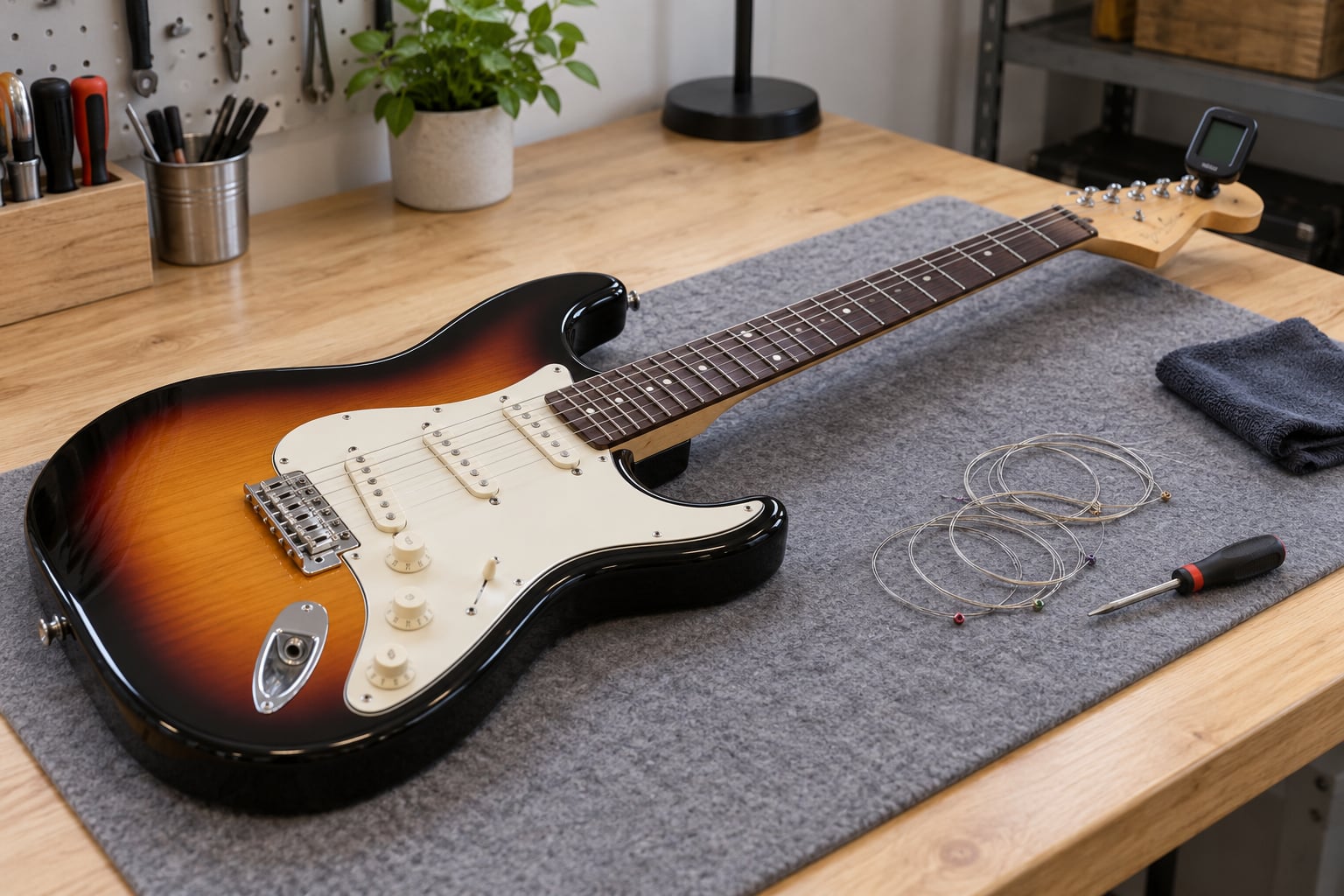
To tune a guitar to drop D, lower your thickest sixth string from E down to D — one whole step, two semitones — and leave the other five strings exactly where they are. The result is D-A-D-G-B-E, and the open bottom three strings now form a D5 power chord you can grab with one finger. It takes about two minutes with a tuner.
That two-string-free change is why drop D became the default tuning for so much metal. Instead of root, fifth and root across the bottom three strings, you get a clean power chord the moment you mute the other strings and hit the open D.
Here is the short version before the detail: tune the sixth string, check the other five are still standard, stretch the strings, then check again.
Table of Contents
What You Need
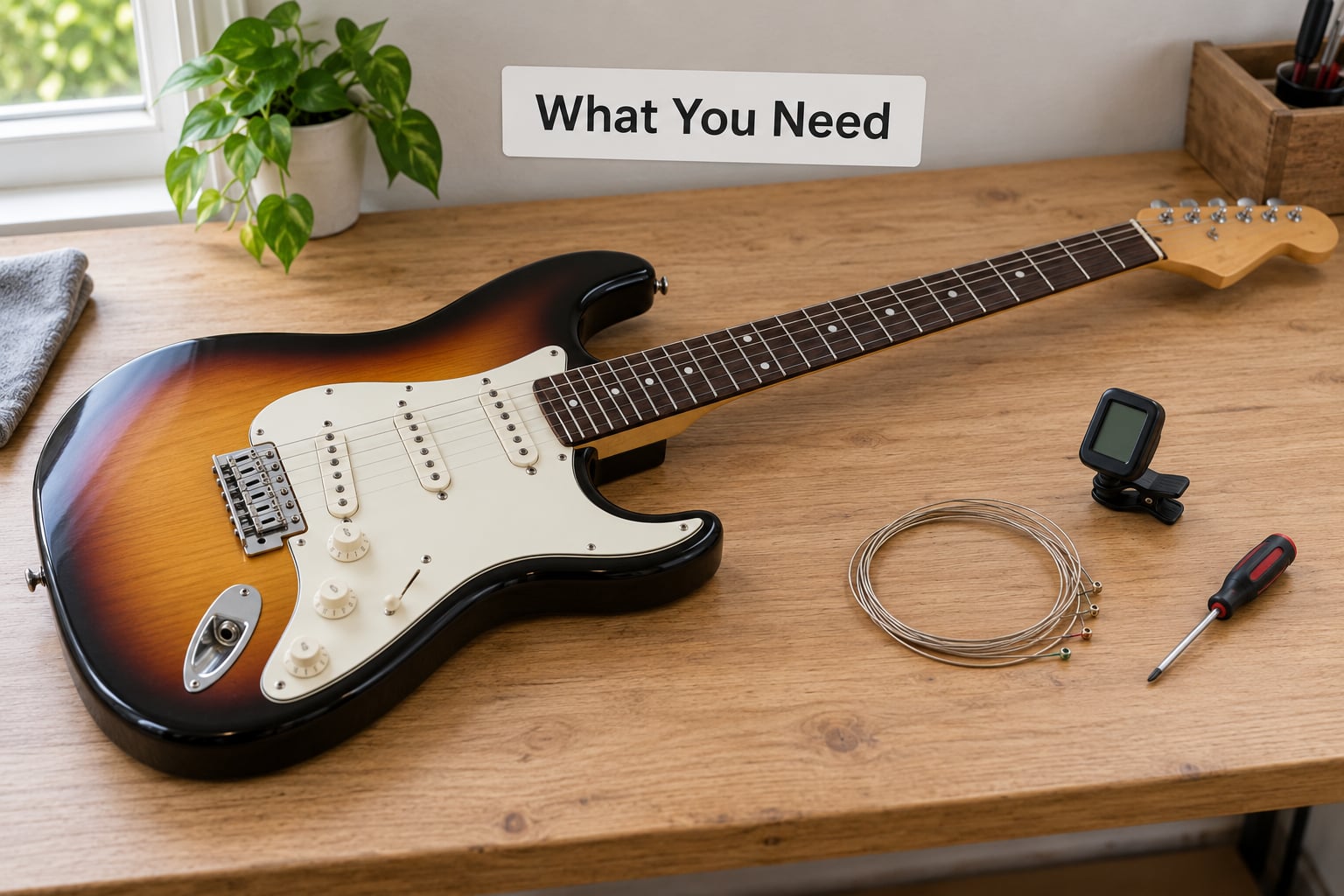
Drop D is not a fussy setup. You need very little, and most of it you probably already own.
- A tuner. A cheap clip-on works, a phone app works, and any hardware pedal tuner works. Accuracy matters more than price here.
- Fresh strings, ideally. Dropping a string two semitones loosens it noticeably, and an old set that has already stretched will not hold pitch as well.
- A soft cloth or a fretboard guard. When you lower and re-tune a string it whips around the headstock more than you expect.
- A clear work surface. Guitars get dropped when you are leaning over them trying to read a tuner at a bad angle.
A flat-head screwdriver is worth having nearby, but only if your guitar has a truss rod and you know what you are doing there. The tuning itself needs no tools beyond the tuner.
One piece of safety advice: if your guitar is old, has a floating tremolo, or has visible rust on the frets, get a setup before you start cranking things down. Dropping a string changes neck tension, and neck tension changes action.
Step-by-Step: How to Tune a Guitar to Drop D for Metal
Standard tuning is E-A-D-G-B-E, low to high, written EADGBe. Drop D is D-A-D-G-B-E, written DADGBe. Only the sixth string moves. Everything else stays put, which is why the change feels smaller than it sounds.
1. Check Your Guitar and Strings Before You Drop Tune
Sit down with the guitar in playing position, not on its back on a table. A guitar flat on its back reads differently on a tuner than one held against your body, and the difference is enough to leave you a semitone off.
Look at the strings. The sixth string is the thickest one, the one furthest from your face when the guitar hangs at your side. If the low string looks furry, rusted, or has a kink in it from being pushed down and back up too many times, replace the set now rather than after you have tuned down.
Play the low string open and listen. A dead thud means a bad string. A clear note with no fret buzz means you are starting from a healthy place.
2. Tune the Low E String Down to D
This is the whole trick, and the direction matters. Turning the machine head to loosen the string drops its pitch. On a standard three-per-side headstock the sixth string peg is on the top left, and loosening means turning it anticlockwise when you look straight at that peg from the front of the headstock. On a single-side six-a-side headstock the pitch direction is the same for every string, so you are looking at the string end rather than the back of the machine.
If you turn the wrong way and the needle on your tuner keeps climbing instead of dropping, stop and go back a quarter turn. This is the single most common beginner mistake, and it takes about four seconds to fix.
Watch for overshoot. Turning the peg at normal speed, the low string passes from E to D quickly because the string is slack and responsive. Small movements, then check, then move again. Aim for 73.4 Hz on an A440 reference if your tuner shows frequencies, or the D marker on the note display if it does not.
3. Tune the Remaining Five Strings
Strings five through one stay in standard tuning. Work from the fifth string down to the first and check each one rather than assuming:
- 5th string: A (110.0 Hz)
- 4th string: D (146.8 Hz)
- 3rd string: G (196.0 Hz)
- 2nd string: B (246.9 Hz)
- 1st string: E (329.6 Hz)
Here is why that matters. Your low D at 73.4 Hz and your fourth string at 146.8 Hz are two octaves apart, not one. Muting the other five strings and playing only the open sixth gives you a clean D at the bottom, and the fourth string D sits exactly two octaves above it. If your fourth string is sharp, the gap disappears and those octave checks will not match.
That relationship is the fastest way to catch a mistake. Play the open sixth string, then fret the fourth string at the 12th fret. They should sound identical. If the 12th fret sounds sharp, you have intonation or tuning work to do.
4. Check Your Guitar’s Tuning Stability
New strings and newly dropped strings both need settling. Press each string down gently behind the nut and behind the bridge, pulling it slightly toward the neck, and give it a few firm but controlled tugs. Then run your palm across the fretboard and check the tuner again. Repeat this two or three times.
After that, play something. Not a full speed riff — slow power chords and palm-muted notes, checking the tuner every minute or so. A guitar that is a semitone sharp on the sixth string after twenty minutes of playing has usually settled a half turn loose, and the fix is one more correction rather than a different gauge of string.
If your guitar has a floating tremolo such as a Floyd Rose, add a step. Loosen the string at the fine tuner, do the drop, tighten the fine tuner to bring the pitch back up, then set the floating block to the height you want before you fine-tune with the bridge screws. Dropping the sixth string changes the balance of the whole trem system, and a naive tune-up will pull the bridge forward and flatten everything else. If this is your first time with a double-locked guitar, have a tech set the spring balance before you change tunings.
5. Know the Drop D Notes and Riffs
Standard drop D is D-A-D-G-B-E. That is not the same as full D tuning, which drops the top two strings as well and is a completely different instrument to learn.
What drop D does is move every E-based shape down a whole step. A power chord you played on the bottom three strings in E now sits on the bottom three strings in D without moving your fretting hand to a different root. More practically, you gain two useful low notes: the open D on the sixth string and the D a whole step below it at the second fret. Those two notes are the whole vocabulary of a lot of metal riffing, and they are the reason pedal tones work so cleanly in this tuning.
Strings five and up are untouched, so anything you already know in standard tuning still works at the same fret. Drop D is a one-string change, not a new instrument.
Common Mistakes and How to Fix Them
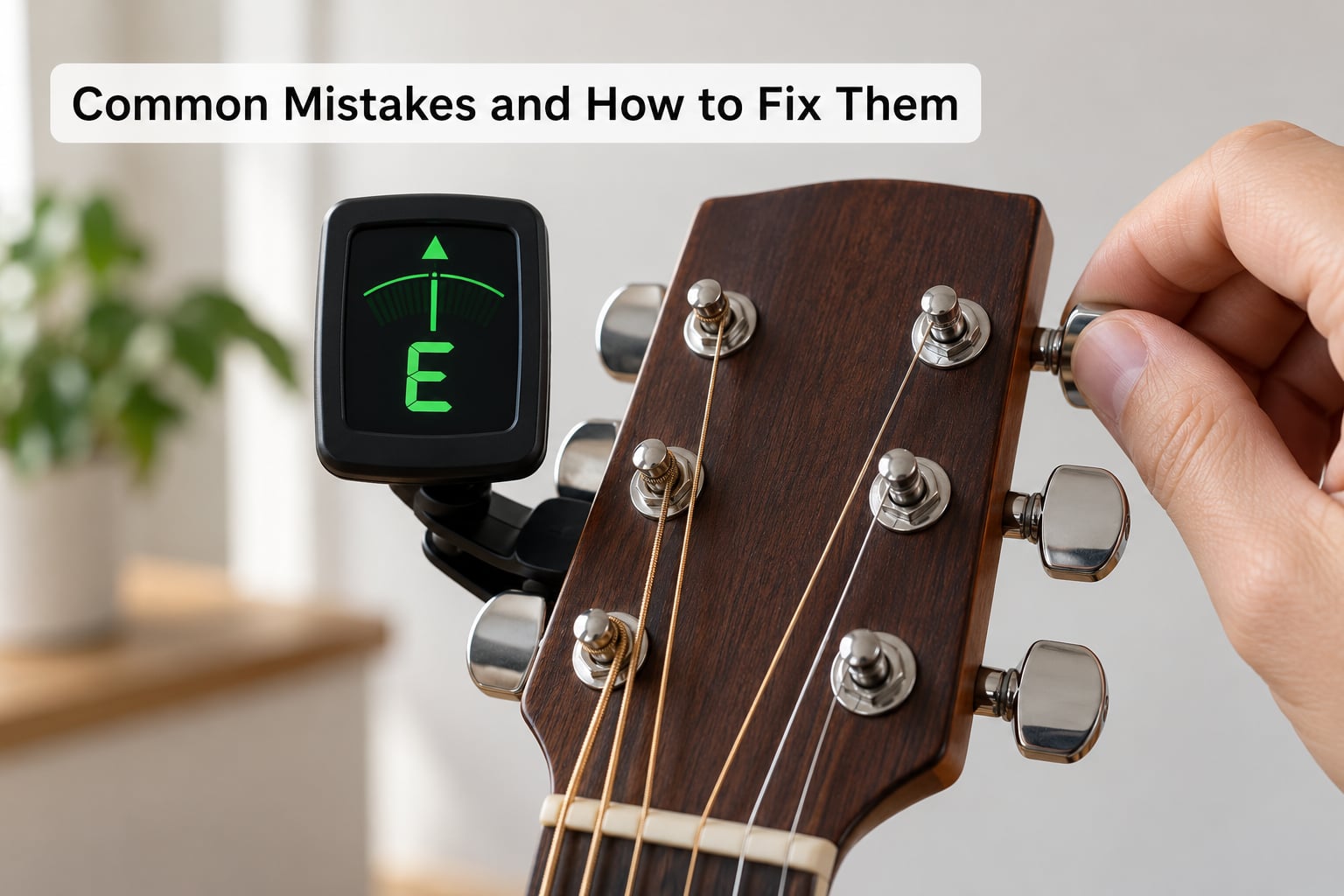
Almost every drop D problem is one of five things. They are all fixable, and none of them mean your guitar is damaged.
Tuning the Wrong String Down
Counting strings by thickness works until you have a coated set, where the gauge difference is harder to see. Count from the thinest string instead, or check the headstock from the front. If you find yourself two octaves below where you should be, you dropped the fourth string by mistake.
Confusing Drop D With Full D Tuning
Full D is D-A-D-F-B-D — the top string comes down as well. Somebody who learned full D and then puts their guitar in drop D will find their lead parts sound two frets too low. Check your plan: if the tab or score says the top string is D, you are in full D, not drop D.
Strings Go Floppy After the Drop
This is the most common complaint in guitar forums, and it is a string gauge problem, not a tuning problem. Light sets such as 9s and 10s lose a lot of tension when you drop them a whole step. Heavier bottom strings solve it, and players regularly recommend hybrids with a heavy low string and a normal top, such as Ernie Ball Hybrid Slinky 9-46, which handles drop D comfortably, or Skinny Top Heavy Bottom 10-52 if you want headroom to go lower later. D’Addario NYXL and Ernie Ball Cobalt sets are also frequently praised in player forums for holding pitch in alternate tunings, largely because of their core construction. Players who stay in drop D for months usually end up at a heavier gauge than they started with.
Fret Buzz on the Low String
Buzz after tuning down is almost always action. The strings lost tension, the neck relaxed slightly, and the low string is closer to the frets. Turning the truss rod a quarter turn in the loosening direction usually takes care of it, though the correct fix is a proper setup with the string height measured at the 12th fret against your fret radius. If the buzz is only at a couple of frets and the string is new, wait a day — new strings settle differently as they stretch.
Breaking Strings When Switching Back to Standard
Cranking a dropped string back up a whole step puts a lot of load on a kink point at the nut or the bridge saddle, and that is where strings snap. If you plan to move between standard and drop D often, take the string off the saddle, hold the tension, move the peg, and put it back. Or keep a second guitar in the tuning you use most, which is what many live players do anyway because mid-set retuning is not realistic with one instrument.
Frequently Asked Questions
What is drop D tuning and how is it different from standard?
Drop D lowers only your sixth string from E to D, a whole step or two semitones. The other five strings stay in standard, so the tuning reads D-A-D-G-B-E, or DADGBe. Standard tuning is E-A-D-G-B-E. Because the open sixth, fifth and fourth strings now spell a D5, power chords that used to need three fingers come down to one.
Can I tune to drop D without a tuner?
Yes. Fret the fifth string at the 5th fret, which is the same D as the open fourth string, and lower your low string until it matches that pitch an octave below. Then check it against the fourth string at the 12th fret. They should be exactly two octaves apart and sound identical.
What string gauge should I use for drop D?
Anything lighter than about 10s at the low end will feel slack once the string is dropped a whole step. Most players land on a hybrid set with a heavy bottom and a normal top, such as 9-46 or 10-52, which keeps the low string firm and the high strings bending normally. If you plan to go to drop C or below, move up to a heavier bottom string and expect to restring more often.
Why do my strings buzz when I tune down to drop D?
Dropping a string reduces tension across the neck, so the neck relaxes and the action drops. The low string ends up closer to the frets, particularly in the middle of the neck. A small turn of the truss rod, roughly a quarter turn toward the thinner neck, usually clears it. If buzz persists, have the action and intonation set properly for the heavier gauge you should be using in a dropped tuning.
Is drop D bad for my guitar neck?
No. Dropping one string a whole step is a very small change compared to what heavy-gauge players and extended-range players do routinely. It can, however, expose an existing setup problem, because the reduced tension changes action and intonation slightly. On a floating tremolo guitar the spring balance shifts and the bridge can move. Either way the result is a setup adjustment, not damage to the instrument.
How do I switch between standard and drop D during a show?
Retuning one string in the middle of a set is awkward but doable, especially on a stop-start number. Loosen the string at the saddle so you take the load off the tuning peg, move the peg, then reseat the string. On a double-locked guitar, change the fine tuner and the bridge block together or the whole guitar will shift. Most players sidestep the problem by keeping two guitars on different tunings or by picking one tuning for the whole set.
Conclusion
Start with the sixth string. Lower it from E to D, small movements, checking as you go, and leave the other five strings alone. Play the open sixth string and the fourth string at the 12th fret together; when they match, the tuning is right and everything else is arithmetic.
After that, the honest work is strings and setup. A heavier low string stops the floppiness, and an adjustment to action stops the buzz. Both are quick, both are normal, and neither means anything is wrong with your guitar. Do them once and the tuning holds for as long as you want to play in it.