
Learning how to palm mute like a thrash guitarist comes down to one thing: rest the fleshy edge of your picking hand on the strings just behind the bridge saddles, keep the pressure light enough that the note still speaks, and drive the part with relaxed downstrokes from the wrist rather than the fingers. Get those three right and your chugs tighten up immediately. It takes about three weeks of daily 15-minute work to make it automatic.
Most of the muddy, dead-sounding palm mutes I hear come from one of two errors. Either the player leans on the strings so hard that the note has no pitch left, or the hand drifts forward toward the pickups as speed rises and the mute disappears altogether. Both are fixable, and neither needs more strength.
Table of Contents
Quick Answer: How to Palm Mute Like a Thrash Guitarist
- Rest the side of your picking hand on the strings a few millimetres behind the bridge saddles, not on the bridge itself.
- Use the lightest pressure that still kills the sustain — the note must keep its pitch and percussive attack.
- Downpick with a loose wrist pivot, letting the forearm stay quiet and still.
- Practice single notes and power chords at a slow tempo before adding speed.
- Add a gallop pattern and syncopated accents once the mute stays consistent between strings.
- Record yourself and raise the metronome by small steps, five BPM at a time.
That is the whole method for learning how to palm mute like a thrash guitarist. The rest of this guide is about the details that separate a tight chug from a thud.
What You Need
You do not need a specific guitar, and that is worth saying up front because a lot of players stall here. Any solid-body electric with a fixed bridge will do the job. A tremolo bridge works, but it needs a small adjustment: rest the heel of your hand against the tremolo arm block so the bridge stays put while you mute.
- An electric guitar with a humbucker or hot single-coil in the bridge. The tighter the pickup, the less you have to press.
- A pick around 0.8 mm to 1.0 mm thick. A very thin pick flexes on downstrokes and buries the attack, which is exactly what a chug does not need.
- An amp with some gain left in reserve. Most of the perceived tightness comes from pick attack, so a moderately overdriven amp with a fast attack response beats a wall of saturated gain.
- A metronome or a phone app. Speed work without a click is guesswork.
- Tab or a reference track so you are copying a real riff rather than inventing one.
Wrist position matters more than most gear. Sit or stand so the picking forearm is roughly parallel to the floor and can swing without your shoulder creeping up. If your shoulder lifts when you pick, the movement is coming from the wrong place.
Step-by-Step: How to Palm Mute Like a Thrash Guitarist
Set a Stable Picking-Hand Position
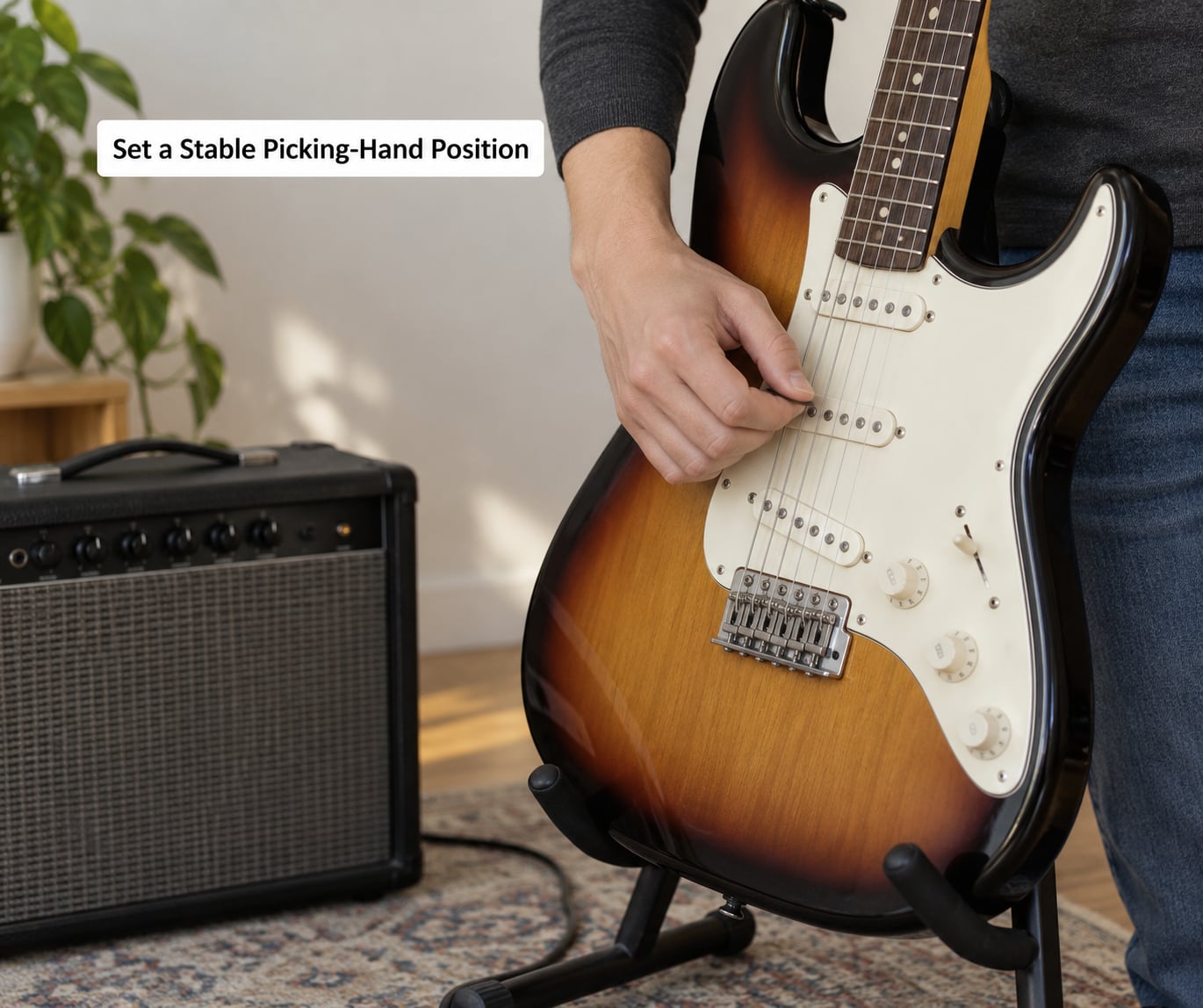
Anchor the side of your hand just below the pinky knuckle against the strings, roughly level with the rear edge of the bridge saddles. You are aiming for the fleshy pad of the hand, not the heel and not the fingers.
There is a small gap between the strings and the saddle tops where the palm can rest without touching metal. Beginners often creep forward because the bridge hardware feels solid, but sitting on the strings is what creates the choke. Slide your hand a few millimetres back until you feel the pressure drop noticeably, then hold there.
Keep the thumb and index finger loose. If you can see white knuckles in your grip, the tension will travel into the wrist and kill both speed and tone. Players who work on seven-string guitars often describe the anchor point as somewhere between the bridge and the pickup, and that range matters by instrument — a guitar with a wider neck track may need you slightly further back.
Touch the Strings Without Pressing Down
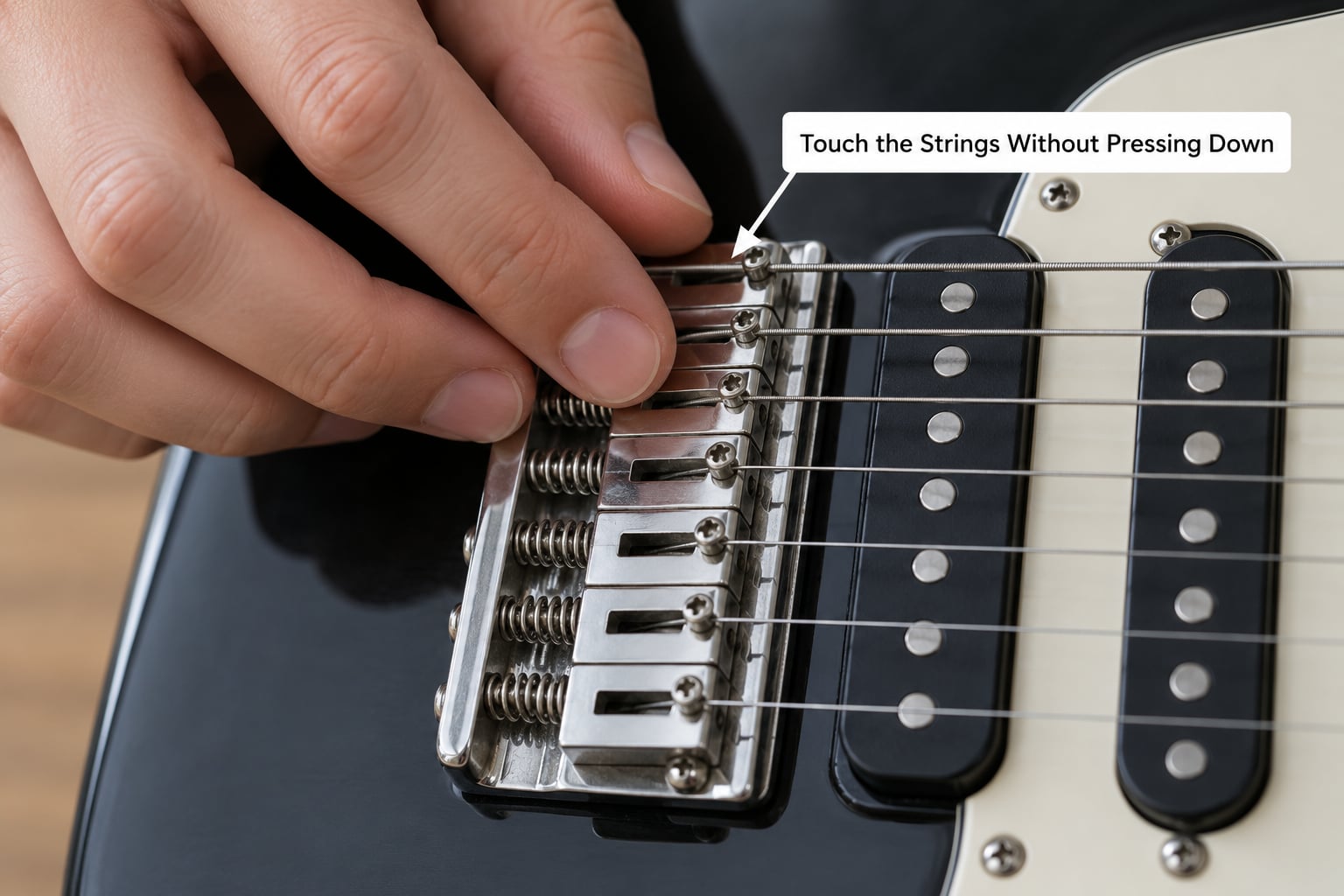
This is the part most people get wrong, and the fix is counter-intuitive: mute less than you think you need to. Light contact kills sustain while leaving pitch and harmonic content intact. Heavy pressure flattens the string into the fret and you hear a dull knock rather than a note.
A useful test is to mute one note while an open string rings, then release the pressure and listen to what comes back. If the note comes back as a clear tone, your pressure is right. If it returns as a thinner, quieter version of the same note, you were too heavy.
Pick grip angle changes muting depth more than most players expect. Rolling the pick so the tip angles slightly into the strings shortens the gap between the pick and your muting hand and tightens the mute. Flattening the pick out makes the same riff sound looser and airier. Small rotations of the pick between the thumb and index finger give you a workable range of mute depths without moving your hand.
Mute Notes Between Picking Strokes
The timing principle behind a tight riff is simple: the pick strikes while the palm is doing its light damping job, and the palm stays put between strokes. Your hand does not lift to articulate. It sits at one depth and the pick does the work.
Where you release matters. On a chug followed by a muted rest, you can keep the hand anchored the whole time, because the pick simply does not move. When you move between strings, the muting hand adjusts by a fraction so the string you are leaving stays damped and the string you are arriving at is free to speak.
That micro-adjustment is the whole skill. Think of the muting hand as a fixed post with the strings passing underneath it, rather than a sweeping motion chasing each note.
Use Controlled Downstrokes First
Thrash rhythm guitar is built on downpicking, and the movement comes from the wrist. The forearm stays put and the wrist rotates through the string like a hammer. Downpicking sounds heavier than alternate picking at the same tempo because each stroke carries more mass, and the mass is what produces the percussive attack.
Start with straight eighth-note downpicks on a single note, palm muted, at 80 BPM. Play for a full minute without your hand creeping forward. Then move to paired downpicks — two strokes per string, one string per beat — which is the backbone of most Metallica and Slayer-era riffs.
If your forearm starts to lock up, you are gripping. Drop the pick slightly, shake the hand out, and restart at a lower tempo. Endurance comes from a relaxed movement repeated, not from a tense one held longer.
One more detail worth naming: in most thrash transcriptions you will see P.M. above a run. P.M. stands for palm mute and means the effect applies until the line ends or a P.M. end marker appears. Occasionally you will see PMO, a heavier variant that some players use to signal an extra-dry section. If a riff is written as palm muted and your version sounds wide open, you probably lifted your hand rather than reducing pressure.
Practice Palm-Muted Chord Changes
Power chords are where the technique gets tested, because you are muting some strings while others ring. Take an E-shaped power chord on the low E string and check what is actually sounding. The low E should speak clearly, the A should be quiet or silent, and nothing above it should buzz.
The trick is to bring the chord shape in under the muting hand rather than swinging in from open position. Move the whole shape as one unit, arrive, then check that only the intended strings are cutting through. Doing slow chord changes on the same two strings for two minutes teaches the arrival far better than fast ones do.
Once E5 and A5 shapes are clean, put them in a progression and keep the pressure identical on every chord. Inconsistent pressure across a progression is the reason a single note sounds fine but a full riff wobbles.
Gradually Add Speed and Heavier Grooves
Once downpicked eighths hold steady, the ceiling for most players sits around 180 BPM, and that is where the hand starts drifting and the mute opens up. The cure is not faster downpicks; it is deciding when to stop downpicking.
Alternate picking is the practical answer, and it is under-used in thrash for no good reason. It keeps the same muting position while halving the stroke distance, which means the hand never has to travel as far. Sound slightly softer and busier? Yes. Use it for the fast runs and save heavy downpicks for the accents and the breakdowns where the weight is wanted.
Now add the patterns. The gallop is the signature thrash figure — two sixteenths followed by an eighth, repeated, usually on a single note or a simple power chord. Play it as written first at a comfortable tempo, then subdivide it into even downpicks until it sits behind the click. The odd grouping should feel wrong for a while; that is normal.
Different subgenres want different amounts of mute. A useful comparison before you start:
| Style | Mute depth | Pressure | Typical pattern |
|---|---|---|---|
| Thrash | Moderate | Light, constant | Downpicked chugs and gallops |
| Death metal | Moderate to heavy | Heavy, index finger rests on strings | Tremolo-picked runs and syncopated stabs |
| Black metal | Light | Minimal, often rhythmic palm | Tremolo picking, long ringing notes |
| Traditional or heavy metal | Light | Light, mainly to clean up chords | Lead lines and open chord work |
That table matters because most muddy palm mutes are death metal muting applied to thrash riffs. Too much pressure, too far forward, and the riff loses its punch.
Breakdowns are the other place to practise control. Slow the tempo down, drop to one hit per beat with a full palm mute and a power chord behind it, then release the mute for the final hit so the chord rings out. That contrast only works if your muted hits are genuinely dry.
Common Mistakes
These are the problems that come up again and again, with the correction that fixes each one.
- Pressing too hard. If the note has no pitch left, back the pressure off by half. Rest a little closer to the saddle tips, where the strings have less room to move.
- Drifting toward the pickups as speed rises. Set a reference point: the second fret wire. Every few minutes, glance down and confirm the hand is still behind it.
- Anchoring the wrist or resting on the forearm. A planted wrist kills the wrist pivot that gives downstrokes their weight. Float the forearm and let the hand rest on the strings only.
- Muting the wrong strings. When open strings ring through, the muting hand is usually too far forward or too shallow to catch them. Pull back and flatten the hand slightly so more of the pad contacts the string.
- Losing note clarity. If individual notes disappear inside the chord, reduce the mute depth for that note rather than picking harder. A slightly drier riff still reads better than a thick one.
- Raising tempo without a click. Record yourself. Mutes that sound solid at 100 BPM frequently fall apart at 140 with nobody noticing in the moment.
A four-week schedule is a reasonable way to structure this. Ten to fifteen minutes a day beats an hour once a week, because muting is a motor habit rather than a strength skill.
| Week | Focus | Tempo target | Daily time |
|---|---|---|---|
| 1 | Anchor position, single-note eighth-note downpicks | 70 to 90 BPM | 10 minutes |
| 2 | Paired downpicks and power chord changes | 90 to 120 BPM | 12 minutes |
| 3 | Gallop patterns, syncopated accents, alternate picking runs | 120 to 150 BPM | 15 minutes |
| 4 | Full riffs to track, breakdowns, dynamic contrast | 150 to 180 BPM | 15 minutes |
Increase the tempo by five BPM at a time and only when two clean minutes at the current speed feel easy. Speed that arrives before the sound is right usually has to be undone later.
On gear, one thing to check is the amp side of it. If your muted notes lack definition, try backing off the gain a step and turning up the presence. A slightly cleaner signal with more bite in the top end will sound tighter than more saturation.
Frequently Asked Questions
How do I stop my palm mute sounding like a dead thud?
You are almost certainly pressing too hard. Palm muting should remove sustain, not pitch, so halve the pressure and rest closer to the rear edge of the bridge saddles where the strings have less room to move. If the note still sounds flat, roll your pick slightly into the string for more attack. A quiet note with a clear pitch beats a loud thud every time.
Should I palm mute with my picking hand or my fretting hand?
For thrash riffs, use the picking hand. Anchoring the side of that hand just behind the bridge saddles gives you control over sustain and lets the wrist keep picking. Fret-hand muting is a different tool, useful for staccato notes and cleaning up open strings in a chord. Most beginners meet fret-hand muting first because it shows up more often in early method books.
How do I increase downpicking speed while keeping the mute tight?
Most players hit a wall near 180 BPM because the picking hand travels further on each stroke. Two fixes help. First, shorten the stroke so the pick lands just past the bridge instead of near the neck. Second, switch the fastest runs to alternate picking, which halves the travel while leaving your muting hand anchored. Build back to downpicking for the accents.
How do I mute a single guitar string?
Mute a single string by moving the side of the picking hand over it so it sits under your palm pad while the others stay clear, or by lightly touching it with the side of the index finger without pressing. For a lead note, this keeps the other strings silent while you sound the note you want. For a chord, tuck the unwanted strings under the heel of the hand at the same depth.
How do I play a gallop rhythm on guitar?
A gallop is two sixteenth notes followed by an eighth, repeated on one note or a simple power chord. Start by palm muting and playing it as straight downpicked eighths so the timing sits behind the click, then restore the real grouping. Gallops usually land on the offbeat before a snare hit, so practise the pause as carefully as the strokes.
What does PMO mean in guitar tabs?
P.M. stands for palm mute and tells you to keep light contact on the strings behind the bridge until an end marker appears. PMO is a heavier variant some players and editors use to signal an extra-dry section. Either way the effect comes from reducing pressure, never from pressing harder, so lift your hand only when the notation tells you to.
Conclusion
Start with four things this week. Set your picking hand just behind the bridge saddles and keep the pressure light enough that pitch survives. Downpick with the wrist at 80 BPM until the position holds for a full minute without drifting. Run paired downpicks and one power chord progression with identical pressure on every chord. Then record a minute of playing and listen for the two usual faults: over-muting and drift toward the pickups.
Once those sound right, raise the metronome five BPM at a time and bring in the gallop. Tight thrash rhythm guitar is built from a small number of habits repeated without tension, and three weeks of short daily sessions will do more than a weekend of trying to play fast.