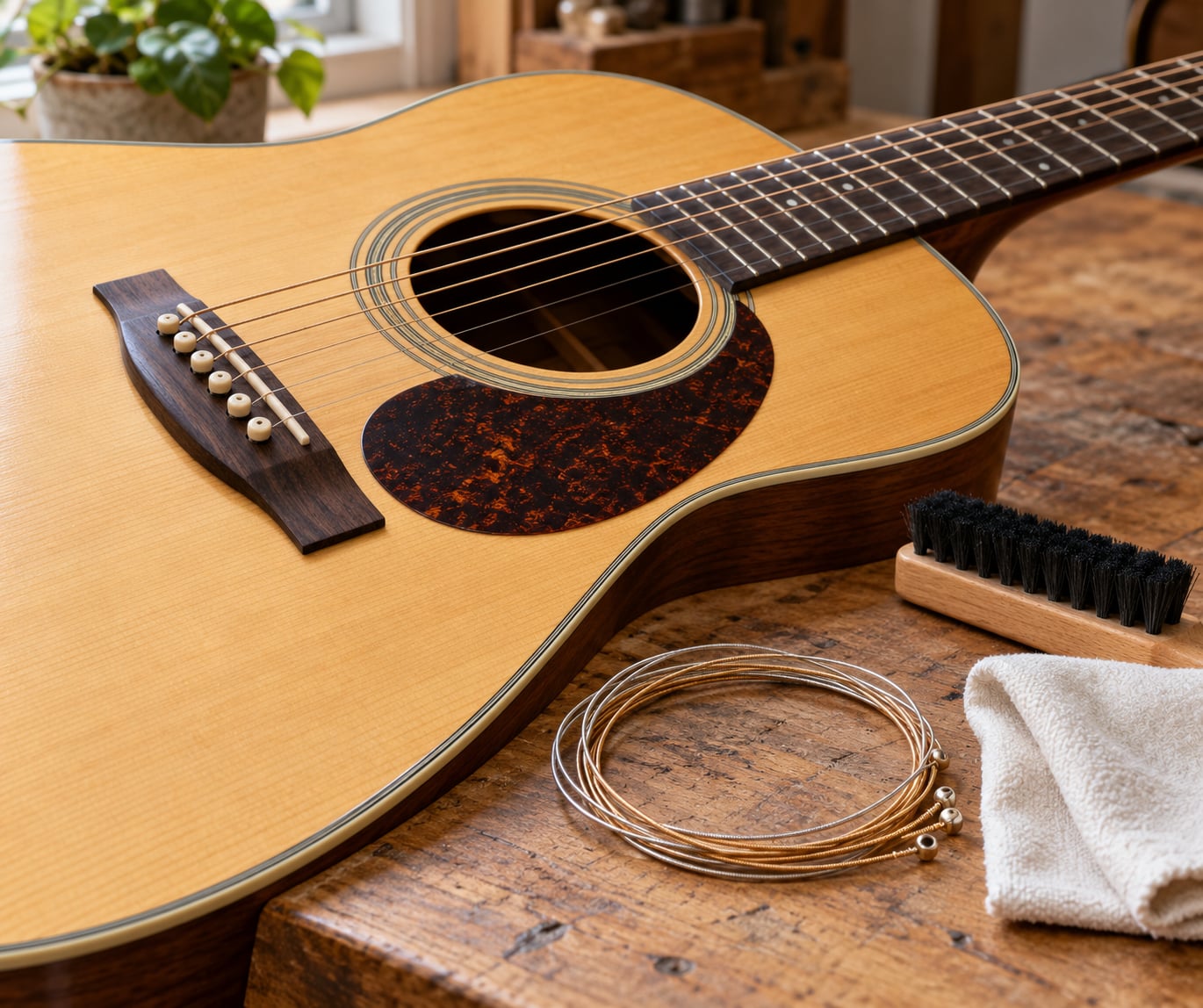
If you play most days, plan on fresh strings every three to six months. If you pick up the guitar on Sunday afternoons, four to eight months is realistic, and a touring musician can burn through a set in a couple of weeks. How often should you change guitar strings? The honest answer is that the calendar matters far less than what your ears tell you, so treat the numbers below as a starting point rather than a deadline. Updated for 2026.
Strings do not wear out evenly. They collect oil, sweat and dirt, stretch from tension, and slowly lose the brightness that made you fall for the guitar in the first place. By the time one snaps, the whole set has usually been dead for weeks.
Table of Contents
- How Often Should You Change Guitar Strings?
- What Factors Affect How Long Guitar Strings Last?
- What Signs Mean Your Guitar Strings Need Replacing?
- How Often Should You Change Strings by Guitar Type?
- How Can You Make Guitar Strings Last Longer?
- How to Change Guitar Strings Without Damage
- Frequently Asked Questions
How Often Should You Change Guitar Strings?
Most players land somewhere between three and six months, and that range holds up well because it tracks hours on the instrument rather than weeks on the calendar. A player who puts in 30 minutes daily will get closer to the three-month mark. Someone who touches the strings twice a week can double that without any harm done.
How often do working players actually go?
Regular players on guitar forums land in a fairly tight band. One electric player described changing whenever the strings feel dull or lifeless, roughly every four to six months, and replacing all six at a time even when only one breaks. Others who practise an hour a day report closer to a month between changes, and a little under two months at lighter levels. Touring players are the extreme case: many change before every show or at the start of each run so the tone matches from night one.
The intervals, at a glance
| Player type | Typical hours per week | Uncoated strings | Coated strings |
|---|---|---|---|
| Touring or session professional | 20 to 40 | 1 to 4 weeks | 3 to 6 weeks |
| Daily practice or gigging | 7 to 14 | 6 to 10 weeks | 3 to 5 months |
| Several times a week | 3 to 6 | 3 to 5 months | 6 to 10 months |
| Casual or weekend player | Under 3 | 5 to 8 months | 8 to 14 months |
| Guitar sits in its case | Occasional | Check every 6 months | Check every year |
Coated strings roughly double the calendar time because the polymer layer keeps oil and moisture off the metal. The trade is a slightly rounder, less bright initial tone, and coated sets tend to keep sounding like themselves instead of decaying, which is why many players find them easier to leave on for months.
What Factors Affect How Long Guitar Strings Last?
Everything that speeds up wear does the same thing: it gets junk into the windings, where it damps vibration. A string that vibrates freely stays bright. A string packed with grime sounds like a muffled version of itself.
Playing frequency is the biggest factor. Ten hours of contact leaves more residue than ten half-hour sessions, and it is hours, not days, that matter. A guitar untouched for a year does not age the same way as one played daily in a humid room.
Sweat and skin chemistry vary wildly between players. Some people get roughly a month out of uncoated strings, others get six, with the same guitar and the same playing time. Wiping the fretboard and strings after a session removes most of the salt that causes corrosion between the windings, which is where rust actually starts.
Humidity and storage do their damage quietly. Coastal summers, basements and heated winter rooms all push strings around. A guitar that lives in a dry, stable room keeps pitch and tone far longer than one that shuttles between a hot car and an air-conditioned house.
String material sets the ceiling. Plain steel corrodes fast, bronze-wound acoustic strings hold warmth at the cost of quicker tarnishing, and coated strings trade a little sparkle for months of extra life. Winding type matters too, since flatwounds collect far less debris than roundwounds and stay clean through a long run.
Playing style and setup push the limit either way. A heavy-handed player with a worn truss rod setting wears strings flat against the frets, which dulls tone and shortens life. A lighter touch and a decent setup mean the string floats above the fret wire, ringing freely and lasting longer.
What Signs Mean Your Guitar Strings Need Replacing?
Change them if any one of these shows up. You do not need all of them, and you rarely notice more than two before the swap becomes obvious.
What you hear
The clearest signal is a tone that has gone flat and lifeless, with less sparkle on the front notes. Chords start sounding papery. If your guitar has covered the same room for months, this is the sign most people catch first, though usually only once the new strings are on and they realise how much they had lost.
Second is tuning instability. If the guitar drifts sharply within minutes of tuning, and the action is not badly worn or the neck badly bowed, tired strings are usually the cause. You may also notice intonation drift at the twelfth fret, where the note sits noticeably sharp.
What you see
Look along the string length and check for dull grey or black grime in the windings, then run a finger along it. A rough, gritty surface that once felt smooth is a clear signal. Greenish or white fuzz on the string, the frets, or the pickup poles means corrosion has started, and on an acoustic you will sometimes find rust where the strings meet the bridge pins.
What your hands tell you
Your fretting hand comes away dirty after playing, and sliding fingers feel tacky instead of smooth. Bending a string takes more effort than it should, and a string that feels springy but refuses to stay in tune is giving you the same message. Dead strings can also buzz against the frets, so if buzzing appears and the action feels normal, suspect the strings before you assume a setup problem.
How Often Should You Change Strings by Guitar Type?
How often should you change guitar strings also depends on which instrument is in your hands, because tension, materials and playing surfaces all differ.
Electric guitars hold strings well, since the bridge and pickups shield them from a lot of handling. Uncoated sets usually last three to six months at moderate playing time, and coated sets can run past a year for a casual player.
Acoustic guitars work harder. Higher tension and the open air around the soundhole pull more moisture into the windings, so expect three to four months on plain bronze or phosphor bronze. Coated acoustic sets regularly last six months or more, which is the main reason players who sweat a lot or live somewhere damp switch over.
Classical and nylon guitars outlast steel by a wide margin. Nylon strings stretch a lot at first, then settle, and they resist corrosion. A player in a classical forum reported a bass string still in place and showing surface rust after fifteen months, which is longer than many steel sets manage under daily playing. Expect a year or more.
Bass guitars see fewer rotations per minute but heavier winding, and the thick gauges shed a string’s core tension quickly. Most players land on three to four months, or closer to two months on a roundwound set used hard onstage. Flatwound bass strings go longer, often six months, because they trap almost no debris.
Unusual setups need care of their own. A twelve-string is twelve string jobs, and the high strings are the first to go. A locking tremolo system is quick to change but punishes sloppy winding, because uneven coils can ping against the saddle. Ukulele and banjo strings stretch far more than steel and need two or three full tuning rounds after fitting before they settle.
How Can You Make Guitar Strings Last Longer?
None of this is complicated, and the payoff is real.
- Wipe the strings after every session. A dry microfibre cloth along the strings and fretboard takes off the salt and oil before they work their way into the windings. Ten seconds, and it is the single biggest win.
- Wash your hands before and after playing. Many players who never touch their face or hair see their corrosion problems nearly disappear. Some also wipe the strings with a barely damp cloth while the guitar is still on the bench.
- Keep the guitar in a stable room. Aim for roughly 40 to 50 percent relative humidity, away from radiators, air conditioners and car interiors. Moving a case from a cold boot to a warm house causes more damage over a season than most people expect.
- Loosen the strings when the guitar is idle. For a solid-body, dropping a quarter turn at the tension on long breaks reduces the constant pull on the string ends. Always loosen a locking or floating trem a whole step or two first, or the bridge will slam forward.
- Stretch new strings properly and let them settle. Work each string gently up and down, retune, then repeat. After a full change, give it a few playings and several tunings before judging the tone, because fresh strings genuinely sound worse for the first day or two.
- Match the string type to your conditions. Coated sets in a humid climate, flatwounds for jazz or a smoky bar, heavier gauges for a strong fretting hand, all of these buy extra months.
- Change the whole set, not the odd string. A single new string next to five tired ones sounds lopsided, and mixing gauges and ages makes tuning and intonation harder. This is what most players on the forums do anyway.
How to Change Guitar Strings Without Damage
Allow fifteen minutes for the first few changes, less once it becomes routine. Work on a flat surface with a good light, and have your tools to hand before you start.
- Detune first. Loosen each string several turns. On a floating trem, mark the bridge position with tape so you know where it sat, and feed the strings onto the saddles carefully as you go.
- Undo the anchor point. On a fixed bridge, back the tension out at the bridge before touching the nut end. On a locking trem, release the cam with the correct hex key as the tension drops, and never force a string that is still under load.
- Remove the strings. Slide the old strings out from the back of the bridge or tuning machines. Keep a cloth nearby, because broken high strings in flatwounds throw fine wire.
- Wipe the fretboard and inspect. This is the moment to check for rust on the frets and pickups, and to look for raised frets. Clean now, while the strings are off.
- Fit the new set. Clean strings and clean hardware, thread carefully, wind evenly with consistent coil direction, and trim the excess. Leave enough slack for two to three stretches.
- Stretch, settle, then check intonation. Pull each string gently sideways while tuning it up, repeat two or three times, then tune properly and let the guitar sit. Finally, check the intonation at the twelfth fret and at the bridge, especially after a gauge change. A big jump in gauge can also need a truss rod adjustment, which is a job for a luthier unless you know what you are doing.
If a string will not seat properly, or a screw keeps slipping, stop and inspect it. A damaged saddle post or stripped tuner screw is a five-minute repair, but forcing it turns into a new problem on the bridge.
Frequently Asked Questions
How do I know if my guitar strings need replacing?
Change them if you notice a dull, lifeless tone, strings that will not hold tuning for more than a few minutes, visible grime, rust or black fuzz on the winding, a rough or gritty feel under your fingers, dirty hands after playing, or new fret buzz. Any one of these is enough. You do not need to wait for all of them, and you certainly should not wait for a string to break.
How long do guitar strings last on average?
For most players, three to six months. A daily player with an hour or more of practice a day often gets closer to one or two months out of plain uncoated strings, while someone playing a few times a week can run four to eight months. Coated sets roughly double those times. Storage conditions, sweat and humidity shift the numbers either way.
How often do professional guitar players change strings?
Touring and session players change far more often than the general advice suggests, commonly before every performance or at the start of a run. The reason is consistency rather than necessity. A guitar that sounds slightly different in the last song of a set is a problem in front of an audience, so players swap on a schedule instead of waiting for the tone to fade.
Do coated guitar strings really last longer?
Yes, and the difference is large. The polymer coating keeps oil, sweat and moisture off the wound wire, so coated sets often run two to three times longer than plain strings on the same guitar. The usual complaints are a slightly rounder, less bright initial tone and a slippery feel, and many players find the tone is more consistent over the life of the set rather than decaying.
Do I have to change all six strings at once?
You do not have to, and plenty of players do not, but most regular players do anyway and it is worth considering. A single new string beside five tired ones sounds lopsided, and mixing ages and gauges makes tuning and intonation harder to keep stable. One commonly repeated piece of player advice is to replace the full set even when only one breaks.
What is the golden rule of guitar?
There is no single official rule, but the advice given most often is to change strings when the sound or the feel stops satisfying you, rather than on a fixed date. One useful rule of thumb is to change before you would be unhappy to be recorded or heard playing, which in practice means earlier than most people think.
Here is what to do first. Wipe your strings and fretboard tonight. It costs nothing, and if the tone brightens afterwards you have just bought yourself a few months.
If nothing changes, run through the signs above honestly. Dull tone plus drift plus grime means a full set is due, and how often should you change guitar strings is answered differently by everyone, so settle it with your own ears and your own hours on the instrument.