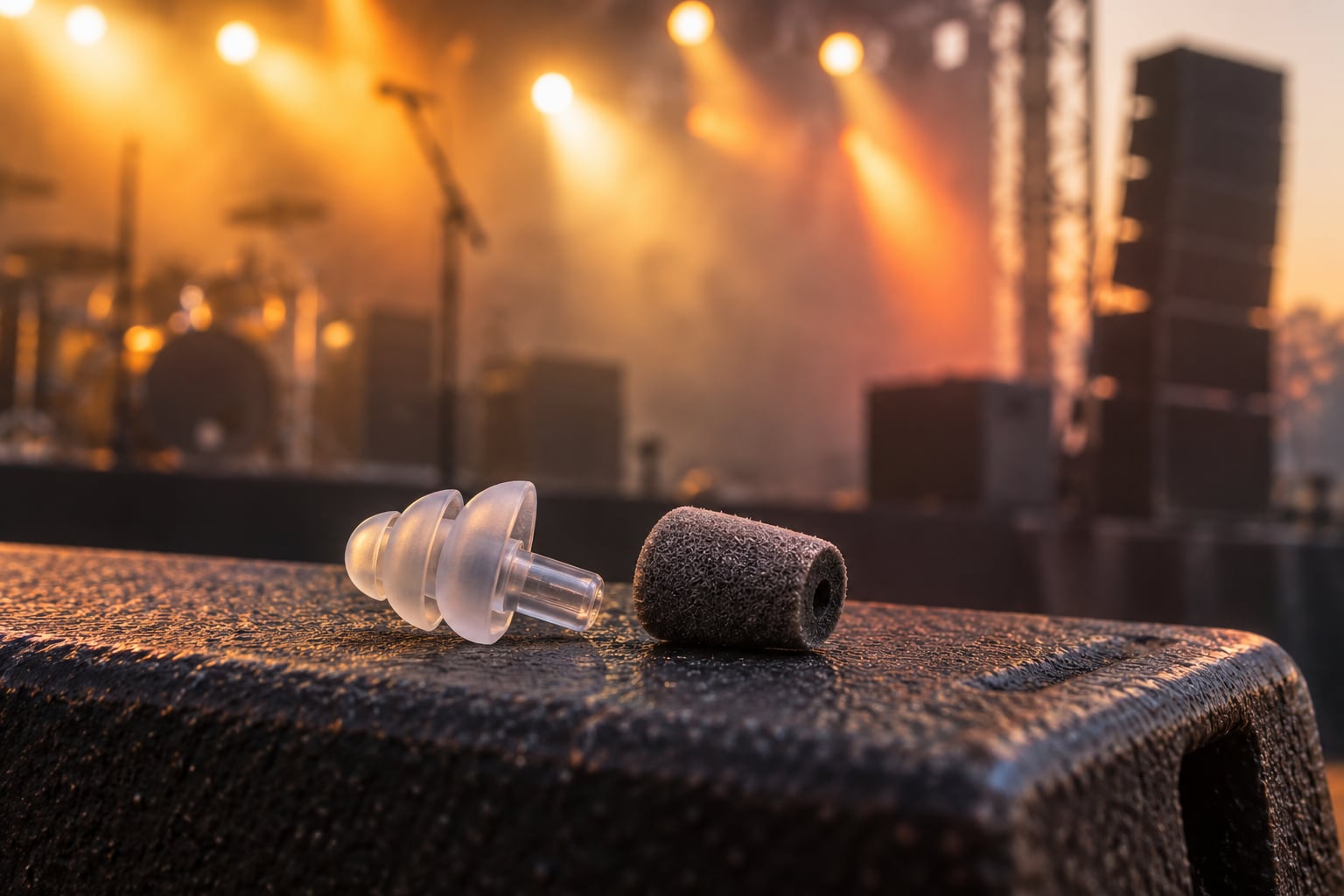
Are earplugs bad for concert sound quality? Only with the wrong pair. Foam plugs and most lifestyle silicone plugs knock the high frequencies down hardest, so a band turns into a wall of drums and bass. Filtered flat-response plugs pull every frequency down by a similar amount, and the set sounds like the same show with the volume turned down.
That distinction is the whole answer. Sound quality, hearing protection and personal taste are three separate questions, and a pair of earplugs can win one and lose the other two.
Table of Contents
- Are Earplugs Bad for Concert Sound Quality?
- What Changes When You Put In Earplugs?
- Which Type of Earplugs Preserves the Most Music?
- Foam, Filtered, or Musician Earplugs: What Sounds Best?
- How to Choose Earplugs for Loud Metal Concerts
- Do You Need Earplugs at Every Concert?
- How to Tell Whether a Concert Is Too Loud
- Earplugs and Hearing Safety at Metal Shows
- Frequently Asked Questions
- Conclusion: Start with the Right Filter
Are Earplugs Bad for Concert Sound Quality?
There is no single yes or no, because the two camps arguing about this are usually talking about different products. Brands say earplugs make live music clearer because cutting the level down lets detail survive. Working musicians say earplugs kill the music because everything goes underwater.
Both reports are real, and forum threads show them sitting right next to each other. On r/audiophile, one listener using filtered plugs at a Rammstein show said the sound was decent and far better than foam, but the vocals and guitars faded and they were left with a wall of drums and bass. On r/livesoundgear, a full-time musician who had tried several well-known lifestyle brands wrote that they all muffle the sound, ruin the vibe, and end up coming out at moments because the live music cannot be felt any more. On r/Concerts, other listeners report that the same category of plug cuts the decibels without wrecking the music.
So the objection is not a myth. It is also not a verdict on earplugs as a category. It is a description of what happens when a plug blocks sound unevenly.
What Changes When You Put In Earplugs?
Four things change, and it helps to separate them because they are often confused.
Attenuation is simply the overall level drop. Every plug has some, and it is the least interesting part of the sound picture.
Frequency filtering is where good and bad pairs separate. Conventional foam plugs, and many uncorrected silicone plugs, cut treble far more than bass. Human hearing is most sensitive in the 2 to 5 kHz range, which is exactly where vocals, snare attack, cymbal wash and guitar pick detail live. Take that band away and the mix sounds dull and lopsided.
A flat-response filter is built to attenuate all frequencies by a similar amount instead. The level drops, the tonal balance survives, and the perceived result is a cleaner mix rather than a thinner one. Audiologists describe the uneven version as producing dullness of sound and making speech difficult to understand, which is also why singers in a metal band can vanish before the cymbals do.
Seal is the physical barrier. A poor seal leaks sound and defeats the rating printed on the box. A deep seal is better acoustically and often worse physically, which is where ear fatigue over a three-hour festival set comes from.
The occlusion effect is the one nobody names, and it is the real reason a plugged ear sounds wrong. When you seal an ear canal, sound waves bounce off the blocked canal wall and re-enter the eardrum through the bone and the canal itself. Low frequencies are affected most, so perceived bass swells, the ear feels pressure-full, and the direct sound from the stage arrives mixed with that reflected boom.
The symptom list is recognisable. Bass that seems to grow after you put plugs in. Vocals and guitars sitting behind the kit. A vague sense that the stage is further away. If someone describes hearing a wall of drums and bass while the melodic parts vanish, that is the occlusion effect showing up at a show, not evidence that protection and enjoyment are incompatible.
Which Type of Earplugs Preserves the Most Music?
Read the table as a guide to behaviour rather than a promise of a specific number of decibels, because real protection depends on fit, seal and the plug you actually bought.
| Type | Effect on sound quality | Comfort over a long set | Reusable | Suits | Watch out for |
|---|---|---|---|---|---|
| Disposable foam | Most muffled; strong treble loss | Can press after an hour or two | No | Sleep, construction, sudden noise | Unfiltered by design; the worst choice for music |
| Silicone flanged | Mild to moderate change, depends on the filter | Good, low pressure | Yes | Rehearsal rooms, side of stage, travel | Lifestyle versions are often unfiltered |
| Mouldable wax | Variable, depends on seal and pressure | Felted rather than inserted | Partly | Occasional shows, light amplification | Easy to over-insert and cause discomfort |
| Reusable flat filter | Even reduction, tonal balance largely kept | Usually good, varies by shape | Yes | Most concerts, clubs, festivals | Insertion depth matters more than the brand |
| Musician-style filtered | Even reduction, designed to stay off the mic | Built for stage-length wear | Yes | Onstage players, loud rooms, long sets | Low-profile models need a habit to seat |
| Custom moulded filtered | Even reduction plus a consistent seal | Best long-wear comfort once broken in | Yes | Regular gigging, anyone with narrow canals | Needs a professional fitting and costs more |
Foam, Filtered, or Musician Earplugs: What Sounds Best?
Foam plugs are the reference point for bad, and they are bad for a reason. Nothing about the design tries to preserve tonal balance, so a band playing fast and loud ends up as a thumping blur with a bright edge. They are genuinely good at protecting you from a jackhammer or a power drill, and that is a different job.
Silicone plugs sit in the middle. A flanged plug with no filter behaves much like foam in perceptual terms, just less deep in the canal. Add a proper acoustic filter and the same shell becomes a high-fidelity plug, which is the whole trick of the category.
Flat filter plugs are the balance most listeners end up preferring. The mix keeps its shape, the vocal stays in front, and the level comes down enough to be comfortable. Forum consensus converges here: enthusiasts and working musicians both land on filtered or custom high-fidelity plugs, while casual attendees gravitate to lifestyle brands that many report as muffling.
Musician-style plugs are filtered plugs shaped for people who wear them for a working shift. They sit close to the canal entrance, come in sizes, and are built to survive being in all night. A user on r/audioengineering put the realistic goal plainly: a good pair should drop the level substantially, but extended wear brings its own buildup problem.
Custom moulded plugs are the accuracy play. Because the mould matches one ear exactly, the seal is repeatable, and the fit is stable across a long night. The catch is access: you need a professional fitting, and musicians commonly point to union or hearing-charity schemes as the cheaper route to being fitted.
How to Choose Earplugs for Loud Metal Concerts
Start with how much reduction you actually want, not with the biggest number on the box. A live show typically sits somewhere around 110 to 120 dB, where recommended safe exposure is measured in minutes rather than hours. Aim to bring that down into a range where a full support act is comfortable, which usually means a moderate filter rather than maximum block.
Second, check the rating honestly. The noise reduction rating is a laboratory figure measured in a way that overstates real-world protection. The usual correction is to subtract 7 and halve what is left, so a plug rated at 27 gives a realistic estimate of about 10 dB. The single number rating used in Europe is calculated similarly and usually runs a couple of decibels higher for the same plug. Treat these as guides.
Third, think about where you will be standing. At the barrier, the stage is loud and direct, and a heavy filter is more defensible. At the back of a large room or off to the side, the direct sound is already lower, so a lighter filter keeps the mix intact. Nobody in the search results compares notes on this, and it explains a lot of contradictory reports about the same pair of plugs.
Comfort decides whether you keep them in for a three-hour set. Low-profile designs, a connecting cord and a carry case matter more than people expect, because plugs you will not keep in are worth nothing. A pair that stays in is worth more than a pair that protects more on paper.
Finally, follow the fitting instructions for the specific product and follow the advice of a hearing professional if you already have symptoms or a known hearing condition.
How to Insert Earplugs Without Making Sound Worse
Roll foam plugs into a thin cylinder, pull the ear canal up and back with the other hand, insert deeply and hold for a few seconds while the foam expands. A good foam plug should feel like pressure behind the eardrum and drop your ability to hear the room. If you can hear around it, the seal is leaking.
For reusable plugs, the target is depth without force. Push gently until the filter sits near the canal entrance, then check the fit by talking and clapping once. Most of the muffled complaints trace back to a plug that sits too shallow to seat, or one that is seated at an angle.
Do not wedge a plug in tighter to chase more protection. A forced insertion gives a poor seal and ear pain, and the pain lasts longer than the set. Take them out afterwards, wipe them down, and let your ears settle before bed.
Do You Need Earplugs at Every Concert?
Not at every concert, and no rule can decide it for you. What matters is how much sound energy reaches your ears and for how long, and that changes with the room, the stage power, the act you came for and how far you stood from the source.
A quiet room with a full acoustic set and a hard room with a loud band are different problems. Some small clubs reach uncomfortable levels with no help from the PA. A powerful stage can be physically painful within minutes, and sitting closer usually makes it worse rather than better. Acoustic gigs and orchestral halls are a different category again, where the exposure risk is much lower and heavy attenuation costs you more than it protects you.
Wearing protection when you did not need it is a small cost. Not wearing it when you needed it is a permanent one. That asymmetry is the honest argument for making plugs part of the routine rather than a special occasion.
How to Tell Whether a Concert Is Too Loud
The most reliable signal is what happens after the show, not how it felt during it. If you need to raise your voice to be heard at the merch table, if your ears feel blocked for hours, or if the room sounds muffled for a couple of days, the level was past what you should have been exposed to.
Ringing in the ears that lasts more than a few hours after a gig is a common early warning. So is new sensitivity to ordinary street noise. If either happens repeatedly, stop treating the show as the problem and book an appointment with a clinician.
Phone apps are not dosimeters. An unscreened reading from a phone on your seat tells you very little, because results vary wildly with phone model, case, calibration and where you hold it. Use them as a rough comparison between shows if you like, not as a safety number. Venue guidance and your own symptoms carry more weight.
A useful rough guideline people in the field quote is the 60-60 rule: about 60 minutes of exposure at 60 decibels or below, and less time as the level climbs. It is not a medical standard, but it captures the part that matters, which is that time and level multiply.
Earplugs and Hearing Safety at Metal Shows
Hearing damage from loud music is cumulative and irreversible, and the same exposure that leaves a ringing ear tonight can leave lasting noise-induced hearing loss decades later. Protection reduces how much energy reaches the eardrum. It does not make unlimited exposure safe, and no product removes the reason to leave a loud room or to vary where you stand.
If you already have tinnitus, protection is still worth wearing. Many people with ringing report that reducing the level makes the show more comfortable and easier to sit through, because the ringing itself stops competing with the music. That is an improvement in comfort, not a treatment.
For children at family shows, over-ear defenders are the usual answer because they are easier to fit and often better tolerated than inserted plugs. Sit them further back from the stage if you can.
Get medical advice from a qualified clinician if you notice persistent tinnitus, ear pain, any drainage, a drop in hearing, or dizziness after a show. That is general information about signs worth acting on, not a diagnosis, and nobody online can diagnose you.
Frequently Asked Questions
Do earplugs ruin the sound of a live concert?
Not inherently, but some types do. Disposable foam plugs and unfiltered lifestyle silicone plugs reduce high frequencies far more than low ones, which dulls cymbals, snare attack and vocal detail. Filtered flat-response plugs lower all frequencies by a similar amount, so the music keeps its tonal balance and simply gets quieter. The type of filter matters far more than the brand.
Will filtered earplugs change how heavy metal sounds?
A little, and the change is mostly in level rather than character. Doubled guitars and cymbal wash are the first things listeners notice dropping, and the occlusion effect adds a boost to the bass you hear through the canal. Most people adapt within ten or fifteen minutes. Expect the mix to sit differently, not to be ruined.
Can wearing earplugs at concerts damage your hearing?
Wearing a well-fitted pair cannot damage your hearing; the risk comes from the exposure the plug is there to reduce. What matters is the fit and the seal, and using a plug that is too shallow gives you far less protection than its rating suggests. If you have existing tinnitus or hearing loss, ask a hearing professional for guidance before choosing a filter strength.
Are musician earplugs better than foam earplugs for concerts?
For music, yes, and the difference is filter design. Foam earplugs are built for continuous noise such as machinery and are not balanced for a live mix. Musician-style earplugs use acoustic filters, come in small sizes, sit close to the canal entrance for long wear, and are generally better for a full set. Foam is still the right tool for power tools.
How do I stop earplugs from hurting my ears at a show?
Most discomfort is a fit problem, not a size problem. For foam, roll it thin, pull the ear up and back, insert deeply and hold while it expands. For reusable plugs, push gently to the canal entrance without force, since forcing a plug deeper gives a poor seal and more pain. If it still aches, change size, try a lower-profile shape, or take a break.
Conclusion: Start with the Right Filter
Start with a reputable filtered or musician-style plug, read the fitting instructions that came with it, and wear it for the whole support act before you judge it. The first ten or fifteen minutes genuinely sound worse, and that is your ears rebalancing rather than proof the plug is bad.
Choose a moderate filter rather than the maximum, and prioritise a comfortable, properly fitted seal over any brand name. A pair you keep in for a full set protects you far better than a superior pair sitting in your pocket.