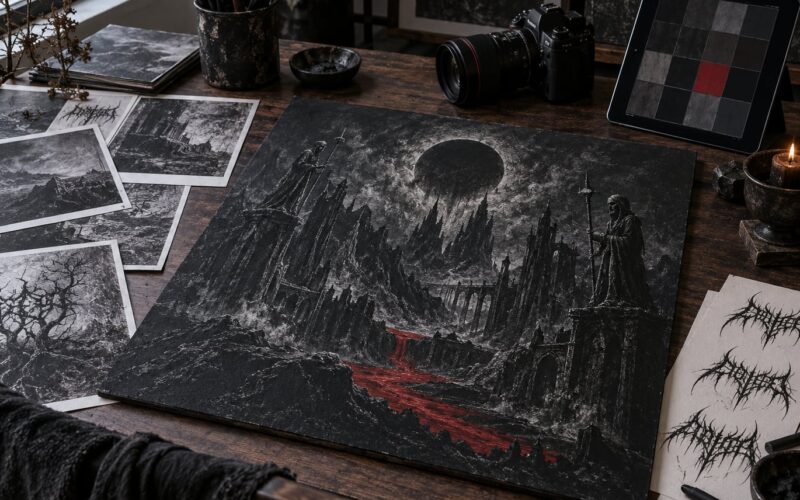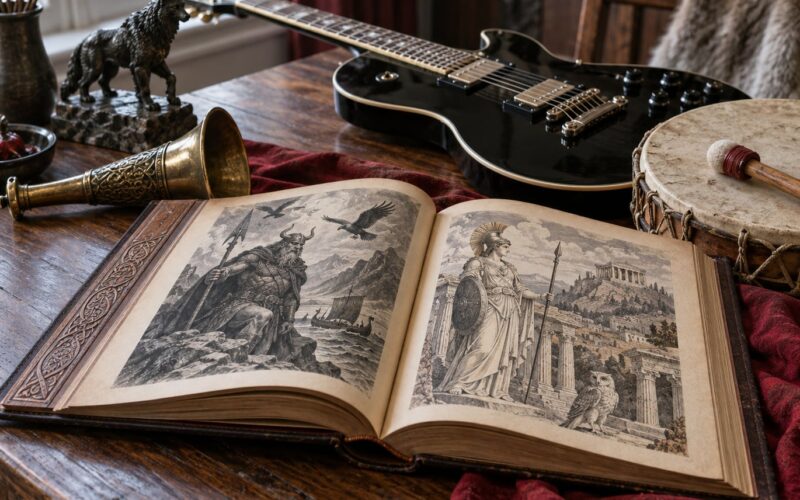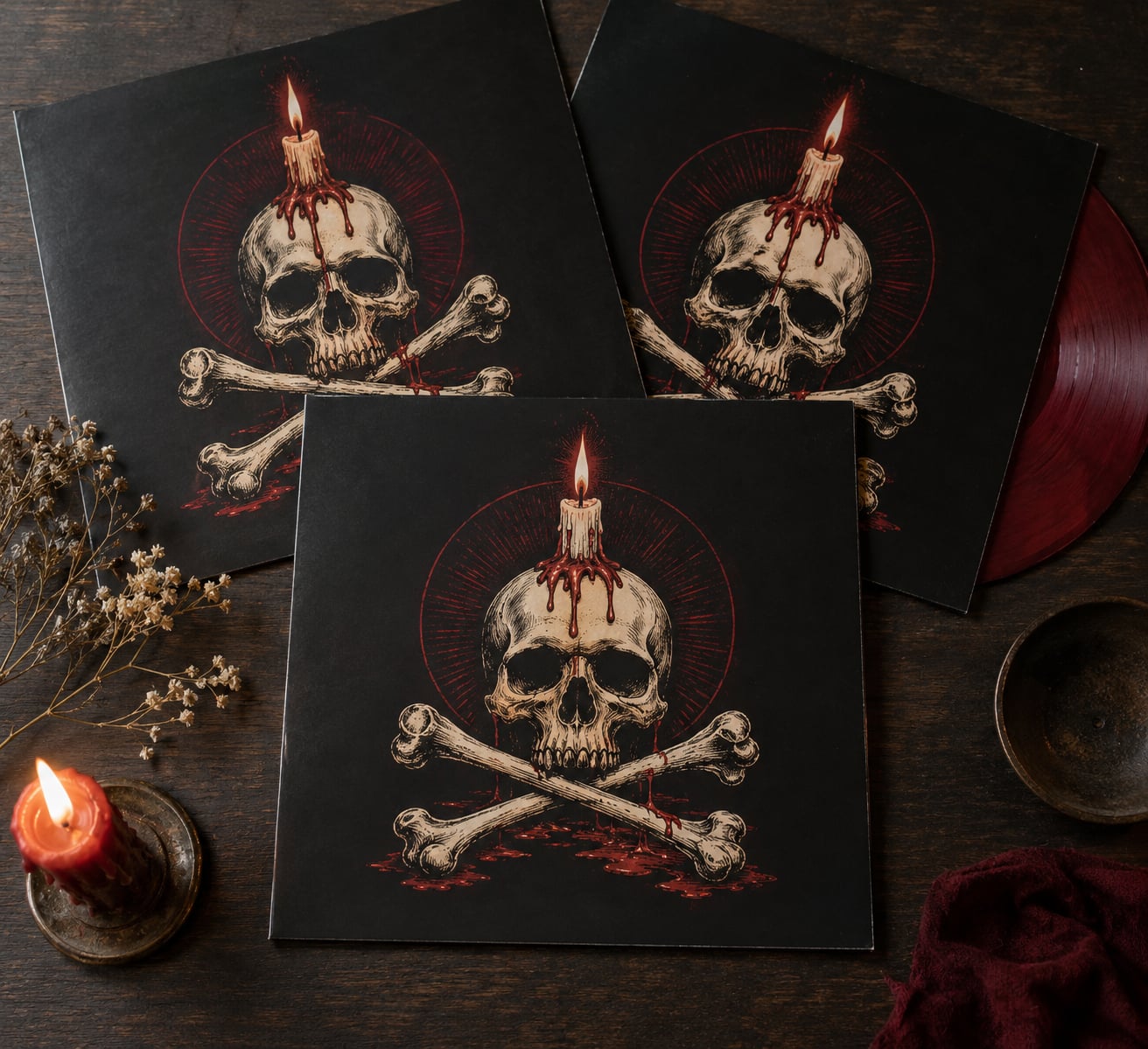
Skulls appear on so many metal covers because one simple image carries a whole stack of inherited meanings at once: mortality, defiance of death, danger, toughness and refusal to submit to social authority. Borrowed from vanitas painting, the pirate death’s head and military insignia, the skull also survives the brutal format constraint of the sleeve, where a band has about a square inch of attention to win.
There is no single reason. The motif is popular because it is old, cheap to reproduce, instantly legible, and endlessly adaptable, and because generations of bands have reused it until reuse itself became the point.
Table of Contents
- Why Skulls Appear on So Many Metal Covers
- Why skulls appear on so many metal covers rather than other symbols
- What Does a Skull Symbolize in Metal Artwork?
- Death and mortality
- Defiance of social norms
- Fearlessness and strength
- Rebellion and anti-authority
- Wisdom and hidden knowledge
- How Did Death Imagery Shape Metal Album Art?
- Where Did Metal Artists Get the Skull Motif?
- Anatomy books and medical illustration
- Tattoo flash and biker patches
- Comic books and heavy metal magazines
- Horror films and their poster art
- Medieval engravings and heraldry
- Military and naval insignia
- Occult and esoterica material
- Why Does the Skull Fit Metal’s Identity So Well?
- It survives the format and the logo does not
- Different subgenres lean on it differently
- The cover does not stay on the cover
- Is it becoming a stale symbol?
- Are All Skulls on Metal Covers the Same Symbol?
- Is Using a Skull on Album Artwork Original?
- Frequently Asked Questions
- Does a skull on a metal album cover have one fixed meaning?
- Are skulls in metal connected to Satanism?
- Did heavy metal bands invent the skull-and-crossbones symbol?
- Why are skeletons used on metal covers as often as skulls?
- What details reveal what a skull means on a particular metal cover?
- Conclusion: Read the Skull in Its Cover’s Context
Why Skulls Appear on So Many Metal Covers
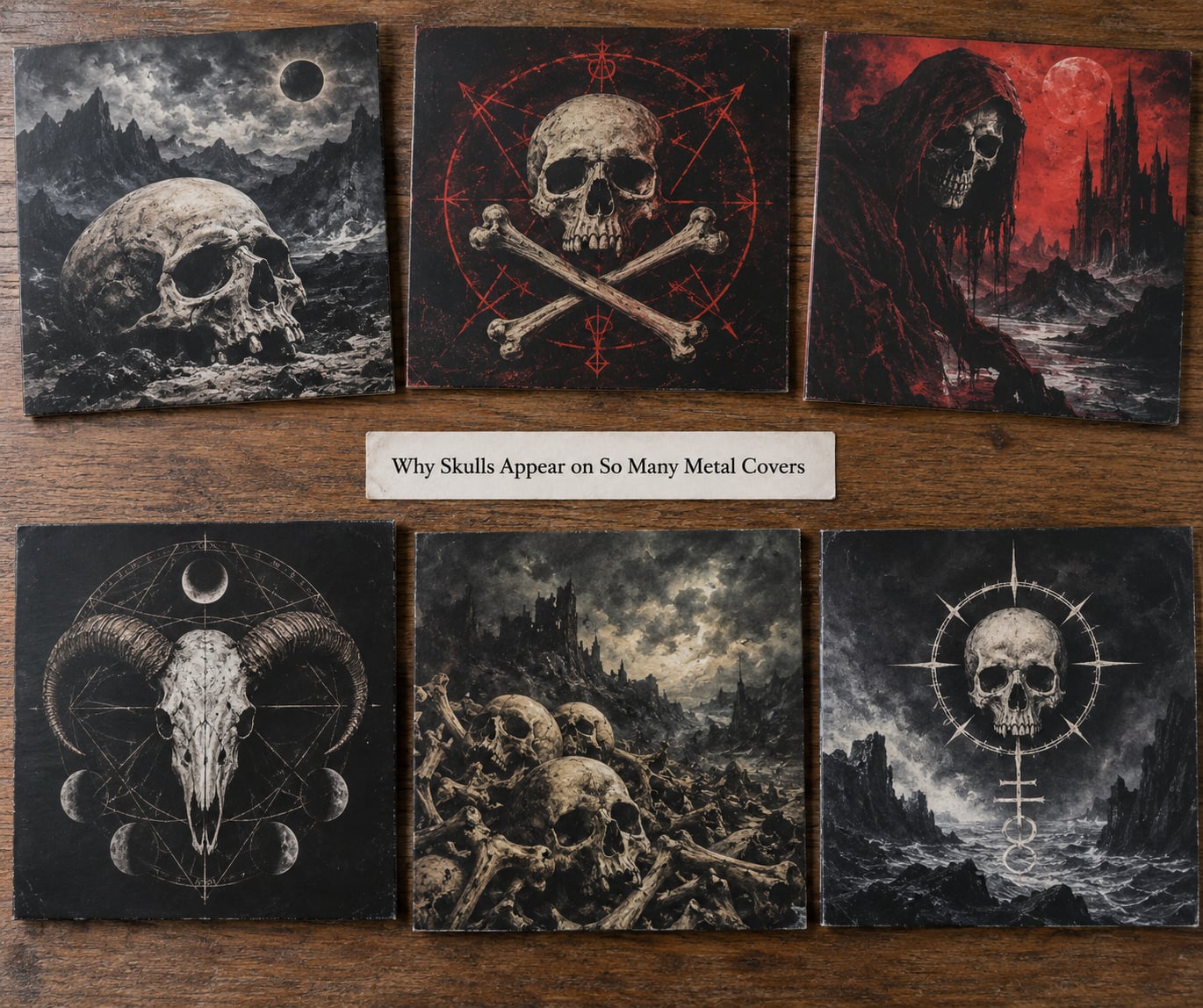
Six reasons explain the ubiquity better than any single explanation does.
- Memento mori. The skull is art’s oldest reminder that life ends, which suits a genre built around mortality as a subject rather than a taboo.
- Rebellion and anti-authority. Death imagery reads as a refusal to accept rules about what may be shown or said.
- Fearlessness. A band comfortable with death on the sleeve signals it will not flinch on stage.
- Strength and toughness. Bone survives where flesh does not. For heavy and speed metal this reads as endurance.
- Danger and taboo-breaking. The image provokes a reaction from outsiders, which is worth something in a crowded release schedule.
- Hidden knowledge. To anyone outside the scene, the skull marks a record as belonging to people who know something you don’t.
That last one is worth pausing on. Skulls function as a membership badge rather than a piece of art, and the badge gets copied because badges that work get copied.
Why skulls appear on so many metal covers rather than other symbols
Compare the skull with the alternatives metal bands rejected. A microphone is generic. A raised fist is politically specific. A lightning bolt says one thing and one thing only. The skull is unusually wide-band: it can mean death, poison, pirates, soldiers, medicine, rebellion, or pure decoration, and the surrounding artwork disambiguates it.
That flexibility, plus the fact that a skull is a shape with high internal contrast, explains most of what follows.
What Does a Skull Symbolize in Metal Artwork?
Start with the practical reading, then move to the cultural one. Here is how the common death-related elements divide up.
| Symbol or element | Where the form comes from | What it tends to signal on a metal cover |
|---|---|---|
| Skull, front-facing | Memento mori engraving, 19th-century Romantic art | Mortality accepted, confrontation, gravity |
| Skull and crossbones | Pirate Jolly Roger, called the death’s head; German Totenkopf military insignia | Outlawry, danger, poison, no quarter given |
| Full skeleton | Anatomy illustration, danse macabre traditions | Death as a person, decay, the body as a machine |
| Hourglass, usually with sand | Vanitas still life, 17th-century Dutch painting | Time running out, wasted life, finitas |
| Lit candle or single flame | Vanitas and ecclesiastical memorial imagery | A life still burning, remembrance, a vigil |
| Bone stacks, wings, horns | Heraldry, tattoo flash, badge design | Rank, dominion, a hardened identity |
| Grim reaper figure | European folklore and 20th-century horror illustration | Death as an agent with intent, judgement |
| Animal skull | Western and survival iconography | Predation, wilderness, frontier toughness |
| Calavera, decorated sugar skull | Mexican Day of the Dead | Ancestor reverence and celebration, not horror |
| Inverted cross, inverted pentagram | 20th-century occult and anti-religious iconography | Deliberate provocation, inversion of a sacred order |
Read the table as a starting point rather than a dictionary. Three meanings dominate, and the rest decorate them.
Death and mortality
The plainest reading. Memento mori is Latin for remember that you must die, and it is the oldest framing device in Western art for a skull. A band using a bare skull is usually stating a theme rather than making a threat: war, decay, extinction, or the short life of anyone who tells you otherwise.
Defiance of social norms
This is where the skull becomes an argument. The motif says the audience is being shown something the polite world would rather not discuss. In a lot of metal that means sex, violence, drug use or despair, and the imagery does the arguing before the music starts.
Fearlessness and strength
Two related but distinct jobs. Fearlessness is about the band: it will play ugly, break rules, and take the consequences. Strength is about the subject: bone is what is left after everything else fails, which makes a skull a reasonable logo for a genre built on endurance.
Rebellion and anti-authority
Metal inherited this one from punk and from motorcycle culture more than from anything ancient. The skull on a battle vest or a back print works partly because it marks the wearer as someone outside the rules that apply to everyone else.
Wisdom and hidden knowledge
The oldest and most widely spread layer of all. Skulls appear in shamanic and religious traditions far outside metal as containers of insight, because the dead are imagined as knowing what the living cannot. Christian vanitas painting, Hindu and Buddhist traditions, and Mesoamerican ancestor art all treat the skull this way.
Metal bands pick up this reading whether they intend it or not, and readers who like their metal thoughtful tend to attach to it hardest.
How Did Death Imagery Shape Metal Album Art?
Nobody can point to a moment when metal bands decided to use skulls, because the motif arrived from several directions at once and had already been borrowed by everything metal borrowed from. Tracing the line back gives a chain rather than an origin.
- Religious and funerary art. Skulls appear in Christian meditation on death, in Buddhist ritual vessels, in Hindu iconography, and in Mesoamerican ancestor imagery, long before printing and long before sleeves.
- Medieval and Renaissance memento mori. The danse macabre placed skeletons and corpses alongside the living to remind both parties that the difference was temporary. Engravings from this period are still recognisable on metal covers.
- The 17th-century Dutch vanitas. Still lifes piled with skulls, extinguished candles, hourglasses and wilting flowers made one argument: everything here is borrowed time. Art historians including Aby Warburg and, later, Erwin Panofsky wrote about this material, and it is the standard reference point whenever anyone asks why metal covers look the way they do.
- 19th-century Romantic and Gothic art. Rembrandt’s anatomical studies and the skull as a melancholic object, then the illustrated horror market, supplied the expressive model: a skull lit dramatically from below.
- Mid-century horror and underground comics. EC Comics in the 1950s normalised gags, skeletons and severed heads for a teenage readership, and those artists’ compositions turn up constantly in extreme metal artwork.
- Punk and biker graphics. Straight-up-together patches, photocopied zines and motorcycle club iconography supplied the DIY posture and the emblem vocabulary that metal inherited wholesale.
The metal-specific run, once the motif was in wide circulation, is short and well documented.
| Year | Release | What it contributed |
|---|---|---|
| 1979–80 | Motörhead, Bomber and the Snaggletooth era | The snarling Snaggletooth war-pig, drawn by Joe Petagno, fixed the visual grammar of the genre logo: spiky, angry, instantly readable at a distance |
| 1981 | Venom, Welcome to Hell | Crowd noise and a deliberately primitive speed metal identity built around infernal imagery |
| 1983 | Metallica, Kill ‘Em All | Established the hand-drawn, photocopied underground look that later bands copied rather than paid an artist for |
| 1985 | Megadeth, Killing Is My Business | Pushed the cartoonish horror register, with Vic Rattlehead as a recurring mascot on later covers |
| 1988 | Danzig, Danzig | Adopted a stark death’s-head emblem that fans still trace to a comic book origin and argue about |
| 1990 | Entombed, Left Hand Path | Death and decay imagery central to the Stockholm scene’s identity |
| 1994 | Mayhem, De Mysteriis Dom Sathanas | The high-contrast photo-plus-symbol format that black metal sleeves still use |
| 2006 | Iron Maiden, A Matter of Life and Death | Eddie, the band’s skull-adjacent mascot, used as a full-bleed photographic subject rather than a drawn emblem |
Two forces in the 1980s pushed bands further toward generic death imagery. One was the Satanic Panic, when parents, record labels and tip sheets treated inverted crosses and pentagrams as evidence. The other was simply practicality: an illustrated skull sold, and it did not require a photographer, a budget or a licence.
Where Did Metal Artists Get the Skull Motif?
Cover illustrators work from a shared reference shelf, and most of its contents are older and more ordinary than the finished covers suggest.
Anatomy books and medical illustration
Public domain anatomy plates remain the single most useful source. They provide a front-facing skull with correct proportions in seconds, which is why so many covers share that exact posture and slight leftward tilt.
Tattoo flash and biker patches
Traditional tattoo charts have carried skulls, hourglasses, crossbones and grim reapers since the mid-20th century. The biker vest then treated those images as badges. Anyone designing for metal grew up with the same chart.
Comic books and heavy metal magazines
This is where the Danzig argument comes from. Fans have long traced that skull to a comic panel, and the recurring question on fan forums is whether anyone was ever asked. Whether or not that is settled, comic composition is unmistakably visible in a large share of extreme metal sleeve art.
Horror films and their poster art
Italian and American horror posters of the 1960s and 70s gave the genre its lighting model: skull lit from below, deep shadow above, a cold figure on one side.
Medieval engravings and heraldry
Dürer and the woodcut tradition supply the graphic weight, and heraldic badges supply the crossed bones and the shield shape that so many logos still use.
Military and naval insignia
The Totenkopf was a real uniform marking on Prussian, then Imperial German, units, and the death’s head appears on regimental badges well before metal. Submarine crews also used the Jolly Roger to record kills, which is a nice reminder that the emblem was functional long before it was decorative.
Occult and esoterica material
Sigils, alchemical marks and ceremonial diagrams get reproduced freely, usually by artists who understand them as texture rather than doctrine. Treat that with some scepticism.
Why Does the Skull Fit Metal’s Identity So Well?
It fits because of a design constraint that bands forget they are solving. A sleeve is small, printed in a restricted palette, viewed as a thumbnail in a streaming service, and seen across a record shop wall in a second. A skull is one of the few shapes that survives all four conditions.
It survives the format and the logo does not
Metal logos are famously hard to read, and that is a deliberate trade-off: spikiness and illegibility mark a band as belonging to the scene rather than to mainstream radio. The cover goes the other way. Simplified, high-contrast, centred, the skull survives being shrunk to a square or photocopied in black and white.
Different subgenres lean on it differently
Doom and stoner metal tend to use weathered or burned skulls. NWOBHM and the German 1980s scenes favour military and heraldic deaths’ heads. Thrash uses cartoon horror and mascot creatures. Death metal goes for anatomical realism, gore and the full skeleton. Black metal is the most restrained with the motif despite the reputation, often choosing a single high-contrast symbol instead.
The pattern is roughly that the further a band sits from pop, the less central the skull becomes on the cover and the more it moves into the logo, the stage, or the merchandise.
The cover does not stay on the cover
Cover art is the source material for everything else. Patches, shirts, tattoos, back prints and banner designs are all traced from the sleeve, which is why a skull that works as artwork ends up painted on strangers’ skin. Corpse paint extends the same logic onto faces, and it arrived through the same underground circuit.
Is it becoming a stale symbol?
Some fans say so, and it is a fair criticism: three decades of black and white pen-and-ink skulls have made the scene visually predictable. The counter-movement is visible in 2026 releases, where bands lean on photography, retro sleeve typography, hand-drawn illustration and deliberately mismatched production. The skull has not disappeared, but it is no longer the default.
Are All Skulls on Metal Covers the Same Symbol?
No. The same drawing means different things depending on what is next to it and how it is set.
- Skull versus skeleton. A skull alone is a symbol. A full skeleton is a body, which shifts the emphasis toward decay, anatomy or the mechanics of dying.
- Grim reaper. A figure with a scythe makes death an agent with intent, and turns the cover toward judgement or fatalism.
- Bone pile. Many skulls means a mass, a battlefield or a battlefield’s aftermath, which is a different claim from one death.
- Winged or horned skull. Borrowed from aviation and heraldry, so it reads as rank and dominion rather than mortality.
- Animal skull. Cattle and longhorn skulls are Western and survival iconography. They say frontier and predation, not death.
- Calavera. The decorated Mexican sugar skull is about celebrating and remembering the dead, which is the opposite emotional register from the horror reading.
- Skull-like faces. Corpse paint and masks borrow the hollow eyes and painted teeth without depicting a skull at all, and they carry stage menace rather than mortality.
Then there is context. A skull laughing reads as cruelty, a skull bowed reads as mourning, and a skull in a bishop’s mitre reads as satire of religious power. Colour shifts things too: bone white against red suggests violence, while a monochrome illustration reads as heritage.
Typography matters as much as the image. Heavy blackletter or jagged display lettering makes the skull aggressive, and a clean serif makes the same drawing look like a museum object.
Is Using a Skull on Album Artwork Original?
The symbol is public domain, so using it is never original in the strict sense. What has not been done before is the particular combination: this drawing, this pose, this lighting, this palette, this lettering, this set of objects around it.
That is the actual craft on display in metal artwork. Skilled cover illustrators have spent decades in this idiom, and a sleeve can look like a photocopy and still have been carefully constructed. When the format collapses, the distinguishing work is usually in the composition and the lettering rather than in the symbol itself.
Worth remembering that the emblem has also moved between scenes with wildly different politics, being reclaimed and reworked as it moves. Its meaning is a record of who has worn it, not a fixed property of the drawing.
Frequently Asked Questions
Does a skull on a metal album cover have one fixed meaning?
No. The same drawing means mortality on one cover, defiance on the next, and decoration on a third. Meaning comes from context: what surrounds the skull, how it is lit, what lettering it carries, and which subgenre the band plays in. Treat the skull as a starting vocabulary rather than a definition.
Are skulls in metal connected to Satanism?
Usually not, and the association is largely a 1980s artefact. The skull’s documented roles are memento mori, the pirate death’s head, military Totenkopf insignia and anatomical illustration. Most bands using one are making a mortality or graveyard statement. Inverted crosses and pentagrams are a separate choice, and even those are often aesthetic provocation rather than belief.
Did heavy metal bands invent the skull-and-crossbones symbol?
Not remotely. Skull and crossbones marks are documented on pirate flags from the late 17th century onward, and the Totenkopf was worn by German military units long before rock music. The reason why skulls appear on so many metal covers today is inheritance rather than invention, with new meanings layered onto an emblem that was already centuries old.
Why are skeletons used on metal covers as often as skulls?
A skeleton makes death a person rather than a symbol. Where a skull compresses an idea into one shape, a full skeleton brings anatomy, decay and the mechanics of dying into the frame, which suits bands whose lyrics are about the body. Death metal in particular favours the full figure, while extreme metal tends to keep the isolated skull.
What details reveal what a skull means on a particular metal cover?
Start with the pose and expression, then read the company it keeps: crossbones, hourglass, candle, wings or chains. Check the palette, since red and bone white reads as violence while monochrome reads as heritage. Then read the typography, which is usually the loudest signal on the sleeve, and finally the era and subgenre of the band.
Conclusion: Read the Skull in Its Cover’s Context
Skulls recur on metal covers because they compress mortality, rebellion, toughness and shared knowledge into a shape that reads instantly at thumbnail size. They are inherited symbols, not a code with one answer, and the meaning shifts with pose, palette, typography and era.
When you pick up a record with a skull on it, look at the objects around the skull first, then at the lettering, then at what the band is actually singing about. That order tells you more than any symbol dictionary will.