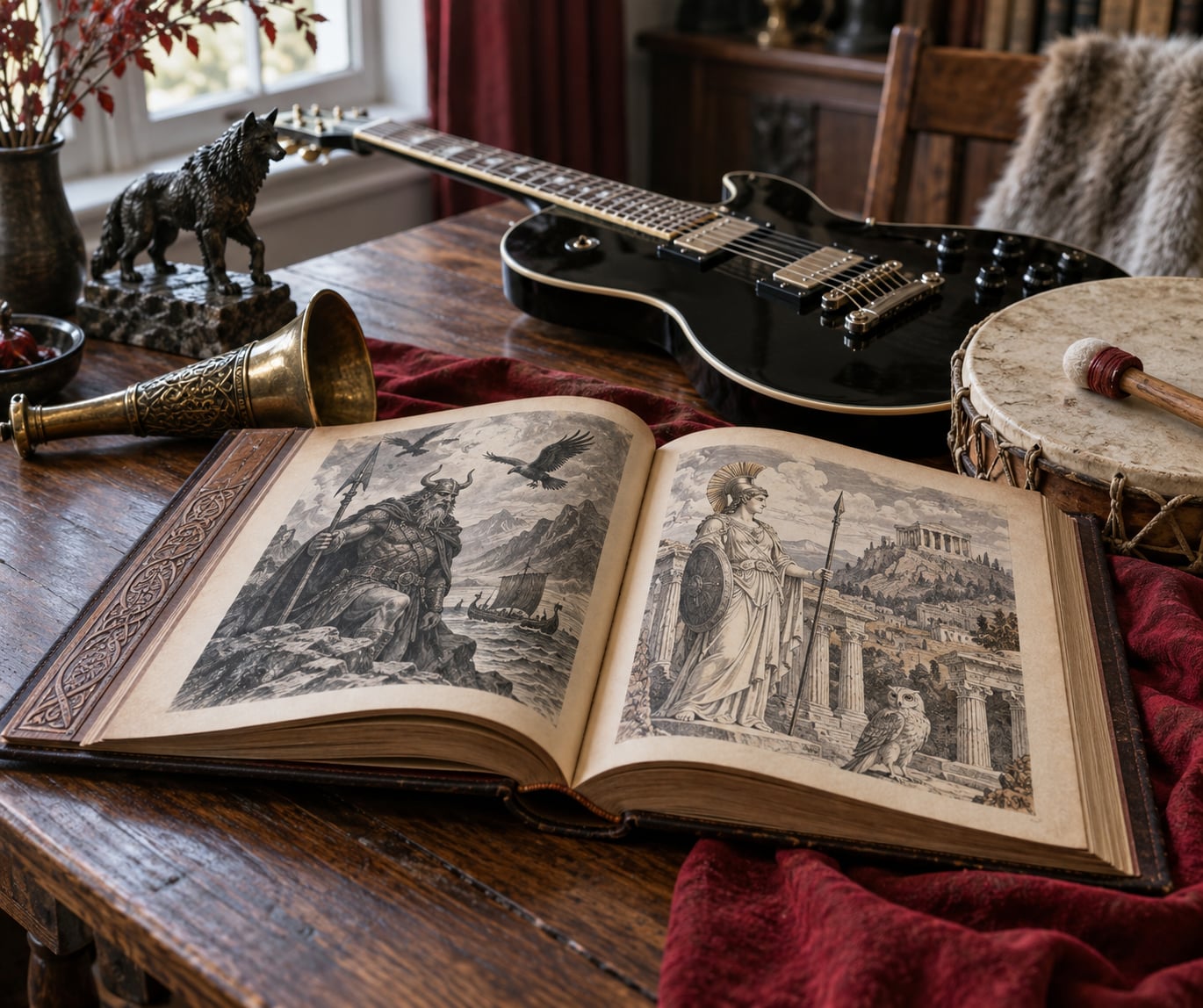
Mythology shaped metal songwriting by handing the genre a library of ready-made epic stories: gods, betrayal, apocalypse, ancestral war and underworld journeys. Metal songwriters rarely retell those myths. They pull one figure or conflict out of the source, compress it into a verse-and-chorus arc, and back it with modal minor-key music, chant-like gang vocals and folk instruments that sound ritualistic.
That shorthand is why a three-minute song about Ragnarok can feel like a chapter in a saga. It is also why the topic confuses newcomers, who hear Norse names and assume the band is describing history. Let me clear that up and then show you what each tradition actually supplies, and how you can use the same method on your own songs.
Table of Contents
- Why Mythology Resonates in Heavy Metal
- How Mythology Shaped Metal Songwriting
- 8 Mythological and Folkloric Influences in Metal
- Norse Legends and the Modern Metal Sound
- Greek and Roman Mythology in Metal
- Mesopotamian, Sumerian and Egyptian Myth
- Slavic Myth, Satanism and the Satanic Panic
- Hindu Myth in Metal
- Medieval Legends, Folklore and Historical Memory
- Fantasy Mythology and Metal’s Invented Worlds
- Occult Imagery and the Quest for Transcendence
- How Musicians Turn Myth Into a Song
- What Makes a Metal Mythology Reference Work?
- Frequently Asked Questions
- Why do so many metal bands use mythology?
- Are metal lyrics about Norse or Greek myths historically accurate?
- Does using Tolkien-inspired imagery make a metal song mythological?
- What is the difference between a literary reference and a myth in metal?
- How can a musician use mythology without copying an existing song?
- Start With a Question, Not Just a Monster
Why Mythology Resonates in Heavy Metal
Myths fit metal because metal already does four things that myth does natively: it treats a small group of people as a congregation, it rewards loud shared repetition, it sets a single idea at enormous volume, and it accepts death as a real subject rather than a euphemism.
Start with moral absolutism. Most mythology runs on promises, debts and betrayals. Oath-breaking, violated hospitality, a god who breaks their word to mortals. Those are sharp positions, and sharp positions write well because there is no ambiguity to soften in the chorus.
Then there is the ritual feel. Long vowels, repeated phrases, gang vocals answering the lead singer line for line. That is structurally close to communal chanting, and it is why myth-based metal choruses get shouted back at shows without the crowd needing to know the plot.
Compression is the third factor. A myth arrives to you pre-concentrated. Someone else did the work of deciding what mattered about the fall of Troy, and you inherit it in a paragraph. A metal lyric has about four minutes of space, and a pre-digested story fits perfectly.
Finally, myth is old, and metal wants to feel like it sits under something larger. In 2026 the same Ragnarok reference still lands because the story was old before the band existed, which gives the speaker a posture rather than an opinion.
How Mythology Shaped Metal Songwriting
A myth reaches a metal song in one of six ways, and knowing which one you are using fixes most lyric problems.
- Premise. The song answers a question the myth asks, such as what a god owes a world that worships them.
- Character conflict. One figure carries the whole song, usually the flawed one, not the hero.
- Symbolic image. A single object, a bridge, a tree, a chain, does the storytelling work with almost no text.
- Narrative arc. The verse-chorus-bridge order maps onto rising action, turn and collapse.
- Atmosphere. The myth mostly sets a temperature: funeral, hunt, frost, flood, burial.
- Moral question. The song takes the myth as established and interrogates it, which is where the most interesting work happens.
Most weak metal lyrics fail at the first step. They retell a plot the listener already knows, so nothing lands. Change the vantage point instead: sing the valkyrie’s side, sing the god, sing the ruined city. Same story, fresh mouth.
The other failure is decorative naming. Dropping a rune or a god’s name into a verse that would mean the same without it is set dressing, not songwriting.
8 Mythological and Folkloric Influences in Metal
Metal draws on eight distinct traditions, and they do not work the same way. Treating all mythology as one interchangeable ancient-flavor pool is the most common mistake in myth-based metal, and here is how each tradition actually functions in a song.
Norse Legends and the Modern Metal Sound
Norse mythology is metal’s default source because it already contains war, an afterlife worth singing about, a final battle, and a creation myth. Ragnarok, Valhalla, Odin and his ravens, Thor, Loki, Yggdrasil, Bifrost. The tradition supplies the highest stakes with the least invented machinery.
It also gives metal its cleanest musical cues. Bathory, Amon Amarth, Moonsorrow, Turisas, Ensiferum, Korpiklaani and Månegarm all build on modal riffing over folk melody, drum patterns that sit somewhere between a march and a work song, and choruses built to be shouted. Amon Amarth built a career on Swedish Viking history, ending each record in the way a saga ends. Månegarm made a concept album out of the Old Norse poem Ynglingatal, with Iron Maiden and Judas Priest as stated reference points.
Enslaved is the most interesting case because they treat myth as long-form architecture rather than decoration. Guitarist Ivar Bjørnson described building Heimdal by writing songs for the running order rather than writing tracks and sequencing them later, and frontman Grutle Kjellson said Heimdall had been circling the band for three decades, appearing on the 1992 Yggdrasill demo and returning as the subject of the 2023 album. A myth figure became the spine of a catalog.
One correction worth making for new listeners: most of what gets called Norse myth is reconstructed, not recorded. Snorri Sturluson wrote the Edda in the thirteenth century, drawing on much older material.
Greek and Roman Mythology in Metal
Greek and Roman myth is the metal tradition that supplies flawed protagonists. Achilles chooses between a long obscure life and a short glorious one and picks glory. Agamemnon sacrifices his daughter. Oedipus solves the riddle and destroys his family. That last-moment, wrong-choice quality is closer to how metal lyrics actually behave than the fixed hero of a Norse saga.
Greek myth also gives metal its underworld. The descent, the gatekeeper, the bargain, the return that changes everything. Magica built a Greek-myth thread around Persephone, and Doomocracy has talked openly about mixing personal experience with fiction drawn from Greek and wider mythological sources on the same record. Rotting Christ, Septicflesh and Necromantia work in the same space.
The structural feature worth copying is that Greek stories rarely resolve cleanly. They end in aftermath, and aftermath is what metal imagery lingers in. Iron Maiden’s Powers of Darkness, for instance, takes its Norse material from the band’s own reading rather than from a soundtrack, and lands somewhere closer to a morality play than a battlefield scene.
Mesopotamian, Sumerian and Egyptian Myth
Mesopotamian metal is the least crowded lane and the most strange. Its canon runs through Tiamat, Marduk, Enki, Ereshkigal and Absu, with creation happening through conflict rather than prayer. Melechesh built the most visible body of work here, with albums named for Assyrian rulers, and Tiamat’s early material draws on Sumerian and Babylonian sources.
Musically it tends to sit closer to blackened extreme metal than to folk metal, which makes it useful for songwriters who find Viking metal crowded. The imagery is unfamiliar enough that listeners stay curious instead of pattern-matching.
Scholarship tends to read this subculture as more than a theme. The Cambridge Companion to Metal Music treats Mesopotamian metal as a subcultural discourse with its own ideas about how to compose, write and perform, and as a politics of history used by bands working out where they belong. That reading is worth holding, because it means the myth choice can be an argument rather than a mood.
Egyptian sources, from Anubis and the weighing of the heart to the Nile’s annual flood, are rarer but turn up in extreme metal, and the band Nile built a whole identity on death, mummification and the underworld.
Slavic Myth, Satanism and the Satanic Panic
A fourth branch uses darker, inversion-based material. Behemoth’s catalogue is the clearest example, pairing Satanic framing with a distinct Polish historical setting and recurring occult ritual elements. That is not the same thing as Norse paganism, and confusing the two is the single most persistent fan debate in the genre.
Here is the honest breakdown. Pagan or folk metal works with older nature and hero traditions. Satanic imagery works with deliberate inversion, blasphemy and ritual staging. Nobody in metal is conducting actual rites, and a horned stage set is a visual language, not a practice.
That distinction matters historically, because this imagery got people arrested. In 1985 the US Parent Music Resource Council placed Black Sabbath and Iron Maiden on its Filthy Fifteen list, and police raids on record shops and concert venues followed through the late 1980s. Myth-driven metal met organised religious panic, and the panic lasted longer than the scene’s actual behaviour warranted.
Hindu Myth in Metal
Hindu material reached metal through extreme and blackened scenes, where figures such as Kali and the rtas, the order that holds the cosmos together, offer a different kind of tension. Norse myth asks what survives an apocalypse. Hindu myth asks what holds a system together when a force bigger than it appears. That is a heavier question and it makes unusual lyrical material.
Writers who work here have to be careful, and the caution is not censorship. Hindu traditions are living religious practices, not a public-domain image library, and bands drawing on them have faced criticism for treating the material as aesthetics. The line most writers now describe: study the source properly, name where your knowledge comes from, and do not stage a ritual you do not understand.
Medieval Legends, Folklore and Historical Memory
Medieval material in metal comes from three places that get blurred together: documented history, later legend, and nineteenth-century invention. Knowing which one you are quoting is most of the work.
Most metal references to Arthurian, Carolingian or Norse heroic matter come from later legend or modern fantasy rather than from records. That is not a problem for songwriting, but it is a problem for writing that claims authority.
| Source type | Where metal meets it | How to use it |
|---|---|---|
| Documented history | Battles, sieges, real leaders | Ground truth. Name the source and the limits of what you know. |
| Legend and folklore | Beowulf, balladry, ghost tales, cursed places | The richest seam. Let the story stay unresolved. |
| Modern invention | Reconstructed rituals, invented pantheons | Signal it as invention. Do not present it as recovered tradition. |
| High fantasy | Invented realms, elves, dragons | Borrow the method, not the vocabulary of a specific author. |
Ballad and epic fragments also come with musical help. Fragments of Beowulf and the German Volkslied are short, rhythmic and built for chanting, which is why they pair so well with gang vocals.
Fantasy Mythology and Metal’s Invented Worlds
Borrowed fantasy languages are everywhere in metal: invented races, sunken kingdoms, epic war, a hero who refuses the call. The Tolkien-derived vocabulary became so widespread that it now functions as a shared shorthand in the scene, and Blind Guardian’s Nightfall in Middle-Earth is a well-known case.
The productive distinction is adaptation versus imitation. Adaptation takes the method, a world built by rules, and adds something of your own. Imitation copies specific names, maps and images from a living author’s work, which in Tolkien’s case has been contested in court and would be a bad idea regardless.
For songwriting purposes the practical rule is simple: if your listener could picture your world without your album cover, you have probably borrowed vocabulary instead of borrowed structure.
Occult Imagery and the Quest for Transcendence
A final strand uses ceremonial language rather than a specific pantheon. Alchemy and transformation, astrology and fate, inversion and crossing thresholds, robes, candles, geometry. Extreme metal leans on this heavily because it maps onto transformation without demanding a character or a plot.
Used well, this is atmospheric rather than programmatic. It gives a song a temperature and a ritual pace, and it lets a band sound ancient without committing to any one culture’s gods. Used badly, it is empty set dressing, and the tell is always the same: imagery that would mean exactly the same thing if you swapped in a different symbol.
Keep the distinction clean between symbolic use and literal belief. Ceremonial imagery in a song is a literary device, the same way a detective novel can be full of ritual without meaning anything supernatural.
How Musicians Turn Myth Into a Song
This is the working method, and it holds whether you are writing one song or a concept album.
- Pick the source and the question. One myth, one real question you want answered. What does a god owe the people who made them? What does the survivor owe the dead? A myth without a question becomes a summary.
- Isolate the conflict. Find the sharpest disagreement in the story and drop everything else. Two forces, not six.
- Choose the speaker. First person from inside the myth, or third person watching it happen? The second lets you be colder about it.
- Build a small symbolic vocabulary. Three images, reused. Rust, a threshold, a name said twice. Recurring images are what make listeners feel depth.
- Map the arc onto the running order. Verse sets the state, chorus states the conflict plainly, bridge turns or breaks, final chorus either resolves or refuses to. This is how Enslaved built Heimdal from song sequencing.
- Choose a register. Saga recitation, plain speech, chant, formal speech. Register tells the listener how seriously to take it.
- Cut the retelling. Read the lyric without the music. Any line that only works because you already know the myth has to go or be rewritten from the inside.
That last step is where most drafts fail, and it is the one that separates a song from a trivia question.
What Makes a Metal Mythology Reference Work?
A reference works when it is emotionally relevant before it is intellectually impressive. Six things to check:
- Emotional relevance. The myth has to answer a feeling the listener recognises, not just display knowledge.
- Narrative clarity. A stranger should follow the verse structure without a synopsis.
- Musical fit. The mode, rhythm and instrumentation match the story’s temperature. A funeral in a lilting dance pulse is a choice, not a mistake.
- Respectful sourcing. You know whether you are drawing on a live tradition, a fragmentary record or an invention, and you say which.
- Originality of angle. Your point of view is yours, not the encyclopedia’s.
- Coherence across the package. Art, stage design, logos and lyrics point at the same world. This is where myth stops being lyrical content and becomes band identity.
That last point is where the biggest gains live. Bands like Summoning, Eluveitie and Alcest use art, packaging and sound design to make a world coherent, and that coherence is what people remember. Here is how the traditions compare side by side.
| Band | Myth source | Named album or song | What the myth supplies the lyric |
|---|---|---|---|
| Enslaved | Norse, Heimdall and Bifrost | Heimdal, Behind the Mirror | A figure recurring across three decades of releases |
| Amon Amarth | Norse saga and Swedish Viking history | Heimdall’s Warcry, Twilight of the Thunder God | A finish line. Every album ends the way a saga ends. |
| Månegarm | Old Norse poem Ynglingatal | Ynglingatal | A dynastic list that becomes a concept album spine |
| Iron Maiden | Norse, Egyptian, Arthurian, literature | Powers of Darkness, Rime of the Ancient Mariner | A moral frame, plus imagery a stadium can shout back |
| Magica | Greek, Persephone and descent myths | Greek-myth concept work | Underworld journeys and the cost of returning |
| Melechesh | Mesopotamian, Assyrian and Babylonian | Assyrian ruler-titled releases | Creation through conflict and an argument about belonging |
| Tiamat | Sumerian and Babylonian | Sumerian-influenced early work | Older, stranger imagery than the folk-metal lane allows |
| Behemoth | Satanic inversion with Polish historical setting | The Satanist and the Zoser Kiapa cycle | Ritual staging and deliberate blasphemy as stagecraft |
| Summoning | Lost armies and mountain invocation | Summoning the ancient lost armies | Atmosphere over plot, which is the whole method |
| Blind Guardian | Tolkien-derived high fantasy | Nightfall in Middle-Earth | A rules-based world and a singalong quest structure |
Frequently Asked Questions
Why do so many metal bands use mythology?
Because myth is compact, emotionally loaded and already structured. A story about a broken promise or a coming apocalypse arrives pre-digested, which fits the four-minute format. It also matches how metal sounds: loud repetition, shared chanting, moral absolutes. Bands can drop one figure into a song and get scale and atmosphere for free.
Are metal lyrics about Norse or Greek myths historically accurate?
Usually not, and rarely aim to be. Most Norse material comes from medieval sources like the Poetic and Prose Edda, which were written down centuries after the period they describe, and much of what circulates as tradition is modern reconstruction. Greek material is better recorded but still filtered through late playwrights. Accurate is not the goal; emotionally true to the story is.
Does using Tolkien-inspired imagery make a metal song mythological?
Not by itself. Myth belongs to cultures and carries meaning for communities. Fantasy worldbuilding borrows the method of myth, coherent rules and a cosmic scale, without carrying the ritual weight. A song with elves and a sunken kingdom is high fantasy. A song built on inherited story and belief about where people come from is mythic.
What is the difference between a literary reference and a myth in metal?
A literary reference borrows a line, a character or a plot from a known work, and the audience has to recognise the source for the joke or allusion to land. A myth is a story a culture tells about origins, death, gods and order, where the meaning matters more than the citation. Iron Maiden draws from both, and the strongest songs lean on the second.
How can a musician use mythology without copying an existing song?
Change the vantage point. Any well-used myth already has famous songs attached to it, so retelling the plot from outside is guaranteed to sound like those songs. Sing the antagonist, sing the bystander, sing the ruined city, or set the same event in a different era. Pick the emotional question first, plot second, and the resemblance drops away.
Start With a Question, Not Just a Monster
The whole method fits in one move. Choose a myth, write down the emotional question it raises for you, then write one lyric from a specific point of view inside that story. Everything else in this guide, the imagery, the structure, the sound, follows from that.
And if the Norse lane feels crowded right now, it is. Mesopotamian, Greek, Hindu and Japanese sources are all wide open, and most bands have never touched them. That is where the interesting song in 2026 is sitting.