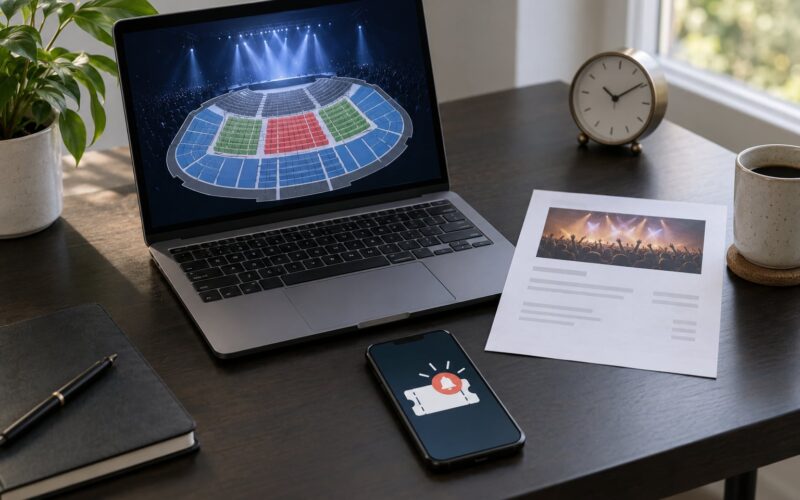
If you have ever watched a band’s tour route and noticed your city missing between two dates that were barely an hour apart, the answer is usually not attitude. It is arithmetic. Promoters screen dates by expected attendance, venues only exist in certain sizes, drive time and freight costs eat into every guarantee, and contracts quietly block nearby dates around festivals. Understanding why bands skip certain cities on tour comes down to who takes the financial risk on a show nobody has promised will sell.
The frustration is real, and it is specific: you drive six hours, you skip work, and the nearest date is across three state lines. But the pattern almost never means your city does not matter to the band. It means a date in your market never cleared a desk.
Table of Contents
- The Short Answer: Routing Never Follows a Straight Line
- How Ticket Demand Shapes the Route
- Why a Promoter or Venue Says No
- The Geography of Travel and Freight
- What Band Schedules Reveal
- Why Some Cities Are Added Later
- How Fans Can Spot a Likely Tour Stop
- Frequently Asked Questions
- Why would a band skip a city that is close to another stop?
- Does a city not appearing on the first tour announcement mean the band will never play there?
- Can a band add a concert after the rest of the tour has been announced?
- Are smaller or less famous cities less likely to get tour dates?
- How can fans tell whether a rumored show date is real?
- Conclusion: Read the Route, Not Just the Missing City
The Short Answer: Routing Never Follows a Straight Line
Bands skip cities because every date has to clear four gates at once: a promoter willing to bid, a venue that fits, a route that connects, and expected ticket sales that cover what was promised. Miss any one gate and the date does not exist, no matter how many fans live nearby. The band usually hears about the absence of your city weeks before you do.
Here is what sits behind those gates:
- Expected attendance. Nobody can prove a room will sell, so a promoter prices their worst night and either accepts the risk or declines it.
- Venue fit. Some markets simply have no room in the size and price tier a band needs, and the wrong room empties the tour faster than an empty calendar.
- Route geometry. Drive time, overnight costs and freight movement decide whether a city is worth adding or just an expensive detour.
- Contract terms. Radius clauses and non-competition windows around festivals can block a nearby date even when a room is available.
- Relationships. Local promoters advocate for their market. If nobody there is pushing, the date often never gets requested.
- Merch reality. Bands weighing a stop look at the whole night, and merch tables can out-earn a door in some rooms and lose in others.
How Ticket Demand Shapes the Route
Before a band agrees to anything, somebody has to guess the draw. A booking agent looks at past ticket sales in that market, streaming numbers, local scene activity and the size of the room being offered. Then the local promoter decides whether that guess is good enough to put money behind.
This screen is where the surprise usually comes from. Two cities can be a hundred miles apart and produce opposite answers, because what gets measured is not population but recent, comparable attendance in a similar room.
| Demand read | What the promoter expects | What happens next |
|---|---|---|
| Strong local demand | Room sells in advance, or has a solid history at that tier | Date gets bid on, possibly against another promoter in the same market |
| Uncertain demand | Depends on routing luck, the opener, or a festival nearby | Offered on a door split, or held until another date confirms |
| Weak demand | Loss on an average night looks likely | No bid, or a bid the agent declines, and the city is skipped |
A useful thing fans can learn to spot: strong demand shows up in advance sales, not in population charts. A town of 40,000 with three colleges, an active scene and a promoter who has packed the same room repeatedly can screen stronger than a metro of a million with a fractured scene and no recent history at that tier.
That is the whole answer to why bands skip certain cities on tour, in miniature. Nobody is ranking cities by size. They are ranking cities by how a comparable night recently went somewhere.
Why a Promoter or Venue Says No
The promoter is the person who actually says no, and they usually have a list. Offers on shows that stay unsigned usually start at a flat fee paid whether or not tickets sell, which is the safest arrangement for a touring act. When a promoter cannot see the break-even, they walk away before the routing is even drawn.
Other reasons a date dies quietly:
- The bid doesn’t reach the guarantee. A strong local act might draw well and still fall short of the number the band needs to make the night worth its position on the route.
- Two promoters, one room. In a hot market, venues get courted and the date settles on who offers more certainty, not who has the bigger mailing list.
- Competing events. A festival, a theatre show or another tour in the same week splits the same audience three ways.
- No room in the right tier. The city has clubs but nothing that matches the band’s ticket range, so the best option either sells out instantly or dies.
- No date available. Routing needs three to six weeks of lead time on rooms, freight and crew. If the venue calendar is full for that week, the city is off the map.
- Production limits. Some shows need a specific load-in window, power, floor space or a crew that cannot be in two places the same night.
None of these is a judgment about your taste. They are about risk, and risk gets decided by people who lose money when a night goes wrong.
The Geography of Travel and Freight
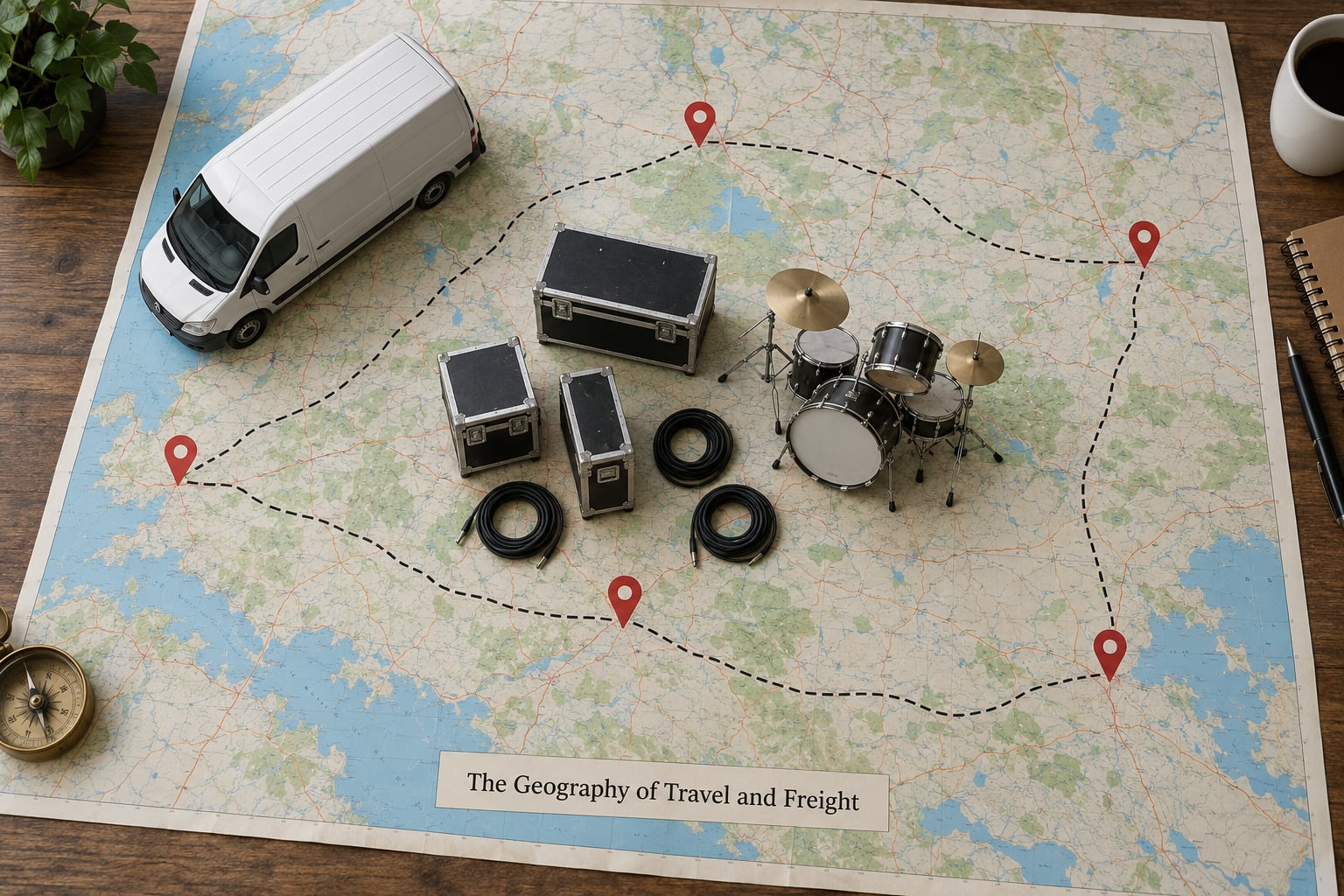
Two cities can be close on paper and far apart in practice. Tour routing is measured in drive hours, not miles, and the crew knows the difference.
A mid-size band in a bus or a rented van has hard limits: how long a person can drive before the next show suffers, where the bus legally parks overnight, and whether the freight mover can deliver backline and road cases on the promised morning. Add a mountain crossing, a winter storm, a border crossing with customs paperwork, or a route that lands the crew at four in the morning after a six-hour run, and a date that looked easy on a spreadsheet stops making sense.
Freight is its own line item. Amplifiers, cabinets, lighting rigs and instruments move as freight, often on a separate truck from the people. Bands that skip the UK or parts of Europe frequently cite the cost of moving equipment across borders or onto an island for a short run, where the gear moves less often and costs more to move at all.
None of that is about whether the fans are there. It is about whether the show can arrive and leave without costing more than it earns.
What Band Schedules Reveal
A routing map is a working document, not a promise. The version you see online at announcement is one point in time, and it changes for reasons that have nothing to do with your city.
- Confirmed dates have a venue, a ticketing link and an on-sale time. Those are real.
- Announced markets mean someone is working the city, but not that a date exists yet.
- Hold dates sit on a routing map as placeholders, sometimes for weeks, before they are confirmed or dropped.
- Festival obligations take up a chunk of the calendar and pull the surrounding weeks into a fixed shape.
- Release and recording weeks are often protected, because a band that misses a new release’s promotional window loses more than one night’s door.
- Deliberate breaks exist too. Weeks off for family, health or rest show up as gaps that look identical to a skipped market.
So a missing city in an early announcement is not a verdict. It is usually a question nobody has answered yet.
Why Some Cities Are Added Later
Routes get amended more often than fans realise, and additions are normal rather than exceptional.
Common reasons a date appears after the first announcement: a room freed up and the promoter made an offer, a sponsor or brand asked for a specific market, a festival slot opened and freed a week nearby, a date was cancelled and the routing manager needed to fill the gap, or another band fell through and the crew was already nearby. Bands also add shows specifically because they have never played the city, which reads as a signal that demand was assumed rather than proven.
Warning signs that a date is genuinely uncertain: no venue named, no local promoter or ticket seller attached, a date that keeps sliding by weeks, or a routing announcement that lists a whole region without dates.
Signs it is real: an on-sale time with a presale code, a named local promoter, an opening act from that scene, or a venue calendar updated before the band’s own announcement.
How Fans Can Spot a Likely Tour Stop
You cannot force a date, but you can read the signals earlier than most people do.
- Watch venue calendars, not just the band’s feed. A hold or a soft hold often shows up on a room’s site weeks before any announcement.
- Follow the local promoter. Regional promoters post interest early because they are the ones bidding.
- Track presales. A presale code means a deal exists, even if the public on-sale is days away.
- Look at routing geography. When a band commits to a region, nearby dates usually follow within weeks.
- Watch support acts. A local opener appearing on a routing list or a social post is a quiet leak from the same side of the deal.
- Read freight and crew movement. Oversized shipments, van hires and freight manifests tied to a week show where production is heading.
- Check the local scene accounts. Regional music accounts often hear about dates before the press release is written.
None of this guarantees anything. It just moves you from finding out the day after to finding out the week after.
Frequently Asked Questions
Why would a band skip a city that is close to another stop?
Distance is measured in drive hours and freight moves, not miles. A city can sit near another date and still add a long run, an overnight in a bad town, or an extra equipment delivery. It can also be blocked by a contract that prevents a nearby show within a set radius and time window. The routing manager weighs that cost against expected attendance, and a nearby city sometimes loses that comparison.
Does a city not appearing on the first tour announcement mean the band will never play there?
No. The first announcement is a snapshot of a routing plan that is still moving. Rooms get held before they are confirmed, dates get added when a promoter makes a workable offer, and cancelled weeks get filled. Cities outside the first announced markets are frequently booked later in the same cycle. Absence from the first list is missing information, not a decision.
Can a band add a concert after the rest of the tour has been announced?
Regularly. Dates get added when a room becomes available, a festival changes the calendar, a sponsorship covers a specific market, or a cancelled show leaves a gap that is cheaper to fill locally. Bands also add first-time stops on purpose, since a market they have never played can be cheaper to try than a proven one. Some cities only appear because a local promoter made the room work.
Are smaller or less famous cities less likely to get tour dates?
Size matters less than most people assume. What decides it is recent attendance in a comparable room, venue inventory, and whether a local promoter will bid. Smaller cities with active scenes, college populations and a track record of filling rooms can screen better than much larger markets with a fractured scene. Conversely, a large city with no room at the right price tier can get skipped entirely.
How can fans tell whether a rumored show date is real?
Look for an on-sale time, a venue named, and a local promoter or ticket seller attached. Rumours usually lack at least one of those three. Routing posts that list a region without dates are early, not confirmed. The most reliable confirmation remains a venue calendar update plus a ticketing page going live, usually within hours of each other, often before the band’s own channels say anything.
Conclusion: Read the Route, Not Just the Missing City
A skipped city is almost always the result of several constraints landing together: thin expected attendance, a venue that does not fit, a route that does not connect, a contract window, or nobody local pushing for it. Population size is usually the smallest part of that list, which is why bigger cities get passed over while smaller ones fill rooms.
If a date matters to you, check three things first: whether the venue in your city has updated its calendar, whether a local promoter has posted anything, and whether nearby announced dates still have holds active around them. That is where most routing news surfaces before it becomes an announcement, and it is the earliest a fan can reasonably get.