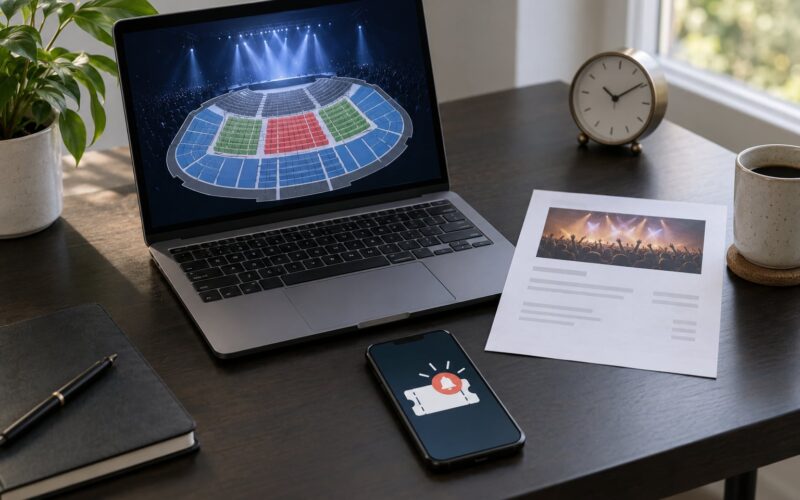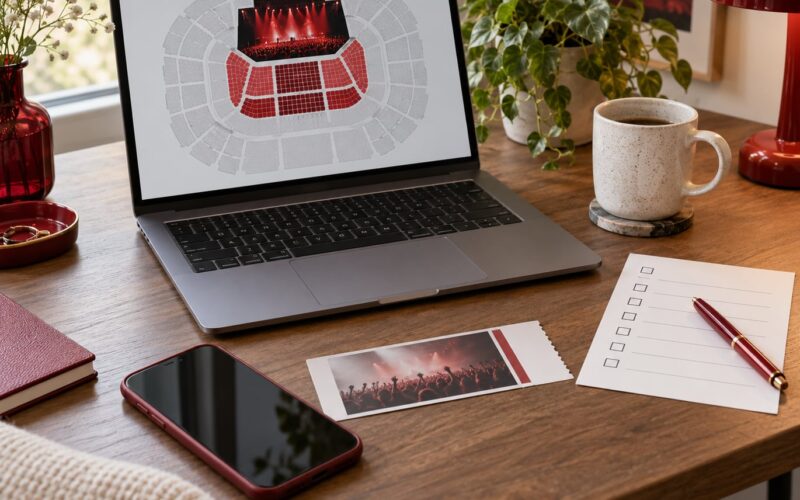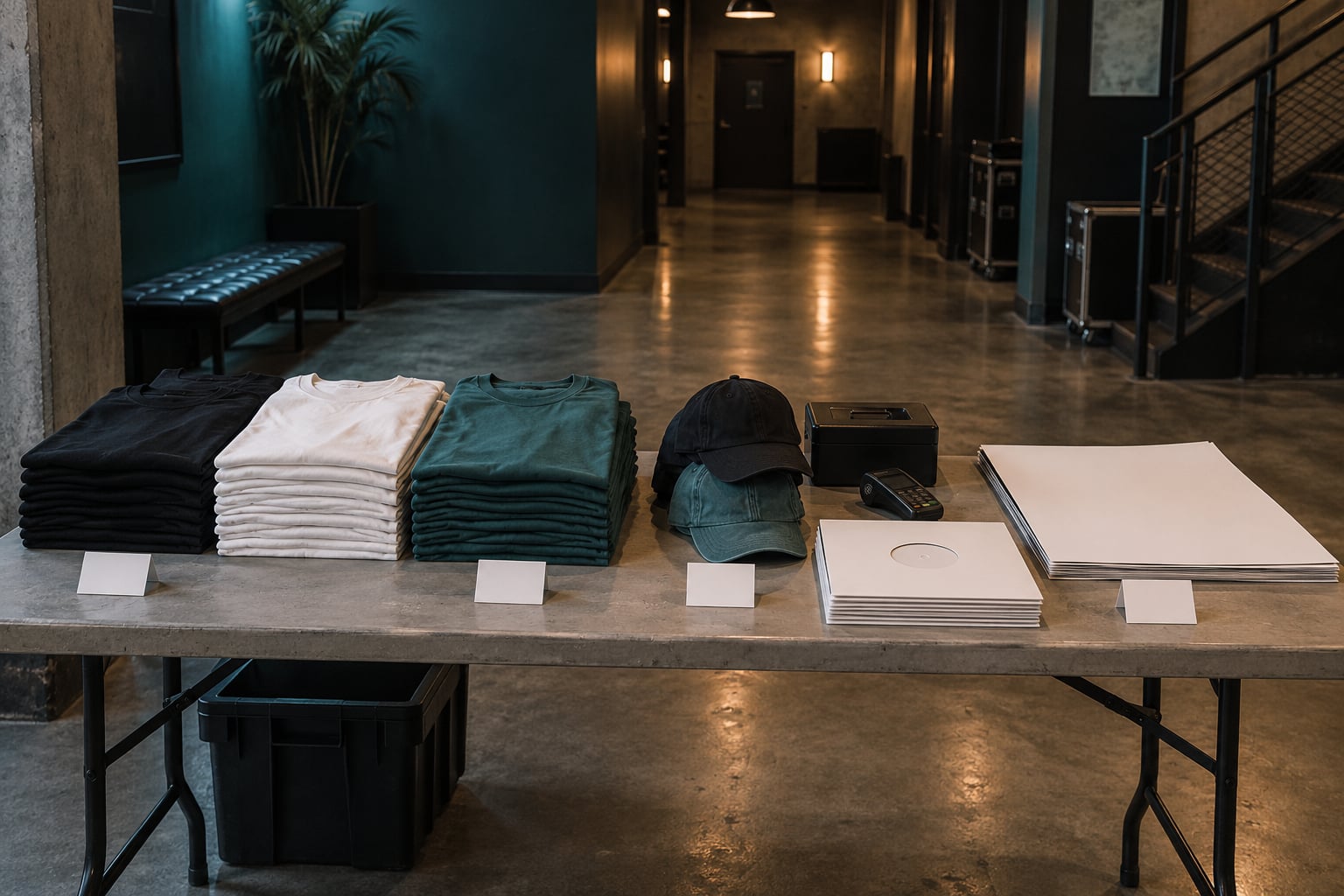
A concert merch table is a folding table in the venue lobby where you buy the tour shirt you have been looking for since the record came out. Most nights nobody gives it a second thought. If you have ever wondered who is standing behind it, when it opens, whether you can queue during the set, and who ends up with the money, this guide walks through how merch tables work at concerts from load-in to final settlement.
The short version: the band or a merch company brings stock to the venue, sets up a display, and sells it in a short window around the show. Most of the money moves in roughly the 45 minutes before doors and the 45 minutes after the final song.
Table of Contents
- What Is a Concert Merch Table?
- What Happens Before the Doors Open?
- Choosing what to bring
- Setting the prices
- Packing and transport
- Payment setup
- Staffing and venue rules
- How Merch Tables Work at Concerts During the Show
- What Makes a Merch Table Work Smoothly?
- How Are Merch Sales and Inventory Tracked?
- How Merch Tables Work at Concerts for Different Artists
- Touring bands on a big run
- Emerging bands
- Support and opening acts
- Clubs and small rooms
- Tribute acts and cover bands
- Festivals and nonprofit events
- Frequently Asked Questions
- How do bands make money from merch tables at concerts?
- Do concert merch tables take cash, cards, or mobile payments?
- Why are some concert merch items sold out before the show ends?
- Can fans buy merchandise without attending the concert?
- How much usually goes toward the artist from merch sales?
- What happens to unsold concert merchandise after the show?
- What to Do First If You Are Buying
What Is a Concert Merch Table?
A concert merch table is a folding table set up in the venue lobby, foyer or merch room, staffed by two or three people, where fans buy the shirts, hoodies, vinyl, patches and posters that were produced specifically for that run of shows. The venue usually keeps a commission of 15-25% of gross sales for the space, the power and the footfall.
Four things get confused with it. A merch booth is the same operation in a permanent room, common at arenas and festivals, and it often carries extra event-branded products. A pop-up shop is a temporary retail space with a fitting room, lighting and a proper till, usually in a shopping area rather than a venue. An online store is where most of the sales actually happen, either as pre-orders collected at the table or as catch-up orders afterwards. A signing table is not a sales point at all; it is where items get autographed after purchase.
Who runs it matters more than people expect. Some bands self-run the table with a crew member and two volunteers. Others hand the whole thing to a specialist merch company, which prints the stock, staffs the table and takes a share of the sales in return.
What Happens Before the Doors Open?
By the time the doors open, the visible part is over. The table arrives packed, priced and tested.
Choosing what to bring
Designs are picked months ahead, then the tour run is allocated per date. A band on a European leg might bring 150 shirts for a 400-cap room and deliberately run out, because a sold-out table sells better than a full one. The sizing run is the part people get wrong: most tables carry a broad spread of small, medium, large and extra large, with 2XL and 3XL deliberately undersupplied because those sizes cost more to produce and sell slower.
Setting the prices
Pricing is decided before printing, not on the night. T-shirts usually sit at the bottom of the range, hoodies and embroidered pieces above them, and limited-run vinyl often costs more than a shirt even though it costs less to make. Every table displays a printed price list, because a visible number stops people hesitating at the till.
Packing and transport
Stock travels in large bags or rolling cases and is counted twice, once leaving the van and once on arrival. Sizes are separated into bags, and the biggest items like hoodies and coats are folded rather than stacked so a fan can see the design on top.
Payment setup
The card reader or phone terminal is the part that decides whether the night works. Sellers pick cash, card or both, then check whether the venue has reliable signal or whether a mobile hotspot is needed. In a basement or a rural club, a terminal with no connection cannot take a tap payment, so a cash float is the backup that keeps the line moving.
Staffing and venue rules
Two people is the minimum that works: one talking and taking payment, one fetching, folding and bagging. Someone in the band’s organisation also checks the venue’s rules on where a table can be placed, whether power is supplied, and whether signage is allowed.
How Merch Tables Work at Concerts During the Show
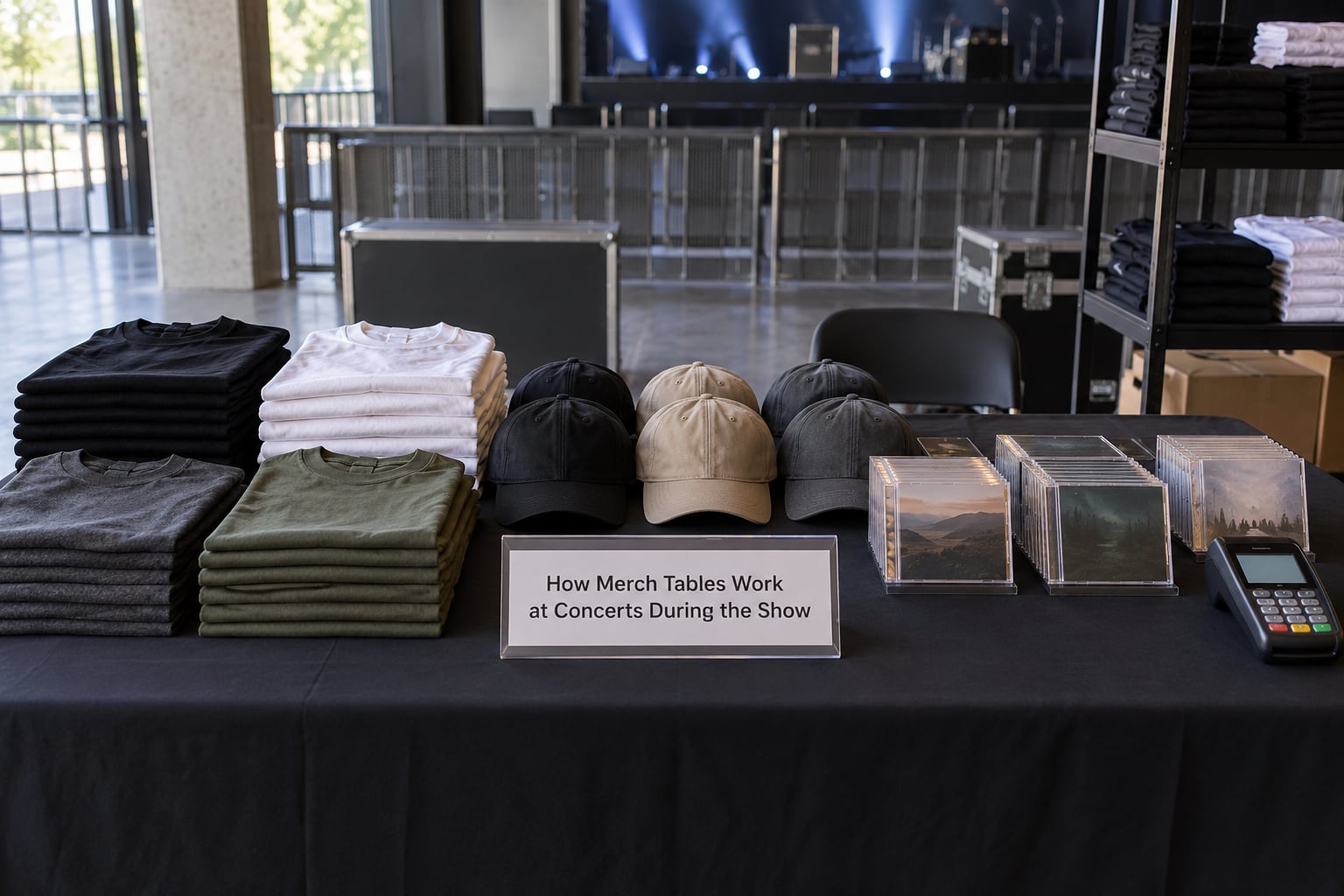
When merch tables work at concerts as a sales process, it is the same loop all night: browse, ask, pay, bag, leave. Fans walk up, look at what is laid out, ask about sizes, and either buy or put it back.
Openers are the busiest stretch. The queue builds while people wait for the room, and the table has the audience’s full attention and none of their impatience. Folders keep moving stock forward so the top of the pile is never the design that sold out two hours earlier.
Payment is where most stalls happen. A tap, a confirmation on the reader screen or a short code sent to a phone, and the sale is done. Cash is handed back with change from the cash box, and a receipt goes with the item if the buyer wants one. In busy periods many tables stop writing receipts and rely on the card terminal’s own record, with the paper trail settled at the end of the night instead.
During the set itself the table is usually left unattended or watched by one person. That is when people drift over, so a small run of high-demand items left visible keeps the table from looking dead. Fans who buy during the set usually ask whether their bag can be held until the end of the show, and most tables say yes for small items like vinyl and posters.
After the final song the room empties into the lobby fast, and that is the second and often bigger buying window. Headliners sell most of their stock here. By the time the crowd leaves the building, whatever is left is folded, counted and packed back into the van.
What Makes a Merch Table Work Smoothly?
Smooth tables are not lucky, they are just organised. These are the details that separate a line that keeps moving from one that stalls.
- Visible prices. A printed list on the table means nobody has to ask, which removes the most common pause.
- A full sizing run laid out. Folding a large, a medium and a small tee where people can see them signals that the band came prepared. Fans report buying more when the table looks intentional.
- Separated payment and pickup zones. One side takes money, the other bags the item. Two people standing side by side is faster than one person doing both.
- Defined roles. One person talks to the customer, one folds and bags. Swapping roles without warning is how queues double.
- A queue that does not block the door. Venue rules often limit this, and a rope or a designated spot prevents a merch line from looking like an entry line.
- Both payment methods. Fans routinely turn up with the wrong one, and a cash-only table reads as amateur hour even when it is not.
- A backup for the terminal. Spare battery, hotspot, or enough cash float to cover a card outage.
- Something watching the stock. On a table with a full wall of tees and no staff, theft is easier than most sellers expect.
How Are Merch Sales and Inventory Tracked?
Tracking is mostly a counting problem, and it happens three times: on arrival, during the night, and at settlement.
Before doors, staff count every size and style and record the opening number. That baseline is what makes the end-of-night count meaningful. Mid-set, sellers mark down sold sizes rather than guessing, so a large that has sold twice shows two fewer tees on the table.
Card and cash are kept separate throughout. Card sales sit in the terminal with a per-sale record, and cash lives in a cash box with a starting float recorded. At the end, the counted cash is compared with the recorded float plus sales, and any difference is written down as a variance on the cash sheet rather than quietly absorbed.
Sizes that come back unsold get folded back into the run, and anything damaged in transit or tried on and marked gets pulled aside for the band to decide on. Nothing is written off on the night; it goes back to the van and becomes part of the next date’s allocation.
Settlement usually happens the same evening, often in a dressing room or the promoter office. The person who worked the table hands over the cash and a takings summary, and the promoter or merch company takes their commission before the band’s share is calculated against unit costs.
How Merch Tables Work at Concerts for Different Artists
The mechanics are identical everywhere. What changes is the staffing, the stock volume and the level of security.
Touring bands on a big run
A touring act arrives with pallets of stock, often sells through the entire allocation at one show, and has an online store open the same night to catch everyone who missed it. Staffing is usually a merch company crew who work several dates in a row and know the drill.
Emerging bands
Two people and a folding table, with stock carried in a car. These nights are where merch matters most, because a show at an unknown band can earn little in guarantee money while the table clears a decent margin. Clean layout and a visible sizing run do more here than anywhere else.
Support and opening acts
Support acts usually sell at their own table with a completely separate line, which catches out fans every single time. If both acts share one table, they normally share one queue and split the takings on the night.
Clubs and small rooms
Low capacity, cash more common than card, and the entire stock often sells from a duffel bag. Nobody has a gridwall in a 150-cap room, and nobody needs one.
Tribute acts and cover bands
The economics are straightforward: the act owns no designs, so items are ordered from a licensed supplier and the margin is thinner. Posters and apparel carry logos the act has no claim to, which matters legally more than it does commercially.
Festivals and nonprofit events
Event-branded merchandise is a separate product from artist merchandise, usually owned by the promoter or festival and sold by concession staff on a commission. Nonprofit and community events often run on volunteer labour, which removes the staffing cost and puts the whole gross into the cause.
Frequently Asked Questions
How do bands make money from merch tables at concerts?
Band income at a show is mostly guarantee money, with the venue taking a commission and costs eating into the rest. Merch sold at the table is different because the band usually controls the product and the margin. The venue typically takes 15-25% of gross sales, a merch company may take a further share, and what remains after unit costs is the band’s to split. On small and mid-size shows, a good merch night can match or beat the performance fee.
Do concert merch tables take cash, cards, or mobile payments?
Usually at least two of the three. Most tables take card through a reader or phone terminal, and cash, with small notes in the box for change. Mobile payments such as tap-to-pay work wherever the terminal supports them. Some small-room tables run cash only, which surprises fans and slows the line. If signal in the venue is poor, the card reader may need a hotspot, so tables that expect a full room usually prepare a cash float as backup.
Why are some concert merch items sold out before the show ends?
Bands deliberately under-order on a per-show basis. Carrying too much stock risks unsold items that tie up cash and have to be hauled to the next city, so many acts bring a limited allocation and let the table sell out. It also creates urgency, and a sold-out table tends to pull more buyers. Smaller items like patches, posters and hats are the ones that disappear first, since they are cheapest to replace and easiest for a fan to carry out.
Can fans buy merchandise without attending the concert?
Yes, in most cases, though the rules vary. Many bands open online orders the day of the show for anyone who missed out, and some venues have a will-call or ticket-holder pickup option. Merch-only entry is unusual and usually arranged with the venue in advance, so it is worth emailing the band’s management rather than turning up at the door. After the show, the online store stays open, and most catch-up sales happen there rather than at the table.
How much usually goes toward the artist from merch sales?
It depends on the setup more than the shirt. From gross sales, the venue commonly takes 15-25% for space, power and footfall. A merch company that handled production and staffing may take a further 15-25%. After that, production costs and unsold stock come off before the band sees anything. On a low-guarantee show the leftover amount can be meaningful, while on a big tour it is usually a bonus rather than the main income. Bands do not publish these numbers, which is why the figure is hard to pin down.
What happens to unsold concert merchandise after the show?
Most of it goes back in the van and travels to the next date. Bands carry a per-show allocation rather than a fixed amount, so leftover stock from a quiet night tops up the next room. Anything left at the end of a run is either folded into the tour’s closing sales, pushed to the online store, or sold at a discount. Some acts give the remainder to crew or donate it to a cause, which is common on nonprofit and benefit shows.
What to Do First If You Are Buying
Find out whether the table opens with the doors or at the first song, because that decides when you queue. Bring a card and some cash so you are not the reason a line stops moving, and decide on your sizes before you reach the front.
If you are working one, the single highest-value job is laying out a full sizing run with visible prices. It takes twenty minutes and it changes how the table sells for the rest of the night.