Florida death metal is the name for the movement that grew out of Tampa Bay between 1983 and 1993, built around one recording studio and a mail-order tape network. To explain how the Florida death metal scene grew, you have to start with infrastructure rather than inspiration: cheap suburban rehearsal space in a warm climate, a single studio that could make low frequencies audible on tape, kids swapping cassettes in the mail, and out-of-state musicians moving south into the middle of it.
Death, Morbid Angel and Obituary came out of that Tampa orbit, recorded at Morrisound Recording with engineer Scott Burns, and by 1987 had a template that bands from California to New York were copying. Most of what follows is that machinery, plus the four or five years when the whole thing peaked and then came apart.
Table of Contents
- How the Florida Death Metal Scene Grew From Its Underground Roots
- What Made Florida Death Metal Different?
- How Did Early Florida Bands Build the Scene?
- The Timeline of the Florida Death Metal Scene
- Which Bands Helped Define the Florida Sound?
- How Did Florida Bands Turn Underground Success into a National Scene?
- How Did the Scene Influence Metal Beyond Florida?
- Frequently Asked Questions
- Is Florida the birthplace of death metal?
- Did death metal start in Florida?
- Where is death metal from?
- Who is the father of death metal?
- How old was Chuck Schuldiner when he started Death?
- Is Morbid Angel still active?
- Conclusion: Start With the Records That Show the Growth
How the Florida Death Metal Scene Grew From Its Underground Roots
The Florida death metal scene grew because four forces reinforced each other for about six years: an economy that made practice cheap, a studio that made the sound competitive, a distribution network that carried demos between teenagers who lived hours apart, and a steady migration of players into Tampa.
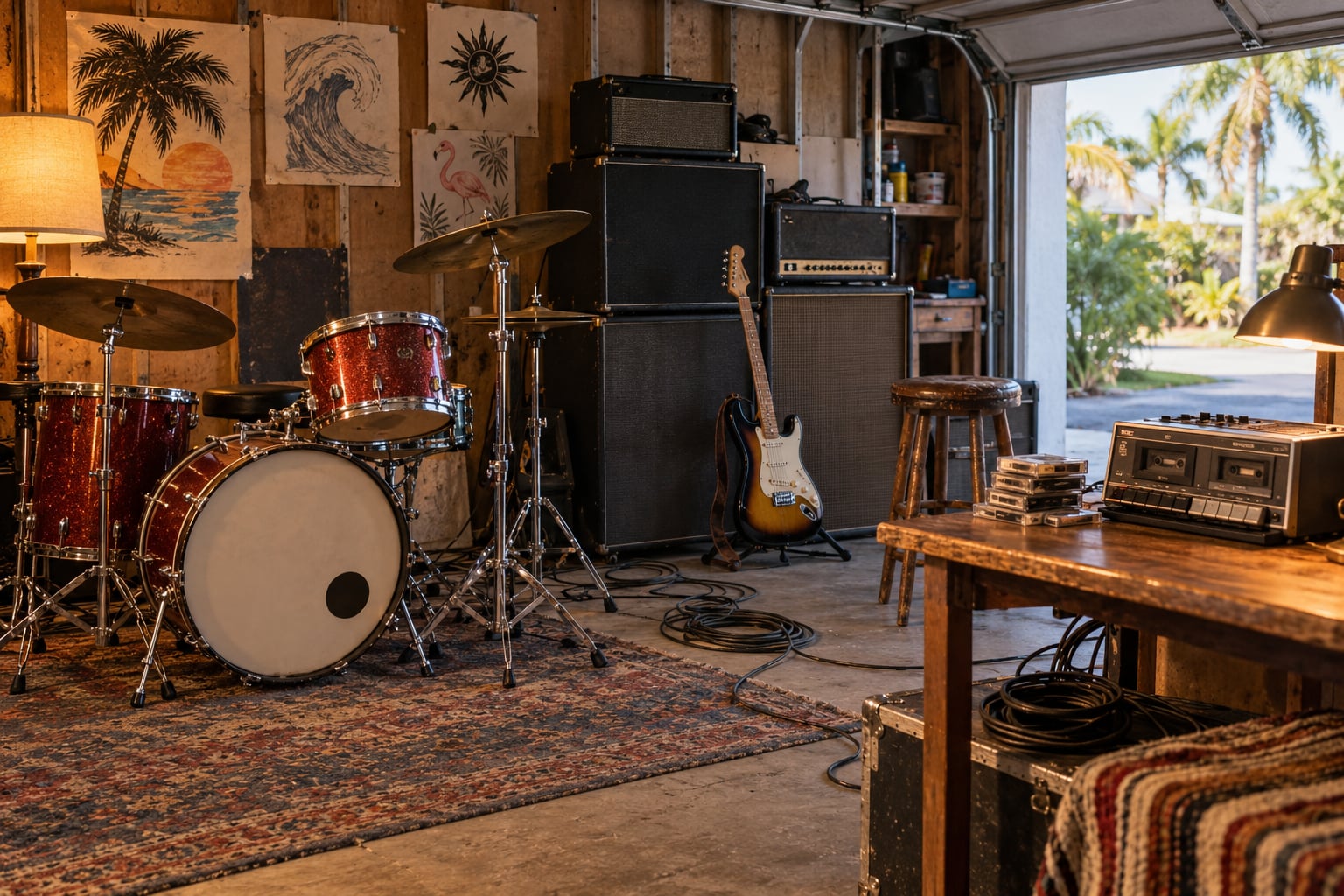
Cheap space was the first piece. Garage rents in Florida were low, the weather allowed practice year round, and suburban sprawl meant a rehearsal room or a bedroom amp stack was easy to find. None of this is unique to Florida, and plenty of warm places produced bands. It just meant fewer people here had to quit to keep the practice going.
The second piece was Morrisound Recording, opened in Tampa in 1981 by brothers Jim and Tom Morris. Its engineer Scott Burns, working there from the late 1980s into the mid-1990s, became known for drum triggering, a bass-forward console sound and more outboard gear than a basement studio could afford. For a scene working from cassette copies, that was the difference between a demo and a record.
The third piece was the tape and fanzine network, which is the part most write-ups skip. The fourth was migration. Cannibal Corpse formed in Buffalo before relocating to Tampa, and other musicians arrived from elsewhere for the same reason bands did: there was already something happening to walk into.
On the birthplace question, the honest answer has two halves. Possessed’s 1984 demo was titled Death Metal and their 1985 album Seven Churches came out on Combat Records, so the genre got its name and first album from a Virginia band. But Death’s Scream Bloody Gore, recorded in Los Angeles by a Tampa band and released in 1987, is the record that defined the sound, and Florida supplied the template, the studio and the scene that followed.
What Made Florida Death Metal Different?
Florida death metal was defined less by one riff than by a set of production and lyrical choices that arrived together: down-tuned guitar, blast beats, guttural vocals, a thick low end, and lyrics about death, horror, disease, or religious mockery.
The guitar work was rarely fast for its own sake. Death wrote riffs that moved in odd intervals and dropped into slow, half-time weight, and the Tampa bands generally played in short, heavy shapes rather than long thrash lines. Morrisound made that guitar audible by keeping the kick drum huge and the bass in front of it, which is why a lot of these records sound heavier than their tempo suggests.
Vocals were low, wet and hard to parse, delivered more as texture than as language. Bands mixed that with death-fixation imagery that ranged from the clinical to the outright grotesque, and with satire aimed at organised religion and at the idea of respectability itself.
Geography matters more than most writing on this allows. Tampa and South Florida produced noticeably different music, and putting Cynic in the Tampa column is a common mistake even though Cynic is often described as a Florida band without a city.
| City | Bands | Defining records | Signature |
|---|---|---|---|
| Tampa and Tampa Bay | Death, Obituary, Morbid Angel, Deicide, Cannibal Corpse, Atheist | Scream Bloody Gore, Altars of Madness, Slowly We Rot, Cause of Death | Groove weight, riff-driven death metal, blunt horror imagery |
| Miami and South Florida | Cynic, Floor, Hate Eternal, Malevolent Creation | Focus, King of All Kings, Retribution | Jazz and funk influence, technical playing, long compositions |
How Did Early Florida Bands Build the Scene?
The scene was built by tape trading: bands recorded demos, copied them, and mailed or traded them to other players, who played them for anyone who would listen.
A demo was cheap to make and cheap to copy. Two guitars, a bass, drums, a four-track or a borrowed studio, and a few days. Once that tape reached a stranger in Wisconsin or Sweden, a local scene became part of a national one without anybody signing anything or anyone’s parents finding out. Fanzines carried the same traffic in print, with review columns, interview transcripts and addresses for ordering records by mail.
Shows happened in the same low-stakes environment: small rooms, a few bands on the bill, sound supplied by whoever had the van. Bands shared bills constantly, and a local promoter or a tiny label such as Nuclear Winter Records would put out a demo or a split record. Every one of those steps is unglamorous, and every one of them is why the scene grew at all.
Local public reaction pushed back the other way. The scene sat inside the national moral panic of the 1980s, when Tipper Gore’s Parents Music Resource Center used congressional hearings to press retailers and radio programmers, and Florida’s own response is the subject of the only peer-reviewed study of this scene. Marco Swiniartzki’s article in the Journal of Popular Music Studies, published in 2021, argues that local conditions and local public response both shaped how the Florida death metal scene developed between 1984 and 1994.
Deicide’s Glen Benton described the social side of it in a 2009 Revolver interview: “Florida is a melting pot of degenerates. I used to say we were all kidnapped by our folks and brought down, and that created a camaraderie of angry kids.” That outsider dynamic is usually offered as a joke, and it was one. It is also the reason a scene formed between a retiree-heavy state and a very loud religious right.
The Timeline of the Florida Death Metal Scene
The scene ran through four phases: formation from 1983 to 1987, the Morrisound golden age from 1987 to 1993, a commercial peak and contraction from 1993 to 2000, and a long afterlife since.
| Year | Event | Band | Record | Label |
|---|---|---|---|---|
| 1981 | Morrisound Recording opens in Tampa | — | — | Morris family studio |
| 1983 | Chuck Schuldiner forms Mantas in Tampa | Mantas, later Death | — | — |
| 1983 | Band forms in Tampa | Morbid Angel | — | — |
| 1984 | Band forms in Tampa | Obituary | — | — |
| 1985 | Genre gets a name and an album from a Virginia band on a New York label | Possessed (Richmond, Virginia) | Seven Churches | Combat |
| 1987 | Scream Bloody Gore recorded in Los Angeles and released | Death | Scream Bloody Gore | Relapse |
| 1987 | Band forms in Tampa | Deicide | — | — |
| 1987 | Band forms in Miami | Cynic | — | — |
| 1988 | Formed in Buffalo, relocated to Tampa | Cannibal Corpse | — | — |
| 1988 | First full-length on small labels | Obituary | Slowly We Rot | Self-released |
| 1989 | Altars of Madness reaches Europe through Earache | Morbid Angel | Altars of Madness | Earache |
| 1990 | The breakthrough run of Tampa releases | Death, Obituary, Cannibal Corpse | Human, Cause of Death, Tomb of the Mutilated | Relapse, Metal Blade |
| 1991 | Technical wing arrives | Atheist | Unquestionable Presence | Earache |
| 1992 | Blasphemy record and technical record in one year | Deicide, Atheist | Legion, Piece of Time | Roadrunner, Earache |
| 1993 | Last album before the band’s first breakup | Atheist | Vile | Earache |
| 1993 | Commercial peak for the scene | Death, Morbid Angel, Cynic | Individual Thought Patterns, Covenant, Focus | Roadrunner, Giant, Columbia |
| 1994 | Peak sales era for gore-lyric death metal | Cannibal Corpse | The Bleeding | Metal Blade |
| 1996 | Scene thins as Florida bands split or change lineups | Cannibal Corpse and others | Vile | Metal Blade |
| 1998 | Death’s final album; Gore Obsessed triggers a PMRC letter | Death, Cannibal Corpse | The Sound of Perseverance, Gore Obsessed | Unisound, Metal Blade |
Two moments explain the shift in the middle of that table. In 1993, Covenant put Morbid Angel on a major label and Focus put Cynic on Columbia, and the scene briefly had the kind of visibility it had been aiming at since the first tapes went out. Then the market moved: labels cut rosters, the groove era arrived, and bands that had been lumped together got sorted into subgenres that no longer had a shared home.
Scott Burns moved into a computing career around 1997, which longtime listeners treat as a real inflection point even though it is not a musical event. When a single engineer carried so much of a scene’s sound, losing him is a change in the scene’s centre of gravity, not just in one band’s records.
Which Bands Helped Define the Florida Sound?
Death formed in Tampa in 1983 as Mantas and supplied the template: riff-led death metal that kept the structure of thrash and replaced the melody with weight.
Obituary formed in Tampa in 1984 and moved death metal toward groove, with the twin-Tardy lineup turning simple repeated shapes into something slow and physical. Slowly We Rot was a statement of intent as much as a record.
Morbid Angel formed in Tampa in 1983 and gave the scene its clearest riff writing, plus Trey Azagthoth’s lead guitar, which is still the benchmark for Florida tone. Altars of Madness in 1989 is the record that made the scene legible outside the United States.
Deicide formed in Tampa in 1987 and pushed lyrics from horror into open religious mockery. Glen Benton remains the scene’s most quotable voice because he said plainly what most bands only implied.
Cannibal Corpse formed in Buffalo in 1988 and moved to Tampa, where the combination of George “Corpsegrinder” Fischer’s riffing and Chris Barnes’s vocals defined gore-themed death metal. It is also the band that drew the sharpest public attention later, and the reason the 1998 PMRC letter is part of this history.
Atheist and Cynic formed in Tampa and Miami respectively and gave the region a technical, jazz-inflected wing that runs parallel to the Tampa heaviness. Piece of Time, Unquestionable Presence and Focus are the reference points for anyone who thinks Florida death metal was only about speed and gore.
Malevolent Creation, Hate Eternal and Monstrosity fill out the roster, and the less famous names matter too: Bastard Priest, Floor and Hibernus Mortis are the bands longtime listeners name when the conversation turns past the canon. As one commenter on a Metal Warfare thread put it, picking an obscure Florida band is hard “because 99% of the bands ended up getting signed.”
How Did Florida Bands Turn Underground Success into a National Scene?
Florida bands turned underground success into a national scene through distribution deals: Earache’s Columbia licensing put Morbid Angel records in American record shops, and Giant Records put Morbid Angel on Covenant in 1993 on a major label.
The route was not clever marketing. It was tape trading first, which built an audience that already trusted the records, and label deals second, once a band’s following was obvious. Earache, Roadrunner, Metal Blade, Combat and Relapse all moved Florida records around, and in the early 1990s the biggest of them had US distribution deals that put Tampa bands in chain stores.
Covenant is the record that broke the ceiling. It reached MTV and Beavis and Butt-Head, and by most accounts it was the first death metal album on a major label, which meant it was the first one the mainstream machinery would push. Cannibal Corpse’s The Bleeding followed in 1994 and pushed gore-themed death metal to a wider audience than anything Tampa had released before.
It did not last. By the middle of the decade, labels were cutting rosters, the groove era was pulling audiences toward a different kind of record, and Florida bands that had been lumped together were being sorted by sound. Death released its final album in 1998, and Cannibal Corpse’s Gore Obsessed that same year drew a PMRC letter demanding the band be held up as an example in a Senate hearing. That is the same censorship argument from the late 1980s, repeated almost word for word.
How Did the Scene Influence Metal Beyond Florida?
The Florida scene set the terms that other national scenes worked from: fast heavy riffing, guttural vocals, horror imagery and underground tapes before major label money.
The clearest comparison is Sweden. Stockholm in 1989 and Gothenburg a year later arrived at a similar set of extremes, but with a colder, buzzsaw tone and thin production rather than Morrisound’s weight. Scandinavian players took Florida’s structure and changed the surface, and melodic death metal as a genre grew out of that tension rather than out of Tampa directly.
The technical and jazz wing travelled too. Bands writing complex, jazz-influenced death metal in the early 1990s had Florida records to point at, and Atheist and Cynic get cited by later scenes in Europe, Brazil and Japan more often than by Florida bands themselves.
Brutal death metal is harder to trace cleanly, since it mixes Florida’s riff approach with the Swedish tempo work. Maniacal Destruction in the United States and Carcass in the United Kingdom both sit in that overlap.
The business model travelled further than the music. Underground tapes first, small labels second, major money third became the standard route for extreme metal bands in most countries, and the fanzine-and-mail-order economy that carried Florida demos in 1988 is the same one that later carried extreme metal from bedrooms online.
What survived the contraction was the old-school death metal revival, which treats 1987 to 1993 as the reference point rather than the gate. Hillsborough County’s 2025 historical marker for Morrisound Recording is a small, slightly moving sign that the scene’s infrastructure is now part of local history rather than scene folklore.
Frequently Asked Questions
Is Florida the birthplace of death metal?
Possessed named the genre: their 1984 demo was titled Death Metal and Seven Churches came out on Combat Records in 1985. But Death’s Scream Bloody Gore in 1987 is the record that defined the sound, and Florida supplied the template, the studio and the scene. Most people who answer this question split it between the two, and the priority debate is still genuinely open.
Did death metal start in Florida?
Florida was the centre of death metal’s first golden age between 1983 and 1993, but the genre crystallised out of a transatlantic tape network rather than one state. Florida was its most concentrated node, not its only one. Marco Swiniartzki’s 2021 study in the Journal of Popular Music Studies frames the scene as the product of regional conditions and a local public response, not a single birthplace.
Where is death metal from?
Death metal comes from the United States, emerging in the middle 1980s. Three early centres ran in parallel: Virginia for Possessed and the first album, Florida for Death, Morbid Angel and Obituary, and New York for Suffocation and Immolation. Sweden and Gothenburg followed in 1989 and 1990 with a colder, faster take on the same basics.
Who is the father of death metal?
There is no agreed answer, and anyone who gives you one is picking a side. Chuck Schuldiner is usually credited, because Death’s Scream Bloody Gore defined the template. Others argue for Possessed, whose 1984 demo named the genre and whose 1985 album came first. Others still point to Larry Howell and the Possessed lineup. The honest answer is that several people in three states created it at once.
How old was Chuck Schuldiner when he started Death?
Schuldiner was born in 1967 and formed Mantas in Tampa in 1983, which puts him at about 15 or 16 at the start. The band played its earliest material in the Tampa area before the name became Death in 1984. Biographies differ slightly on the exact months, so treat any single figure as approximate rather than settled.
Is Morbid Angel still active?
Yes, the band has continued despite lineup changes. David Vincent departed in 2023 and Trey Azagthoth left the guitar position in 2024, which was a significant change given how central his playing was to the band’s sound. Lineup and activity status shift often in this scene, so check current sources before writing about members or touring plans.
Conclusion: Start With the Records That Show the Growth
The Florida death metal scene grew from practical things: cheap rooms, one well-equipped studio, a tape network, and a generation of kids with nowhere better to be.
Start with the records in the order the scene developed, not the order it got famous. Scream Bloody Gore in 1987 is the template. Slowly We Rot in 1988 shows the groove arriving, and Altars of Madness in 1989 is the Florida sound at its most controlled. Cause of Death, Human and Tomb of the Mutilated from 1990 cover three different versions of heavy. Unquestionable Presence in 1991 and Piece of Time in 1992 take the technical turn. Covenant in 1993 is the commercial peak, and starting there gives you a distorted picture of where the scene came from.
To check any of this yourself, the Swiniartzki article in the Journal of Popular Music Studies is the one peer-reviewed treatment of the scene, Alan Moses’s Glorious Times documented the era as it happened, and Obituary’s Turned Inside Out covers the Tampa side in detail. Encyclopaedia Metallum and Discogs settle discography arguments; Decibel’s interviews handle the rest.
Ask how the Florida death metal scene grew and the answer in 2026 is still being revised, four decades on. That is normal for a scene this young and this well documented.