To know how to rate albums fairly, score every record against the same fixed set of criteria, in the same order, and keep that judgment separate from whether you personally enjoy the music. The process takes three or four deliberate listens, about 40 minutes of actual scoring, and one written sentence explaining the number you landed on.
If your scores drift every time you revisit a record, or everything you love sits at 8.5 while everything else crowds around 8.2, the number has stopped carrying any information. That is a method problem, not a taste problem, and it is fixable.
This guide covers the practical side: what to set up before pressing play, a seven-step sequence that produces the same result twice, a weighted rubric you can copy, and the specific biases that quietly push scores up or down. It is written for people keeping a library log or rating on Rate Your Music, Album of the Year or Discogs, and for anyone writing reviews who wants their numbers to survive a second reader.
Table of Contents
- What You Need
- Step-by-Step: How to Rate Albums Fairly in Seven Steps
- 1. Decide What You Are Rating
- 2. Listen Without Interrupting or Searching Online
- 3. Judge the Album in Context
- 4. Score Each Part of the Record: A Rubric for Rating Albums Fairly
- 5. Test Your First Impression for Bias
- 6. Compare It With the Right References
- 7. Revisit the Rating Before Saving It
- Common Mistakes and How to Fix Them
- Frequently Asked Questions
- Should I use a 10-point scale to rate albums fairly?
- How many times should I listen to an album before rating it?
- Is a rough-sounding heavy metal album necessarily bad?
- Should I rate an album against the band’s previous work?
- Can my album rating change after reading other people’s reviews?
What You Need
Four things. None of them expensive, and all of them cheap to skip if you do not care about consistency.
- A quiet listening setup. Headphones or decent speakers, and about 45 minutes where you will not be interrupted. Listening to the same record in different rooms and at different times of day surfaces details a single evening misses.
- A scoring sheet. A notebook page or a note with six criteria and a weight next to each. If it lives only in your head, it changes every time.
- Reference material. Two or three albums from the same era and style, chosen before you score, so the comparison is not built to flatter the record in your headphones.
- Time. Three or four listens spread over at least two sessions, plus one week between the final listen and the final number if you can manage it.
One more thing matters more than the equipment: decide in advance which conventions apply. A black metal record is not failing because it is lo-fi and a death metal record is not failing because the guitars are tuned down. Judge an album on whether it does what it is trying to do within its own genre conventions, then note separately whether you were moved.
Step-by-Step: How to Rate Albums Fairly in Seven Steps
1. Decide What You Are Rating
Before the first listen, name the purpose. Are you scoring songwriting, performance, production quality, lyrics, emotional impact, or the album as a complete package?
That choice sets the weighting. If you are rating songwriting, production clarity barely matters and a rough mix is close to neutral. If you are rating production, a great song with a muddy low end scores poorly. Rating a record without a declared purpose is why two people can both be honest and land three points apart.
2. Listen Without Interrupting or Searching Online
Play the record straight through, start to finish, once. Do not check track lengths, do not look up the album’s rating on Metacritic, do not open a review. None of that is allowed to touch the first pass.
When it ends, write three lines before you do anything else: what repeated, what bored you, and what you expected versus what happened. Those lines are raw material, not a score.
The reason for the rule is simple. Hype, review consensus and fan arguments all arrive with expectations attached, and expectations reliably distort a first assessment. You will score what you were told to look for instead of what you heard.
3. Judge the Album in Context
Context tells you what the record was competing with. Was it the band’s debut or their fifth? What did the group say in interviews about what they were chasing? What did the era’s production norms allow, and what did comparable records on the same label manage?
Two rules keep context from turning into an excuse. Historical significance is not a criterion — an album does not gain points for being old or for having sold millions, and a first album in a bad scene can be better than a seventh. And context is not an excuse either. If a record is sloppy, sloppy in 1987 is still sloppy.
4. Score Each Part of the Record: A Rubric for Rating Albums Fairly
Score each criterion on its own, out of ten, before combining anything. The weights below suit general listening across rock and metal; adjust them once for your taste and then stop adjusting them.
| Criterion | What it measures | Weight | Common misjudgement |
|---|---|---|---|
| Songwriting and structure | Whether songs have a shape that earns its runtime | 30% | Rewarding complexity that never resolves |
| Performance | Vocal delivery, guitar and drum playing, chemistry | 25% | Penalising an unusual vocal style |
| Production and mix | Clarity, dynamics, arrangement, mastering | 20% | Treating roughness as incompetence |
| Originality and identity | Whether the band sounds like itself on purpose | 15% | Confusing familiar with good |
| Consistency across tracks | Whether the record holds up from opener to closer | 10% | Rating one standout song as the album |
Here is the same rubric in action. Say a doom record scores 7.5 on songwriting, 8 on performance, 5 on production and 7 on originality, with consistency at 7. Weighted, that lands near a 7. If the same record is rated as a pure production object, the 5 dominates and the number drops to about 6.5. Nothing about the music changed — only the purpose, and therefore the weighting.
5. Test Your First Impression for Bias
Most unfair scores come from a small number of repeatable distortions. Name yours, because unnamed bias just looks like taste.
- Harshness bias. Anything distorted or abrasive reads as poor quality when it is only a deliberate aesthetic.
- Complexity bias. Unfamiliar structures get called confusing before you check whether they resolve.
- Canon effect. A classic is assumed excellent and a new release is assumed thin. This runs both ways, and rating above consensus to look independent is the same error in reverse.
- Hype. Pre-release attention inflates the first listen. Pre-release indifference deflates it.
- Fandom and contrarianism. Loving a band and disliking one produce scores with the same shape, one mirror image of the other.
Collector threads about reassessing ratings put the correction plainly: there are two legitimate ways to rate, against all music in general or against your own collection, and the mistake is mixing them mid-project. Pick one, write it down, hold to it.
Correction is not the same as pretending you have no preferences. If a record is well made and you find it dull, both sentences are true and they belong in different columns.
6. Compare It With the Right References
Pick two or three comparison albums by era, style, production level and artistic aim — not by popularity. A first wave British thrash record belongs next to first wave British thrash, not next to whatever is popular now.
Reference albums are for calibration, not for ranking. The moment you start asking which of the four is better, you leave rating and enter a contest with a winner, and the score stops describing the album in front of you.
Rate Your Music users tend to publish their scale definitions in words rather than bare numbers, and readers respond to those anchors far more than to the digits. Write your own band of descriptions once and reuse them. That verbal anchor is what makes your scores comparable a decade from now.
7. Revisit the Rating Before Saving It
Take a break of at least a day, listen again, and write a two-sentence rationale: what earned the score, and what held it back. Then check the number against the sentences.
If your rationale says the record is uneven and largely unlistenable, and your number is an 8, one of the two is wrong. Fix it before saving.
That gap is score drift, and it is the single most common complaint about ratings entered years ago. A rate that moves more than a full point between two listens a week apart is not a judgment, it is a mood. Log the score with its date and reason so a future revisit has something to argue with.
Common Mistakes and How to Fix Them
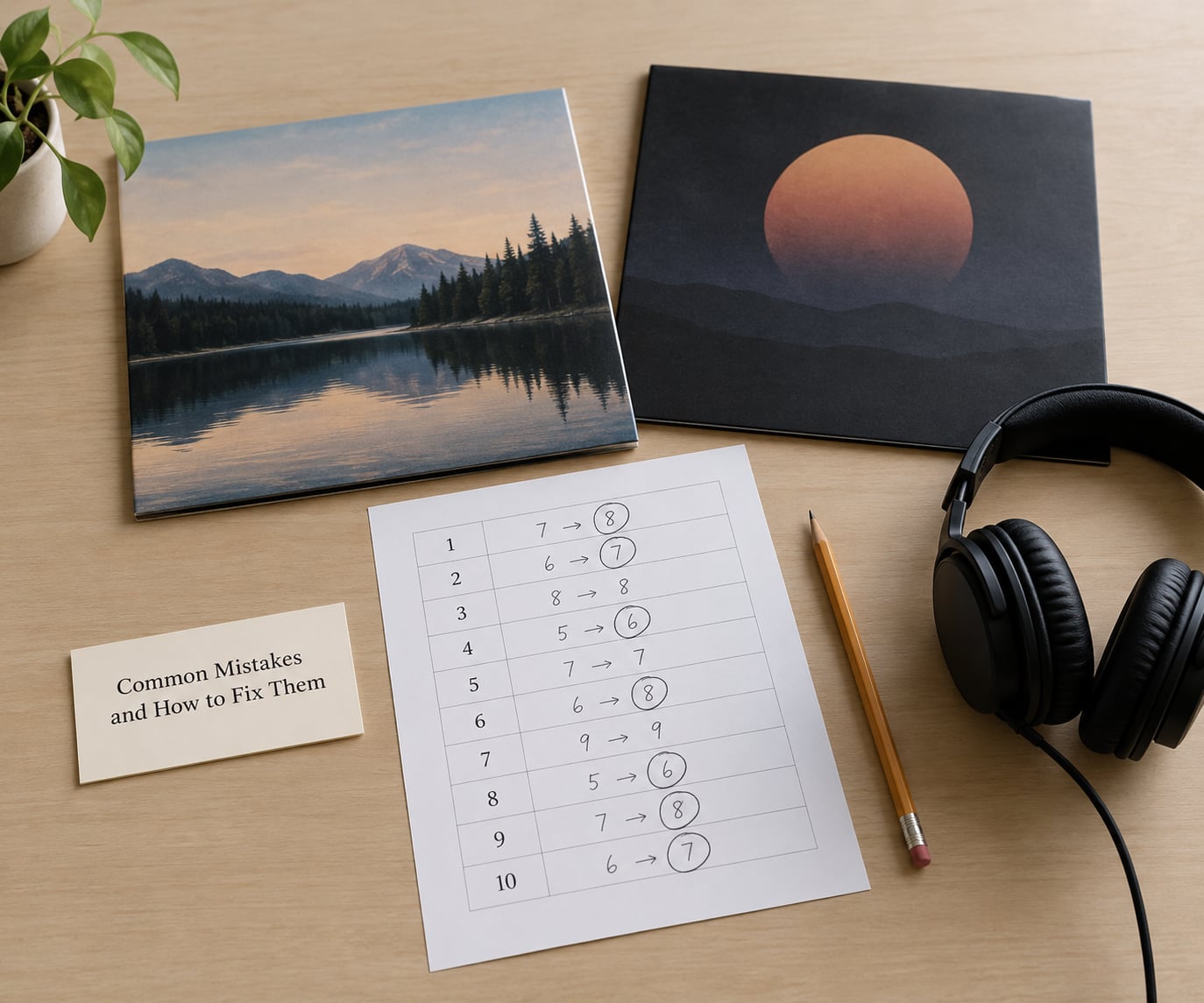
Six errors account for most unusable scores, and each has a mechanical fix rather than a willpower fix.
- Rating one song as the whole album. A standout single does not carry eight weak tracks. Fix: score the worst two tracks as well as the best two.
- Treating roughness as weakness. Lo-fi and raw are production choices, not defects, unless the mix actively obscures the band. Fix: judge the mix against the record’s stated intent.
- Rewarding popular releases. Critical reception and sales are data about attention, not quality. Fix: remove them from the listening session entirely.
- Confusing difficulty with quality. A record that takes three listens to enter is not automatically a better record. Fix: judge the second and third listen on their own terms.
- Using half-star precision as a substitute for evidence. Fake precision, an 8.3 against an 8.4 with nothing to separate them, is noise. Fix: drop to whole numbers, or keep decimals only when a specific track or mix decision justifies the gap.
- Defaulting upward when unsure. When you cannot place a record, most people nudge it up rather than admit the uncertainty, and a whole catalog inflates without anyone noticing. Fix: write “unsure” in the note and revisit it later instead of guessing.
One habit covers most of these: keep the review and the score separate. A review is where you argue, describe and enjoy. A score is a measurement. Mixing them is how a good paragraph ends up attached to a number it does not support.
Finally, calibrate against yourself rather than against other people’s numbers. If most of your catalogue sits in the 8-to-10 band, the scale has stopped measuring anything, and being called out for an implausible curve counts as a credibility problem in the communities where rating distributions are visible.
Frequently Asked Questions
Should I use a 10-point scale to rate albums fairly?
A 10-point scale is fair as long as every band has a written meaning attached to it. Write a one-sentence definition for each score and reuse it, so a 7 means the same thing in every entry. Whole numbers usually serve people better than decimals, because extra precision tends to appear when you have no evidence for it. Whatever scale you pick matters less than the verbal anchors.
How many times should I listen to an album before rating it?
Three to four deliberate listens across at least two sessions is a reasonable minimum. The first is for the record as it happens, the second for detail you missed, the third for how the sequencing and pacing hold together. A fourth listen after a week helps you separate a first impression from a real judgment. Score only after the last one, and note the date.
Is a rough-sounding heavy metal album necessarily bad?
No. Production quality and songwriting quality are separate criteria, and a record can be poorly recorded while being exceptionally well written, or crisply produced and empty. Judge the mix against what the band was trying to do rather than against a pop standard, then score songwriting, performance and production independently. A deliberately raw record should lose production points, not craft points.
Should I rate an album against the band’s previous work?
Use previous releases as context, not as the yardstick. A band that has improved is not automatically a good band, and a worse-sounding follow-up is not automatically a failure. Score the album on its own merits first, then note how it sits beside earlier records. If the only thing keeping your score down is that it sounds unlike the debut, that is preference, not judgment.
Can my album rating change after reading other people’s reviews?
It can, and that is normal, as long as you record what changed and why. A review that names something you missed, such as a structural choice or a mix decision, is legitimate new information. A review that simply says an album is a masterpiece is consensus pressure, and it is a reason to hold your original score until you have checked the evidence yourself.
Start with one album tonight. Play it straight through without looking anything up, write your three lines, then score the five weighted criteria out of ten and put the result in writing with a reason. Do the same for the next record, and the third. By record ten your scores will already be more consistent than they were last month, and the number will finally mean something you can defend.