Metal journalism changed over time by following every format its readers moved to: photocopied fanzines in the early 1980s, paid print magazines through the 1990s, independent webzines after that, and now social feeds, video channels, podcasts and streaming playlists. What moved less was the job itself — finding out who is worth listening to, then telling a scene that others had not heard yet.
I have gone back through the surviving interviews, zine archives and reader threads on this subject while writing this, because the story is less a straight line of decline than a series of handoffs between people who cared enough to do the work unpaid. The handoffs are the interesting part.
Table of Contents
- How Metal Journalism Changed Over Time at a Glance
- What Metal Journalism Looked Like in the Fanzine and Print Era
- How Did Print-to-Online Change Metal Journalism?
- What Changed When Social Media and Streaming Arrived?
- How Has Metal Journalism Changed Over Time for Readers and Writers?
- Niche long-tail coverage thinned out
- Creator and fan communities blurred together
- Paid access became normal, then optional
- Virality and algorithms reward the middle
- What Endured Across Every Era of Metal Journalism?
- Frequently Asked Questions
- When did metal journalism move from magazines to websites?
- Did fanzines have more influence than major music magazines?
- Why did many independent metal websites disappear?
- How has social media changed the work of metal critics?
- Is algorithm-driven music coverage replacing human criticism?
- What should readers look for in trustworthy metal journalism?
- What to Take Away
How Metal Journalism Changed Over Time at a Glance
Six eras, each with its own format, its own gatekeepers and its own answer to one question: how does an unsigned band get heard?
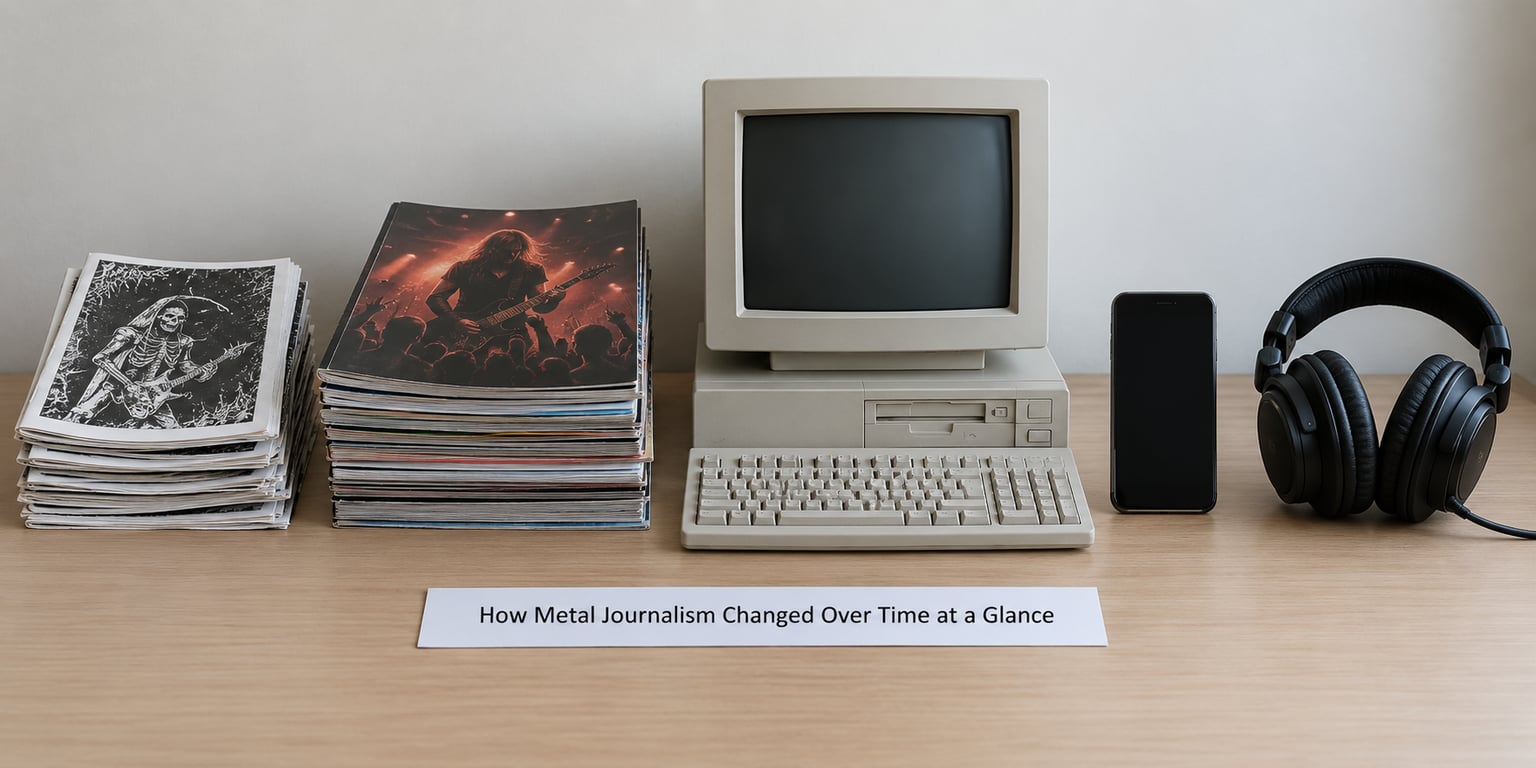
| Era | Dominant format | Who gatekept | The change that mattered |
|---|---|---|---|
| Pre-1985 | Photocopied fanzines, club sheets, underground papers | Band members and tape traders | Coverage was a favour between readers |
| 1980s-1990s | Paid specialist print magazines | Editors at Kerrang!, Metal Hammer and their peers | Subgenres got named and sorted |
| 1990s-2000s peak | Zines at their largest, plus mail-order | Zine editors with local scenes plugged in | A 150-copy zine could reach 10,000 readers |
| Mid-1990s-2000s | Webzines, artist sites, forums, mp3 blogs | Bands, labels and site owners | News broke the day a record dropped |
| 2010s | Blogs, social feeds, Bandcamp, YouTube | Creators and their followers | The pitch became an email and a link |
| Now | Video, podcasts, playlists, AI-written roundups | Platforms and invisible algorithms | Volume exploded; attention fragmented |
Two eras sit oddly in that table. The zine peak and the internet shift overlapped for years, which is why a lot of people who started on a photocopied page ended their careers on a WordPress theme.
What Metal Journalism Looked Like in the Fanzine and Print Era
A zine is a small publication made by fans, usually photocopied and assembled with cut-and-paste and a typewriter, sold or given away at shows and through the post. That is the whole concept, and it matters because it removes editors from the story entirely.
In the early 1980s, metal writing largely happened inside that structure. Someone in a city heard a band, wrote a scene report about the local clubs, photocopied a few hundred copies, and mailed them out with a PO Box printed on page two. Readers wrote back. Some of those letters contained a trading ad offering a dub of a rare demo for a dub of yours, which is how tape trading — swapping live recordings by mail — functioned as both commerce and community.
The advice those pages gave was unusually blunt. Metal journalist Matt Coe told Extreminal that unsigned bands needed more constructive criticism back then, which meant specific notes on the songs and a willingness to print the reply. He got into the underground through a tape-trading notice printed in Metal Mania, read his first fanzine — Curious Goods, in 1988 — and ended up contributing unpaid to around ten titles over roughly three decades, including Spectrum and Snakepit.
Print magazines then gave the same material a larger stage. Metal Forces, Metal Mania, Metal Maniacs, Hit Parade and later Kerrang! and Metal Hammer built paid staffs around interviews, reviews and columns, and they inherited the rock press habits of Creem and Circus, including the scorched-earth review as a genre of its own.
What changed in this stretch is not access but authority. A zine writer’s judgement came from being present at the show. A magazine writer’s judgement came from an editor assigning a deadline.
How Did Print-to-Online Change Metal Journalism?
Going online changed three things at once: speed, reach and standards. Nothing else in metal journalism has moved as sharply as those three.
Speed was the first win. A webzine could post a review the day a record arrived, and a label could update a news page instead of mailing a corrected schedule. A site like Blaster or Eternal Terror could keep a running archive that no printed page could match, because adding a page cost nothing once the template was built.
Reach was the second. A fanzine in Ohio reached Ohio. A small webzine reached a reader in Osaka who could not order a physical copy anyway. International scenes that had existed as isolated pockets suddenly shared release dates, tape-ripping culture and scene gossip, which is how a lot of the extreme metal cross-pollination in the 2000s actually happened.
Standards were the loss. Print had a visible hierarchy — editor, features writer, staff photographer — and a visible correction culture. A blog had none. Anyone with a domain could publish a takedown or a top-ten, and there was no editor to slow it down. Coverage became cheaper to make and harder to trust.
The saddest consequence was archival. When a print zine folded it simply stopped. The web partly fixed that and partly hid it: a site can vanish just as completely as a print run, except nobody prints a retrospective about a lost website.
What Changed When Social Media and Streaming Arrived?
Social media turned the pitch into a link and the critic into a creator. Streaming turned listening into a feed. Both moved the gate.
For a band, the old routine was stubbornly physical: mail a demo to every fanzine and every underground radio station you could find. Chris Forbes, who edited Metal Core from a first issue of 150 copies in 1986 to 31 issues by 2001, described bands in that era doing exactly that. He also described the free-newsprint issue at the other end — issue 25, roughly 10,000 copies handed out because advertising and trade-outs covered the printing. His verdict on the digital shift is blunt: there is more to read or listen to with podcasts, but people listen less.
Today that editor gets something closer to a hundred promotional emails a day instead of a padded envelope. Discovery moved to Bandcamp, SoundCloud, Instagram and TikTok, and the interview moved to YouTube and podcasts where the video, not the word count, is the currency.
Streaming added a gatekeeper nobody can appeal to. Editorial playlists at Spotify and Apple Music decide how many plays a record gets, and no amount of good writing touches that decision directly. On top of that sits a newer layer: AI-written and SEO-optimised “best metal bands of the year” roundups, which now outnumber genuine criticism in search results and answer a question nobody in the scene asked.
How Has Metal Journalism Changed Over Time for Readers and Writers?
The honest summary is that supply went up and attention went down. Here is where that shows up most.
Niche long-tail coverage thinned out
The old press could sustain a magazine about a single regional scene or a single subgenre because a fanzine only needed a few hundred readers. Independent websites did this well for about fifteen years. Once ad revenue dried up, the sites that closed were disproportionately the ones covering the most obscure material, because obscure coverage never monetised.
Creator and fan communities blurred together
A band with a mailing list or a Discord now does its own press. That removed the intermediary and gained some honesty, since nobody can claim neutrality about a label they love. It also means coverage is only as good as a fan’s attention span on a given evening.
Paid access became normal, then optional
Membership tiers, Patreon back issues and newsletter paywalls fund part of the current independent press. Readers who once bought a magazine on impulse now subscribe to individual writers, which is a healthier arrangement for the writer and a worse one for anyone who cannot pay.
Virality and algorithms reward the middle
An algorithm has no use for a careful, negative, 2,000-word review of a demo. It rewards a reaction video with a clear opinion in the first ten seconds. The result is a lot of coverage that is instantly consumable and forgettable, which is exactly what older writers complain about when they say the volume went up and the reading went down.
What Endured Across Every Era of Metal Journalism?
Formats died. A few habits did not.
The first is knowing the scene directly. Matt Coe described listening to an album five to ten times before writing a word of a review. That is impractical for a full slate now, but the principle survives in any form: you cannot judge a record you have heard twice, and you cannot judge a scene you have never stood in.
The second is honesty about what you do not know. The best underground writers always flagged whether they were reviewing, reporting or repeating a rumour.
The third is independence of ownership. Metal’s own press exists because mainstream coverage routinely ignored the genre or treated it as a joke. Nobody was going to fix that, so fans built it themselves — and the printing press, the website and the channel are all just the current container.
Good reading survives in archives. Snakepit and Voices From The Darkside have both been reissued as hardcover sets, and the Press of Darkness archive holds long interviews with the editors who ran titles like Metal Core, Symposium, G.A.S.P., Depth of Pain, Total Thrash and Comedy of Errors. If you want to know what metal journalism was, the editors are still on the record.
Frequently Asked Questions
When did metal journalism move from magazines to websites?
Mostly during the late 1990s and early 2000s, as bands, labels and independent webzines adopted the format and mail distribution became expensive. Print did not vanish at once: specialist titles kept running for years while new reviews, interviews and scene reports appeared online first, often weeks before the magazine version.
Did fanzines have more influence than major music magazines?
On the underground, yes. A fanzine reached the exact scene a band was trying to enter, with an editor who had been at the shows, and its word counted with the people who ran the merch table. Major magazines reached a much larger audience, but they were slower and usually several degrees removed from a local scene’s daily reality.
Why did many independent metal websites disappear?
Two main reasons: advertising revenue collapsed when readers moved to social feeds, and much of the traffic went to platforms that pay nothing for a link. The content vanished with them. A site could host decades of reviews and interviews and still disappear without warning, unlike a print run that at least physically existed.
How has social media changed the work of metal critics?
It moved the work upstream. A band now emails one link to one inbox instead of mailing a demo to every fanzine and college radio station, so the volume of submissions for a writer’s attention went up sharply. It also made criticism faster and more public, and made it far easier for a single loud reaction to outweigh a considered review.
Is algorithm-driven music coverage replacing human criticism?
It is replacing the entry point, not the whole job. Streams and editorial playlists decide who gets heard first, and search increasingly surfaces AI-written roundups before any named journalist. Behind that layer there is still real criticism, but a listener now has to know the names to find it, which is a discovery problem rather than a writing problem.
What should readers look for in trustworthy metal journalism?
Look for a named writer, a stated relationship to the subject, and evidence they heard the record more than once. Editors who will print a bad review of a band they love are rarer than they should be. Also check whether a piece separates reporting from opinion, and whether the outlet sells anything to the label being covered.
What to Take Away
Start with the archives rather than the feed. Read a reissued Snakepit volume next to a modern playlist-driven roundup and the difference in what each one asks of you is obvious within a page.
Then judge metal coverage the way you would judge anything else: by whether a named person stands behind it, whether they have direct knowledge of the releases they discuss, and whether they say plainly what is reporting, what is opinion and what is promotion. Formats changed five times. Those three checks never did.