Scandinavian metal became distinct in a single decade, roughly 1985 to 1995, when musicians in Norway, Sweden, Finland and Denmark pushed imported 1980s thrash and Venom-style proto-black metal into something rawer, colder and more abrasive, then built a whole world around it: tape trading, fanzines, record shops, labels and a look that was instantly readable anywhere.
The short answer is that the region did not invent one sound. It invented a method: take an imported style, strip the production back, add local themes, and keep going until the result could no longer be mistaken for anyone else’s.
Here is how Scandinavian metal became distinct, layer by layer, and which bands did the work.
Table of Contents
- How Scandinavian Metal Became Distinct
- How Scandinavian metal became distinct, in four layers
- Which countries shaped Scandinavian metal?
- Why did melody, atmosphere and musicianship become defining traits?
- How did the 1980s and early 1990s create a common regional identity?
- What changed with Scandinavia’s second wave?
- How did musicians, labels and fan communities reinforce the identity?
- How did folklore and the Nordic environment shape the writing?
- How did Scandinavian metal change metal worldwide?
- Is every Scandinavian band part of the same genre?
- What should listeners hear first to understand the tradition?
- Frequently Asked Questions
- Why is Scandinavian metal considered distinct?
- Which countries are included in Scandinavian metal?
- Is Swedish metal the same as black metal?
- Which bands started the Scandinavian metal movement?
- Is all Nordic metal part of the Scandinavian scene?
- Which Scandinavian metal subgenre should beginners hear first?
- What to Listen to First
How Scandinavian Metal Became Distinct
Distinctiveness came from four layers reinforcing each other: a sonic signature, a visual signature, a mythic and geographic signature, and an infrastructure that moved records across borders before there was an internet to do it.
Remove any one layer and the result weakens. Banal rap metal with Norse imagery is not a scene, and a garage band with immaculate production in Oslo is not the thing anyone means.
How Scandinavian metal became distinct, in four layers
- Sound: tremolo-picked tremolos, blast beats, detuned or dissonant riffs, shrieks set against grunts, and recordings that sound almost accidentally rough.
- Image: corpse paint, medieval weaponry, snow-covered forests, and album art that looks like it was pulled from an old art book.
- Story: sagas, Ragnarok, national romantic imagery, and a sense of a cold place that outsiders find forbidding.
- Infrastructure: photocopied zines, mailed cassettes, small shops with strong opinions, and German labels that licensed Nordic records to the rest of the world.
Those layers describe a regional cluster, not a genre. A Finnish folk band and a Swedish technical death band share almost nothing musically except a continent and a decade.
Which countries shaped Scandinavian metal?
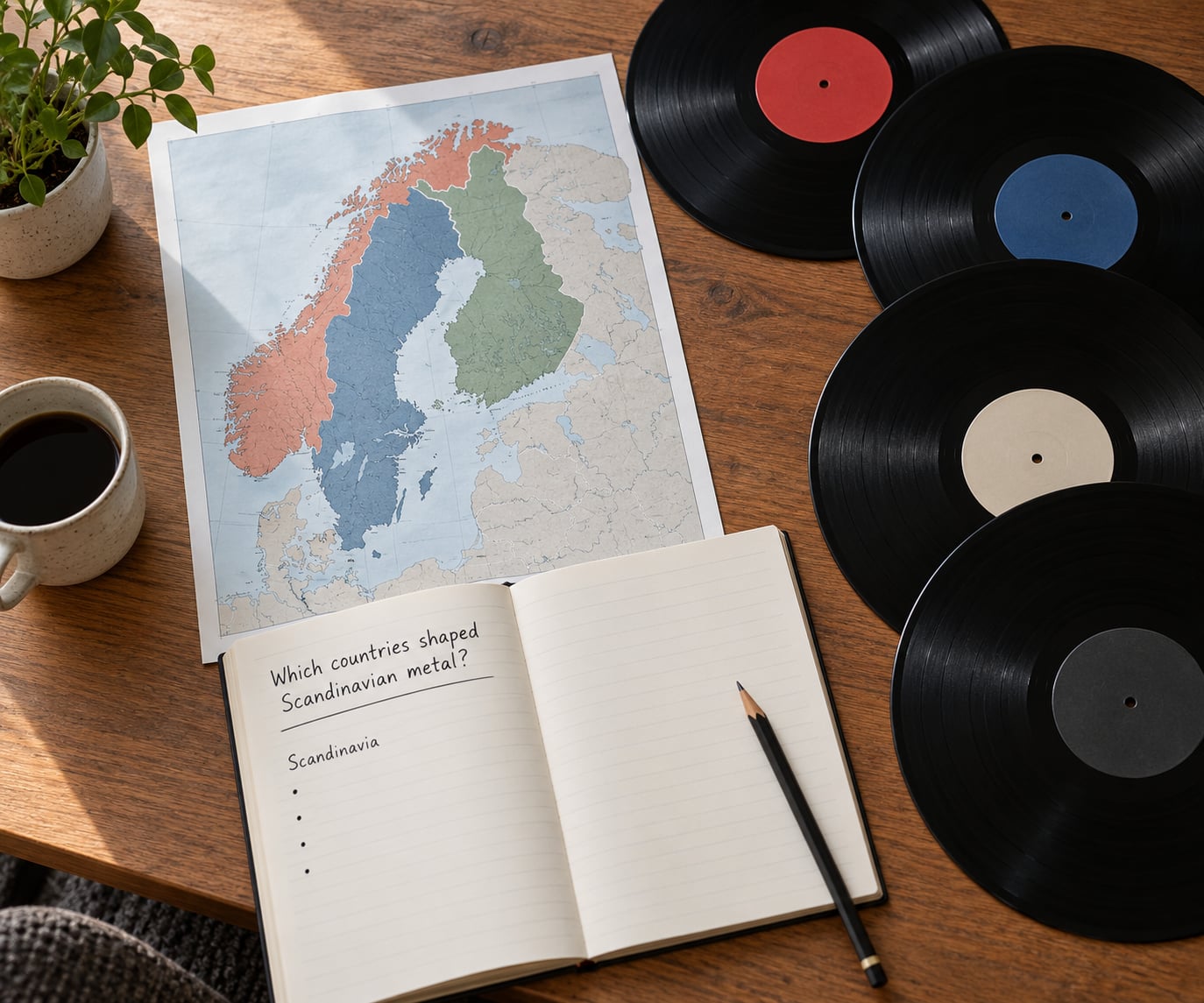
Strictly speaking, Scandinavia is Norway, Sweden and Denmark. Finland is Nordic rather than Scandinavian by geography, but it sits inside the same language, media and record-trading circuit, so most writing on this subject includes it.
| Country | Main centres | Musical tendencies | Key bands | Signature branches |
|---|---|---|---|---|
| Norway | Oslo, Bergen | Rough, atmospheric, drone-heavy, deliberately unpolished | Mayhem, Darkthrone, Burzum, Emperor, Immortal, Enslaved | Second wave black metal, blackgaze |
| Sweden | Stockholm, Gothenburg, Linköping | Fast, riff-led, technical, later melodic and anthemic | Entombed, Dismember, Dissection, At the Gates, In Flames, Dark Tranquillity, Opeth | Stockholm death metal, Gothenburg sound, progressive metal |
| Finland | Helsinki, Tampere | Melodic, epic, folk-inflected, unusually clean-sounding for its era | Nightwish, Ensiferum, Amorphis, Impaled Nazarene, Beherit, Apocalyptica | Symphonic metal, folk metal, baritone death metal |
| Denmark | Copenhagen, Aarhus | Early theatrical heavy metal, later tight extreme and stoner metal | Mercyful Fate, King Diamond, Konkhra, Illdisposed, Volbeat, Týr | First wave proto-black and doom, later extreme metal |
Denmark is the thread most people forget, and it happens to hold the earliest end of the chain: Mercyful Fate and King Diamond released their defining records in 1983 and 1987, years before anyone outside the underground had heard the word black metal.
Sweden supplied the largest body of bands and the most varied one. Finland contributed the melodic and folk branches that eventually outsold everything extreme. Norway supplied the aesthetic that became the scene’s calling card.
Why did melody, atmosphere and musicianship become defining traits?
Because extreme music without a hook does not survive contact with listeners. The bands that lasted tended to combine harsh material with something you could remember and sing back.
Several habits recur across the region, though none of them is universal:
- Melody inside the noise. Sweeping tremolo lines and singable guitar phrases sat on top of riffs rather than fighting them. Nihilist’s guitar work in Stockholm and later Gothenburg refinement both came out of that habit.
- Dynamic contrast. Long intros, clean instrumental passages and sudden collapses into blast beats gave records an arc that a nonstop wall of speed never had.
- Vocal contrast. Low growls against high shrieks, and later, a third clean singing voice. Tomas Lindberg’s use of clean vocals on In Flames’ Sound of Silence in 1996 changed what the genre could do.
- Technical playing that stays out of the way. Fast, precise, but in service of the song rather than showing off.
- A cold palette. Minor keys, low frequencies and sparse arrangements create distance and cold, which listeners read as northern and bleak.
That last one is a real production habit, but it is also a critic’s shortcut. Plenty of Scandinavian records are sunny, fast and major-keyed, and plenty of non-Scandinavian records are bleak. The stereotype is a useful first guess, not a rule.
How did the 1980s and early 1990s create a common regional identity?
The 1980s gave the region a shared vocabulary rather than a shared sound. Venom from Newcastle released Welcome to Hell in 1981, and its stage look and shrieking vocals were copied long before anyone outside Scandinavia had the vocabulary to describe what the copy was doing.
Quorthon’s Bathory answered from Sweden in 1984 with a debut album recorded on equipment the band could barely afford, followed by Hammerheart in 1985 and Blood Fire Death in 1988. Bathory’s blend of thrash, epic metal and proto-black metal, plus the Black Album cover’s cartoon, told an entire generation exactly how to look.
Denmark’s Mercyful Fate had already gone theatrical in 1983 with King Diamond’s high, controlled vocal lines and satanic stage sets, and their 1987 EP Don’t Break the Oath was a touchstone for the Hellhammer and Celtic Frost scenes that fed Norway and Sweden in turn.
What came out of that prehistory was a shared vocabulary: minor keys, low tunings, shrieks, extreme subject matter, and the conviction that heavy music did not have to be polished to be valid.
Then the countries pulled apart. Swedish musicians took the vocabulary into speed and technical death metal. Norwegian musicians took it into atmosphere, drone and theatre. Denmark went its own way and then largely vanished from the conversation until the late 1990s.
The 1991 Swedish compilation The Deathly Silence, put out by Deathlike Silence Productions, is usually treated as the moment the Norwegian scene discovered itself as a scene. Bands that would define the following decade shared a record and a label.
What changed with Scandinavia’s second wave?
Between 1992 and 1996, black metal stopped being a Swedish invention and became a Norwegian export. Darkthrone released A Blaze in the Northern Sky in 1992, Burzum put out Aske the same year, and Mayhem’s De Mysteriis Dom Sathanas in 1994 gave the genre its most quoted statement of intent.
What changed musically was that producers and labels now had a template to aim at, and the bands had a scene to answer to. Emperor’s In the Nightside Eclipse in 1994 and Immortal’s At the Heart of Winter that same year added orchestral and melodic weight that raw production alone could not carry.
Sweden’s answer arrived at the same time from a different direction. The Gothenburg scene put melody at the front of extreme metal, with At the Gates, In Flames and Dark Tranquillity trading raw aggression for riffs and hooks that a wider audience could follow.
The 2000s split the region into branches that stopped overlapping. Symphonic black metal took the orchestral template abroad. Progressive work from Opeth and Meshuggah pushed technical ambition in new directions. The Gothenburg scene’s turn toward cleaner vocals and shorter songs alienated a lot of its original audience, and the backlash became its own story.
How did musicians, labels and fan communities reinforce the identity?
Distinctiveness is not only a matter of what a band plays. It also depends on how the bands find each other, how records get pressed, and who decides what counts as authentic.
In the pre-internet years, a photocopied zine and a mailed cassette did the work that YouTube does now. Editors wrote in caps about why one record mattered, readers ordered it by post, and the physical difficulty of getting a record filtered everything out except the committed.
Record shops mattered just as much. Oslo’s Helvete on Schweigaards gate, run by Euronymous and Necrobutcher, became a gathering place and then something close to a landmark; the shop and the label attached to it, Deathlike Silence Productions, exported Norwegian releases to listeners who had never left their own towns.
Germany played the quiet role of distributor. Century Media, based in Dortmund, licensed Norwegian and Swedish signings worldwide, which meant a Norwegian band could reach a Brazilian or Japanese fan through a German company’s sales team. Labels like Osmose in France and No Fashion and Black Sun in Sweden fed the same machine.
Festivals and record fairs did the rest. Later, institutional recognition followed: NRK’s documentary series Helvete, a 2023 exhibition at the National Library of Norway, and the 2018 feature film that drew both interest and criticism for how it handled the period.
How did folklore and the Nordic environment shape the writing?
Norwegian black metal drew on the sagas and the Poetic and Prose Eddas, and the imagery is everywhere: Ragnarok, Yggdrasil, Valhalla, wolf and frost. Swedish bands leaned more on war and death in a broadly heroic register, while Finnish acts pulled toward national epic and folk music traditions.
Art matters as much as text. Theodor Kittelsen’s paintings of trolls, ash forests and winter light have been on Nordic metal covers for decades, and the pine-and-snow landscape became a shorthand for a whole genre’s interior weather.
Two corrections are worth making. First, Viking and Norse are not the same thing, and treating them as interchangeable flattens a culture of trade, poetry, law and writing into a barbarian stereotype. Second, not every Scandinavian band used any of this: plenty wrote songs about nothing in particular, and plenty wrote in Swedish or Finnish rather than English.
Finland’s folk metal branch is the clearest case where older Nordic music is played rather than illustrated. Bands like Ensiferum and Korpiklaani use melodies, drones and rhythms drawn from regional folk material, which sounds different in kind from black metal’s use of myth as subject matter.
How did Scandinavian metal change metal worldwide?
Once four or five labels had a country to sell and a distribution network to sell it into, other scenes started copying. The direction of influence is often reversed in casual writing, but the pattern is clear: extreme metal spread outward from Scandinavia through records and tours, not the other way round.
- Extreme metal as a category. Death metal as it is now played almost everywhere, from Brazil to Indonesia, inherits the Stockholm model of fast riffs and guttural vocals more than any other single origin.
- Blast beats and tremolo picking. Both became default vocabulary, and both were used in ways their originators would not have recognised.
- Atmospheric and drone-based black metal. Burzum and Enslaved influenced later extreme bands that treated texture and space as the point rather than speed.
- Melodic metal and metalcore. In Flames and Dark Tranquillity fed directly into US metalcore and into the alternative turn that later divided their own fan base.
- Symphonic and cinematic metal. Emperor and Nightwish made orchestral extreme metal a market, and the template was picked up worldwide.
- Blackgaze. The collision of black metal with shoegaze and post-rock, most associated with Myrkur and later others, is a distinctly Nordic invention.
The pattern repeats differently in each country. A Japanese or French band copying Gothenburg melodies, a Brazilian band copying Stockholm riffs and a Middle Eastern band combining both with progressive structures are all doing what the original scenes did in the first place: taking a foreign form and making it local.
Is every Scandinavian band part of the same genre?
No. The label is regional and editorial, useful for describing a shared infrastructure and a shared set of references rather than a musical style. Inside it sit traditions that barely overlap.
| Branch | Where | Vocals | Guitar approach | Production |
|---|---|---|---|---|
| Stockholm death metal | Sweden, 1989-1994 | Low growls | Fast, riff-driven, dissonant | Gritty but not deliberately ruined |
| Norwegian black metal | Norway, 1991-1996 | Shrieks and grunts | Tremolo picking, drone, sparse | Deliberately underproduced |
| Gothenburg sound | Sweden, 1993-2000 | Melodic growls, later clean vocals | Melodic riffing, twin guitars | Polished, wide, loud |
| Folk and symphonic | Finland, 1998 onward | Clear, clean, often operatic | Anthemic, orchestral layers | High fidelity, modern |
| Progressive and technical | Sweden, 2000s | Varied, often restrained | Odd meters, virtuosity | Modern studio polish |
The 1990s extreme branches and the 2000s melodic branches even disagreed with each other. Fans in Oslo treated Gothenburg’s chorus-driven approach as a betrayal of the values they had started with.
What should listeners hear first to understand the tradition?
Work forward and keep one album from each country at any time, so you are not learning the region from a single scene’s habits. Each pick below earns its place by showing a step in the process.
Mercyful Fate, Don’t Break the Oath (1987, Denmark). Theatrical vocals and satanic imagery before anyone had a genre name for them.
Bathory, Blood Fire Death (1988, Sweden). The bridge between 1980s Swedish thrash and everything that followed, and the album that convinced Sepultura and others abroad that extreme metal was possible.
Darkthrone, A Blaze in the Northern Sky (1992, Norway). The moment the Norwegian wave produced something with a coherent identity, with a cover image that defined a genre’s look.
Burzum, Aske (1993, Norway). Drone, atmosphere and long silences. If it feels inert to you, that reaction is part of understanding the scene.
Entombed, Left Hand Path (1990, Sweden). Written as Entombed’s 1990 debut, this is the Stockholm death metal sound at full strength and still the benchmark for it.
Dissection, The Somberlain (1992, Sweden). Melodic and atmospheric death metal with an unusually strong visual identity.
At the Gates, The Red in the Sky Is Ours (1993, Sweden). The Gothenburg statement of intent, and the earliest point where you can hear the melodic future of the branch.
Dark Tranquillity, The Gallery (1996, Sweden). Gothenburg refinement with the emotional weight the earlier records lacked.
Beherit, At the Gates of Darkness (1993, Finland). Baritone vocals and Finnish extremity from before the symphonic wave, which is useful context for how much Finland has moved.
In Flames, Sound of Silence (1996, Sweden). Clean vocals on a death metal record. Play it after the two At the Gates-era albums and the change in the conversation becomes obvious.
Opeth, Orchid (1995, Sweden). A progressive detour from the extreme side, and still the reference point for what Swedish metal could do next.
Nightwish, Once (2004, Finland). Symphonic metal at full commercial reach, and the point where the region stopped being an underground scene and became an industry.
Frequently Asked Questions
Why is Scandinavian metal considered distinct?
Because four things reinforced each other: a sonic signature built on tremolo picking, blast beats and detuned riffs; a visual signature of corpse paint, medieval imagery and snow-covered forests; a mythic and geographic signature drawn from Norse sagas and cold northern settings; and an infrastructure of zines, cassette trading, record shops and European labels that exported the records worldwide. Any one layer alone would not have produced a recognisable scene.
Which countries are included in Scandinavian metal?
Strictly, Scandinavia means Norway, Sweden and Denmark. Finland is Nordic rather than Scandinavian geographically, but it shared the same language influences, record shops, festivals and distribution networks, so most writing on the subject includes it. Iceland and the other Nordic countries are not part of it, even though their bands are sometimes grouped with the wider Nordic scene.
Is Swedish metal the same as black metal?
No. Black metal is a genre with recognisable traits such as shrieks, tremolo picking, blast beats and deliberately raw recordings. Swedish metal is a national category covering several genres, including Stockholm death metal, the melodic Gothenburg sound, progressive metal and thrash. The overlap is real but limited: Sweden’s black metal bands are a minority of the country’s catalogue.
Which bands started the Scandinavian metal movement?
The prehistory is Venom from Newcastle, whose 1981 album Welcome to Hell supplied the look and the shrieks. In Scandinavia itself, Bathory in Sweden and Mercyful Fate in Denmark released defining records in the mid-1980s, followed by Celtic Frost and Hellhammer from Switzerland. The 1990s then added Darkthrone, Burzum, Mayhem and Entombed, which turned a shared vocabulary into a scene.
Is all Nordic metal part of the Scandinavian scene?
No, and the term Viking metal makes this worse rather than better. Viking metal is a commercial nickname rather than a real genre, and conflating it with Norse culture turns a tradition of trade, poetry and law into a barbarian cartoon. Finland is usefully included in most accounts; Iceland is Nordic but not Scandinavian, and its bands have their own lineage.
Which Scandinavian metal subgenre should beginners hear first?
Start with Swedish melodic death metal rather than raw black metal, because it is easier to hear and it shows the region’s melodic instincts clearly. At the Gates’ The Red in the Sky Is Ours from 1993 is the usual recommendation, with Dark Tranquillity’ The Gallery from 1996 as the more polished follow-up. Once the melodies make sense, the early Norwegian records are much easier to enjoy.
What to Listen to First
Begin with one landmark record per country and compare them back to back, because the differences are the whole point. Mercyful Fate or Bathory for the Danish and Swedish prehistory, Darkthrone or Burzum for the Norwegian turn, Entombed for Stockholm, At the Gates or Dark Tranquillity for Gothenburg, and something from Finland for the melodic and folk branches.
Then move outward through the subgenres rather than through a single band’s discography. That way you hear how Scandinavian metal became distinct: not one sound, but four national scenes that shared a vocabulary, a visual language and a distribution network, and pushed in different directions from there.