The parental advisory sticker started with a political pressure campaign, not with a record release. In 1985 the Parents Music Resource Center, a group founded by senators’ wives including Tipper Gore, pushed the record industry to warn parents about lyrics. The black-and-yellow label you recognise today arrived separately, in 1990.
That distinction matters, especially on a site like this one. The story gets flattened into “one band caused the sticker” all the time, and heavy metal takes the blame for something that was really a fight between advocacy groups, the Senate, and an industry that would rather self-regulate than get legislated.
Table of Contents
- How Did the Parental Advisory Sticker Start?
- What Was the Parent Music Resource Center?
- What Led Up to PMRC’s 1985 Campaign?
- How Did the ‘Hearing Is Believing’ Campaign Work?
- Why Did Metal Records Become the Main Target?
- Did a Record Label Invent the Sticker?
- How Did the Warning Become the Black-and-Yellow Label?
- What Changed in the 1990s and 2000s?
- Why Is the Sticker’s History Often Blamed on Heavy Metal?
- What Is the Most Accurate History?
- Frequently Asked Questions
- Who invented the parental advisory sticker?
- What album was the first to receive a parental advisory label?
- What was PMRC’s Filthy Fifteen?
- Did the US government make record labels use parental advisory stickers?
- Why were heavy metal bands prominent in the controversy?
- What does the parental advisory label mean legally?
- Conclusion
How Did the Parental Advisory Sticker Start?
Two separate things happened, five years apart. In 1985, Tipper Gore and the Parents Music Resource Center (PMRC) launched a campaign to force warning labels onto records, and a Senate hearing on September 19, 1985 turned it into a national political issue. The industry agreed to a voluntary “Explicit Lyrics: Parental Advisory” notice. The familiar black, white and yellow sticker came later, in 1990, from the Recording Industry Association of America (RIAA).
So if you search “how parental advisory stickers started” and land on a page claiming a single album or a single band invented the thing, that page has skipped the important part. No band invented it, no label pushed it through alone, and no court ordered it.
What Was the Parent Music Resource Center?
The PMRC was founded in 1985 by a group of politically connected women, most of them spouses of members of Congress. Tipper Gore, then married to Senator Al Gore, was the most visible of them; Frances Lear and Susan Baker, the wife of Treasury Secretary James Baker, were also frequently named in contemporary reporting. Contemporaries nicknamed them the “Wives of Washington,” which tells you how the group was perceived at the time.
Its stated argument was straightforward: record packaging carried no warning information, so a parent buying a record had no way of knowing what was on it. The group pushed for truth in packaging, and initially for something closer to a film-style rating system rather than a single vague notice.
Treat those claims as advocacy, not as settled fact. What the PMRC argued about lyrical content was contested then and still is. What is not contested is that the group was effective at getting press attention and at getting members of Congress interested.
What Led Up to PMRC’s 1985 Campaign?
Music criticism had been policing popular music since long before the sticker. Tip sheets circulated through churches, libraries and parents’ groups through the 1970s, flagging album art and lyrics they considered unsuitable. By the early 1980s those tip sheets were a small distribution industry with mailing lists and local campaigns.
Two things changed the scale. Congressional attention sharpened around explicit lyrics, and pressure started arriving from outside music: retailers and radio programmers who did not want to be the ones explaining a record to a parent.
By 1984 and early 1985, repeated complaints from constituents had turned lyrics into a public-policy question. The PMRC formed out of that, and it had an unusually direct channel to power.
How Did the ‘Hearing Is Believing’ Campaign Work?
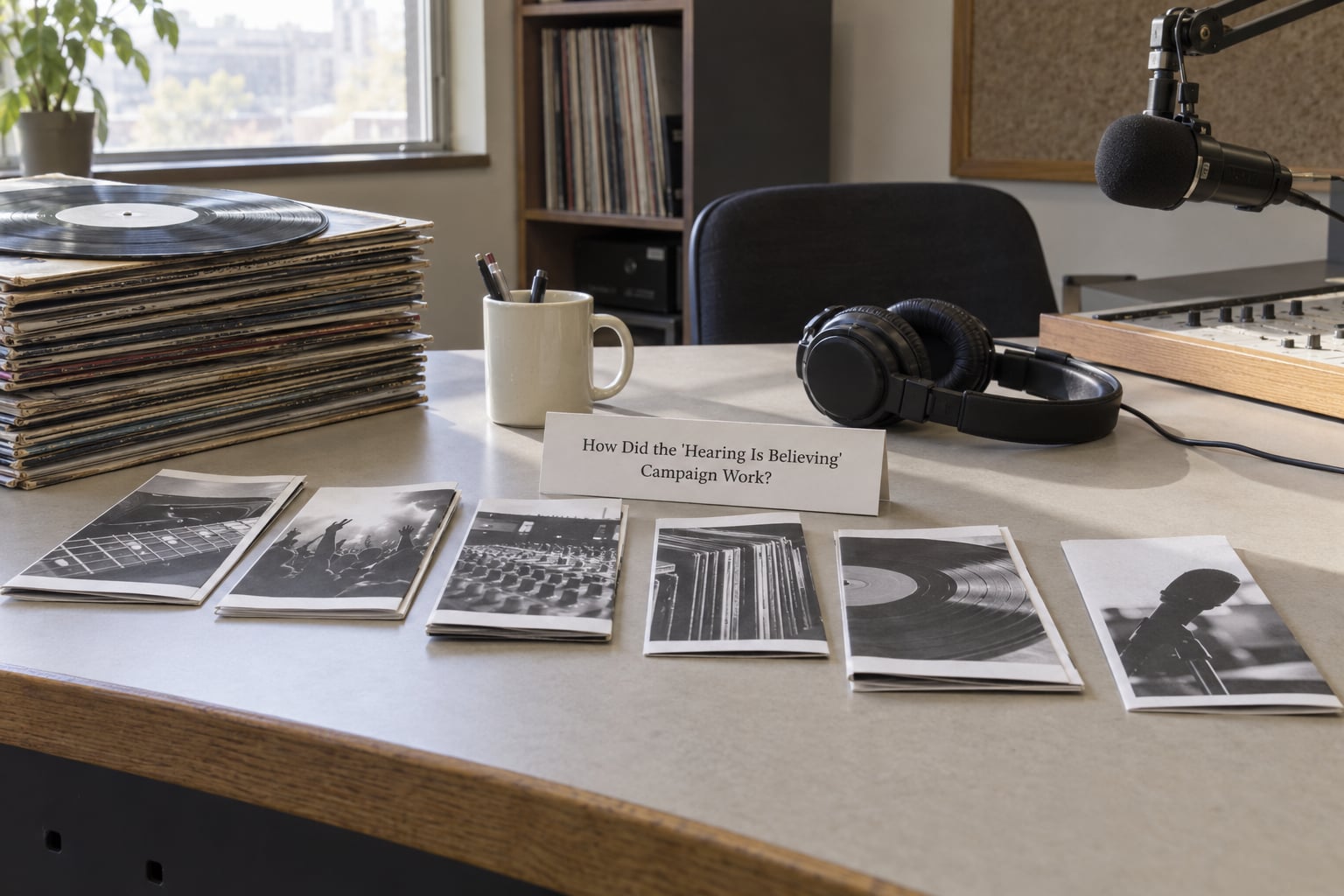
The campaign ran in the second half of 1985 and it worked on three fronts at once. It targeted radio stations, asking them to note the objectionable tracks when they played the songs. It targeted record stores and chains, pressing retailers to either remove the offending records or stop carrying them. And it generated press, because a tip-sheet campaign that names specific songs produces a headline very efficiently.
The centre also published the list that outlived the campaign by a mile: the “Filthy Fifteen,” fifteen records named in the Congressional record in 1985. Those fifteen became the public face of everything the PMRC objected to, even though the group had reviewed far more material than that.
Then came the Senate. The Committee on Commerce, Science and Transportation held its hearing on September 19, 1985, and the room was full of musicians who had decided to fight back in person. Frank Zappa, Dee Snider of Twisted Sister and John Denver all testified against the framing, arguing that the issue was adult freedom of speech rather than child protection. Zappa in particular went after the premise of tip sheets themselves. Whatever you think of the outcome, the hearing made censorship a live national argument rather than a trade-press story.
Why Did Metal Records Become the Main Target?
Because the 1985 list was heavy on hard rock and metal, and because the imagery was made for a fight. Album art for Black Sabbath, AC/DC, Def Leppard, Mötley Crüe, Mercyful Fate and the Dallas band W.A.S.D. was loud, Satanic-looking, and easy to photograph for a local paper.
| Artist on the 1985 list | What the PMRC objected to |
|---|---|
| Black Sabbath | Drug themes and occult imagery, cited as a pattern across the band’s earlier releases |
| AC/DC | Sexual content and crude language in the songs the group reviewed |
| Def Leppard | Sexual innuendo and suggestive album packaging |
| Mötley Crüe | Explicit language, sex and drug references, and deliberately confrontational cover art |
| Mercyful Fate | Occult subject matter and theatrical Satanic presentation |
| W.A.S.D. | Sexual lyrics and drug references, including the song ‘Pisque’ |
Notice the pattern in that list: sexual content, drug content, and the occult. Those three categories were where the PMRC found its easiest ground, because they were the categories most easily photographed.
What that list does not show is how long the fight over rap had already been running. Censorship campaigns aimed at Black musicians and at Black audiences were decades old by 1985, driven by the same moral panic about sexuality that the PMRC invoked. That history matters for a reason beyond fairness: it undercuts any account in which heavy metal is treated as the trigger for music censorship in America.
Did a Record Label Invent the Sticker?
No, and the record is clear on this. The PMRC’s “Filthy Fifteen” was a PMRC document. The label industry did not respond by printing a sticker; it responded by trying to get rid of the problem. The RIAA’s initial counter-proposal argued for printed lyrics on the back of the packaging rather than a warning label at all.
The compromise announced in late 1985 was that labels would apply the words “Explicit Lyrics: Parental Advisory” to the front of releases with explicit content, or print the offending lyrics on the back cover. That is the industry’s response, and it is what the trade actually agreed to first.
The sticker itself came out of a design contest run by the RIAA in 1990. The winning design is generally credited to Deborah Norcross, then a designer at Warner Bros, whose submission was the only one submitted by a major-label designer. The familiar label appeared on 2 Live Crew’s Banned in the U.S.A. that year, and adoption was quick: roughly 225 records carried it by May 1992.
For metal listeners, the early 1990s label era is a collecting story as much as a political one. Stickers varied by pressing, some were printed into the artwork and some were peel-off, and later CD reissues received the label retroactively. That inconsistency is why collectors still argue about which pressing genuinely carried it first.
How Did the Warning Become the Black-and-Yellow Label?
The visual language went through several stages. In the mid-1980s, the notice was plain text on the front of the sleeve. The RIAA’s 1990 label standardised a black-and-white block reading “Parental Advisory: Explicit Lyrics” in the bottom right corner of the front cover, where nobody could miss it and nobody could cover it. In 1996, the wording widened to “Explicit Content,” which was a small but real change: content, not just words. For a while the old and new logos coexisted, which is exactly the kind of detail that makes the 1990s releases collectible.
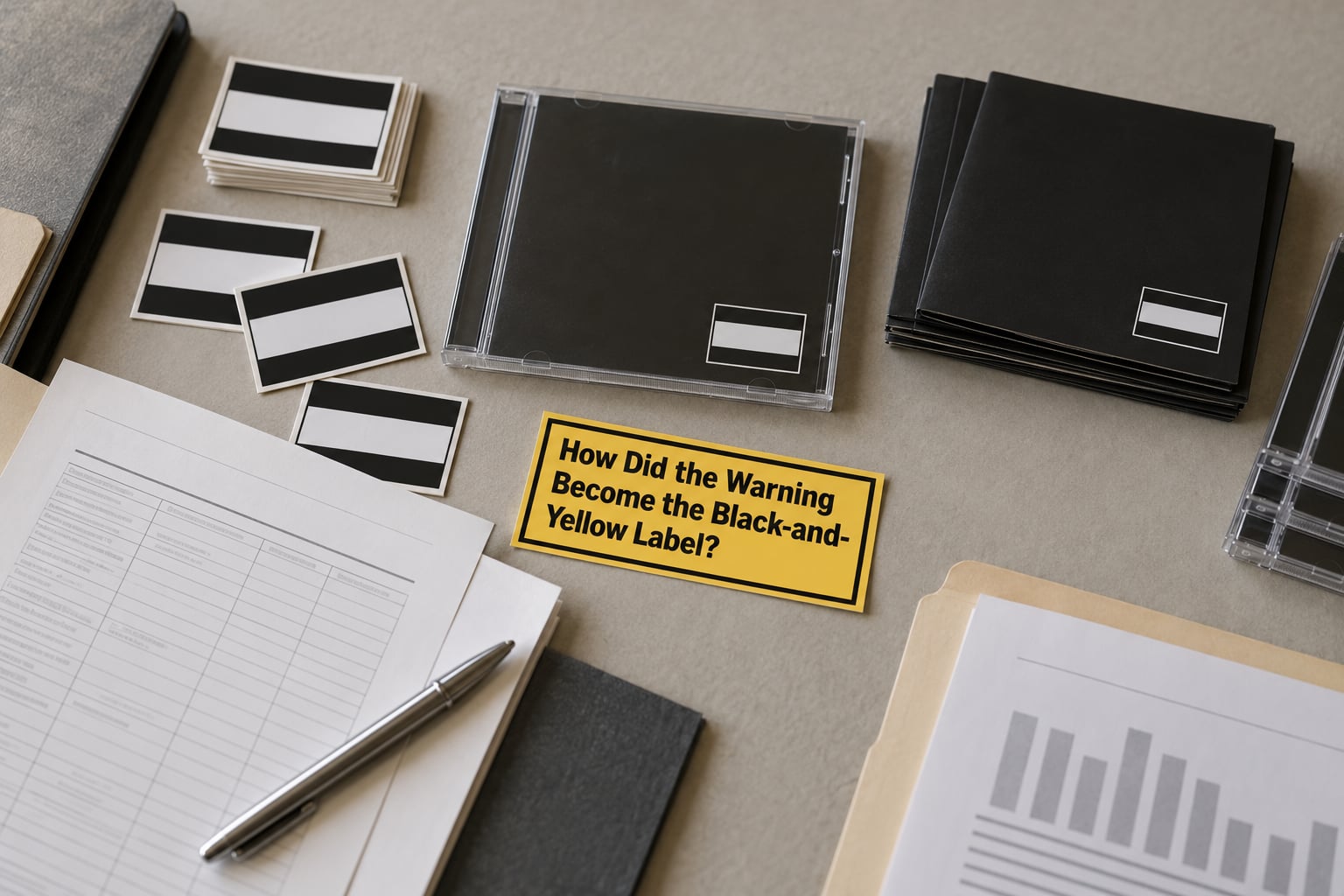
Today most people know the black-yellow-black version, which is the 1996 redesign in a colour scheme that survived nearly thirty years. The wording changed again in 2002, when the RIAA added guidelines for releases where an edited version also exists, allowing a marking that signals both the presence of explicit content and the availability of a clean counterpart.
What Changed in the 1990s and 2000s?
Retailers, not regulators, supplied most of the pressure. Walmart and Target both announced policies restricting or refusing to stock stickered records, which pushed the label toward large chains and specialty retail. The boycott is remembered as the moment the sticker became a genuine consumer force, and as the loophole that made the whole system easy to route around.
Then the legal question. The industry argued that a federal system would be worse than a voluntary one, and that argument largely held. No US government ever required record labels to use the parental advisory label. What came out of Washington was the 2008 Lyrics Label, a different and much smaller thing, attached to direct marketing rather than to the front of the sleeve.
In 2011, forty years on, the industry marked the anniversary with a retrospective that looked back at the campaign and its settlement. PMRC itself has largely receded, though the organisation and figures tied to it still surface periodically in debates about lyrics and live performance. None of this produced a government mandate, which is the single most common misconception about the whole story.
Why Is the Sticker’s History Often Blamed on Heavy Metal?
Attention loops back on itself, and metal sat in the most intense version of that loop. The PMRC named metal albums, the press photographed the albums, and the albums got bigger every time. Def Leppard, Mötley Crüe and their peers got more attention from the controversy than most comparable acts got from their promoters.
Then the publicity hardened into a memory that skips the steps. What was actually a decade-long sequence of advocacy, hearings and negotiation got compressed into “the sticker came from heavy metal,” usually with a purple-rain-adjacent anecdote in place of the political history. The same compression erased the campaigns against rap that ran for years beforehand, and the racial double standard those campaigns ran on.
The inversion is the part worth dwelling on. The sticker was created as a warning to parents, and within a few years it functioned as a badge for the listeners it was meant to steer away from. Fans describe buying stickered records on purpose and peeling the label off the case before anyone at home could see it. Metal and hip-hop both treated the mark as a signal that the record was worth owning.
So the sticker did not do what it was designed to do, and it still became one of the most recognisable pieces of music culture we have. Those two things are not a contradiction; they are the story.
What Is the Most Accurate History?
Here is the corrected chronology. Most pages that get this wrong fail in the same way, by dating the sticker to 1985, 1987 or 1989.
| Date | Event | What it actually changed |
|---|---|---|
| Before 1985 | Tip sheets, congressional letters and earlier campaigns against rap and rock imagery | Lyrics became a political issue, but no label existed |
| 1985 | PMRC founded; “Hearing Is Believing” campaign; “Filthy Fifteen” published | Warning labels became a demand, not an idea |
| September 19, 1985 | Senate Commerce, Science and Transportation hearing | Zappa, Snider and Denver testified against the framing |
| Late 1985 | Settlement: “Explicit Lyrics: Parental Advisory” or printed lyrics | Voluntary self-regulation replaced legislation |
| 1990 | RIAA label launched; first high-profile use on 2 Live Crew’s Banned in the U.S.A. | A single standard design in the bottom right corner |
| 1992 | About 225 records carry the label; Walmart and Target restrict stickered stock | Retailers, not regulators, enforced the warning |
| 1996 | Wording changes to “Explicit Content”; new colour design | The label covered more than lyrics |
| 2002 | Guidelines for releases where an edited version exists | Clean counterparts became a formal part of the system |
| 2008 | Lyrics Label on direct marketing | Minor, separate from the front-cover label |
| 2011 | Industry retrospective on the 30th anniversary | The campaign is remembered; no regulation follows |
| Today | Sticker survives as a digital “explicit” metadata flag | The physical label is optional on most streaming releases |
Frequently Asked Questions
Who invented the parental advisory sticker?
No single person invented it. The Parents Music Resource Center, a group founded in 1985 by wives of members of Congress including Tipper Gore, created the pressure for a warning. The Recording Industry Association of America ran a design contest and introduced the black-and-white sticker in 1990. The design is generally credited to Deborah Norcross, then at Warner Bros. Two organisations, five years apart, not one inventor.
What album was the first to receive a parental advisory label?
2 Live Crew’s Banned in the U.S.A. from 1990 is the release most often named as the first to carry the official RIAA sticker. The question is genuinely debated among collectors, partly because the label was applied inconsistently and because some CD reissues were stickered retroactively. Earlier releases carried text notices rather than the standardised label, which is where much of the confusion comes from.
What was PMRC’s Filthy Fifteen?
The Filthy Fifteen was a list of fifteen records named in the US Congressional record in 1985 as part of the PMRC’s campaign. It was the most visible part of a much larger review of album art and lyrics. Several entries were heavy rock and metal releases, including Black Sabbath, AC/DC, Def Leppard, Motley Crue and Mercyful Fate, which is why the list became shorthand for the whole controversy.
Did the US government make record labels use parental advisory stickers?
No. The parental advisory label is voluntary and has never been required by US law. Congress held hearings on explicit lyrics in 1985, but the industry negotiated a self-regulating system instead, partly to avoid a federal mandate. The 2008 Lyrics Label was a separate, minor measure attached to direct marketing. No regulation was ever imposed on the front-cover warning label.
Why were heavy metal bands prominent in the controversy?
Metal and hard rock releases were well represented on the 1985 list, and their artwork was built for confrontation: skulls, flames, religious imagery and drug references made easy photographs for local papers. That visibility plus press attention turned them into the public face of the campaign. Campaigns against rap had been running for years beforehand, so metal was the loudest target rather than the first one.
What does the parental advisory label mean legally?
It carries no legal requirement or defined rating level. The RIAA guidelines ask labels to apply it voluntarily to releases with explicit lyrics, and record companies decide case by case, which is why application has always felt inconsistent. The label does not restrict sale, broadcast or purchase, and nothing obliges a retailer to stock a release because of it. Retailers have imposed their own policies, but those are private decisions.
Conclusion
If you want one sentence for how parental advisory stickers started: the Parents Music Resource Center’s 1985 campaign created the political pressure, the September 19 hearing forced the industry to respond, and the RIAA’s self-imposed label arrived in 1990. Tipper Gore’s role was sustaining that pressure, not printing the sticker.
What metal contributed was visibility, not invention. Bands on the 1985 list got the controversy in the papers, and the sticker that came out of it ended up doing more for their notoriety than for parental awareness. That is the part of the history most worth remembering on a record-collecting site, where the surviving artefacts are the misprints, the peel-off stickers and the inconsistent applications that made collectors argue about which pressing came first.