Metal albums are recorded one instrument at a time, usually starting with drums, then bass, then rhythm guitars, then leads, and finally vocals, all built on a click track from demos made before anyone enters the studio. Once every part is captured, the takes get edited into comps, mixed into balance, mastered, and sequenced for release. Almost nobody records a metal album live in a single pass, whatever the studio videos suggest.
That last point surprises people most. A pro metal record is assembled from dozens of controlled passes, where a single fluffed bar costs nothing to redo. Understanding how metal albums are recorded in the studio really means understanding that process from preproduction to final master, and which decisions at each stage decide whether the result sounds heavy or just muddy.
Table of Contents
- How Metal Albums Are Recorded in the Studio
- How metal albums are recorded in the studio, step by step
- What Happens Before a Metal Recording Session?
- Should you record to a click track?
- How Do Metal Bands Choose a Recording Studio?
- How Are Metal Guitars and Bass Recorded?
- Three rules for recording metal bass
- How Are Metal Drums Recorded?
- How Are Metal Vocals Recorded?
- How Does the Studio Recording Process Work From Take to Final Mix?
- What Makes a Metal Album Sound Heavy?
- How Much Does It Cost to Record a Metal Album?
- Frequently Asked Questions
- What order do you record instruments in metal?
- How do pros record instruments: one perfect take or comped takes?
- How do you record metal drums?
- What is reamping in metal production?
- Should you record to a click track?
- How much does it cost to record a metal album in a studio?
- Start With the Demos, Not the Studio
How Metal Albums Are Recorded in the Studio
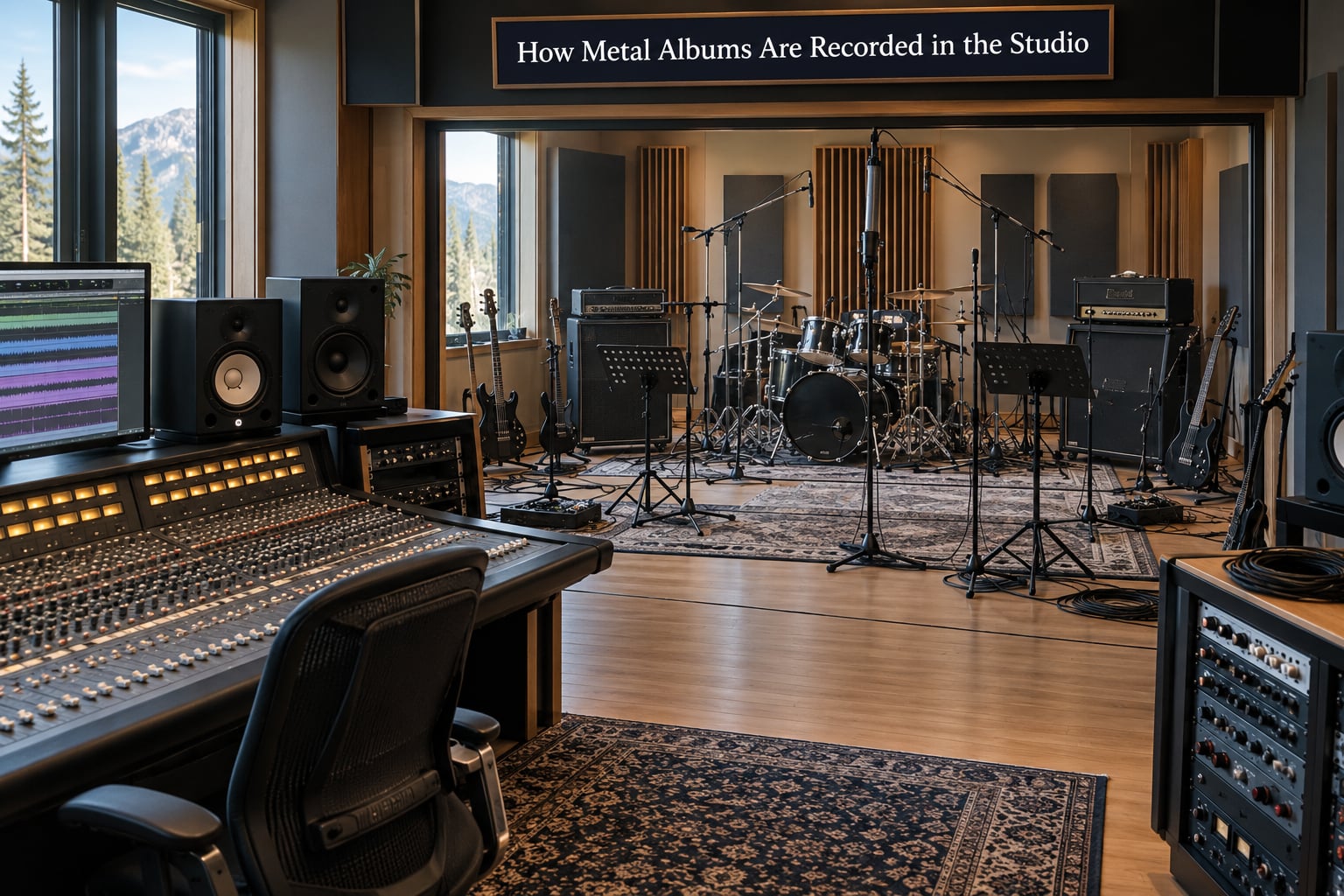
The full workflow runs in a fixed order: preproduction, drum tracking, bass, rhythm guitars, lead guitars and solos, vocals, editing, mixing, mastering, then release prep. Each stage depends on the one before it, which is why the order is not negotiable in practice even when individual bands bend it.
Four jobs sit around that workflow, and they are often confused. The producer decides the sound and the budget. The recording engineer sets up mics, runs the session, and edits. The mix engineer balances the whole record, which may be a different person entirely. The mastering engineer makes the finished record sound right on a phone speaker and on a club PA.
Andy Sneap, Fredrik Nordstrom, Kurt Ballou, Jens Bogren and Will Putney all divide or blend those roles differently depending on the budget, and which arrangement a band picks changes what the record ends up sounding like more than any single piece of gear.
How metal albums are recorded in the studio, step by step
- Preproduction. Every song gets demoed, tempo-locked and arranged before the studio is booked.
- Drum tracking. The drummer plays to a click, usually several passes per song, mic’d close with overheads and often a room pair.
- Bass. Bass is recorded direct through an interface while the amp is mic’d at the same time, so the engineer can reamp later.
- Rhythm guitars. Each part is played twice, once per side of the stereo image, with slightly different amp settings on each pass.
- Lead guitars and solos. Recorded after the rhythm wall exists so a solo can sit in front of it.
- Vocals. Tracked last, on a headphone mix, with clean and harsh parts handled as separate performances.
- Editing and mixing. Takes are comped, drums are aligned, arrangement is balanced and effects are placed.
- Mastering and delivery. The finished mix is mastered and delivered to distributors along with artwork, credits and metadata.
What Happens Before a Metal Recording Session?
Preproduction is the part bands rush, and it is the part that decides whether a session runs smoothly. A studio day is expensive and billed whether the band is ready or not, so a band that has rehearsed every song to click usually finishes faster than one that hopes to figure it out in the room.
Demos come first. They can be rough phone recordings, but they need locked arrangements, locked tempos, and clear decisions about what each song does. The producer builds a click track from those tempos, and the drummer learns against it before the first day.
Song selection happens here too. Ten finished songs in a rough shape are worth more than twenty half-arranged ones, because an unfinished arrangement burns studio time while the band argues about structure.
The other decision is tracking style. A full-band live pass captures energy and bleed between instruments, and some thrash and hardcore records lean into it deliberately. An overdub approach tracks one instrument at a time for tightness and control, which most modern metal work relies on. Many sessions use a hybrid: drums live with the band in the room, everything else overdubbed.
Should you record to a click track?
Yes, for metal. Threads on r/musicproduction and r/metalmusicians keep coming back to the same trade-off: playing without a click feels better in the room, but editing without one becomes painful fast. Once someone misses a hit, the whole take is compromised.
A click also keeps a band honest across an album recorded weeks apart. Tempos drift naturally over time, and a record where song one is 4 BPM faster than song six gets noticed.
How Do Metal Bands Choose a Recording Studio?
The room matters more than the console. Drums want a live room with real size and hard walls, because close miking alone leaves drums sounding thin and close. Guitars want a separate live space so two amps can be miked at once without bleeding into the vocal booth.
After that, isolation and monitoring. Ask how many vocal booths there are, whether they are treated, and what the engineer will do about headphone mixes. A drummer in a untreated room with no talkback will have a miserable day.
Backline matters in specific ways. Bassists often need an amp they can move and a DI box they can reach. Guitarists bring their own pedals and often their own cab, though plenty of studios own cabinets in several sizes. Anyone tracking two guitar amps at once needs a space that can hold them without the room turning into a wash.
Finally, ask what the engineer has made before. A producer who has mixed metal for years knows what to do with four rhythm guitars, and a generic tracking engineer will get a clean recording that still needs a full day’s work in post to become a record.
How Are Metal Guitars and Bass Recorded?
Guitar tone comes from three decisions: the amp, the cabinet, and where the mic sits relative to them. Bands that tour usually bring their own rig and record it live, because that tone already survives a stage. Bands working fast use amp simulation and impulse responses instead, which lets the engineer change amps after the performance.
Double tracking is the core technique behind the width. Every rhythm part gets played twice, one pass per side of the stereo image, with the amp or cab changed slightly between passes so the two sides are not identical copies. Each pass is hard panned opposite the other. That is why metal guitars sound enormous: they are two real performances, not one performance and a stereo plugin.
Reamping is what gives the engineer room to experiment. Record the clean direct signal and the mic’d amp at the same time, and the DI can be replayed through a different amp, a different cab, or a different mic later without asking the guitarist to play the whole track again.
The signal chain for a single guitar pass runs: guitar into pedalboard, into the amp head, into the cabinet, into a microphone or impulse response, into a preamp, into the interface, into the DAW. Every one of those steps adds something, and every one of them can be the reason a tone sounds thin or enormous.
Three rules for recording metal bass
- Play bass, not guitar. Follow the kick, lock to it, and leave space. A bassist who plays riffs over the drums loses the low end of the whole record.
- Record DI and amp at once. The amp gives weight and the DI gives the editor options later. Which one dominates gets decided at mix time, not tracking time.
- Audible does not mean loud. Bass should be felt and clearly heard on small speakers, but it should not fight the kick for the same frequency range.
How Are Metal Drums Recorded?
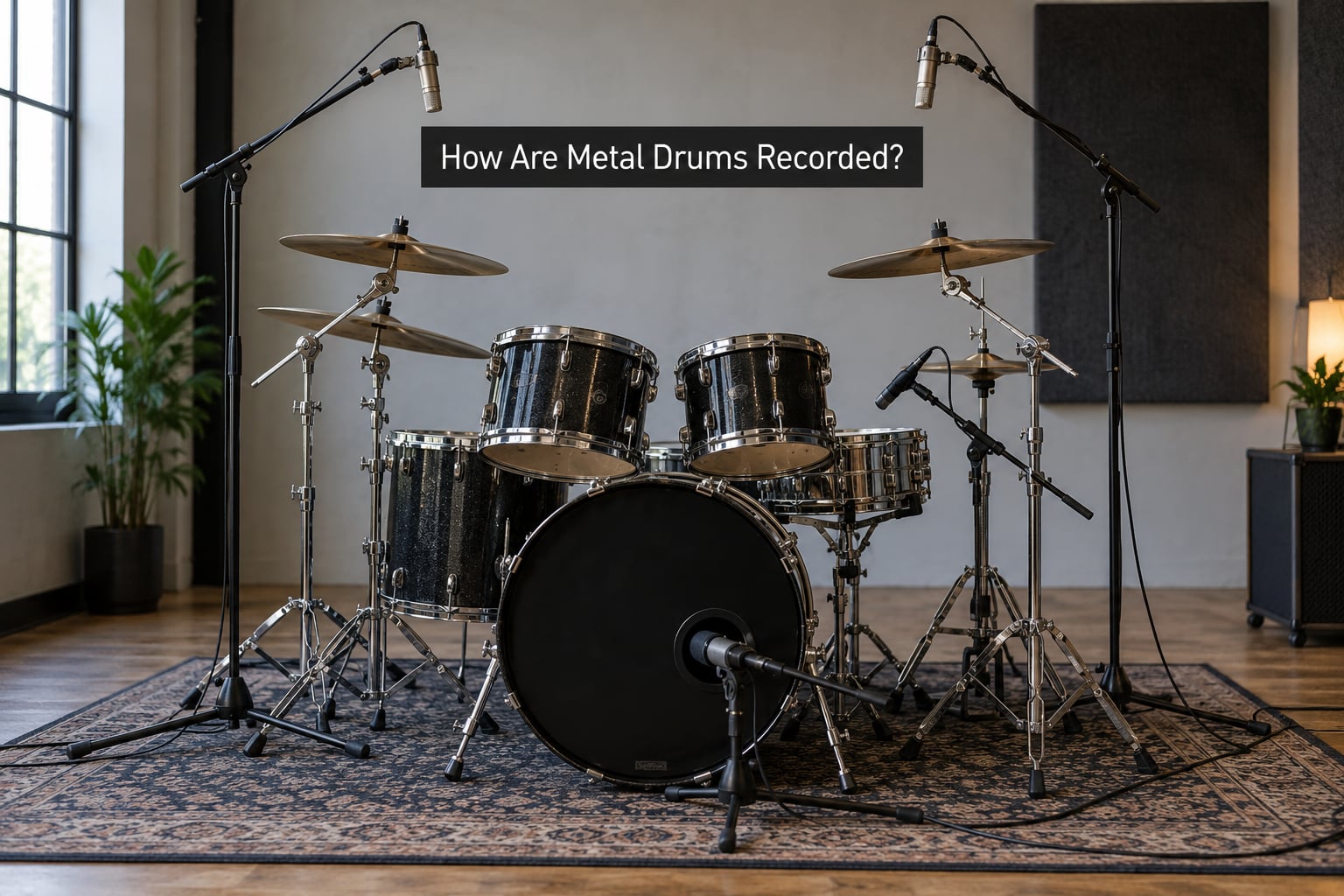
Drums are the make-or-break step. In forums, drummers and producers agree more than anywhere else: get the drums right and the rest can be fixed, get them wrong and nothing else saves the record.
The standard approach combines close miking with room capture. Close mics give attack and definition, overheads give the kit a natural balance from above, and a pair of room mics adds the air and decay that makes a kit sound big.
| Source | Microphone | Position | What it captures |
|---|---|---|---|
| Kick, outside | Dynamic, large diaphragm | About 10 cm from the front head, slightly off-axis | Weight and punch without over-swelling the beater |
| Kick, inside | Condenser, often a small-diaphragm pair | Behind the kick, low and to one side | Click and beater texture for a tighter, more modern low end |
| Snare top | Dynamic | A few cm above the top head, angled | Crack and body |
| Snare bottom | Dynamic or ribbon | Under the snare, pointed at the wires | Snap from the wires, blended for a huge backbeat |
| Overheads L and R | Condenser pair | Above the kit, roughly a metre up | Natural kit balance and cymbal wash |
| Room pair | Condenser pair | High in a corner, away from the kit | Open room sound and decay |
| Toms | Condenser or dynamic | Just above each head | Tom weight and separation |
Placement moves with the sound being chased. Push a mic closer to the snare for an aggressive, dry backbeat, or pull it back and let the room do more work for an older, looser feel. Varying those distances on every song is normal.
Editing follows. Drummers rarely play a perfect take, so takes get comped bar by bar, and any flam or double hit that slipped through gets cleaned up. On tighter modern metal, drum hits are often blended with or replaced by samples after the fact, which is common enough that plenty of records are mostly samples with a live feel.
After the performance is assembled, the kick and bass get checked for phase. If they fight, the low end gets EQ work or sidechain pumping so the bass ducks slightly under each kick hit.
How Are Metal Vocals Recorded?
Vocals come last because everything else has to exist first, and they are tracked in a booth that is set up before the singer walks in. The chain usually runs mic, pop filter, then signal chain into the preamp and interface. Condenser mics dominate, and a pop filter sits between mic and mouth to control plosives.
Warmups happen first. Vocalists who growl, shout and scream all day can damage their voice badly, so hydration, warmup exercises and scheduled breaks are treated as studio discipline rather than optional extras. The headphone mix matters enormously too, because a singer who cannot hear themselves properly will sing flat.
Layers do the heavy lifting. Clean leads get doubled and sometimes tripled, with each take panned slightly differently. Harsh vocals are tracked in layers as well, with the same phrase performed more than once and the strongest moments combined.
Effects on metal vocals go beyond reverb and delay. Common treatments include pitch-shifted screaming doubles, a distorted layer underneath a clean line to add bite, compression for evenness, and gating to control bleed. Tuners and pitch correction are used selectively on harsh parts to tighten snarls without turning the tone flat.
How Does the Studio Recording Process Work From Take to Final Mix?
Editing is where takes become a song. Professionals comp: they play several passes, pick the best 95 percent, and replace weak spots bar by bar rather than demanding one flawless take. Guitarists get punch-ins for mistakes, drums get comped, and vocals get edited for timing before any mixing starts.
Drum alignment comes next. Human timing drifts slightly, so the kit gets nudged into place against the click grid, and any loose flammed hits get tightened or removed. This is the stage where a rough session becomes locked.
Then the arrangement is built in the session. Instruments that played along live may be muted in sections to create space, and that decision has more effect on how heavy a record feels than any guitar tone. Balance follows, and this is where the familiar problems show up: too much low end, guitars that turn to mud, or a vocal buried under the wall.
Bus processing comes after balance, not before. Compression and saturation on grouped guitars, controlled low end across the record, and automation for vocal rides are the standard tools. Revisions happen over days or weeks, often on a mix the engineer has slept on.
Mastering is the last audio step. A mastering engineer sets the overall loudness and dynamics for the format, and streaming has its own target: around 10 to 14 LUFS for a modern release, versus higher targets for a club system. Under that loudness, a limiter keeps peaks in check.
Delivery is administrative but unforgiving. Alongside the audio, a distributor needs an ISRC code, a clean master file, split tracks, credits, artwork, release metadata, and enough runway for pre-save campaigns.
What Makes a Metal Album Sound Heavy?
Heaviness is mostly rhythm and density, not distortion alone. Riffs sit in a low register, the kick and bass lock tightly, and the guitars cover more of the frequency range than most rock mixes ever need to. The production goal is weight with definition, not weight alone.
Different subgenres chase it differently, and the differences are as much about process as tone.
| Subgenre | Drum aesthetic | Guitar layers | Vocal approach |
|---|---|---|---|
| Thrash | Tight, live, punchy, minimal room | Tightly double-tracked, moderate gain | Mostly clean, aggressive delivery |
| Death metal | Triggered or sample-reinforced, extremely tight | Heavily saturated, low tuned, tightly panned | Harsh vocals as the centrepiece |
| Black metal | Room-heavy, sometimes lo-fi, gated ambience | Deliberately raw, minimal editing | Tremolo-picked shrieks and raw belts |
| Metalcore and hardcore | Punchy, triggered on smaller kits | Wide, chugged double tracks with clean low ends | Strong melodic clean sections, then harsh contrast |
| Modern metal and djent | Programmed or heavily augmented, perfectly even | Tight low-end rhythm tracks, upper-mid clarity for riffs | Clarity-focused, buried low end cleared for the riff |
| Progressive metal | Real kit, wide stereo miking, plenty of dynamics | Multiple amp combinations per section | Varies from clean to very harsh by section |
Note that every one of those approaches starts from a real performance. Modern production adds samples, editing and processing on top, but bands that only start from a programmed loop tend to end up sounding like a programmed loop.
How Much Does It Cost to Record a Metal Album?
These are typical US ranges and they change over time, and rates swing a lot by region, so treat them as a planning shape rather than a quote. Studio day rates for a decent tracking room commonly sit between 800 and 1,500 USD, with larger or fully staffed rooms costing more. A ten-song album typically takes 10 to 14 tracking days, plus editing, mixing, mastering and release.
| Item | What it covers | Typical time |
|---|---|---|
| Preproduction | Demos, click tracks, rehearsal block | Several weeks at home |
| Drum tracking | Live room, kit, engineer, mic package | 2 to 3 days |
| Bass and guitar tracking | Overdubs, amp time, multiple passes per part | 4 to 6 days |
| Lead guitar and solos | Overdubs and arrangement work | 1 to 2 days |
| Vocals | Booth time, breaks, editing | 1 to 2 days |
| Editing | Comping, alignment, tidying | 3 to 10 days |
| Mixing | Balance, processing, revisions | 1 to 3 weeks |
| Mastering | Loudness targets, sequencing, delivery | 2 to 5 days |
| Artwork and release | Photography, layout, distribution setup | Several weeks |
What drives the bill is studio quality, how much is tracked live versus overdubbed, and how many revisions the mix needs. Bands that arrive with locked demos finish fastest and change the least.
Ways to cut cost are unglamorous but effective. Track drums first and only start mixing once the album is complete, so the single most expensive stage, mixing, absorbs all the changes. Record at home where possible, including full demos with real guitars. Book the studio for the days that genuinely need it, and mix at home or with an independent engineer afterwards. Black metal and lo-fi approaches are cheaper by design, since a rough room sound is wanted rather than treated.
Frequently Asked Questions
What order do you record instruments in metal?
Drums come first, because they set tempo and the whole rhythmic reference for everything after. Bass is tracked second so it can lock to the kick, then rhythm guitars are double-tracked one side at a time, then lead guitars and solos, then vocals. Overdubs for corrections happen after that, and editing, mixing and mastering come last.
How do pros record instruments: one perfect take or comped takes?
Metal is almost always comped. A drummer plays several passes and the best bars are assembled into one performance, and guitarists punch in only the parts that flubbed instead of redoing a whole take. Expect three to five passes per song for most instruments, with vocals often needing more than that to capture a strong full-power performance.
How do you record metal drums?
Close-mic the kick outside and inside the shell, the snare from above and below, and each tom just above its head. Add a matched pair of overheads for natural balance and a pair of room mics for air and decay. Record several passes to click, comp the best bars, tighten flams in editing, and check phase against the bass before mixing.
What is reamping in metal production?
Reamping means capturing a clean direct signal while the amp is being recorded, then playing that signal back through a different amp, cabinet or microphone later. It gives the engineer different tones for the same performance without asking the musician to replay the entire track. It is standard for bass, and used for guitars whenever a tone change is needed after the fact.
Should you record to a click track?
Yes, particularly for metal. A click locks every take to the same tempo and grid, which makes comping, editing and drum alignment far easier, and it stops tempos drifting across an album recorded over several weeks. Bands that dislike how click feels often record a rehearsal pass without it first, then track to the click.
How much does it cost to record a metal album in a studio?
A ten-song metal album usually needs 10 to 14 tracking days plus mixing and mastering, and a good tracking room commonly runs 800 to 1,500 USD per day in the US. Mixing is quoted separately and adds days to weeks. Rates vary by region and change over time, and bands arrive with locked demos, tracking in fewer days and requesting fewer revisions.
Start With the Demos, Not the Studio
The single useful thing to take away is that the record is decided before the studio door opens. Locked arrangements, locked tempos and honest decisions about who plays what are what turn a two-week session into a finished album.
For anyone listening rather than recording, it explains a lot. The drums on those records were played in a room, once, before anyone else made a sound. Everything after that was layering, editing and balance, which is exactly how metal albums are recorded in the studio.